Order Book Review Over One and a Half Years: Small and Medium-Sized Market Makers Are Under Pressure, Market Depth Continues to Weaken Compared to Competitors.
Written by: matteo
Translated by: Saoirse, Foresight News
Editor's Note: Long-tail assets were once Hyperliquid's core moat, relying on sufficient market liquidity to attract traders. This article relies on one and a half years of order book data, benchmarking against Binance and OKX, comparing the depth, trading costs, and spread changes of long-tail targets on HL, exploring how small and medium market makers gradually exit under the pressure of fees, on-chain congestion, and priority reading auction squeezes, and highlighting the trend of liquidity concentrating towards leading players. It also reminds that the HIP-4 prediction market ecosystem equally relies on the support of small and medium-sized market makers. The following is the content of this article:
In recent months, we have conducted in-depth analysis of liquidity in various trading varieties on major decentralized exchanges. Relying on the trading business of 0d Labs, we have accumulated more than a year and a half of complete order book data and observed a surprising phenomenon across all long-tail segments of cryptocurrency: market liquidity is continuously dwindling.
We initially predicted that liquidity tightening would only concentrate around the stages before and after the October 10 market impact, but as it stands, the entire cryptocurrency market has yet to recover its vitality from this impact.
In addition, many familiar trading peers have recently reported that the competitive pressure for market making on Hyperliquid is increasing, with revenue resources continuously skewing towards a few leading players: priority fees being monopolized by Wintermute, unreasonable fee rules, combined with frequent congestion on L1 public chains, all these issues make it increasingly difficult for small and medium-sized market makers.
As a result, I conducted a deep review of the liquidity evolution logic on Hyperliquid, attempting to clarify a question: does the worsening survival environment for small and medium-sized market makers have a causal relationship with the decline in platform liquidity? After all, Hyperliquid's early core competitive barrier was precisely the sufficient and solid market liquidity of long-tail tokens.
Establishing Reference Benchmarks
To assess liquidity changes, a reliable reference standard is required first. Liquidity contraction may be a common issue across the industry, and we need to differentiate between what is influenced by the overall market downturn and what are issues unique to Hyperliquid. Binance is the most suitable benchmark platform for assessing the liquidity level of altcoins.
This research selects 86 tokens that were listed on both platforms, with a maximum leverage not exceeding 10 times, as samples, with a statistical period from November 1, 2025, to November 1, 2026, constituting our long-tail sample pool.
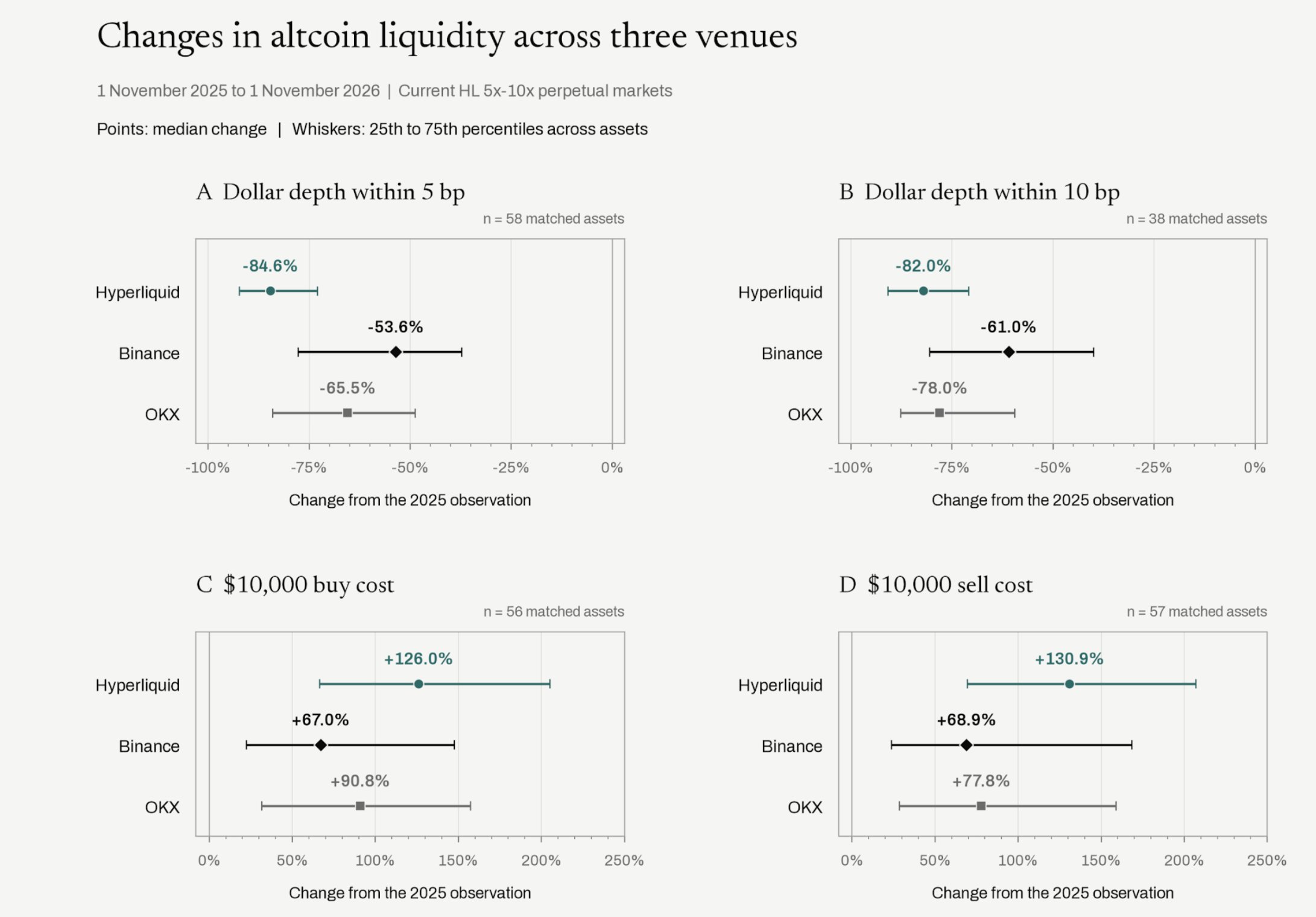
Data from 2025.11.1–2026.11.1 shows that, compared to Binance and OKX, Hyperliquid's long-tail altcoin perpetual contracts had the largest declines in 5bp and 10bp market depth, and the highest increase in slippage for orders of $10,000.
Among the 38 trading pairs that meet the comparison conditions, the median decline in dollar depth at the 10 basis point level is: Hyperliquid at 82%, Binance at 61%, and OKX at 78%, showing a significant difference. Of course, the decline in token prices will directly lower the dollar-denominated on-screen depth, so we also simultaneously counted the number of token orders at corresponding price levels to eliminate the interference from price fluctuations.
To measure the change in Hyperliquid's relative competitiveness separately, we calculated the ratio of Hyperliquid's market depth to Binance's market depth for each token, comparing the differences a year apart. At the 5 basis point level, the median of this ratio decreased by 57.5%. In other words, even when comparing the same type of token, Hyperliquid's liquidity advantage over Binance has significantly weakened. This ratio is calculated independently for each trading pair and is not a direct division of the median of the two platforms.
If, during the subsequent sample period, a subject valued at $10,000 were purchased, only referring to market orders and not accounting for fees, the median slippage on Hyperliquid was 5.21 basis points, while Binance was only 2.95 basis points. Even such a small-scale order incurs a considerable difference in transaction costs.
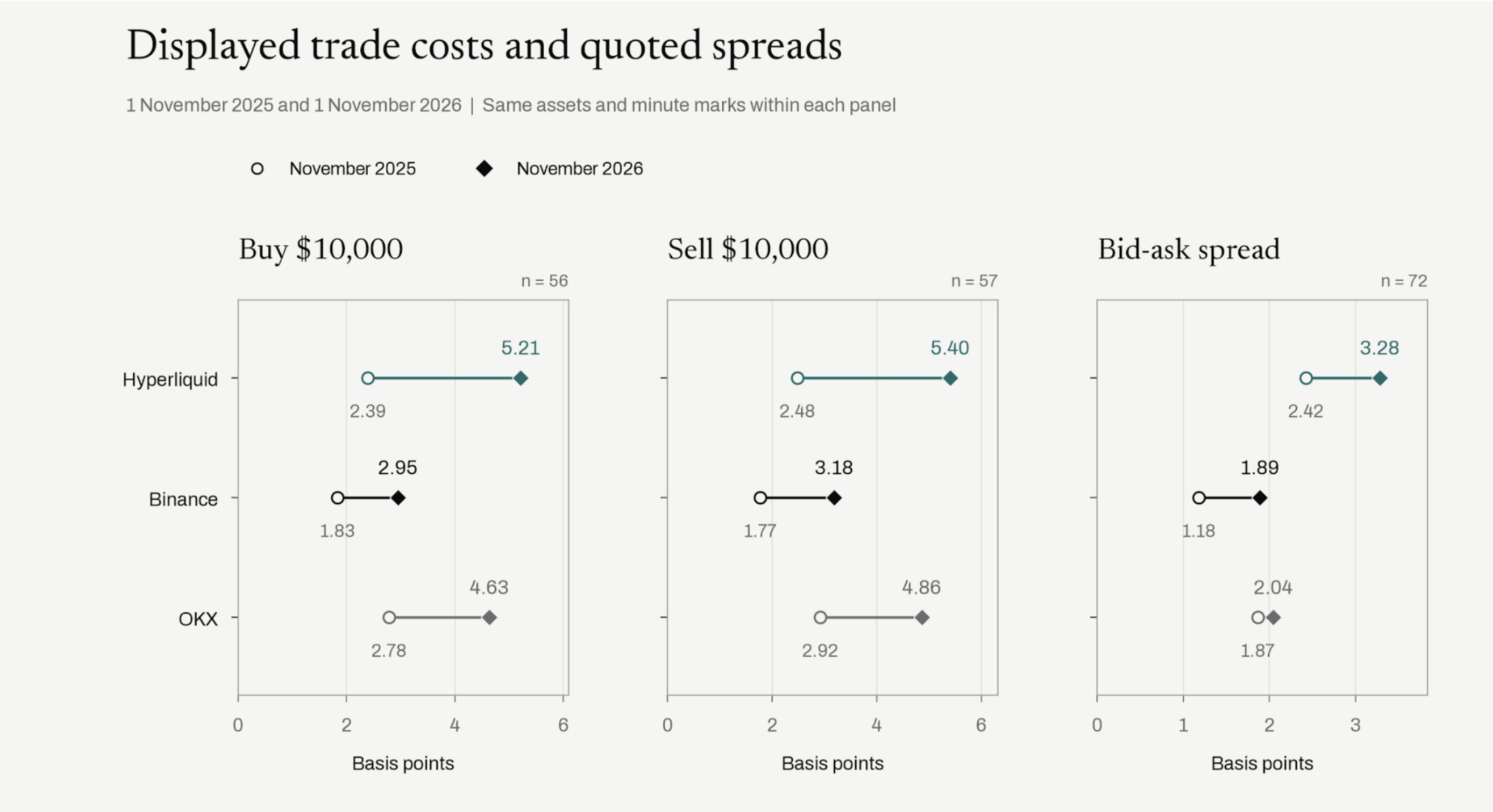
From November 2025 to November 2026, the trading slippage and spread of long-tail tokens across the three platforms have increased, with Hyperliquid's $10,000 order slippage and market spread both higher than Binance and OKX.
The spread indicators, however, show different results: the year-on-year growth rate of Binance's spread is higher. But Binance's initial spread base is lower, and even after a round of widening, the final spread performance still surpasses that of Hyperliquid.
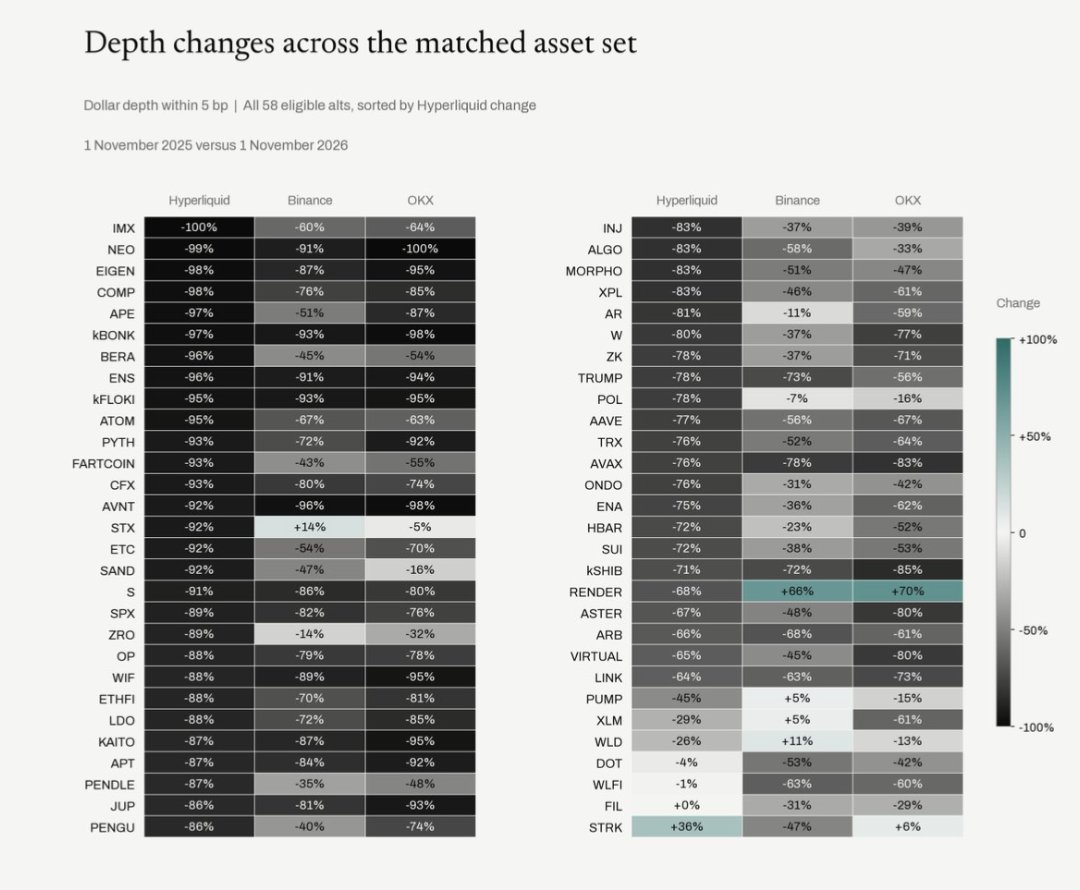
This heatmap compares the year-on-year changes in dollar market depth for 58 long-tail tokens within the 5bp range, showing that the liquidity drops for most tokens on Hyperliquid are significantly greater than those on Binance and OKX, with only a few tokens experiencing positive growth in liquidity.
Contradictions in Near-Market Pricing Are Most Prominent
Regarding this analytical framework, a common doubt arises: when token prices plummet, even if the number of tokens on order remains unchanged, their dollar value will inevitably shrink. To eliminate this interference, we track two indicators at the same time: the dollar value of the orders and the number of tokens ordered.
This set of charts fixes the tokens and observation points, collecting 13 groups of samples in total. The 5 basis point grouping covers 63 trading markets, while the broader top 20 depth grouping covers 80 trading markets. It is worth noting that the sample screening criterion is stricter than that of the previous round and centralized exchange comparison, so the resultant data cannot be directly equated to the previous CEX comparison conclusions.
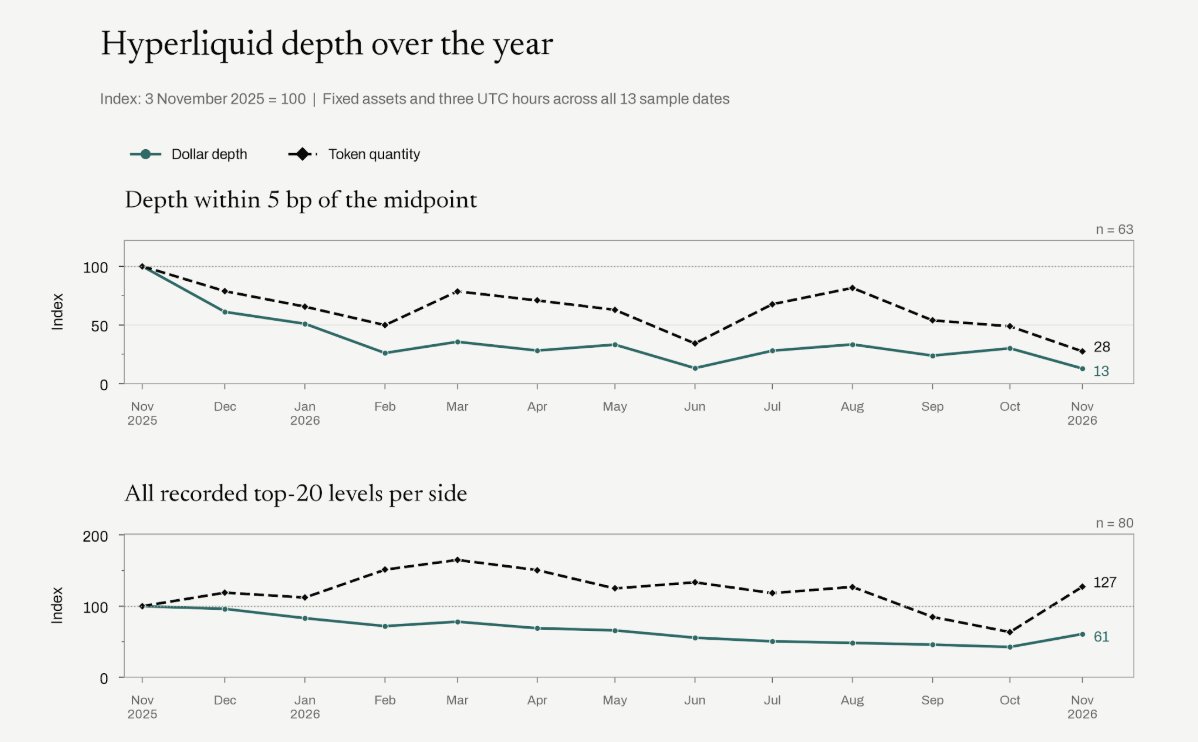
Hyperliquid's liquidity structure has shown significant differentiation in the past year: the near-market depth within a 5bp margin has continued to decline sharply, while the number of tokens ordered at the far end of the order book's top 20 levels has actually increased.
We set the data from November 2025 of each market as a baseline value of 100 for easy horizontal comparison. A year later, at the 5 basis point level, the median dollar depth is only 13, and the median number of token orders remains at 28. In other words, even after removing the impact of token price declines, the scale of near-price orders is still greatly reduced.
If we widen the statistical scope to include all 20 levels of order depth, the indicator performance is entirely different: the median dollar depth is 61, and the median number of token orders reaches 127. It is clear that the number of token orders at the far end of the order book is higher than in previous years. There are indeed orders in the market; however, the depth at the near-market position, where transactions are most frequent and most important for execution, is severely lacking.
More Detailed Observations
In terms of a six-month period, the far-side market depth has actually seen some recovery, but the liquidity near the transaction price has not improved.
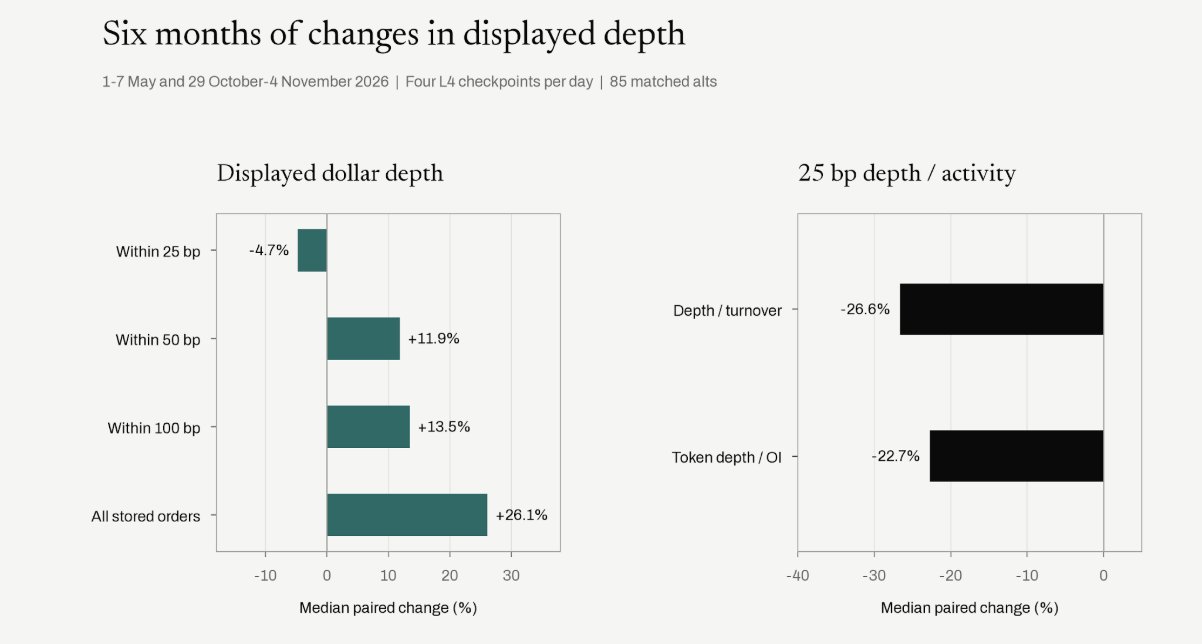
Comparing the data from May and late October to early November, Hyperliquid's near-market dollar depth has decreased within just 25bp, while the more distant levels and the total number of orders have actually increased; furthermore, the ratio of this 25bp depth to trading volume and open interest has clearly declined.
Looking at the spread trend over the entire year, an interesting change is that, until recently, Hyperliquid's spread level has continually aligned closer to industry peers. Of course, we need longer time to verify whether this is a long-term trend or a short-term disturbance. However, the data presented by the order book corroborates the aforementioned phenomenon of the market structure tending towards concentration.
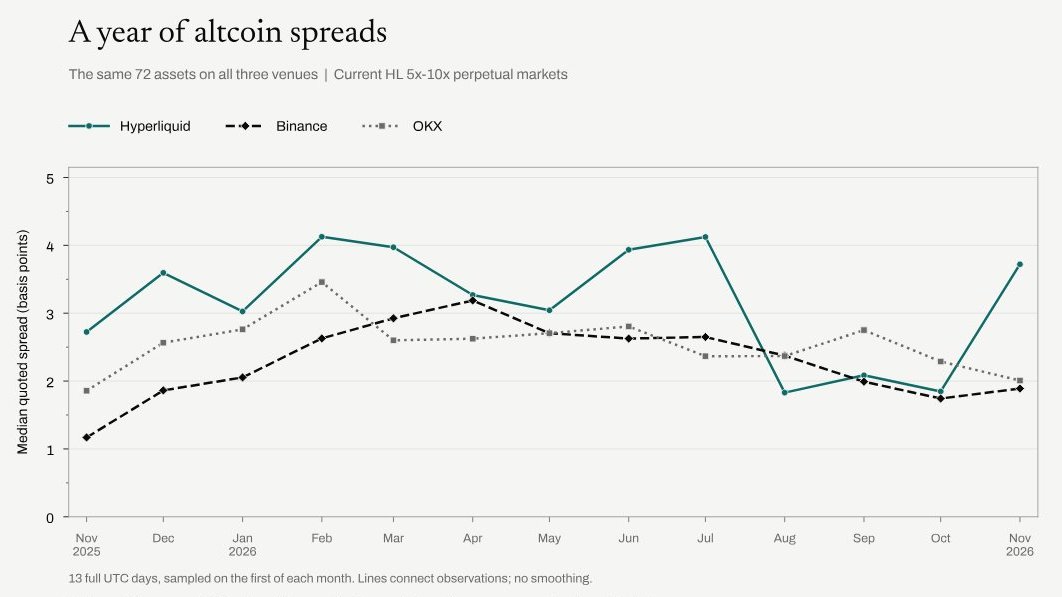
Over the past year, the spreads of 72 long-tail tokens across the three platforms have risen overall, with Hyperliquid's spreads fluctuating more greatly, significantly rising towards the end of the year, and consistently remaining above those of Binance and OKX.
Are Participants on the Liquidity Supply Side Decreasing?
I sorted through the underlying account structure, merging main accounts and their associated sub-accounts into the same account group for statistics, avoiding duplicate statistics of the same trading entity. With this method, we can identify each trading account group, even if we cannot determine the corresponding institution behind the accounts.
I initially thought that a few leading market makers handled the majority of the trading volume, but the annual trading data does not support this hypothesis. Selecting one week from a year ago and the recent week and comparing the same 80 trading markets: the median proportion of fill quantity from the largest account group dropped from 25.2% to 14.6%. Thus, it can be seen that the decline in liquidity throughout the year cannot simply be attributed to a single large institution withdrawing orders. We are more concerned with the short-term changes in market order behavior over the past month.
We focus on the past month, using the same 72 token sample as with spread analysis. The change points are very clear: since around October 30, the spreads have continued to widen, and liquidity near the mid-price has further concentrated. Comparing the two periods of October 8–14, and October 31–November 6: within a single market, the median proportion of orders from the largest account group within the 25 basis point range increased from 34.5% to 38.6%; the median quoted spread increased from 2.13 basis points to 3.55 basis points. This change is highly aligned with the pain points reported by market makers.
However, in the middle of this observation window occurred the Binance security incident on October 29, so this set of data alone cannot entirely attribute the changes to priority fees or network congestion.
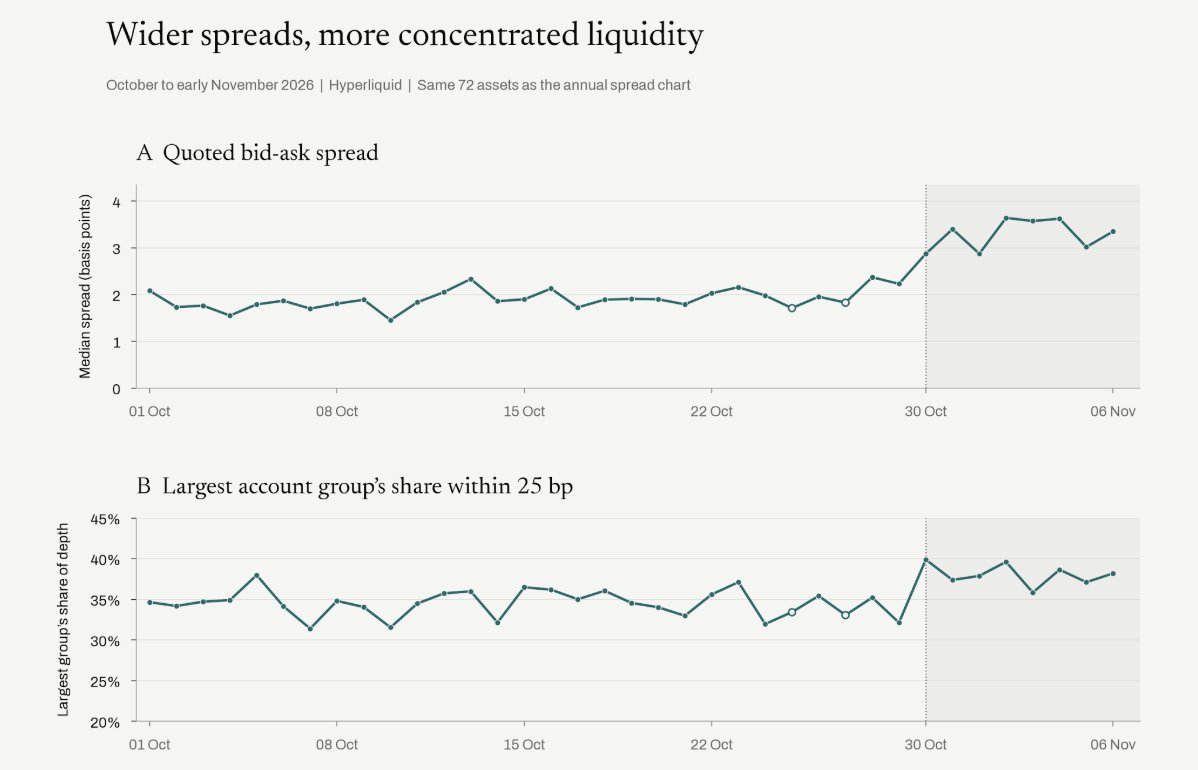
From October to early November 2026, the spreads of long-tail tokens on Hyperliquid widened, while liquidity within the 25bp range concentrated towards larger accounts.
Breaking down account behavior reveals that around November 3, a large liquidity provider significantly withdrew their quotes, prompting several other account groups to subsequently increase their market share. This could also be a trigger for the current deterioration in liquidity, which needs to be continuously monitored going forward.
The Fee Structure Has Inherent Flaws
The fee mechanism itself has structural issues. We analyzed the historical fees for fill orders of 54 account groups, weighted by trading volume: the lowest quartile by volume had a fee rate of 0.961 basis points; while the highest quartile by volume was able to receive a rebate of 0.236 basis points.
For small and medium market makers with lower trading volumes, they must first earn about 1.2 basis points in profit to cover their fee costs, with hedging losses and slippage additional. Given that the market spread itself is often just a few basis points, this cost pressure is hard to bear, leaving small and medium market makers at a natural disadvantage.
The trend of reducing quoting participants is equally evident. Again focusing on the 72 trading markets, comparing the data from October 8–14 with October 31–November 6: in the 25 basis point range, the median number of account groups providing effective quotes of no less than $1,000 on both the buy and sell sides decreased from 7.64 to 6.39. Even excluding the factor of falling token prices, in 58 of the 72 markets, the number of quoting account groups has decreased. The number of entities willing to provide effective quotes near trade prices is diminishing.
HIP‑4 Also Cannot Do Without Small and Medium Market Makers
Network congestion is another major issue.
Hyperliquid's current congestion quota rules are based on the weighted market-making share of addresses from the previous UTC natural day. During periods of high network congestion, a single address can occupy up to twice its allocated block space. To obtain a quota, one must generate trading volume; however, normal transactions and accumulation of trading volume cannot do without quota guarantees for order submission. Many traders participating in HIP‑4 have reported facing the same dilemma: during network congestion, they simply cannot submit quotes.
In fact, these low-transaction-volume small and medium market makers are already shouldering a considerable part of the liquidity supply work. In the 256 HIP‑4 contracts sampled on November 10, four professional wallets contributed 47% of the displayed depth within the 25 basis point mid-price range. This type of market is currently still small in scale; many binary prediction markets fall into this category. If Hyperliquid hopes to have sufficient liquidity for long-tail prediction markets, it must ensure that this supply model can operate continuously.
The core viewpoint of this article: solid liquidity for long-tail assets is the core reason traders initially chose Hyperliquid. However, in this observation-matched trading market, Hyperliquid's relative advantage over Binance has significantly faded. To maintain the competitiveness of the order book, the platform must retain enough market-making teams with quoting capacity. Continuously squeezing the survival space of small and medium market makers outside the leading ones can easily result in losing its most critical advantages. If HIP‑4 is to succeed, it must ensure that small and medium market makers can submit orders stably from the very beginning of its design, and Hyperliquid needs to optimize its mechanisms around this goal.
免责声明:本文章仅代表作者个人观点,不代表本平台的立场和观点。本文章仅供信息分享,不构成对任何人的任何投资建议。用户与作者之间的任何争议,与本平台无关。如网页中刊载的文章或图片涉及侵权,请提供相关的权利证明和身份证明发送邮件到[email protected],本平台相关工作人员将会进行核查。


