The price of STRC has returned to $100, but the funds for buying Bitcoin did not come from STRC.
Written by: Liam Akiba Wright
Translated by: Chopper, Foresight News
Strategy financed its Bitcoin purchases by selling common stock from November 2 to 8, despite its variable rate preferred stock STRC returning to $100. Strategy previously stated it would not issue STRC below $100, but its disclosure on November 9 indicated that no STRC had been sold under its at-the-market (ATM) issuance plan.
The allocation of funds showed where the financing went during that week. According to an 8-K filing submitted on November 9, the financing from MSTR common stock sales totaled $283.8 million, with $188.3 million used for STRC buybacks, $81.9 million for buying Bitcoin, and $13.6 million entering a cash account in US dollars.
That is to say, about two-thirds of the new common stock funding was used for buying back preferred shares, and less than one-third went towards Bitcoin. The market price correction of STRC did not trigger the STRC ATM financing plan.
Common stock simultaneously funded Bitcoin and STRC buybacks
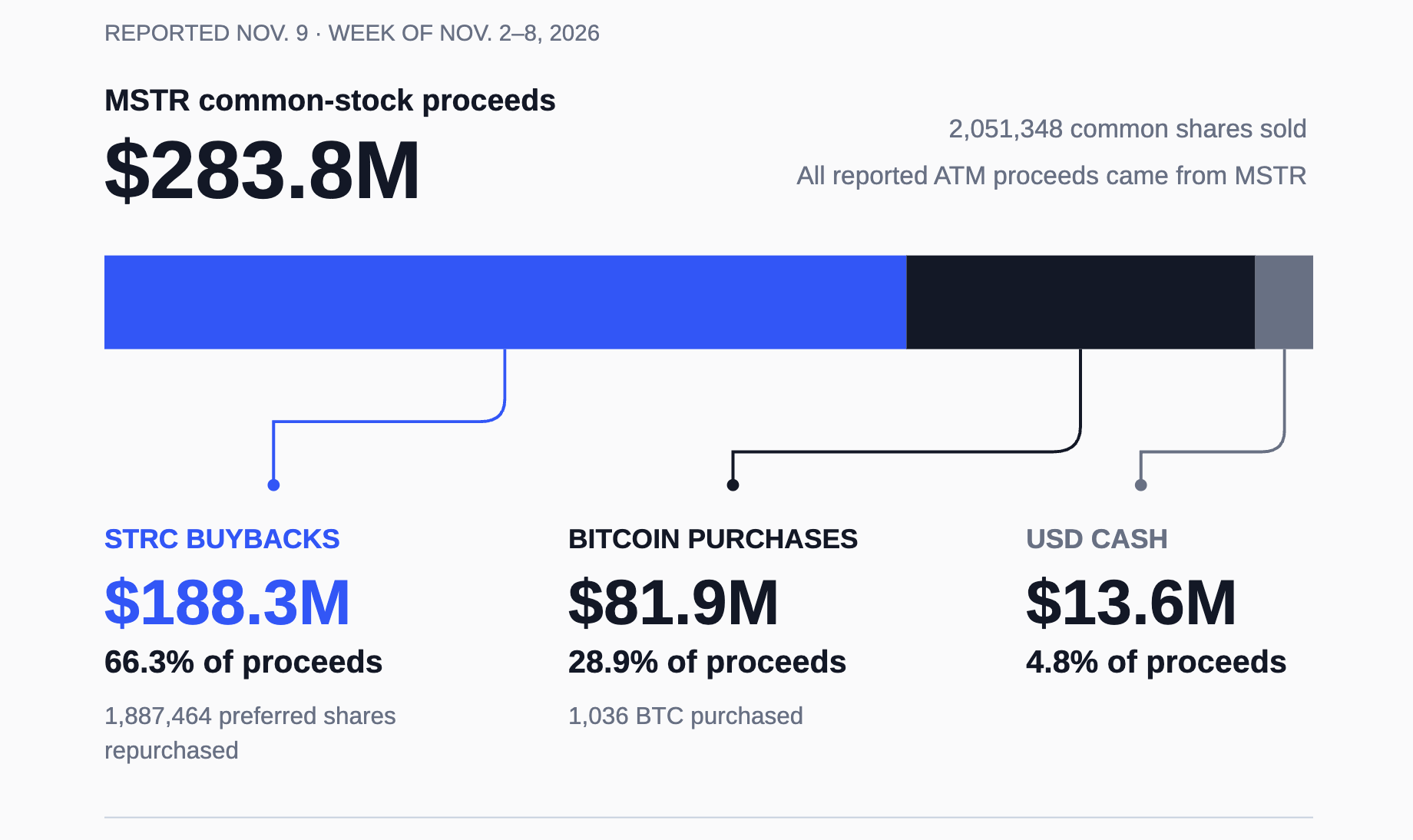
Strategy’s MSTR financing from November 2 to 8 primarily flowed to the preferred share buyback, with no report of any STRC ATM sales that week
STRC hit an intraday high of $100 on November 4, with an unadjusted closing price of $99.98; the highs on November 5 and 6 were $99.97 and $99.84, respectively.
Strategy stated in a press release on July 27 that the company would not issue STRC below $100 and identified "trading healthily and sustainably around that level" as a long-term goal. These issuances and dividend policies are considered intentions and may change.
Strategy raised new equity by selling shares and collecting funds. In secondary market trading, buyers pay money to another investor in exchange for existing shares held by the latter. Therefore, the market transaction price and the issuer's financing proceeds describe two different transactions.
The financing reported from November 2 to 8 came from the sale of 2,051,348 shares of MSTR. This share number includes shares sold but not yet settled as of November 6.
CryptoSlate's previous reports described the restoration of STRC financing as a possibility and cited unverified tracker data estimates suggesting that the issuance may have funded 191 BTC. Subsequent weekly disclosures indicated that there were no STRC ATM sales during this period, including November 4.
Buyback of preferred shares
Strategy bought 1,036 BTC for $81.9 million during that week, with an average price of $79,012 per coin (including fees and expenses). Its 8-K filing on November 9 clearly listed the proceeds from MSTR share sales as a source of funds.
The Bitcoin purchases accounted for 28.9% of the common stock financing. STRC buybacks accounted for 66.3%, approximately 2.3 times the amount allocated to Bitcoin, with another 4.8% entering the cash account in US dollars. This made the buyback plan a significant competitive use of the newly raised capital.
This also changed the company's debt composition. Issuing MSTR expanded the common stock base, while buying back STRC reduced preferred stock debt. Strategy repurchased 1.887 million shares of STRC from November 2 to 8.
The company's policy in July described discounted buybacks as a means to reduce future preferred stock dividend demands. This makes the expenditure not only bear immediate cash costs but also serve an economic purpose. Ultimately, how much dividend savings occur depends on future interest rates and dividend declarations.
Strategy also anticipated that the deeper the discount, the faster the buyback pace would be, and this would gradually slow down as the STRC price approached $100. Relevant decisions remain constrained by liquidity, market conditions, and capital allocation priorities.
The week prior, Strategy also conducted MSTR financing and STRC buyback simultaneously but reported different financing methods. In the 8-K submitted on November 2, Strategy reported $164 million in MSTR financing: of which $65.5 million was allocated for buying Bitcoin, $98.5 million entered the cash account in US dollars; additionally, a separate $208.2 million from the cash account was used for STRC buybacks.
However, from November 2 to 8, the company explicitly allocated MSTR financing directly to buybacks. A comparison of the two sets of data shows that the disclosed funding allocation method changed, but in both weeks, it was common stock sales that provided funding for Bitcoin purchases.
As of November 8, funds in the cash account totaled $146.2 million, along with a reserve of $4.77 billion specifically for dividend and interest payments. Strategy used $21.1 million from that reserve to pay preferred stock dividends that week.
The next financing progress depends on the issuer's announced sales figures and the use of proceeds. STRC returning to $100 is a market price milestone; while the fund allocation for November 2 to 8 shows that it is still MSTR that provides funding for Bitcoin purchases.
免责声明:本文章仅代表作者个人观点,不代表本平台的立场和观点。本文章仅供信息分享,不构成对任何人的任何投资建议。用户与作者之间的任何争议,与本平台无关。如网页中刊载的文章或图片涉及侵权,请提供相关的权利证明和身份证明发送邮件到[email protected],本平台相关工作人员将会进行核查。


