Author: Nikos (@definikos)
Translation: Deep Tide TechFlow
Deep Tide Overview: Nowadays, payment fintech companies can borrow $30 million USDC from Aave or Morpho in a single transaction, but there is currently no institution on-chain that can promise to provide stable loans at a fixed price for the next year.
This article dissects the four structural functionalities that are still absent on-chain, comparing the existing mechanisms of Aave V4 Spokes, Avon, and Morpho Midnight.
Addressing the aforementioned pain points, the article proposes a four-layer credit product framework that includes a committed liquidity vault, a single-amount first-loss buffer layer, interest rate cap hedging tools, and an accounts receivable recovery pricing system, while discussing the true commercial moat outside the contracts.
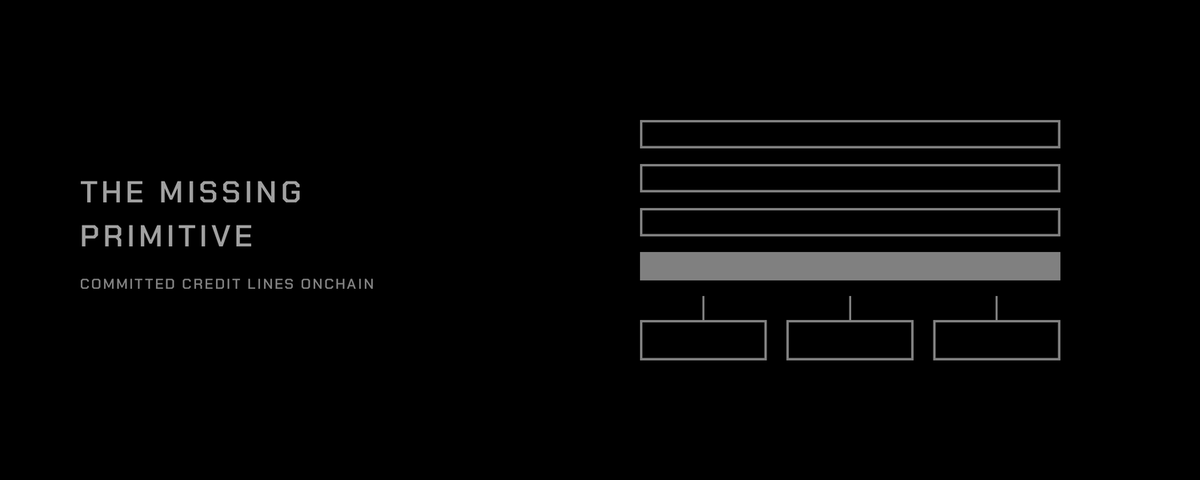
Payment fintech companies can currently borrow $30 million USDC from Aave or Morpho in a single transaction. However, there is nowhere on-chain to purchase a clear commitment: ensuring that every morning for the next year, this $30 million will be available at the agreed price.
This certainty commitment is the core product that traditional banks genuinely sell to fintech companies and is also the only component that has not yet been built in today's on-chain lending technology stack.
Yesterday, I dissected the operational model of fixed-rate working capital, analyzing how traditional finance provides funding for it, how Aave V4 Spokes, Avon, and Morpho Midnight can carry such businesses, and their respective shortcomings. Today's discussion should focus on what should be built at the upper layer, covering the outstanding problems, a set of four-layer product solutions, and the future moats.
Outstanding Core Gaps
By comparison, four major functional gaps can be identified, all of which are located at a layer above the current lending market.
First, no party commits to the credit capacity. Aave V4 Spoke only limits the maximum withdrawal limit for borrowers but has no mechanism to ensure that there will be funds available in the pool when borrowers need to withdraw. The quotes signed by borrowers on Morpho Midnight can still be revoked right before the borrower actually accesses them. Avon merely routes requests to the fund providers that are currently quoting.
For payment fintech companies that need to advance $10 million daily for settlements, they must ensure that this credit line is available on their most difficult days, which happens to be when ordinary lenders withdraw liquidity.
Second, risk separation only stops at the Spoke layer. In Aave V4, once a Spoke experiences unrecoverable bad debt losses, the losses are directly shared by all depositors who provide that asset in the Hub. Although losses remain within a single independent market on Midnight and Avon, all lenders in that market still bear all losses themselves.
The above constructions do not set up a first-loss buffer between borrowers and priority funds, which is exactly the standard structure for every warehouse credit line and financing conduit in traditional finance.
Third, the financing costs for asset issuers are borne by token holders through floating interest rate fluctuations. Currently, about $600 million of tokenized working capital credit is held by holders for leveraging floating rate USDC debts for revolving loans.
When market lending rates soar sharply, revolving loan holders are forced to sell tokens, causing the asset issuers, who initially believed their funding sources were stable, to lose financing support.
Only a sufficiently deep fixed-rate market for the corresponding duration can solve this issue; if such market depth does not exist, tools for hedging interest rate caps must be relied upon. However, currently, no online products on the borrowing rates of Aave or Morpho provide interest rate cap contracts.
Fourth, assets such as accounts receivable cannot be settled within an hour. Traditional on-chain settlements assume that assets have real-time market quotes and always have buyers ready to take over. However, accounts receivable tokens rely on net asset value (NAV) reports for valuation, with redemption queues often calculated by days.
The complete toolbox used by traditional banks for risk disposal, including stopping further lending, taking over repayment accounts, allowing asset pools to naturally amortize, and directly selling to pre-agreed fallback buyers, currently lacks corresponding programmable components on-chain.
Capabilities of Underlying Lending Protocols
In fact, most of the core mechanical components required to build this system already exist.
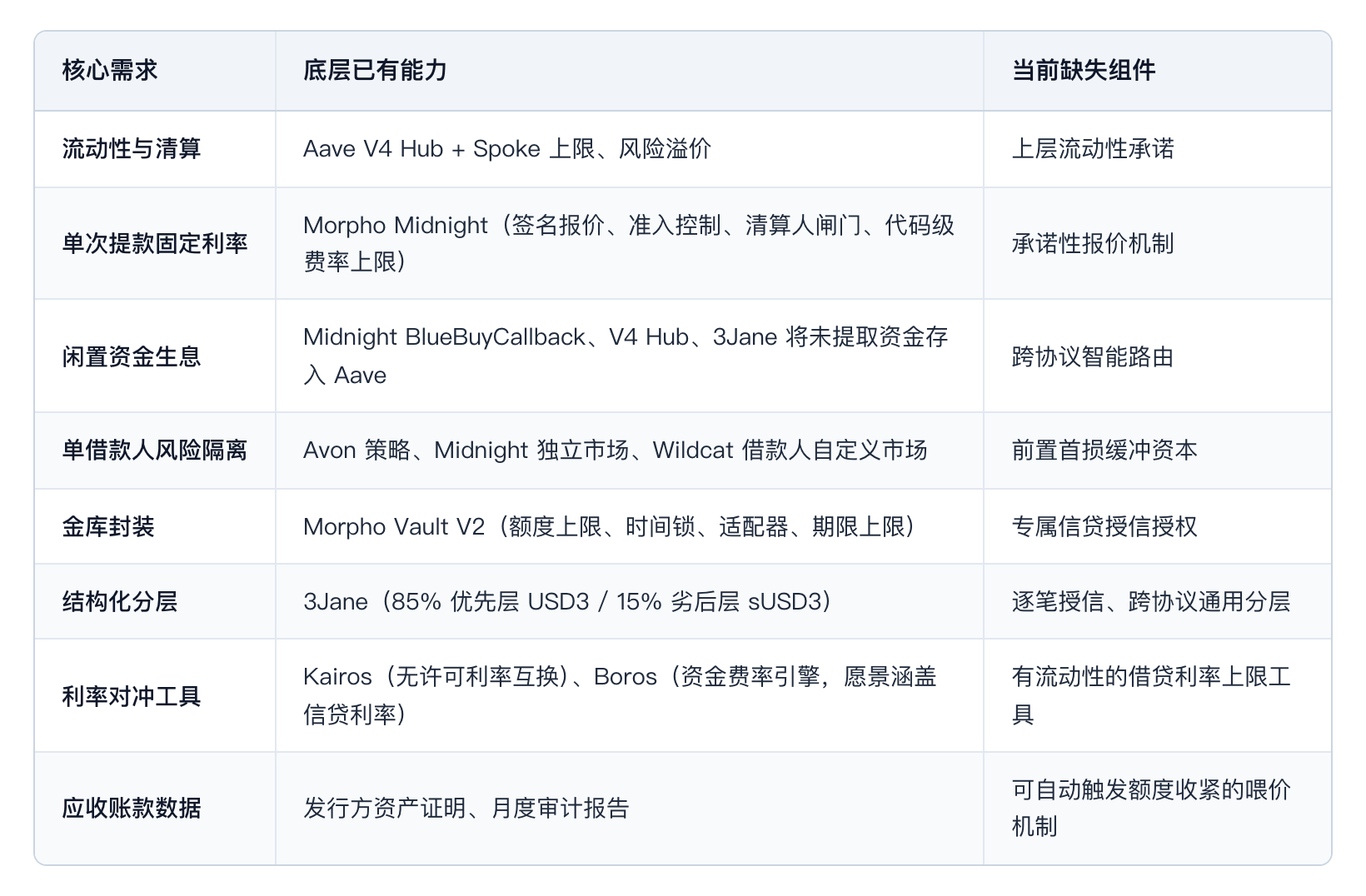
Figure: Comparison of existing capacities of underlying on-chain lending protocols with missing components at the upper level
Two pioneering projects have already set industry benchmarks. Wildcat allows borrowers to set various parameters independently in the marketplace, including capacity, annual interest rate, reserve ratio, and withdrawal cycle. When Kinto defaults for the first time since 2023 in 2025, losses are strictly confined to a single market, with lenders expected to recover 76% of the principal.
Another case is 3Jane, which conducts credit underwriting based on on-chain and bank account data and provides unsecured USDC credit lines, depositing unutilized funds into Aave for interest, and dividing lender funds into 85% priority layer and 15% subordinate layer.
These two cases demonstrate that certain technology stacks are feasible in practice. However, both have not sold strictly committed fixed credit lines to fintech companies, have not achieved routing between Aave V4 and Midnight, and cannot directly support accounts receivable collateral.
Four-Layer Product Architecture Design
The essence of this product is an on-chain credit coordination desk located between fintech borrowers and the underlying lending market, consisting of four layers. Each layer can operate independently, and when combined, they can deliver greater efficacy.
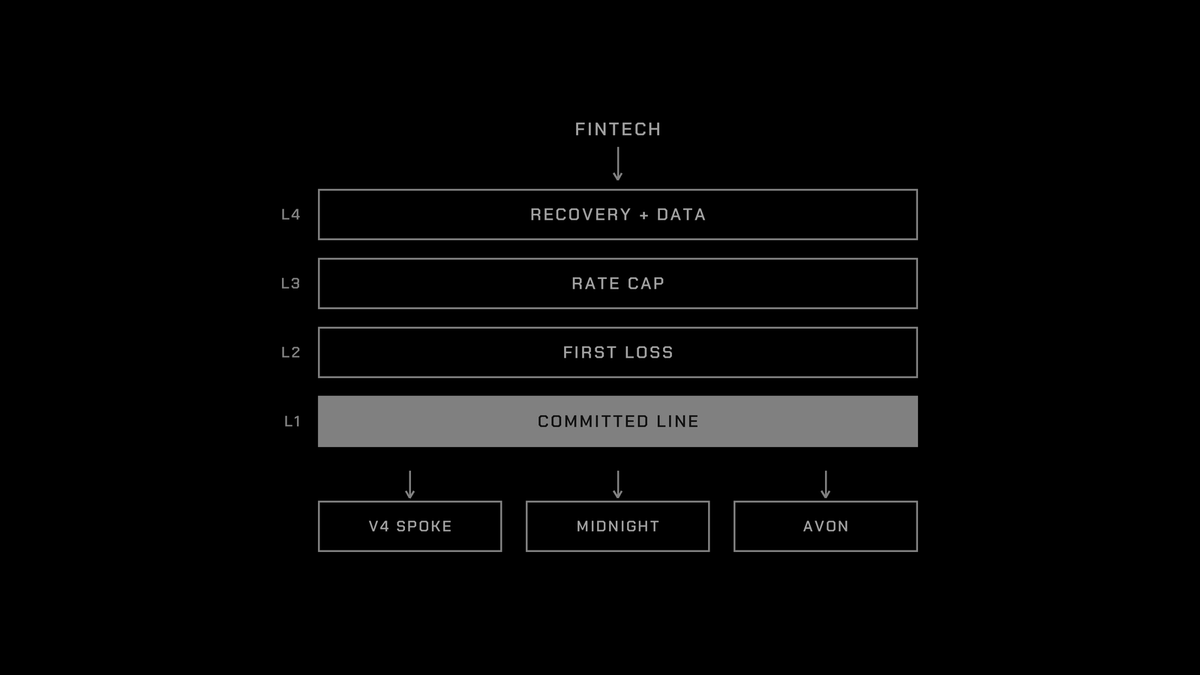
Figure: Diagram of the four-layer on-chain committed credit architecture for fintech borrowers and its connection to the underlying lending market
Layer 1: Committed Credit Line
A credit line is essentially a liquidity vault with a clear investment authorization. Depositors inject funds into the vault, which commits to providing a single borrower a maximum loan amount of X over a period of 6 to 12 months, priced at a spread over a benchmark interest rate or using a fixed interest rate, with borrowers initiating withdrawals and repayments directly through an API.
Unutilized idle funds are deposited in the deepest floating-rate market to earn baseline returns. Each time an actual withdrawal occurs, the system routes it to the underlying market with the lowest funding cost for the corresponding collateral type and term, such as a dedicated Aave V4 Spoke or the corresponding maturity Morpho Midnight market.
Aside from paying the agreed spread for the utilized portion, borrowers also need to pay a commitment fee for the unused credit line, which is the economic pillar that makes liquidity commitments commercially sustainable.
Taking a total credit line of $30 million with an average withdrawal rate of 60% as an example, assuming a spread of 4% and an unutilized commitment fee of 0.5%, the additional return for depositors based on floating interest will be:
60% × 4% + 40% × 0.5% = 2.6%
Equivalent to generating an additional $780,000 per year. The core risk of this model is that the vault is essentially selling a liquidity call option to the borrower.
Borrowers often withdraw heavily when they face liquidity pressure, so the credit line must withstand the shock of withdrawals jumping from an average of $18 million to the full $30 million in the worst days.
This means that when determining the committed credit scale, it must strictly rely on the vault's actual liquidity that can be instantaneously withdrawn from the floating-rate market in extreme pressure environments, rather than the daily average utilization rate; it also requires the vault to establish an orderly redemption queue that cannot intercept committed withdrawals.
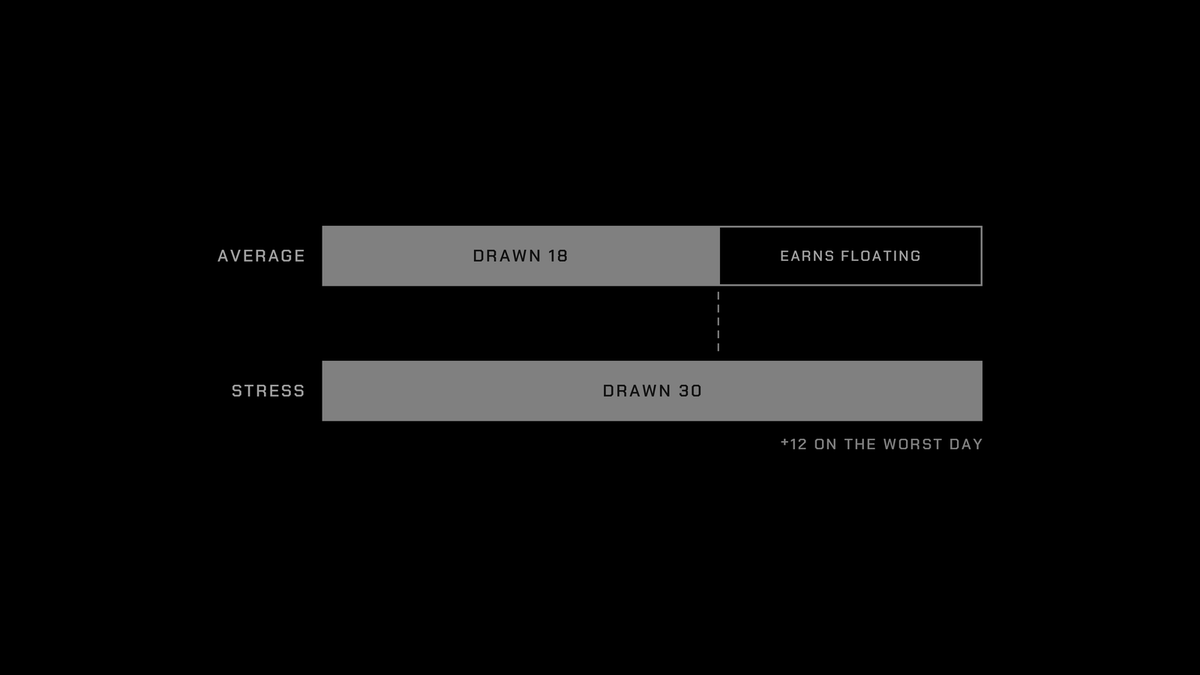
Figure: Comparison of liquidity utilization between daily average withdrawal (18 million) and full withdrawal under extreme pressure scenario (30 million)
Layer 2: Single Amount First-Loss Protection Layer
Each credit line is equipped with a dedicated subordinate tranche that absorbs all bad debts before losses are borne by priority depositors and the underlying Hub or lending market.
This is transferring the equity loss buffer layer from traditional warehouse credit lines to the blockchain in a prominent way. This subordinate capital can either be contributed by the asset issuer themselves, provided by specialized credit funds, or jointly funded by both parties.
If the subordinate tranche is set at 15% of the utilized amount, under a $18 million withdrawal scale, the subordinate principal would be $2.7 million; allocating 60% of the total spread earnings of $720,000, their excess return rate would be:
432,000 ÷ 2,700,000 = 16%
Which means an additional earning of 16% on top of the basic floating return rate. If the utilized loan account experiences a 5% loss (i.e., $900,000), this bad debt only consumes one-third of the subordinate principal, and the principal of the priority fund remains unaffected.
On Aave V4, the existence of the subordinate layer makes risk segregation for Hub depositors via Spoke a reality; in Morpho Midnight, it is this layer of protection that allows the curated vault to provide isolated safe yield certificates to priority depositors, preventing depositors from being completely exposed to all underlying risks.
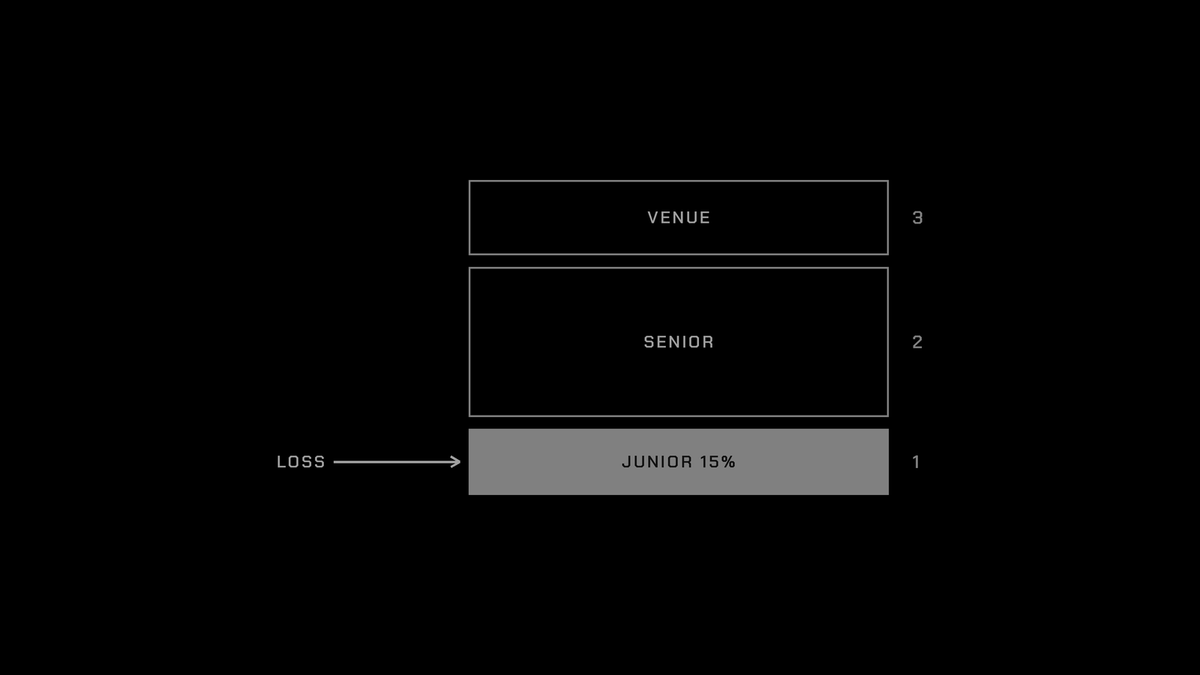
Figure: Three-tier loss absorption priority structure of subordinate layer (15%), priority layer, and underlying lending market
Layer 3: Borrowing Rate Cap Tool
The borrowing rate cap option automatically pays the difference compensation to the option holder when the borrowing rate index in specific lending venues exceeds the executed rate cap, with the calculation formula as follows:
payoff = max(0, r_b - K) × N × t
Assuming the executed interest rate cap is set at 7%, with a nominal principal size of $100 million. If the average USDC borrowing rate rises to 9% within 30 days, the rate cap tool will compensate the holder:
100,000,000 × 2% × 30/365 ≈ $164,000
For asset initiators who heavily rely on external revolving loans, this can provide a uniform purchasing rate cap protection for token holders. When market borrowing rates surge, holders will receive direct interest compensation for their borrowing costs, without being forced to sell their assets at a loss.
The natural sellers of such contracts are the groups that inherently long for high interest rates, including floating rate lenders, fixed rate vaults, and idle interest-earning modules of the credit vault itself.
Technical components have already emerged in Kairos-style decentralized interest swaps and Boros rate engines, but there is a lack of a standardized, high-liquidity rate cap market targeted at Aave and Morpho borrowing rate indices.
Layer 4: Asset Recovery and Data Pricing
This layer is responsible for transforming slow-turning accounts receivable into qualified collateral that the lending market can safely accept, consisting primarily of three parts:
Standby Buyers: Establish a dedicated clearing whitelist that only allows pre-contractual committed buyers (including the issuer themselves, standby service providers, and distressed credit funds) to take over assets at the agreed discounted price, paying standby commitment fees to them.
This replaces the original 60-minute forced urgent liquidation curve of Midnight, allowing assets to flow to buyers who are genuinely patient in waiting for receivables recovery.
Valuation Reassessments (Marks): Collateral is dynamically priced based on net asset value after deducting expected credit losses, with discount rates increasing with the age of audit reports; actual receivable funds are gradually confirmed once funds are received, rather than over-drafting the most ideal earnings on the first day of lending.
Automatic Risk Control Triggers: Continuously access verified accounts receivable details, custodial reserve balances, and liquidation delay indicators. Once the quality of the underlying asset pool deteriorates, pricing data will automatically trigger to reduce withdrawal limits, compress vault quotas, and tighten overall credit limits.
This is directly incorporating the stop-advance clause from traditional warehouse credit into on-chain lending agreements.
The True Moat
Smart contract code itself will not become a long-term moat. The underlying lending market is evolving towards highly converged technical architectures, and the recent acquisition of Avon by Aave Labs clearly indicates that underlying lending platforms also intend to consolidate fixed-rate modules into self-operation.
The credit coordination layer built on top of the underlying protocols must derive its long-term value from the proprietary information stored and the bilateral cooperation relationships established, rather than from the deployment of a mere contractual code.
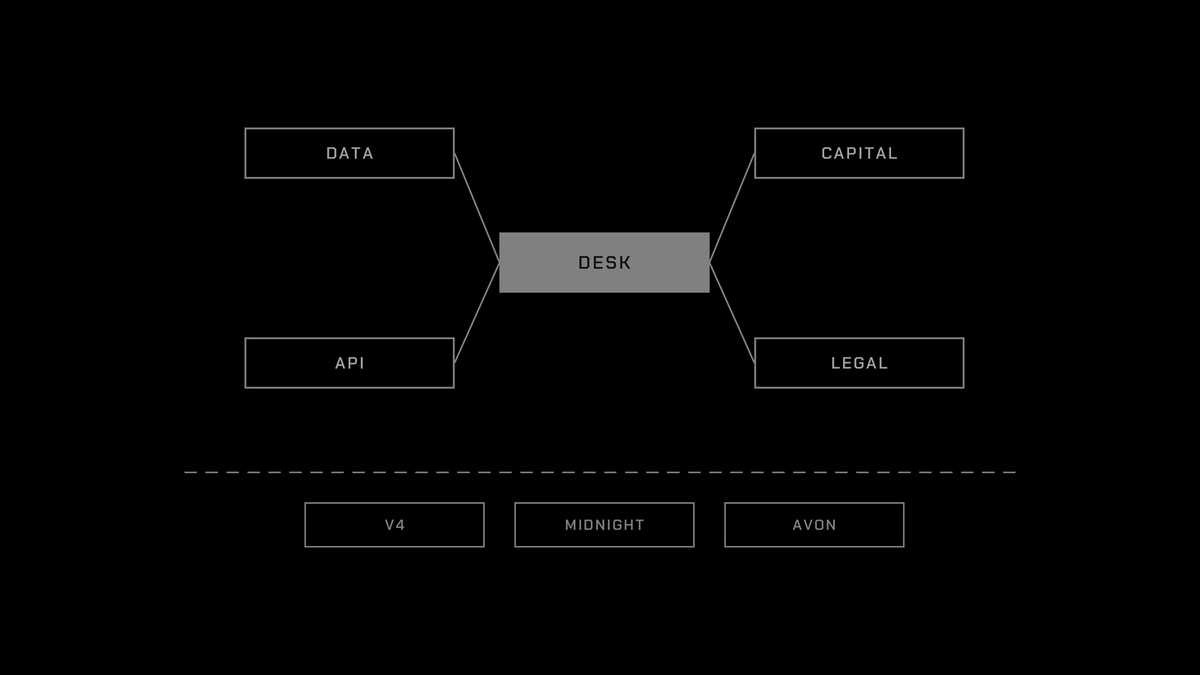
Figure: Structure of the moat of the credit coordination layer with aggregated data, API integration, bilateral capital, and legal frameworks
First is the barrier of underwriting data. The credit coordination desk can observe detailed records of every withdrawal, repayment, and international settlement delays for all borrowers under its umbrella, and these real default and repayment historical data will create a compounding effect over time. After two years of operation, the desk's ability to precisely price specific cross-border payment channels or accounts receivable asset pools will significantly exceed newcomers, while the underlying public chain lending market cannot see this data at all.
Secondly, the bilateral capital network effect. Priority depositors require a reliable subordinate buffer to support them, while subordinate capital and standby buyers also need a continuous flow of compliant credit objects. Whoever can be the first to successfully connect funding from both ends will control the market pricing power of the next credit line.
Third is the stickiness of enterprise system integration. Fintech companies are willing to connect only one unified credit API rather than maintain complex interfaces for three different lending protocols simultaneously. Once a borrower's corporate cash management system automatically triggers withdrawals daily through the coordination desk, and risk control triggers are directly linked to their clearing transaction data, high switching costs will ensue.
Finally, the most difficult to replicate is the legal packaging architecture. Granting unsecured credit lines to payment institutions, ensuring that recourse against underlying accounts receivable has legal enforceability in the borrower’s jurisdiction, and implementing comprehensive KYC due diligence for both lending parties.
These tasks rely heavily on time accumulation and a seasoned team of legal experts, effectively blocking hasty and blind copycats.
Core Challenges for Implementation
Committed credit lines essentially belong to option tools in finance. The most critical risk control challenge for the entire system is accurately pricing concentrated withdrawal risks in extreme pressure scenarios while not severely diluting depositors’ basic earnings and retaining sufficient liquidity to respond. If there is a miscalculation in the model assessment, the credit coordination desk may break its commitment during the crucial week it needs to fulfill its obligations.
Moreover, default recovery for unsecured credit or accounts receivable financing involves long and offline legal processes, which cannot be resolved instantaneously through on-chain transactions. The Wildcat first default case is expected to recover 76% of the principal, while 3Jane chose to offload bad debts at a discounted price to licensed debt collection agencies, requiring the on-chain revenue waterfall model to factor in these time-discounting costs for pricing comprehensively.
At the same time, the underlying lending protocol is also rapidly evolving. Aave’s push for fixed-rate programs following its acquisition of Avon, the adapters that Morpho will launch this quarter, and the Midnight market operating under accounts receivable all have the potential to incorporate some of the modules within the technology stack.
Therefore, the credit coordination desk must position itself as a cross-market router and professional credit underwriter, rather than simply replicating additional features that could be launched next quarter in a single lending market.
Underneath all business logic, the ultimate foundation remains financial regulatory compliance. Lending to licensed institutions holding payment licenses is currently the clearest wedge for entry, but it also means that financial regulatory authorities on the counterparty side will meticulously review every on-chain credit term list.
If You Are Interested in Joint Construction
I am currently systematically exploring several frontier concepts, including this direction, and hope to find like-minded builders to advance implementation together. If you are building any of the above modules or have a strong interest in this direction, feel free to reach out to discuss. Regardless of who ultimately leads the breakthrough, the above four structural gaps possess high real commercial and engineering solution value.
免责声明:本文章仅代表作者个人观点,不代表本平台的立场和观点。本文章仅供信息分享,不构成对任何人的任何投资建议。用户与作者之间的任何争议,与本平台无关。如网页中刊载的文章或图片涉及侵权,请提供相关的权利证明和身份证明发送邮件到[email protected],本平台相关工作人员将会进行核查。


