Key Takeaways
- Crypto’s $471 million political offensive nearly doubled its 2024 election contributions, with Republicans capturing the lion’s share.
- Industry heavyweights poured millions into pivotal congressional races, seeking greater influence over Washington’s digital asset policies.
- Electoral victories concealed expensive setbacks, as crypto-backed PACs spent $88.2 million on losing political campaigns.
The following analysis is a guest post by James Delmore, a blockchain and crypto market analyst for Breadcrumbs. The report’s figures are based on federal donations only.
Drawing on Federal Election Commission (FEC) records and comprehensive campaign finance data, Delmore’s research identifies the industry’s largest corporate and individual donors, examines the political action committees (PACs) responsible for deploying millions of dollars, and evaluates their influence across pivotal congressional contests. Republicans captured the overwhelming majority of financial support, while crypto-aligned PACs committed substantial resources to shaping the composition of Congress.
Yet the results expose a fascinating contradiction: Despite an impressive record of electoral victories, some of the industry’s most expensive political gambles ended in defeat. The following report examines the financial machinery behind cryptocurrency’s growing political influence in Washington, the winners and losers of the 2026 election cycle, and the industry’s broader ambitions to secure favorable digital asset legislation.
Companies and individuals with ties to the cryptocurrency industry contributed a record amount of at least $471 million during the 2026 US election cycle, nearly double the $250 million spent in 2024, according to an analysis of FEC records.
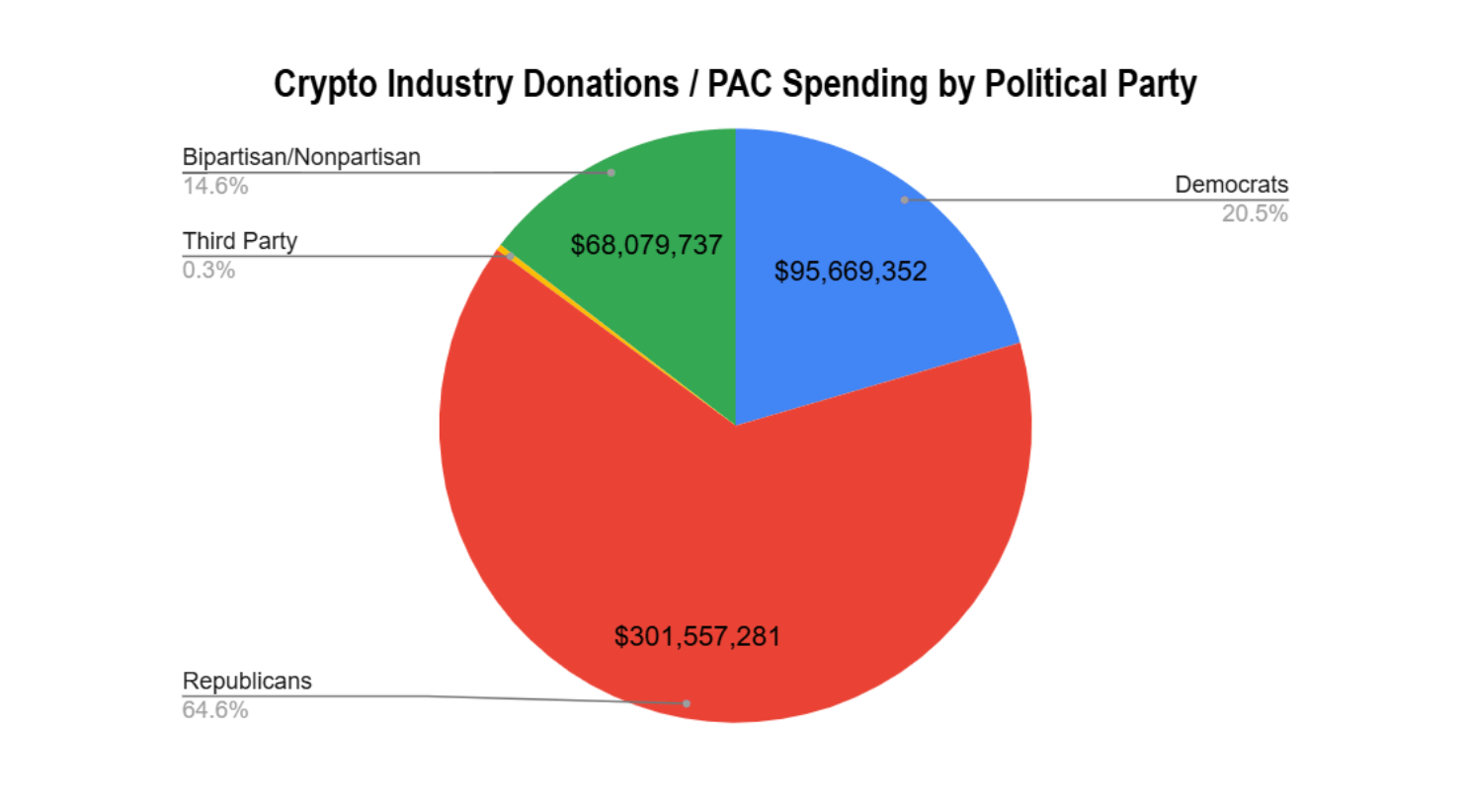
Republicans received the overwhelming majority of contributions and spending support from the crypto industry. Of the $471 million, $302 million (65%) went to or was spent on Republican-aligned candidates, while $96 million (21%) to Democratic-aligned candidates
Non-crypto PACs and committees received more than $250 million in contributions from the crypto industry.
| CONTRIBUTIONS to NON-CRYPTO PACS | ||
| PAC Name | Amount | Description of PAC |
| MAGA, Inc. | $94 million | Supports Trump-endorsed Republicans. |
| Leading the Future | $50 million | Super PAC supporting AI |
| Lone Star Rising | $18 million | Supports James Talarico (D) for Senate in Texas |
| HMP | $17 million | Supports Democrats in House races |
| Congressional Leadership Fund | $15 million | Aligned with Congressional GOP leadership |
| Senate Leadership Fund | $8 million | Aligned with Senate Republican leadership |
| V-PAC: Victors, Not Victims | $6 million | Supports Vivek Ramaswamy for Ohio governor |
| Invest in Tomorrow Coalition | $6 million | Supports Democrat candidates for clean energy |
The rest of the crypto industry’s contributions mostly went to the crypto PAC Fairshake, which then transferred most of its funds to its affiliate PACs, Protect Progress and Defend American Jobs.
These crypto-focused PACs recorded approximately $163 million in spending. 82% of the spending supported Republicans or opposed Democrats, versus 18% supporting Democrats or opposing Republicans.
| Name of Crypto PAC | Political Affiliation | Amount Spent |
| Fairshake | Bipartisan | $18.4 million |
| Protect Progress | Democrat | $29 million |
| Defend American Jobs | Republican | $102 million |
| Digital Freedom Fund | Republican | $8.3 million |
| Fellowship | (Mostly) Republican | $4.8 million |
| Jump PAC | Bipartisan | None Reported |
| First Principles Digital | Republican | $900,000 |
| Senate Race | Crypto PAC Spending | Support | Result |
| Ohio Senate | $64M | Backed Jon Husted/opposed Sherrod Brown | Lost |
| Nebraska Senate | $14M | Backed Pete Ricketts/opposed Dan Osborn | Won |
| Alabama Senate | $13M | Backed Barry Moore | Won |
| Illinois (primary) | $10M | Opposed Juliana Stratton | Lost |
| Kentucky Senate | $8M | Backed Andy Barr | Won |
Overall, Candidates supported by crypto PAC spending were very successful. Of the 90 candidates that received support from crypto super PACs, 73 of them won their races and were elected to Congress, while only 14 lost their races (with three races still to be determined). A winning percentage above 80%.
But the financial commitments were devastating. More than half of the $163 million that was spent went to losing candidates ($88 million). In the Ohio senate race alone, $64 million (or 39% of crypto PAC spending) went to a losing effort trying to defeat anti-crypto candidate Sherrod Brown.
Crypto PACs fared better in Nebraska, Alabama, and Kentucky, where $34 million was spent on the winning candidates.
| Companies and investment entities | Contributed | Individuals | Contributed |
| Andreessen Horowitz / a16z | $117M | Reid Hoffman | $28M |
| Coinbase | $61M | Cameron Winklevoss | $18M |
| Ripple | $50M | Tyler Winklevoss | $18M |
| Crypto.com | $39M | Chris Larsen | $17M |
| Winklevoss Capital Fund | $21M | Ross Stevens | $6M |
The top five entities account for $288 million, or about 61% of the full donor tally.
The totals encompass both crypto-native and crypto-affiliated businesses and individuals.
Crypto-native and affiliated businesses and other entities accounted for approximately $346 million, and individuals in the crypto space account for 125.4 million.
| Donor group | Contributions |
| Crypto-native entities | $276 million |
| Crypto-native individuals | $82 million |
| Crypto-affiliated entities | $70 million |
| Crypto-affiliated individuals | $43million |
| Total | $471 million |
Donors by Political Party
| Foris Dax (Crypto.com) | $38 million |
| Winklevoss Capital Fund | $21 million |
| Tyler Winklevoss | $17 million |
| Cameron Winklevoss | $17 million |
| Andreessen Horowitz / a16z | $10.6 million |
| Cantor Fitzgerald | $10 million |
| Ross Stevens | $6.3 million |
| Blockchain.com | $5 million |
| Solana Institute | $3.6 million |
| Bijan Tehrani | $3 million |
| Matt Huang | $2.6 million |
| Reid Hoffman | $28 million |
| Chris Larsen | $16.7 million |
| Ron Conway | $7.5 million |
| Michael Novogratz | $1.9 million |
| Brian Armstrong | $494,000 |
Methodology: Figures are from James Delmore’s compilation of political-contribution and PAC-spending records for the 2025–26 cycle, reported here as of November 6, 2026. “Crypto-native” denotes businesses primarily engaged in digital assets and associated individuals; “crypto-affiliated” includes diversified firms, investors and individuals with substantial crypto ties. Donations by an affiliated donor are not necessarily donations made to advance crypto policy.
The $471 million is a contribution tally. PAC expenditures are presented separately and must not be added to it. PAC fundraising figures can include transfers between committees. Race totals are rounded, and election results remain subject to certification.
免责声明:本文章仅代表作者个人观点,不代表本平台的立场和观点。本文章仅供信息分享,不构成对任何人的任何投资建议。用户与作者之间的任何争议,与本平台无关。如网页中刊载的文章或图片涉及侵权,请提供相关的权利证明和身份证明发送邮件到[email protected],本平台相关工作人员将会进行核查。


