Goldman Sachs warns that the ratio of reserves to bank assets has fallen to about 11%, just slightly above the low point during the 2019 crisis.
Written by: Dong Jing, Wall Street Watch
With triple pressure from the Federal Reserve, Treasury, and Congress, Goldman Sachs predicts a liquidity crisis in 2027
The U.S. money market is quietly approaching a critical point. Goldman Sachs' latest research report warns that bank reserves are on the edge of a steep demand curve, with cumulative pressures from the Federal Reserve, Treasury, and Congress expected to be released in the second half of 2027, during which the repo market faces the risk of severe volatility.
Goldman Sachs interest rate strategist Isabella Rosenberg noted in a report released on November 10 that the current system liquidity is "just enough to make everything seem normal, but insufficient to cope with any unexpected shocks." The report predicts that the Treasury General Account (TGA) reconstruction triggered by the debt ceiling in 2027 will coincide with larger-scale Treasury auctions, the subsequent impacts of forced repo liquidations, and a stagnation in the growth of money market funds, creating multiple tightening pressures.
Meanwhile, the Federal Reserve is currently in a rare state of policy contradiction: within the same month, while the Fed is expected to restart purchases of short-term Treasury bills (T-bills), Fed Governor Waller has publicly signaled a rate hike of 50 basis points, and the market has fully priced in a rate hike in December, with the 2-year Treasury yield rising to 4.61% before the CPI data release. Goldman Sachs expects the Federal Reserve to begin cutting rates in the second half of 2027, a timeframe that coincides with the peak of liquidity risks.
Underneath the surface calm, reserves are on the brink
In 2026, the repo market remained overall stable. Goldman Sachs data shows that the secured overnight financing rate (SOFR) has consistently been about 2 basis points below the Fed's interest on excess reserves (IORB) since May, and the tri-party repo rate (TGCR) has averaged about 4 basis points lower than IORB. Goldman’s model shows that since the second half of the year, financing costs have been even below the levels implied by the fundamentals.
Rosenberg attributes this calm to multiple factors aligning at the same time: reserves maintaining range-bound fluctuations, declining financing demand, banks being more willing to utilize the Fed’s Standing Repo Facility (SRF), and regulatory changes such as eSLR revisions and secured repos improving dealers' intermediation capacity.
However, Goldman’s scatter plot reveals a key risk: at the same level of reserves (11%-12% range), the system has previously produced repo rates as much as 13 basis points above IORB (i.e., the liquidity stress of the fall of 2025) and has also produced conditions below IORB by 2 to 9 basis points. The same liquidity level has led to sharply contrasting outcomes. Goldman describes the current level of reserves as "on the edge of the steeper part of the demand curve," indicating that the system is equally close to both extreme states.
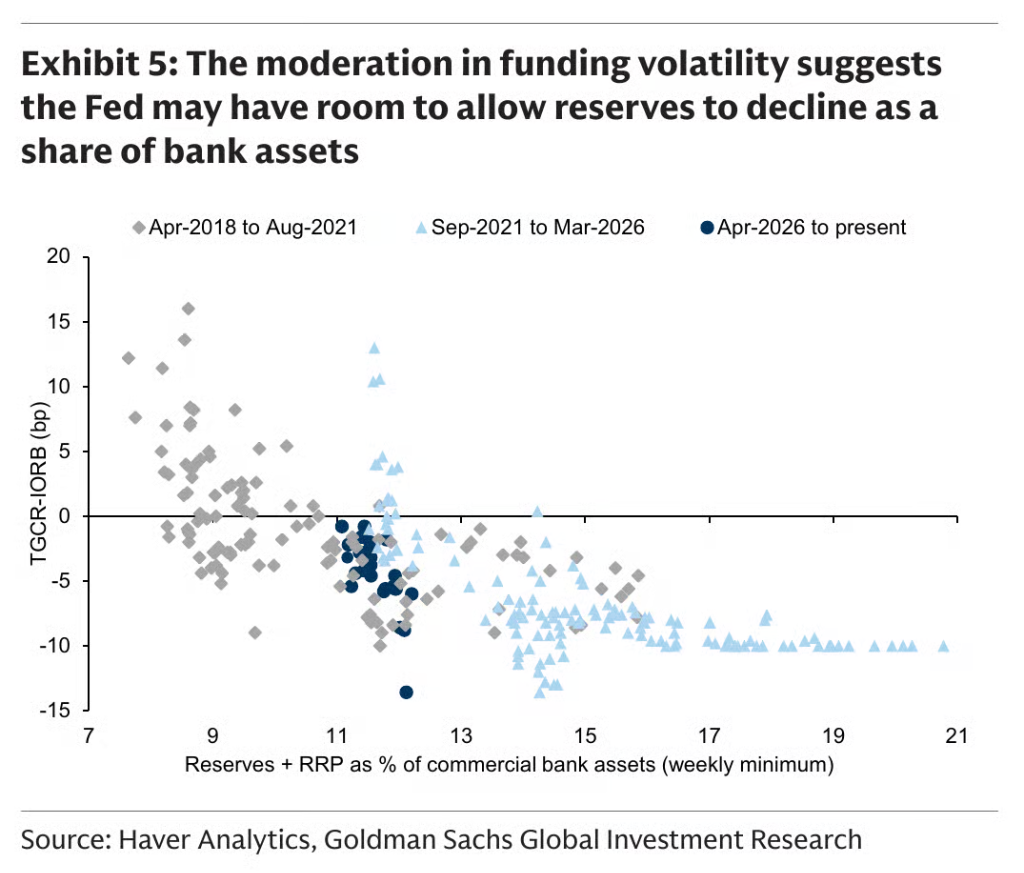
Currently, the ratio of reserves to bank assets is about 11%, lower than the approximately 14% starting point during the liquidity stress incident in 2025, and only slightly above the low point in 2019.
Federal Reserve: Raising rates with one hand, buying bonds with the other
The policy contradiction currently faced by the Federal Reserve lies in the expectation to restart T-bill purchases in November while the market has fully priced in the December rate hike.
Goldman Sachs predicts that the Federal Reserve will restart its Reserve Management Purchase Program (RMP) at a scale of about $10 billion per month this month, maintaining it until the first quarter of 2027, and then ramping up to about $25 billion per month starting the second quarter of 2027—this pace is estimated to be necessary to keep reserves stable as a percentage of bank assets.
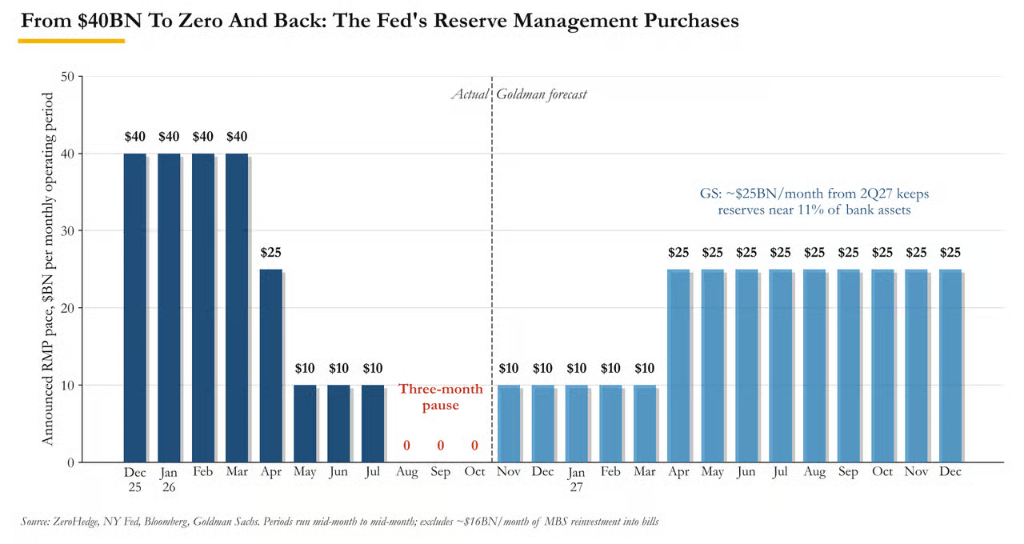
If reinvesting MBS maturing funds into T-bills is also included, Goldman predicts that the Fed's total monthly purchases of T-bills will double from about $20 billion in the winter to about $40 billion after April. Just from the RMP alone, about $255 billion in reserves will be added throughout 2027.
Goldman also states that it is unlikely the Fed will restart quantitative tightening (QT) due to temporarily loose financing conditions. The report notes that the liquidity easing from the decline in TGA during the debt ceiling period is a short-term phenomenon; once the ceiling is lifted and TGA is rebuilt, liquidity will rapidly reverse, with financing costs facing upward risks.
On a longer-term path, Goldman assumes that the Fed will continue to purchase T-bills until their share in the Treasury investment portfolio reaches a market-neutral level, expected to be achieved around 2028.
Treasury: $1.1 trillion in T-bills, where are the buyers?
Goldman predicts that U.S. net bond supply will slightly increase from $2.1 trillion to $2.2 trillion in 2027, but it will skew towards the short end: net T-bill supply will increase by about $200 billion to $1.1 trillion, with non-Fed buyers needing to absorb a portion growing from about $480 billion this year to about $600 billion.
The problem lies in the fact that the natural buyers of T-bills—money market funds—have seen their growth stagnate. In 2024 and 2025, the annual net inflows into money market funds were about $800 billion each; however, after July this year, fund inflows have leveled off, totaling only about $250 billion for the year.
Goldman explains that strong returns from risk assets and higher long-end yields are attracting funds to long-term bond funds; even though recent stock market volatility has increased, investors tend to extend duration rather than shift to cash. Additionally, money market funds have proactively shortened their weighted average maturity (WAM) out of concern for Fed rate hikes, resulting in weakened demand for the Treasury's 3-month and 6-month T-bills.
The report states that after Waller signaled a 50 basis point rate hike, the incentive for funds to maintain short duration further increased. The spread of T-bills relative to the overnight index swap (OIS) has thus widened, and Goldman believes this trend is not over.
In terms of Treasury bonds, Goldman predicts that auction sizes will expand starting in August 2027, focusing on the 2 to 10-year maturities, while the long end remains unchanged, with a slight downward risk bias.
Congress: The debt ceiling is the biggest variable
Goldman predicts that the debt ceiling of $41.1 trillion will be reached in the first quarter of 2027 (most likely in February). After that, the Treasury will not be able to add net debt and will only be able to maintain operations by depleting TGA balances and repaying T-bills. Every dollar TGA flows out will inject reserves into the banking system.
Referring to the last three debt ceiling events, TGA averaged a decrease of about $400 billion from the time of reaching the ceiling until an agreement was finally reached. Goldman estimates that this scale of TGA decline, combined with a corresponding reduction in T-bill supply, will exert about 4 basis points of downward pressure on SOFR (approximately 1 basis point for every $100 billion). Given that the Treasury's cash balance was close to $1 trillion in August of this year, if the starting balance were higher, the potential decline would be even larger.
Therefore, an unexpectedly loose financing environment may emerge in the spring and summer of 2027: increasing reserves, decreasing T-bill supply, further lowering repo rates below IORB.
However, after the Democrats take control of both houses of Congress in January, the market generally anticipates that the debt ceiling negotiations will be prolonged, with X-date predictions concentrated in the fourth quarter of 2027. BMO's Vail Hartman warned after the elections that "the financial markets may face a protracted debt ceiling standoff, leading to risks of sovereign debt rating downgrades, price distortions around the X-date, and increased volatility in cash and repo markets."
Once the ceiling is lifted, the Treasury will rebuild cash balances through large-scale T-bill issuances, completely reversing the process: a sharp decline in reserves, a surge in T-bill supply, and a spike in repo rates. Goldman points out that the wider use of the SRF and a clearer understanding of "ample reserves" will help buffer the shocks, but cannot eliminate them.
Historical precedents: Two TGA rebuilds, two crises
The Goldman report cites two historical cases, both demonstrating that TGA rebuilds trigger systemic shocks when reserves are near lower levels:
2019: The debt ceiling was suspended in early August, and the Treasury immediately began to rebuild cash balances. On September 17, the overnight repo rate soared to 10%. Despite being in a rate-cutting cycle, the Federal Reserve initiated a $60 billion monthly T-bill purchase program in mid-October, characterizing it as "not quantitative easing."
2025: The debt ceiling was raised in July, and the Treasury rebuilt cash balances. On October 31, banks withdrew a record $50 billion from the SRF. The Federal Reserve then halted QT, made three rate cuts in the year, and launched a $40 billion monthly T-bill purchase program in December.
Both events ended with the Federal Reserve cutting rates and expanding its balance sheet within months after the TGA rebuild, and in both cases, officials had publicly stated that reserves were ample prior to the events.
Two prediction lines pointing to the same event
Goldman economists predict that the Fed will begin to cut rates in the second half of 2027, bringing the federal funds rate back to the range of 3.25%-3.5% through three rate cuts by early 2028 due to inflation, oil prices, and AI-related factors.
However, comparing this rate cut timeline with Rosenberg's liquidity calendar, the two are highly aligned: TGA rebuilding, T-bill supply surge, larger-scale Treasury auctions starting in August, the impacts from forced liquidations, and the stagnation of money market fund growth—all concentrated within the same timeline.
The conclusion of the Goldman report is that by then, Fed policy should still be a stabilizing force in the financing market, but "the path may be bumpy, with various obstacles emerging along the way, and risks of financing tightening will gradually accumulate in the later part of the year."
It is noteworthy that if the Fed is still grappling with core CPI pressures and reluctant to respond to repo market disarray with rate cuts, the first step of a new easing cycle may not manifest in federal funds rates but quietly be reflected in the expanded scale of T-bill purchases—Goldman predicts $25 billion per month may only be the lower limit.
免责声明:本文章仅代表作者个人观点,不代表本平台的立场和观点。本文章仅供信息分享,不构成对任何人的任何投资建议。用户与作者之间的任何争议,与本平台无关。如网页中刊载的文章或图片涉及侵权,请提供相关的权利证明和身份证明发送邮件到[email protected],本平台相关工作人员将会进行核查。


