Author: washed
Translation: Deep Tide TechFlow
Deep Tide Introduction: After experiencing the ups and downs of sneaker reselling, money-making circles, and gambling Twitter, the author washed finds that the decline of niche arbitrage communities often follows the same script: when the core focus shifts from discovering early opportunities to climbing the social ladder and monetizing followers, the golden period is over.
In this straightforward review, the author compares the stock price cycles of Nike and Amazon to the rise and fall of the sneaker circle and course-selling craze, pointing out that the Alpha discussions in crypto Twitter are largely moving to private groups and on-chain practices, with the public timeline and the true fundamentals of the crypto industry having undergone structural decoupling.

I noticed a common turning point in the various vertical circles I belong to on Twitter (such as sneaker Twitter, crypto Twitter, money Twitter, etc.): when everyone's attention shifts from the original opportunities that brought us together to climbing the social ladder and monetizing followers, that circle has ended.
Unfortunately, crypto Twitter (CT) is currently at this juncture.
To provide a bit of personal background, my migration path through these circles has been: sneaker Twitter → money Twitter → gambling Twitter → crypto Twitter. In money Twitter and gambling Twitter, I was mostly a lurking observer; but in sneaker Twitter and crypto Twitter, I have been deeply involved for many years.
There are far more similarities between these vertical circles than people are willing to admit. Undoubtedly, the crypto industry is one of the most ambitious tracks, which is also why I decided to remain as a community member, but let's not expand on that for now.
The underlying operational patterns are indeed too similar, and watching crypto Twitter go through everything over the past year has given me a strong sense of déjà vu. I will do my best to organize the thoughts that have been in my mind after observing these communities move from rise to fall over the years.
Early Arbitrage Opportunities and Internal Competition Deterioration
At the beginning, a small group of anonymous players discovered some cool new thing and decided to share their views on Twitter. Pure curiosity drove early growth, with algorithm recommendations or word-of-mouth bringing a continuous stream of new participants who were lucky enough.
The core value proposition of this small circle was to allow early entrants to exchange ideas and extract market inefficiencies. At that time, no one cared about marketing, nor did they want to pull in the next batch of fools to take over.
On the contrary, the early stage often had some form of a "gatekeeping" mentality, deliberately protecting the treasure everyone had just discovered: the less competition, the more money this fortunate group of people who stumbled upon the gold mine could make.
As time passed, the game evolved, and the patterns of arbitrage were gradually unraveled. Tools and businesses specifically servicing participants began to emerge, the influx of newcomers accelerated, the market became more efficient, and naturally, the gold left for ordinary people diminished.
To some extent, this turned into a "race to the bottom" in competition. Greed drove people to do increasingly extreme things to accelerate this deterioration, such as breaking unwritten community rules (buying over 3% of token supply, prematurely leaking early Alpha clues, etc.).
Competitive advantage shifted from "being smarter than others" to "acting faster than others." Everyone had the same ideas in their heads and knew what to do; the only question was who could make a move first.
At the end stage of sneaker Twitter's development, we even started paying some gray market insiders to scan delivery orders in advance, allowing sneakers to be listed for pre-sale before they were officially released.
At that time, the official websites usually released on Saturdays, and the shoes would not arrive until the following weekend. By the time people actually got the shoes in hand, the price often dropped significantly from the peak on the day of release, leading everyone into a competition to see "who could sell before anyone else."
At that time, people mainly used two methods: one was to directly eat the highest buy orders on platforms like StockX, then buy on the market to gather the sizes just sold; the other was to place orders online, immediately resell them without caring that the shoes weren't even in hand yet and not knowing when they would be shipped.
The difficulty was that StockX required sellers to ship within 2 to 3 business days. What was the solution? Pay someone with access to UPS scanning guns to scan your printed prepaid shipping label in advance, allowing the system to mark the package as "shipped."
That way, your order wouldn't be canceled by the platform, and you could send the shoes out once they were actually received. When the buying demand for many shoe models became extremely scarce, you basically had to rely on some form of fanciful pre-sale to eke out a little profit.
(Looking back now, this gray operation of scanning in advance is quite legally borderline, but during that shipping race, no one cared at all. I remember someone later seemed to get into trouble and face legal accountability because of it, but I can't recall the specific details.)
The current situation in the crypto world with dirt coins and token issuance games is basically at this stage. It is a perpetual competition to be the "earliest seller to dump": sniping new coins, trading undeployed internal funds, distributing chips across multiple wallets, all are endless bottom-feeding internal competition.
Participant behavior will only become more aggressive, and unless a disruptive new thing emerges, it will never change for the better. The opportunities in the market have not completely disappeared, but this game is no longer nearly as attractive to ordinary people as it once was.
A Shift Towards Social and "Selling Dreams"
When participants are fighting each other and ruining the original ecosystem, another group turns towards a completely different game: the social game. Since the original opportunities that attracted everyone to join are no longer enticing, selling the "dream of getting rich" to others has instead become a more lucrative path.
Social influence, which was originally just a byproduct of making money in the market, has now become the opportunity itself. People no longer accumulate fans by "making money," but have completely flipped to relying on "gathering fans to make money."
With the momentum of commission kickbacks for referrals and various incentive mechanisms, more and more KOLs engaged in bringing potential victims into traps.
Those course-selling influencers in money Twitter serve as a pertinent reference. Money Twitter and sneaker Twitter are slightly different; there are indeed a group of people operating real businesses and creating social value there, while sneaker Twitter is almost purely a game of low buy, high sell.
From this perspective, money Twitter and crypto Twitter are far more similar than sneaker Twitter. There are indeed cool things happening in the crypto world, like the collaboration between the parent company of the NYSE, ICE, and TradeXYZ, introducing perpetual contracts based on Hyperliquid into the U.S. market.
But as the easily accessible opportunities dwindle, those who genuinely do substantial work have no choice but to share the spotlight with more and more speculative fraudsters, and these speculators are draining the fun out of everything and tainting the entire industry's reputation.
At that time, money Twitter was filled with this type of person: keen to climb the social ladder, packaging personal brands, in order to sell poor-quality information products, scam courses, or bombarding ads to their audience.
When competition in online business intensifies and easy money dries up, some people suddenly realize: selling the "fantasy of getting rich" to others is much easier compared to grinding hard to successfully run a company, and it often yields more profit.
I don't think it's fair to label everyone selling courses or setting paywalls as scammers; there is indeed valuable knowledge out there. My main discussion point isn’t about the knowledge payment itself, but rather how the social ecology of the entire community distorts when "selling opportunities" becomes more profitable than "personally capturing opportunities."
I previously mentioned how sneaker Twitter degraded into a race of selling out first, while crypto Twitter is now facing both of these dilemmas simultaneously: on one hand, the internal competition with the race to the bottom, and on the other, the money Twitter-style "course-selling dilemma." Nowadays, the influencers selling the Memecoin get-rich dream are the new generation of course-selling masters.
People's claims that "Memecoins are dead" are somewhat exaggerated. There have been enough comments on this matter, and I don't want to elaborate, but objectively speaking, the dream of ordinary people getting rich through trading Memecoins has basically evaporated.
This is no longer a wilderness battlefield where newcomers can make a name for themselves; it has become a game that is extremely "K-shaped differentiated," dominated by social resources, where those at the top of the pyramid keep compounding their advantages.
Sneaker reselling has never completely disappeared, and today there are still people earning money from it, but that doesn’t mean it is still as enticing a business as it was during its peak. Memecoins are heading down the same path: a market still exists, but it doesn’t mean it is still a worthwhile game to throw yourself into.
Of course, one day in the future, we will still see amazing projects worth hundreds of millions or even billions of dollars, but the paths for ordinary people to seize them will be as difficult as climbing mountains, just like mining for gold in a minefield. The rewards may be abundant, but the risk-reward ratio and chances of success are at their worst.
The situation has slid to such a point that many people refuse to turn the page and cannot admit that the golden age of asymmetric wealth has passed; instead, they continue to shove this shattered illusion onto the audience, merely to create new liquidity for their exit.
The Kimchi incident played this scene out vividly. Kimchi rose to fame with a story of making $40 million on TRUMP, which was entirely fabricated by his friend as a joke, resulting in it spiraling out of control.
Ironically, he later collaborated with Pump, who was almost brazenly marketing "you can become the next Kimchi by trading dirt coins." In short, it was all about "pretend until you make it." They used the fabricated story of selling the dream of getting rich as a facade from start to finish.
And the current incentives are worsening and condoning such behavior. It is a completely rational choice for the new generation of entrants to prioritize "becoming an influencer" over "being a trader," as long as you could even call what they do as trading.
After all, trading platforms need volume, influencers need to monetize their follower traffic, and neither party truly cares whether their followers are making money.
What is particularly interesting is how much the community's tolerance for this has increased. In the early days, wrongdoers would usually be collectively ostracized as everyone wanted to protect the hard-to-find valuable opportunities; now, the same types of people are given substantial business deals and larger platforms for traffic.
I think there is no point in fighting against this trend. You can't expect others to stop and reflect on the moral implications simply because there is evident profit in a certain direction. It’s better to let them play their game while we just pull the plug and leave the places where they gather.
The Collective Exit of Smart People and Privacy
And what is happening in reality is just that. Many of the people who truly made crypto Twitter valuable are quietly withdrawing from the public timelines. Some have switched to trading American stocks, some have made enough money to retire, and others are still engaged in crypto trading but have completely retreated into private spaces, showing no interest in interacting with the remaining public circles.
I believe the direction of this group is correct; I often sway between "whether to completely vanish" myself. Honestly, I remained in this community because I believe in the long-term inevitability of Bitcoin and blockchain; however, the evolution of crypto Twitter has taken a completely opposite direction, making it increasingly hard to find reasons to continue investing effort in the public domain.
The original value of crypto Twitter was to allow those truly at the forefront of the trend to exchange ideas and jointly discover opportunities. But now, the vast majority of valuable conversations and intelligence have long moved to Telegram, private small groups, and other closed spaces.
As long as you join the right circles, even if you completely block the public Twitter timeline, you can still thrive. The genuine Alpha that can be picked up on the timeline has become exceedingly rare.
Recently, the only thing that has motivated me to do on Twitter is to post some trivial market chatter. However, there are still some individuals much stronger than me in the public domain, who are genuinely providing value without harvesting or marketing scams. I feel these people are severely undervalued.
I temporarily compiled a list of 100 quality accounts. It may be updated in the future, or I might not bother, hard to say for now, but there are definitely many other excellent accounts worth mentioning.
A somewhat positive anecdote is that just as I was writing this article, I’ve started to see some of the speculative "tourists" surrendering and exiting, which is quite uplifting.
I won't name names, but someone who once live-streamed buying new trading pairs, claiming they wanted to bring their followers into the crypto circle (by the way, no one invited him to do this), announced they would keep a distance from crypto Twitter, reasoning that "people always ruin the next great opportunity that is presented to them," which makes it seem like he considers himself that great opportunity.
Decoupling: The Divergence Between the Crypto Industry and Crypto Twitter
In the code圈's favorite jargon, I also want to shout "decoupling," but this time the decoupling is between the crypto industry itself and crypto Twitter. Of course, I’m not here to time the top or escape the top precisely; I believe that crypto Twitter actually peaked long before the 10/10 crash, and the decoupling has long been silently occurring.
The most obvious contrast is right before our eyes: over the past year, ordinary crypto Twitter users have been complaining all day about various token issuance platforms (Launchpads); meanwhile, the truly sharp ones have been doing eight-figure perpetual contract trading, or unearthing quality on-chain targets similar to how early catches like VVV and CARDS were managed.
Strangely, the 10/10 crash seems to have permanently altered the psychological makeup of crypto Twitter participants. It left behind an inescapable shadow: all results might vanish in the blink of an eye.
This latent fear, mostly buried in the subconscious, further fueled the shortsighted, predatory mentality of "scoop and withdraw." The current U.S. president and his family also share a similar mindset towards the crypto industry, which equally proves fruitless.
People have now grown accustomed to such harvesting behavior, no longer collectively ousting wrongdoers as they did a few years ago.
Writing this article is not to mindlessly call for bullishness in the crypto market. I believe the popularization of crypto technology is irreversible; it's just that the way it evolves is completely different from what crypto Twitter imagines.
In my view, crypto Twitter is decoupling from the true trajectory of the crypto industry at a larger cycle scale. Blockchain is evolving into the underlying pipeline to repair the outdated financial system, sounding quite boring. Though there is speculative fun in targeting projects that address pain points, overall, it is far less thrilling than making millions of dollars from air projects.
When Bitcoin's rise reignites market risk appetite, that euphoric moment will certainly return, leading people to once again lose their minds and dump vast amounts of real money into high-risk casinos. But these windows are both fragile and brief, and the escape routes for everyone to cash out will only get narrower.
The sentiments of crypto Twitter are extremely volatile and closely follow Bitcoin price fluctuations, but bullish market conditions more often than not simply cover the underlying decay rather than heal it. Even if Bitcoin enters a strong bull market that allows everyone to temporarily forget all their worries, the fundamental mindset and tactics of the participants will not change.
While the price ceiling may be raised, the number of rug pulls, scams, and malicious harvesting tends to increase disproportionately, potentially leading to overall more harm than good.
The mini bull market that lasted from the end of August to September last year is a case in point: indeed, some coins soared and doubled, but the scale of the draining and harvesting occurring during the same period was equally shocking.
Concluding Thoughts
I am not just shouting "top" for crypto Twitter today; the truth is it peaked 12 to 18 months ago. This article is more like a collection of my observations, to validate the judgment that the peak has passed, and to discuss where this circle might flow next: dim for some, but perhaps not for others.
In the long run, I think this is not that significant. The idea that a few token issuance platforms and the drama of on-chain games could shake the long-term logic of Bitcoin is inherently ridiculous.
Crypto Twitter has a peculiar addictiveness; I don’t think this place will quickly turn into a ghost town. On the contrary, the crowd will only become more consolidated and tribalized, moving into private spaces, becoming increasingly selective about their communication partners. Blocking keywords and accounts, meticulously curating follower lists, has long become the norm and will only intensify in the future.
Returning to the earlier mention of money Twitter and sneaker Twitter, two images may intuitively illustrate what I want to express. To some extent, the stock price chart of Nike (Nike) lines up perfectly with the complete lifecycle of sneaker Twitter:
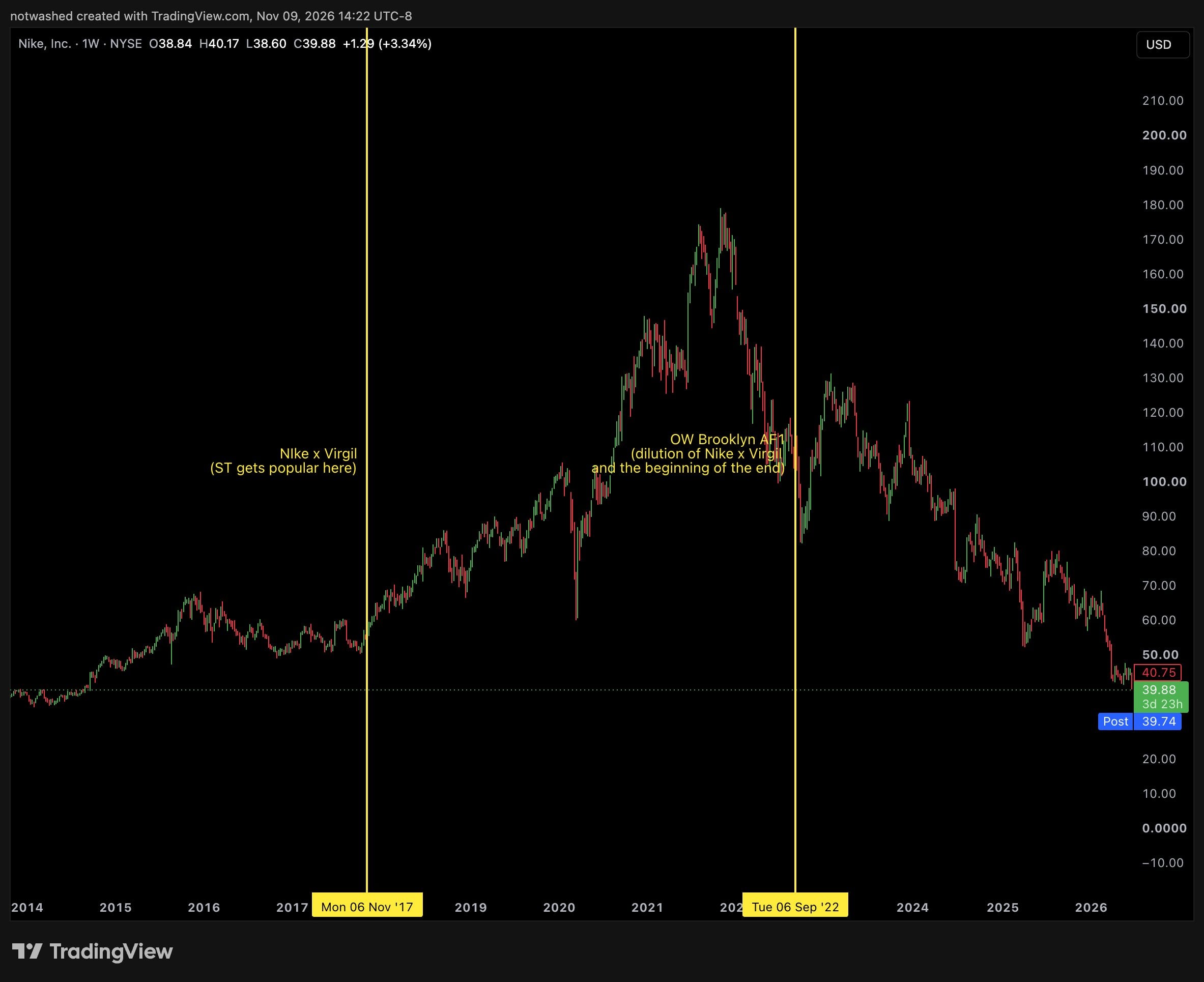
Image: Nike weekly stock price with sneaker Twitter (ST) rise and fall annotated: from the rise of co-branding in 2017 to dilution and peak in 2022 (Source: TradingView)
By 2023, most people in the sneaker circle have dispersed, going to resell trading cards (TCG), resell concert tickets, or start their own companies.
The following image is surely less relevant than the Nike example; it is purely my personal rough association regarding the relevance of crypto Twitter and the crypto industry, so there’s no need to be overly strict:
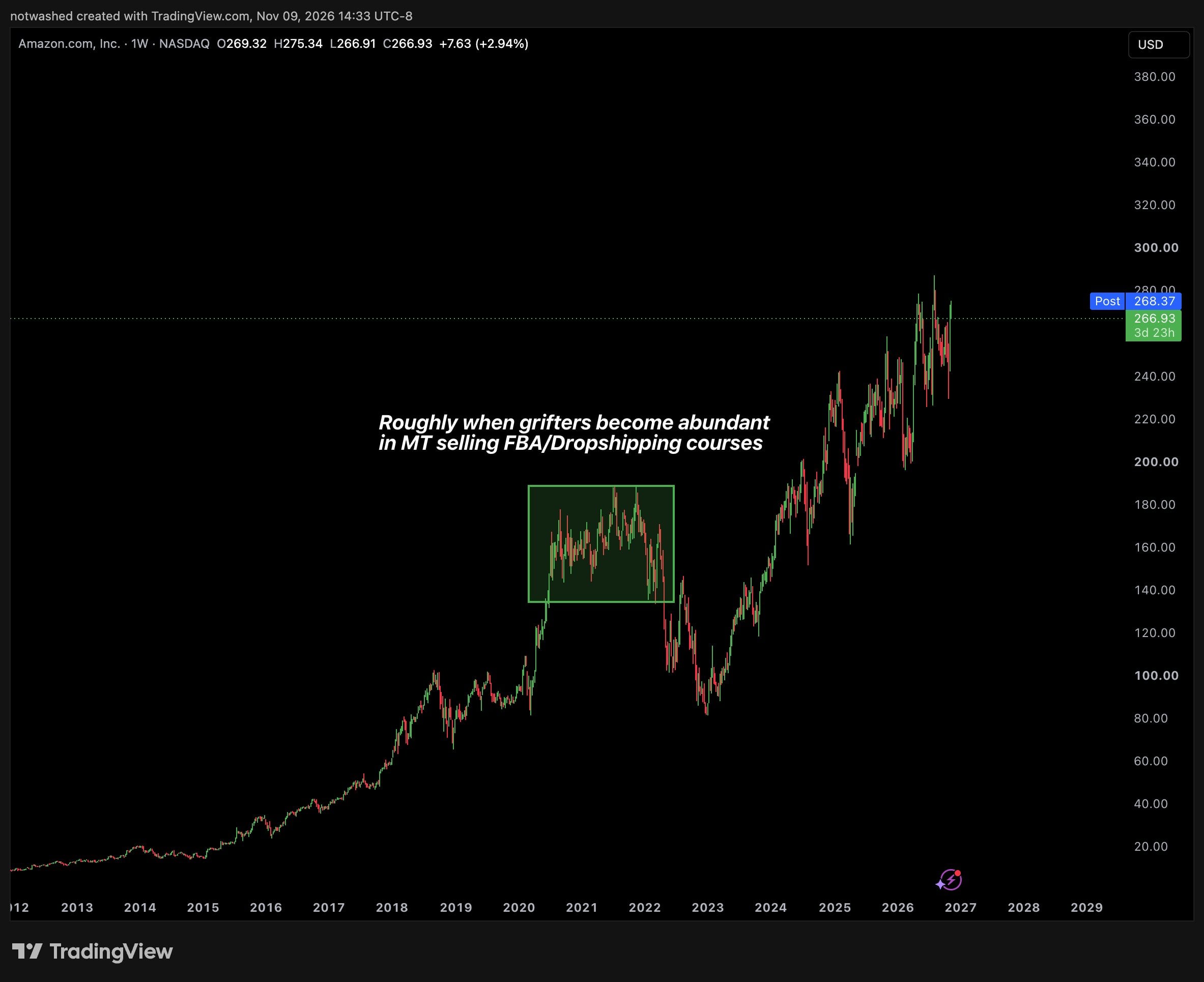
Image: Amazon (AMZN) weekly trend compared to the period of rampant course-selling chaos in money Twitter (MT): the speculative course-selling peak in the boxed area from 2021 to 2022, while the industry itself continued to rise (Source: TradingView)
The e-commerce industry overall has almost consistently trended upwards, but the niche Twitter community, popular discourse, and arbitrage opportunities that have emerged around e-commerce peaked as early as 2021 to 2022.
Of course, Amazon is now far more than just an e-commerce company; it has become a colossal business giant. The real point here is: the sustained success of a large industry does not necessarily mean that the early identifiers and harvesters of this emerging trend in that social circle can continue to enjoy equal dividends.
I also want to add that the scope of money Twitter is quite broad, encompassing almost all online businesses. While I was observing, the mainstream themes concentrated on building personal brands (some relying on dropshipping), information products for paid knowledge, agency operations, and affiliate marketing.
The story of sneaker Twitter explains how participants, through increasingly aggressive malicious internal competition, ultimately destroyed the very arbitrage opportunities that initially attracted them all.
The story of money Twitter, on the other hand, illustrates how, when original opportunities become less appealing, participants shift from "earning money by running real businesses or trading" to "earning money by monetizing their own social influence."
In this sense, today's crypto Twitter resembles money Twitter more than just sneaker Twitter. The crypto industry itself has not completely peaked as the sneaker secondary culture has, and crypto Twitter will not turn into a completely deserted ghost town.
But crypto Twitter can completely become increasingly irrelevant to the future of the crypto industry without affecting the continued growth and strengthening of the crypto world.
The Alpha that once remained on crypto Twitter is now increasingly submerging into purely on-chain practice or hiding in private circles on Discord and Telegram.
Of course, not all public social interactions are bad; there are still quality accounts that, while growing their influence, strive to make this place better. Blocking out noise and focusing on tracking those individuals is the most reasonable choice.
And that once niche corner of crypto Twitter that allowed you to discover new opportunities, collide with new ideas, and meet smart people has basically come to an end, and that’s not a big deal.
免责声明:本文章仅代表作者个人观点,不代表本平台的立场和观点。本文章仅供信息分享,不构成对任何人的任何投资建议。用户与作者之间的任何争议,与本平台无关。如网页中刊载的文章或图片涉及侵权,请提供相关的权利证明和身份证明发送邮件到[email protected],本平台相关工作人员将会进行核查。


