
Author: Biteye
On November 8, Vitalik @VitalikButerin published a long post on X, revisiting the source of ETH's value.
In the past, Ethereum has maintained a narrative of Ultrasound Money: an active ecosystem boosts Gas consumption, and the continuous destruction of transaction fees not only offsets inflation but can even lead ETH into deflation.
However, Vitalik believes that the destruction of transaction fees has never been a reliable bottom for valuation. This is because a significant portion of transaction fees has historically come from speculative activities within the cryptocurrency market, and when the market declines, the destruction revenue also shrinks.
He still supports retaining EIP-1559, but even if the long-term destruction volume falls short of 10% of new issuance, there is no need to lament. If higher transaction fees are intentionally pursued to maintain a high level of destruction, it may harm Ethereum's decentralization and long-term development.
This also raises a question: If the logic of "the more prosperous the applications, the more destruction, the more valuable the tokens" is no longer reliable, what can the continuously issued public chain tokens rely on to support their valuation every year?
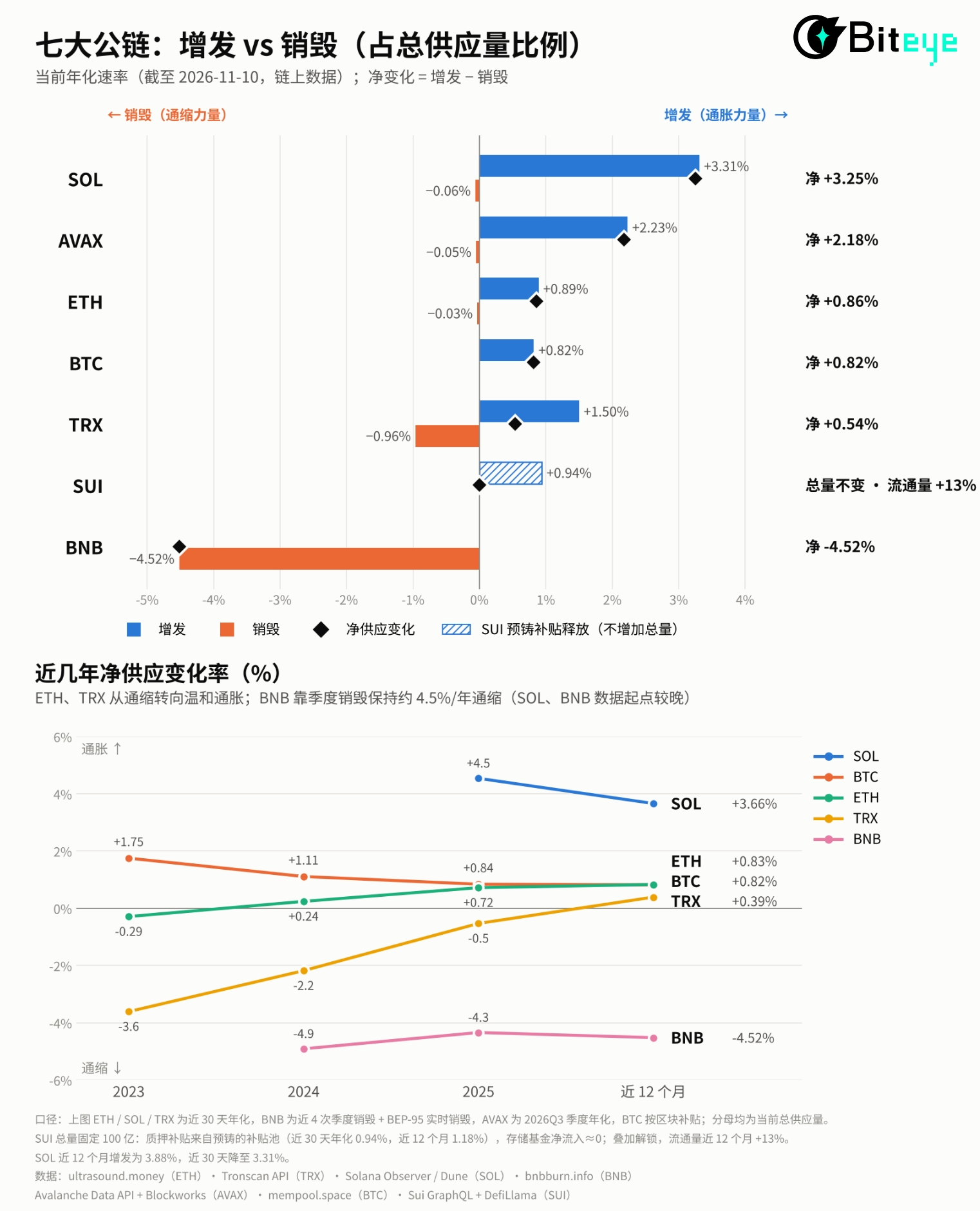
How much do mainstream public chains issue and destroy annually?
Most PoS public chains need to issue tokens to reward validators while using transaction fees to reduce supply through destruction. Different issuance and destruction rules also determine the actual supply changes across various public chains.
1. BTC: Halved every four years, inflation rate continues to decline.
BTC's supply rules are the simplest, with a total cap of about 21 million coins. Currently, each block rewards 3.125 BTC, and with an average block being generated every ten minutes, approximately 164,300 BTC are added annually, resulting in an annualized supply inflation rate of about 0.82%.
2. ETH: Supply growth has been very low since the Merge but has accelerated recently.
After The Merge in 2022, the new issuance of ETH has significantly decreased, with an accumulated supply growth of about 1.37% since the Merge.
EIP-1559 destroys all base transaction fees; however, with the popularity of L2 and the decrease in Gas fees, the destruction in the recent 30 days has only offset about 3.2% of the new issuance, challenging the former deflation narrative.
3. SOL: Continuous issuance, but the inflation rate will gradually decline.
Solana's initial annual inflation rate is 8%, decreasing by 15% each year, with a long-term target of 1.5%.
During the meme craze in 2024, the daily destruction volume once exceeded 10,000 SOL; in January 2025, the destruction volume offset about 23% of the new issuance.
However, after the implementation of SIMD-0096, all priority fees go to validators, only destroying 50% of the base transaction fees. After that, the daily destruction volume dropped to about 700 SOL.
4. BNB: Does not rely on continuous issuance but reduces total volume through destruction.
BNB does not have continuous issuance; instead, its supply is reduced through quarterly Auto-Burn and BEP-95 real-time Gas destruction, with a target total of 100 million coins.
In the first four quarterly destructions before 2026, about 6.2 million BNB were destroyed. Auto-Burn determines the destruction amount based on coin price and block generation, while BEP-95 destroys part of the network transaction fees.
5. TRX: The more active stablecoin transfers are, the more may be destroyed.
TRON issues TRX through block rewards while destroying the Energy and Bandwidth resource fees paid by users.
However, users can also obtain resources through staking or leasing. Thus, even if the transfer volume of USDT increases, the destruction volume of TRX may not rise accordingly.
6. AVAX: Has both a supply cap and fee destruction.
AVAX has a total supply cap of 720 million coins, rewarding validators through new issuance, while all fees from the main networks X, C, and P chains are destroyed.
As of early November 2026, approximately 474 million coins had been minted, with staking rewards of around 114 million coins, and about 5.18 million coins destroyed, which is still insufficient to offset the new issuance.
7. SUI: There is no unlimited issuance; what really needs to be focused on is unlocking.
SUI has a fixed total of 10 billion coins, and the circulating supply mainly increases with the unlocking of tokens.
Its Storage Fund locks part of the storage fees while compensating validators through staking returns. Deleting data allows for the retrieval of most fees, with the unreturned portion remaining in the fund, reducing the freely circulating supply, but not resulting in permanent destruction.
If valuing according to destruction volume, how much is a public chain worth?
In discussions, Vitalik revisited a once-popular "destruction valuation" model:
Token Valuation = Annual Destruction Amount ÷ Discount Rate
Assuming a public chain consistently destroys tokens worth 1 billion dollars annually, using a 4% discount rate, the theoretical valuation would be about 25 billion dollars.
However, Vitalik immediately pointed out that this so-called "valuation bottom" is not reliable.
For example, in 2022, Ethereum destroyed about 1.48 million ETH, worth approximately 3.6 billion dollars; while by November 8, 2026, the cumulative destruction was only about 19,200 ETH, worth about 43 million dollars.
If this year's destruction amount is simply annualized to around 50 million dollars, calculated at the same discount rate, the theoretical valuation would only be about 1.25 billion dollars, while the ETH market cap at that time was approximately 270 billion dollars.
The difference exceeds 200 times, exposing the limitations of the model itself.
Other public chains also face similar valuation issues.
1. Transaction fee revenue is not stable. The past high-level destruction primarily came from speculative activities such as NFTs, and as the market cools, the revenue will decline accordingly, making it difficult to view it as a long-term stable cash flow.
2. Destruction is just one way to distribute the value of a public chain. SOL's priority fees go to validators, and TRX's resource rents may become the earnings of stakers; this economic value will not all be reflected in token destruction.
Therefore, while destruction amounts can measure part of the value captured, it cannot serve as a unified valuation standard for all public chains.
From transaction fee destruction to value storage, is ETH's valuation logic changing?
If transaction fee destruction cannot become a reliable valuation basis, where else can ETH's long-term value come from?
Vitalik places greater emphasis on Ethereum's decentralization, resistance to censorship, open source, privacy, and security. He particularly mentions that in the rapidly evolving era of AI, systems that can run steadily over the long term without being controlled by a single entity may become more valuable.
However, there are also many doubts:
1. ETH has long had a market cap of several hundred billion dollars, which clearly cannot be fully explained by transaction fee revenue. Its demand as an on-chain collateral asset, transaction medium, and the native asset of financial infrastructure may itself form a currency premium.
2. ETH does not have a fixed supply cap, and issuance rules can be adjusted through protocol upgrades. If it is to compete with BTC in the value storage market, it must answer one question: On what basis does ETH gain the same long-term trust regarding supply rules and monetary policy?
Transaction fee destruction can be calculated, but the currency premium from value storage is much harder to find a unified valuation standard for.
Narratives can change, but the market ultimately still needs a reason to explain why it is willing to hold ETH long-term.
In conclusion
In recent years, Crypto has been pursuing higher transaction volumes, lower fees, and a more prosperous on-chain ecosystem.
However, as transaction fees continue to decrease and destruction volumes cannot support valuations, public chains are beginning to rethink the value source of their native tokens.
Vitalik has shifted his focus back to value storage, which may also indicate a transformation in public chain valuation logic.
However, when more and more public chains start to emphasize scarcity, security, and long-term consensus, is the market really willing to pay them currency premiums similar to BTC?
But if the application scale of public chains grows tenfold in the future while transaction fee revenue continues to decline, what can the native token rely on to maintain its value?
免责声明:本文章仅代表作者个人观点,不代表本平台的立场和观点。本文章仅供信息分享,不构成对任何人的任何投资建议。用户与作者之间的任何争议,与本平台无关。如网页中刊载的文章或图片涉及侵权,请提供相关的权利证明和身份证明发送邮件到[email protected],本平台相关工作人员将会进行核查。


