Author: Noveleader, Castle Labs
Translation: Deep Tide TechFlow
Deep Tide Introduction: When the market concentrates attention on high annualized subsidies, it is often the solid "entry and revenue-sharing mechanism" that drives the re-evaluation of protocol valuation. This week’s Castle Labs weekly report, centered on Ethena Pay and the Hyperliquid ecosystem, dissects how on-chain financial products build a self-driven growth flywheel.
Whether it is leveraging nearly $80 million USDe demand with $7.64 million deposits in stablecoin banks, or the L2 Elysium empowered by 50% of sequencer income buybacks, or the TradeXYZ completing pricing rumors of Nvidia over the US stock holiday weekend, the all-weather on-chain market is demonstrating exceptional efficiency.

This week, the crypto industry witnessed the launch of several heavyweight products, leading the way is Paragon Power Perps providing options-like yield curves through perpetual contracts, as well as Elysium positioned as a value capture L2 network for the Hyperliquid ecosystem.
In addition to a deep dive into these two new products, this week’s report also highlights the following core dynamics:
· Ethena Pay and Earn+ growth flywheel: An interview with product market lead (GTM) Lito, analyzing how Earn+ directly drives USDe issuance scale;
· Hyperliquid HIP-4 prediction market entering an accelerated phase: How the leading deploying party Outcome dominates traffic explosion;
· RWA derivatives trends: Derive entering the RWA options track, Rysk Finance launching Nvidia (NVDA) volatility yield strategies;
· Fixed-rate lending protocol IRIS launched: How to aggregate existing lending markets to meet borrowers' fixed-rate needs, and the New York Stock Exchange choosing Avalanche as its settlement layer.
Ethena Pay and Earn+ Flywheel: An Interview with Market Lead Lito
The new internet banking product Ethena Pay under Ethena officially launched in September this year, and in late October the wealth management module Earn+ was introduced, allowing depositors to earn up to 12% annualized yield (APY) through leveraged USDe exposure.
As of now, Earn+ has accumulated $7.64 million in deposits, directly generating about $80 million in USDe market demand. This significant positive transmission relationship proves that Ethena Pay is an efficient growth lever.
Once the total supply of USDe exceeds the $7.5 billion threshold, the protocol's $ENA buyback mechanism will officially start, so any scenario that expands the real demand for USDe is beneficial for $ENA.
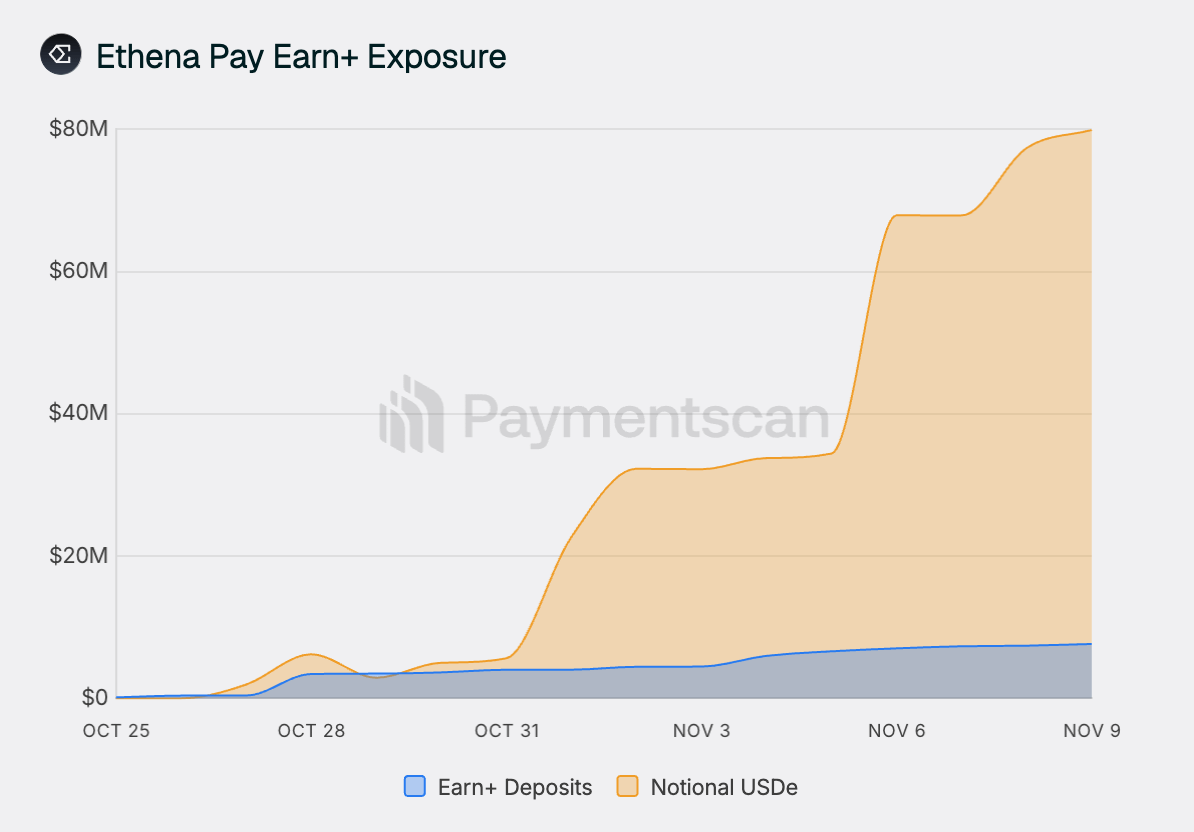
Image: Ethena Pay deposit scale and the leveraged USDe demand exposure trend driven by Earn+
To gain a deeper understanding of this growth flywheel and Ethena Pay’s differentiated barriers, we interviewed Ethena Pay’s market lead (GTM) Lito.
The stablecoin new banking and crypto payment card track is currently very crowded. When discussing how to break through, Lito stated, “In fact, it is a good thing for other teams to enter the market first and complete user education. We can fully learn from the successful experiences and pitfalls of predecessors and then execute more effectively.”
In addition, another major moat of Ethena Pay lies in its clear business model and long-accumulated brand trust.
Lito explained, “We can earn interest on the assets that users deposit in Ethena Pay, this profit logic is similar to how traditional banks earn net interest margin (NIM).”
He further pointed out, “We have withstood every major turbulence in the crypto market; whether it’s the '10/10' flash crash or the Bybit security incident, Ethena has never let users lose even a dollar. This reputation will give the public strong confidence to use Ethena Pay.”
Regarding the flywheel effect generated by the collaboration between Earn+ and DeFi products, Lito emphasized, “Once you have mastered the frontend distribution entry and truly own users, you can smoothly push new features or upgrade experiences to them without being constrained by any intermediate channels.”
This also explains why Ethena Pay can directly benefit the entire ecosystem: every new user's account assets default to holding USDe, which means “every user growth in Ethena Pay essentially corresponds to an increase in the adoption rate of USDe.”
Meanwhile, $ENA will soon play a more direct role in Ethena Pay. Lito revealed, “In a few weeks, we will announce an account level upgrade plan, at which time the upgrade rights will require users to hold and lock ENA.”
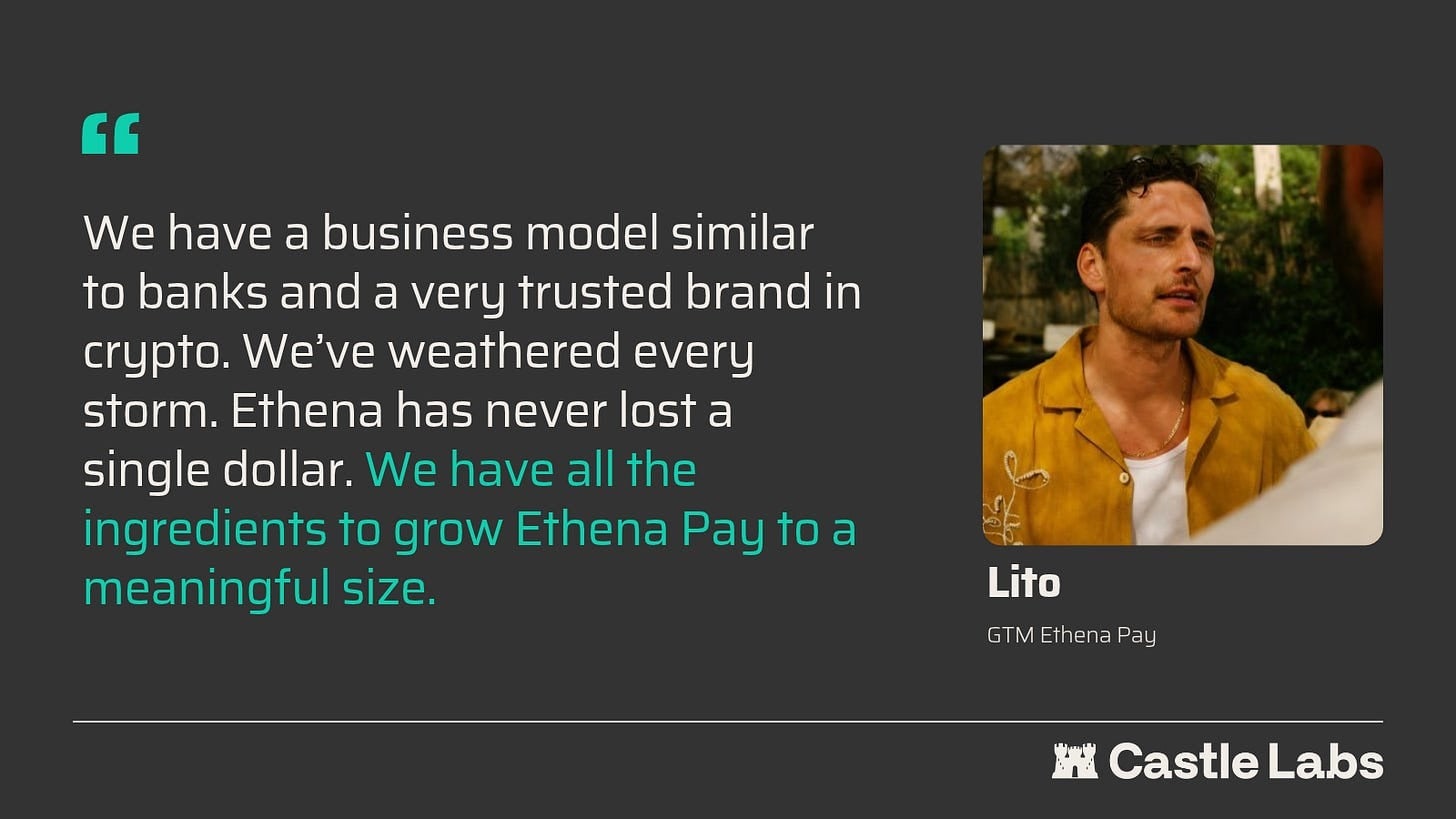
Image: Core insights card from the interview with Ethena Pay market lead (GTM) Lito
Elysium: L2 Creating Value Reflux for the Ecosystem and Early LP Opportunities
Elysium, which officially launched its mainnet yesterday, has one of its core missions to help the Hyperliquid ecosystem reclaim the general on-chain activities that previously overflowed to Robinhood, Solana, and Base, covering DeFi applications, meme coins, on-chain spots, and tokenized US stock trading.
Technically, Elysium is built on top of the Arbitrum Orbit technology stack, using $HYPE as the underlying gas token, and will settle the final state on the Hyperliquid second-layer network HyperEVM.
More importantly is its native value reflux mechanism: the network automatically allocates sequencer income through programmable contracts, with 50% used for buybacks, 25% going to the treasury, and another 25% used to incentivize builders.
Since yesterday's mainnet launch, the cross-chain capital entering Elysium has exceeded $50 million, but the liquidity currently remaining in the decentralized exchange (DEX) liquidity pools is still very limited.
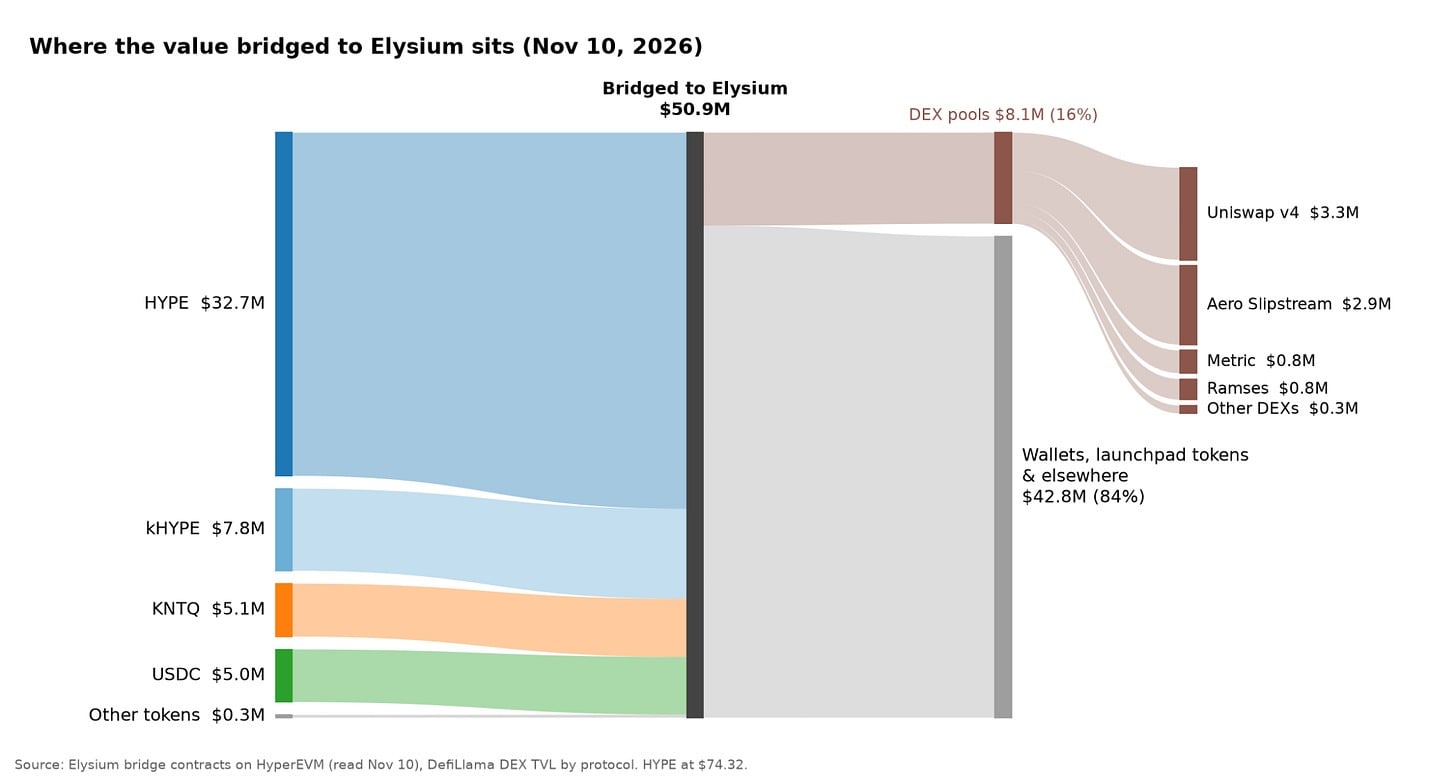
Image: Initial cross-chain capital flow dissection on Elysium; most of the net cross-chain $50.9 million remains in wallet addresses
Due to the early scarcity of liquidity within the pool, there exists a preferable yield window for market makers (LPs) entering the related liquidity pools, with the annualized return rates displayed on the current panel being very attractive. However, as on-chain capital gradually becomes abundant, it is expected that these high yields will quickly decline in the short term.
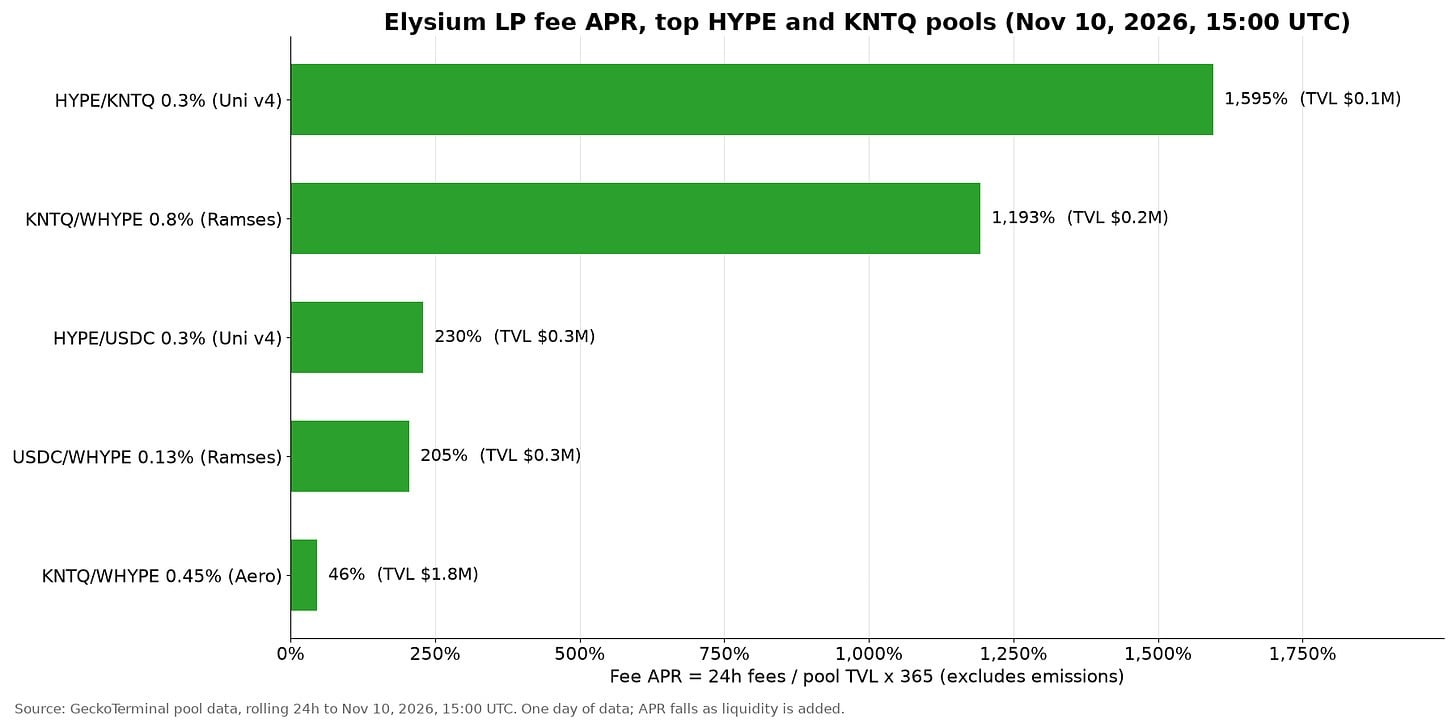
Image: Ranking of annualized fee return rates for mainstream DEX liquidity pools during the early phase of Elysium mainnet launch
Looking at the medium to long-term potential, Elysium's most imaginative differential advantage lies in its ability to directly read core order book data from Hyperliquid, with related core upgrade plans expected to be implemented in four weeks.
At that time, with the low-latency regional advantage and high-performance throughput performance close to the HyperCore core engine, many innovative DeFi protocols are expected to concentrate and emerge on Elysium.
Power Perpetual Contracts: How Paragon Eliminates Strike Price and Expiration Date
As the contract deployer of Hyperliquid HIP-3 protocol, Paragon has recently officially launched power perpetual contracts (Power Perps), incorporating options-like convexity returns into perpetual contracts that have neither strike price nor expiration date for the first time.
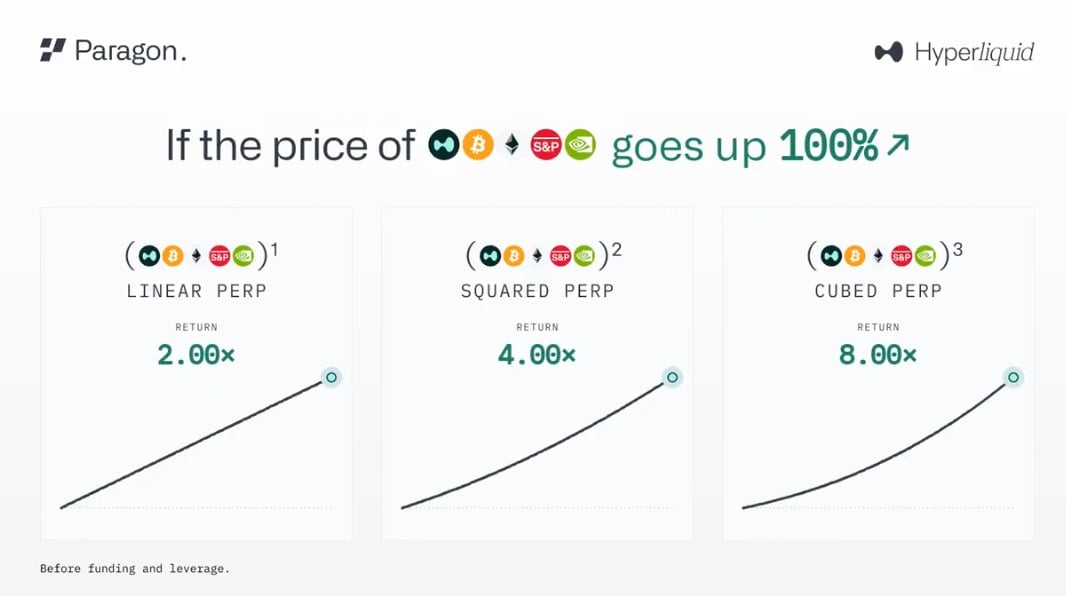
Image: When the underlying price for Paragon's power perpetual contracts doubles, linear, squared, and cubic contracts exhibit 2x, 4x, and 8x yield curves respectively
The operational mechanism of this innovative product is not complicated: conventional perpetual contracts track the immediate price of the underlying asset, while power perpetual contracts track the power of the underlying asset's price, such as squared or cubic contracts.
For example, when the underlying asset's price doubles, the corresponding squared perpetual contract will record a 4x return.
More importantly is its asymmetric curve feature of "less loss and more gain" (not accounting for funding rates and leverage): when the underlying price rises by 10%, the squared contract can profit by 21%; when the underlying drops by 10%, the contract only loses 19%; even if the underlying price crashes by 50%, the squared contract only drops by 75%.
This naturally curved loss and gain structure is quite similar to call options, but it completely eliminates the cumbersome strike price selection and expiration date settlement mechanisms, allowing all liquidity to be highly aggregated on a single order book.
HIP-4 Prediction Market Reaches Escape Velocity: Taking Outcome as an Example
The transaction volume of the HIP-4 prediction market on Hyperliquid has recently surged significantly, with the main driving force coming from leading deploying parties such as Outcome, which quickly rose since the permissionless deployment opened at the end of August this year. The traffic concentration in this track is extremely high, and its ecosystem structure is very similar to TradeXYZ in HIP-3.
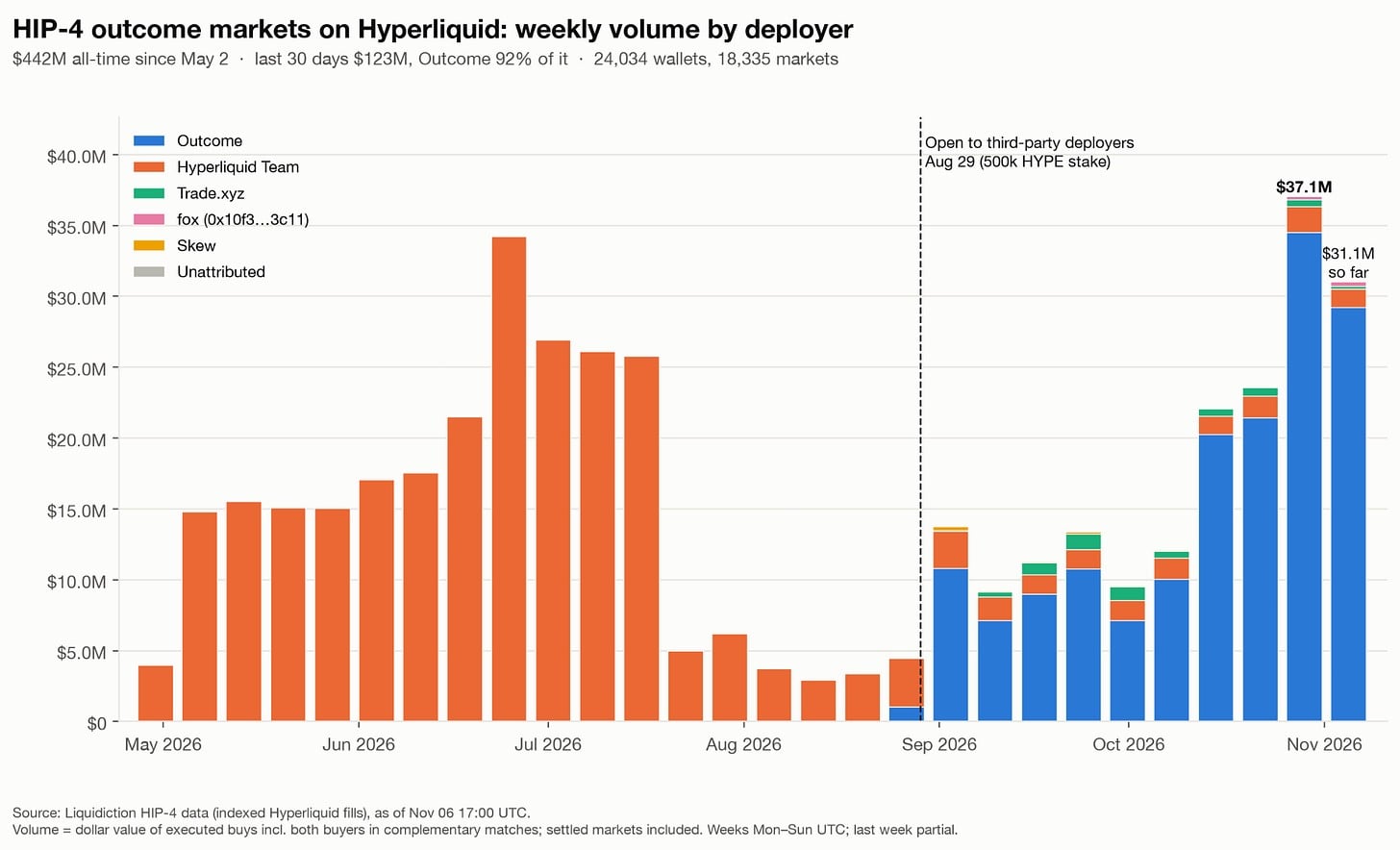
Image: Weekly transaction volume trend of Hyperliquid HIP-4 prediction market classified by deploying parties (the dashed line indicates the opening of third-party deployments on August 29)
From the structural distribution perspective, the overwhelming majority of current HIP-4 transaction volume is concentrated in sports event-related markets, followed by cryptocurrency price prediction markets. This indicates that trading activity has a distinct periodicity, and traders can appropriately amplify positions during major events or milestones.
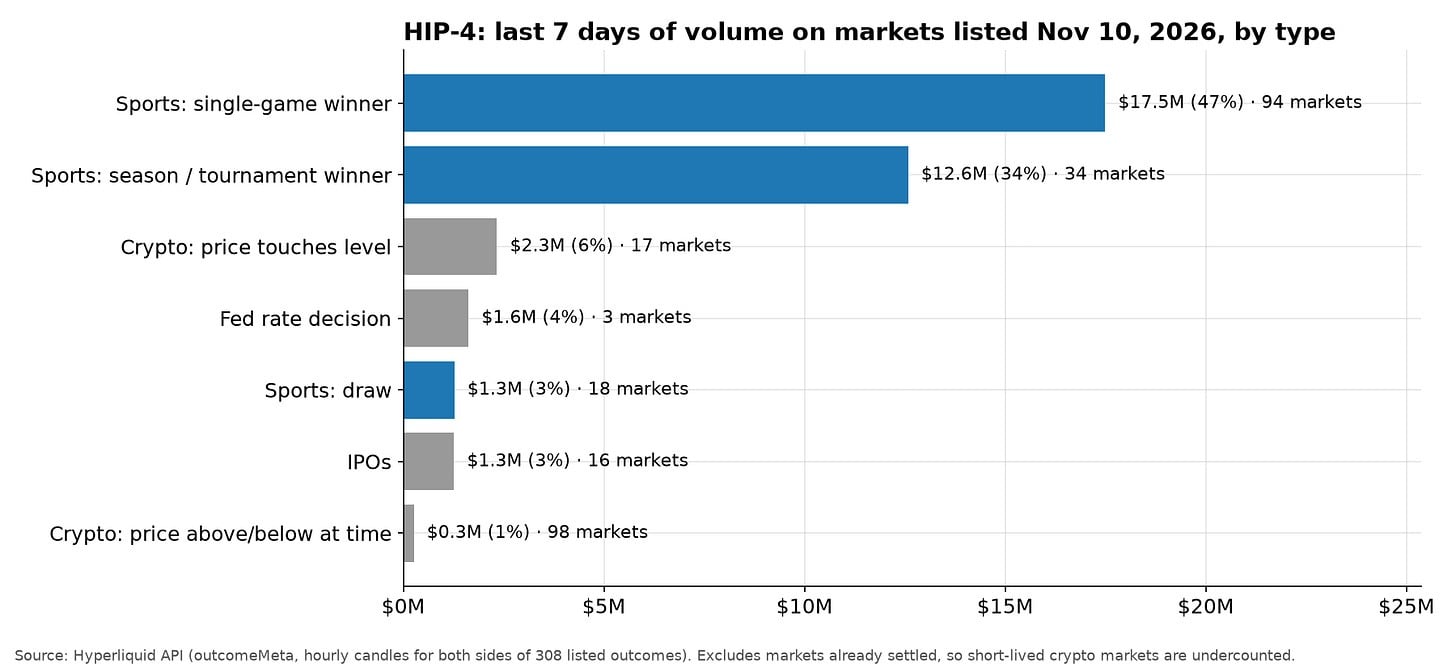
Image: Transaction volume and market quantity distribution of HIP-4 prediction market classified by themes in the past 7 days up to November 10, 2026
Considering Outcome's own potential airdrop expectations and current incentive plans, as well as the future possibility of the Hyperliquid third season's points bonus, currently participating in interactions presents a high cost-performance exploratory opportunity.
A more robust operational market-making strategy is “bidirectional low-price limit orders”: simultaneously placing limit buy orders for "YES" and "NO" with a total cost below $1, for example, placing orders at $0.48 and $0.49 respectively.
During the waiting period for order execution, market makers can continuously earn liquidity rewards provided by Outcome; once both buy orders are completely executed, the investor only needs to spend $0.97 to secure an arbitrage combination that ensures $1 at expiration.
Of course, the core risk of this strategy lies in “one-sided execution,” that is, significant one-sided price fluctuations in the market lead to buying only on one side, turning the position into a purely directional bet. Therefore, this strategy is more suitable for long-term markets with smooth price fluctuations, and it is not advisable to use it rashly in live rolling matches or events with high-frequency significant price changes.
Frontline Project Radar: RWA Options, US Stock Weekend Pricing, and NYSE Settlement Dynamics
· Derive Expands RWA Options: Currently, Derive holds 95% of the market share in the on-chain options market. With the upcoming launch of large-scale real-world asset (RWA) options, investors will gain new hedging tools beyond perpetual contracts.
· Rysk Finance Launches US Stock Volatility Yield: Rysk Finance, which focuses on pre-paid volatility yield, is also accelerating its RWA layout, and has now launched options yield strategies targeting Nvidia (NVDA).
· On-chain pre-emptive pricing of Nvidia rumors over the weekend: During last weekend, when the market reported that Nvidia CEO Jensen Huang was involved in abrupt rumors and review news with a person named Alice Huang, TradeXYZ under Hyperliquid became the key pricing discovery venue.
During the Nasdaq holiday, TradeXYZ provided investors with uninterrupted risk hedging and news trading outlets, which is the core value created by the 7×24 hour all-weather on-chain exposure for all market participants.
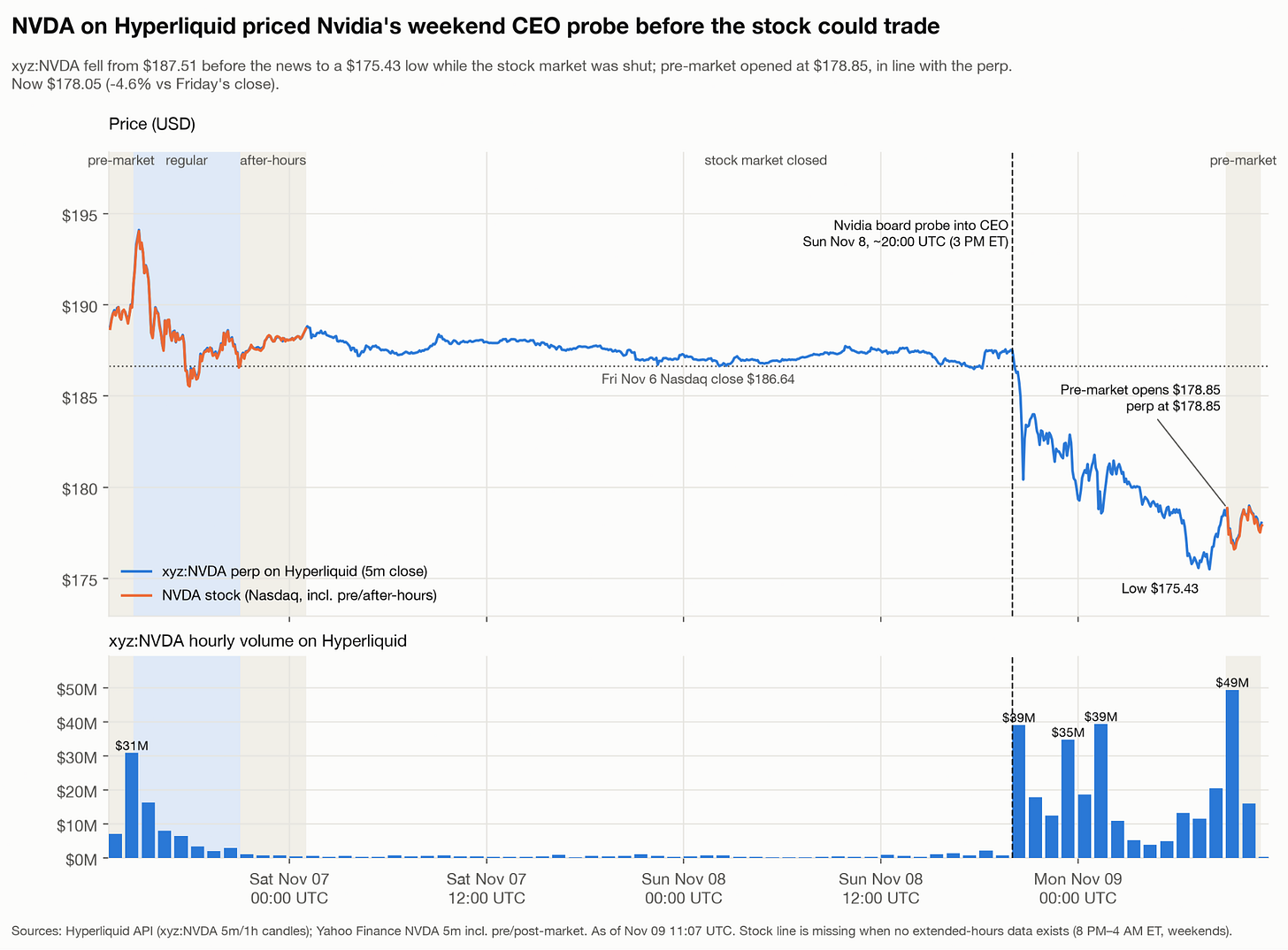
Image: During the US stock market weekend break, Hyperliquid TradeXYZ's xyz:NVDA price preemptively reacted to the rumor drop to $175.43 and hourly transaction volume changes
· Fixed-rate lending protocol IRIS officially launched: In August this year, we published a research report discussing fixed-rate credit design, and one of the protocols covered, IRIS, has now officially entered the mainnet landing stage.
IRIS is directly built on established DeFi lending markets such as Morpho, Spark, and Aave, where borrowers only need to submit fixed-rate intentions, and its backend solver network will automatically cross-market deploy underlying assets and manage dynamic hedging, while optimizing borrowing costs and rate stability.
· NYSE tokenized securities choose Avalanche for settlement: The tokenized stock securities platform under the New York Stock Exchange (NYSE) has confirmed it will use Avalanche as its settlement layer.
The relatively low-profile Avalanche in the market has been steadily advancing its institutional business expansion. Meanwhile, Ethena Pay is also deployed on Avalanche, with Earn+ officially operating on this chain through Aave V4, continuously attracting a large inflow of DeFi funds.
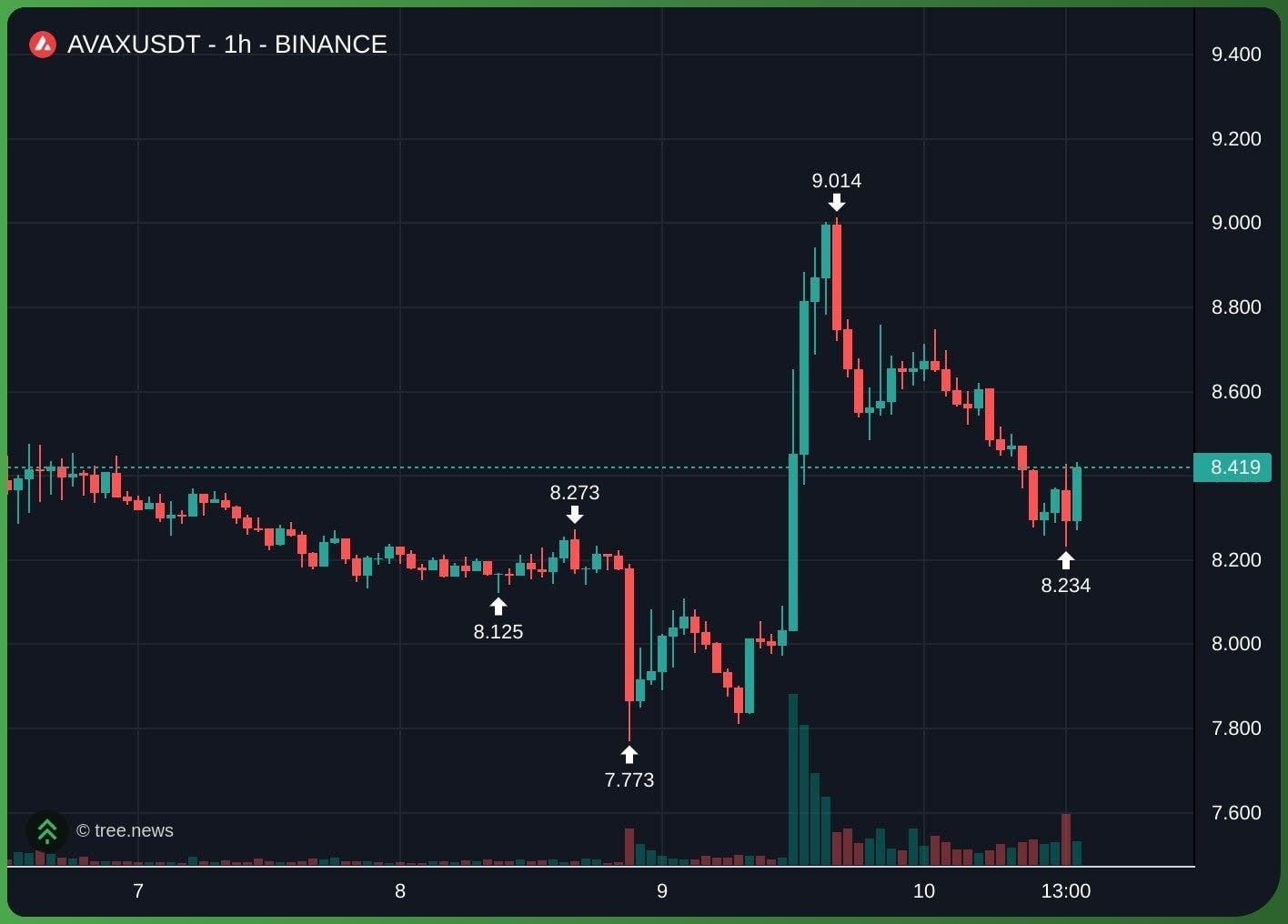
Image: After the announcement of the NYSE tokenized securities settlement cooperation, the AVAX/USDT hourly line rapidly surged and once reached the 9.014 mark
免责声明:本文章仅代表作者个人观点,不代表本平台的立场和观点。本文章仅供信息分享,不构成对任何人的任何投资建议。用户与作者之间的任何争议,与本平台无关。如网页中刊载的文章或图片涉及侵权,请提供相关的权利证明和身份证明发送邮件到[email protected],本平台相关工作人员将会进行核查。


