Author: William M. Peaster, Bankless
Translation: Deep Tide TechFlow
Deep Tide Overview: For a long time, cryptographic privacy solutions such as zero-knowledge proofs have mainly hidden "what was done on-chain," but mobile light wallets still expose true IP addresses and access times to servers when querying balances and broadcasting transactions, becoming a backdoor for tracking identities.
With Zcash wallet Zodl 3.20.0 defaulting to the OHTTP relay splitting mechanism, the industry is addressing the shortcomings of privacy at the network layer. Bankless summarizes the latest defense strategies and trade-offs of Zodl, Nym's mixing network, Ethereum Foundation's Kohaku/anon-rpc, Flashnet, and Bitcoin Core clients.
Cryptographic privacy tools can conceal everything you do on-chain, but identity-associated information can still quietly leak through off-chain metadata. The good news is that this long-ignored weak point is now receiving significant attention from the entire industry.
For example, this week, the Zcash wallet team formerly known as Zashi announced the transition to a new self-developed wallet server architecture for users. This architecture ensures that your IP address and your wallet request data will never fall into the hands of the same operator at the same time; this feature was launched with the Zodl 3.20.0 version and is ready to use out of the box without manual setup.
This marks an exciting shift. A year ago, when I experienced the Zashi privacy exchange feature, its built-in Tor client was still just an optional feature that needed to be actively selected. Now, Zodl has made network layer protection the default starting point.
Below, we will quickly break down the core principles of this new architecture while also reviewing other network metadata leak prevention solutions that are accelerating to the market.
Your exposed IP address is selling your identity
Most mobile crypto wallets are light wallets that do not store a complete ledger of the entire blockchain locally. They rely heavily on remote servers to pull on-chain data and broadcast transactions, meaning that server can clearly see your IP address, query request content, and the exact time the request was made.
In the Zcash ecosystem, this task is handled by the lightwalletd server. Even if the ZEC you hold has achieved full on-chain shielding encryption, these frequent connection traces are still enough for seasoned analysts to piece together who you are and what you are doing.
This is not an unfounded concern; there are already market entities monitoring such metadata. As early as 2023, developer b10c publicly recorded an entity named LinkingLion, which specifically tracks which Bitcoin nodes broadcast new transactions first.
This unique perspective of global monitoring means that behind-the-scenes operators can accurately bind freshly minted BTC transactions to the real IP behind them. Moreover, LinkingLion's active traces can be traced back to 2018, suggesting that they may have secretly collected connection intelligence for years.
The core issue is that this metadata tracking technology has also been applied across major crypto networks and even privacy coin ecosystems (for instance, b10c has observed that the same batch of IP segments connected to Monero nodes). The industry urgently needs a new transaction routing foundation, which is the significance of Zodl taking this step.
How Zodl's new privacy server works
Prior to this, Zodl users wishing to obscure network metadata only had two options: either enable the slower Tor proxy or blindly trust the server operator to not act maliciously.
Zodl's newly released solution introduces an oblivious HTTP protocol (Oblivious HTTP, abbreviated as OHTTP). As a standard IETF internet protocol specification, the elegance of OHTTP lies in its forced splitting of a single network communication into two segments to be processed by two unlinked parties, ensuring that no single node can piece together the complete truth:
· Step one: Your local wallet seals each request with a key that only the ZODL gateway server can unlock.
· Step two: The sealed data packet is sent to a relay server operated by Cloudflare or Fastly. The relay node strips off network message headers containing identity information before forwarding, so while the relay may know your real IP, it cannot comprehend the content of your request.
· Step three: The ZODL gateway becomes the only node on the entire chain that can unlock the request ciphertext, then it forwards the request to lightwalletd. ZODL can see what data you are looking for, but the visitor address in its view is always only the relay server's address.
In short, Cloudflare or Fastly knows "who is asking," ZODL knows "what is being asked," but neither party holds both pieces of information simultaneously.
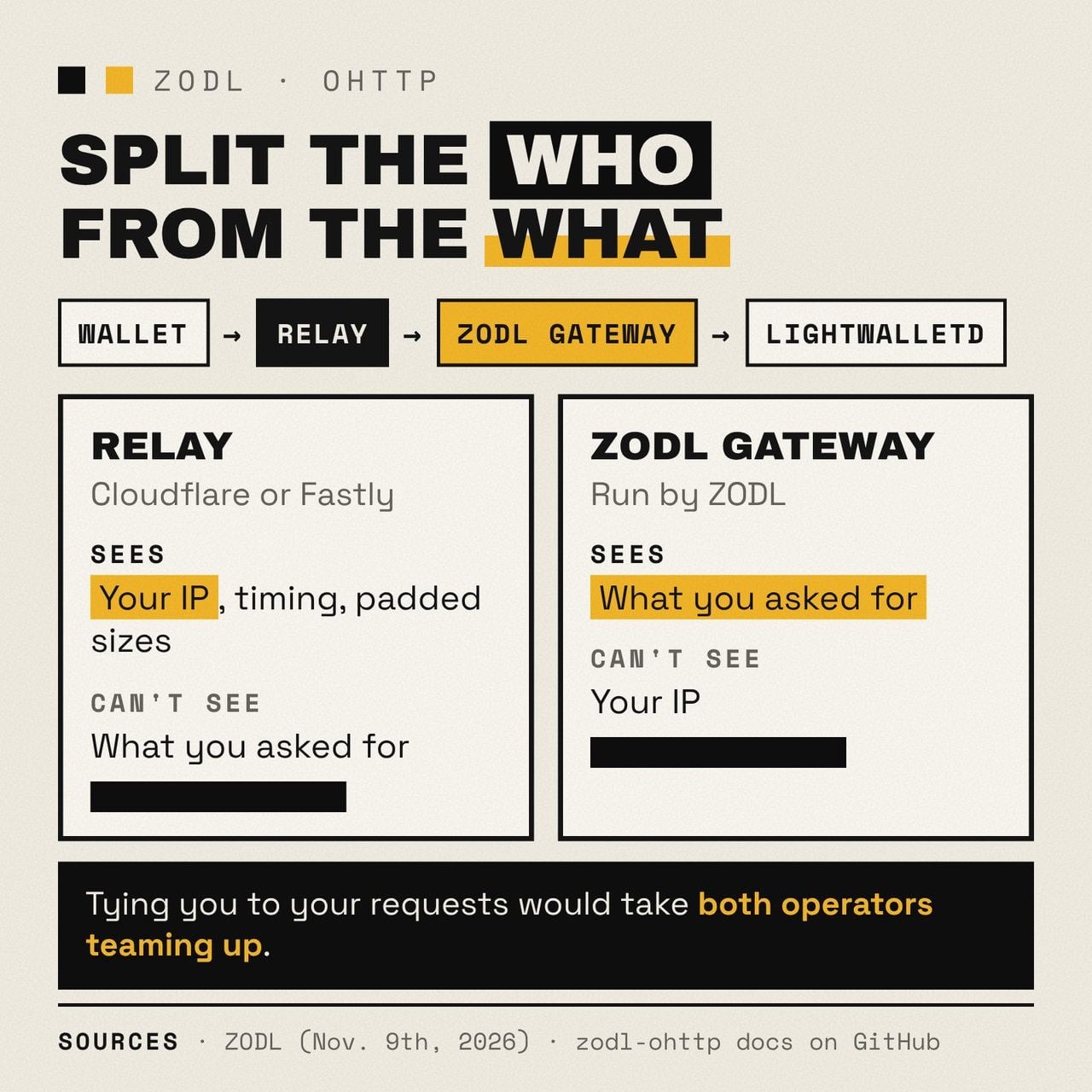
Image: Zodl's privacy splitting architecture based on the OHTTP protocol, where the relay node only sees the user's IP, and the Zodl gateway only sees the request content (Source: ZODL)
This solution combines ingenuity with engineering practicality. From the publicly available open-source code, it also embeds two notable defensive mechanisms: "traffic size padding" and "unlinkable logs."
In terms of traffic features, all outgoing requests are uniformly padded to a fixed size (approximately in 4 KB increments, with transaction broadcasts padded up to 16 KB or more), and sensitive responses are treated similarly, preventing eavesdroppers from deducing whether you are querying a balance or broadcasting a transaction based on packet size.
Regarding log retention, request IDs generated on the relay layer are never recorded in clear text form in the ZODL logs. The system only uses a dynamic key that resides solely in the gateway's memory to compute an HMAC fingerprint for log storage. Once the gateway restarts, the key is immediately destroyed. This means that afterward, no one can align ZODL logs with relay logs.
This code has just gone live, and Zodl will be rolling out the upgrade to all users in batches over the next few days. In any case, its launch has broken the industry's silence on the issues of naked network metadata in the crypto space.
Trust has not been completely eliminated
Objectively, the effectiveness of the OHTTP privacy shield is predicated on one core premise: the relay operator and ZODL must not collude. Furthermore, the relay server can still detect when you connect and roughly how much traffic is transmitted; it just cannot see the plaintext payload.
Consequently, some critics on the Zcash community forum have pointed out that since both Cloudflare and Fastly are U.S. companies and must comply with legal subpoenas, overly promoting this mechanism could create a false sense of security for some users.
In response, ZODL core contributor y4ss candidly acknowledged this limitation, stating that OHTTP is positioned as "a better default starting point, but could not replace Tor or Nym in the face of state-level adversaries."
As y4ss previously suggested in discussions: if the legal pressure faced by underlying cloud infrastructure is within your threat model, you can certainly stack Zodl's Tor option on top of OHTTP; this way, even what the Cloudflare relay nodes see is only a Tor exit node IP, rather than your real address.
Despite existing boundaries, the real victory of this system lies in achieving "privacy by default." Just as David Hoffman celebrated the vision when Ethereum launched the Kohaku privacy wallet in October 2025, privacy must be an out-of-the-box standard feature, and not an optional burden that requires users to manually configure.
Since OHTTP only adds one more lightweight relay hop, its minimal performance overhead is sufficient to support a default on for everyone.
Which teams are also pushing for network-level solutions
Zodl's advancement is just a microcosm of the entire crypto industry’s crackdown on metadata leaks; currently, different public chains and foundational teams are tackling the issue along their respective technical paths. Among them, the highest intensity of protection, and also the most "heavy-duty," belongs to mixing networks (Mixnets).
In short, mixing networks will scatter communication traffic and shuttle between multiple relay nodes, filling all data packets to exactly the same byte size, while injecting a massive amount of fake interference messages (Decoys) into the network, making it impossible for eavesdroppers to match incoming and outgoing traffic.
According to progress disclosed in September by the privacy project Nym, two Zcash wallets have integrated their mixing network: Zingo provides a one-click switch, while Zkool supports switching to direct connections via the mixing network, and Nym is also in talks with Zodl for cooperation.
Last week at Devcon 8, Nym also released a brand new SDK toolkit designed to encourage more wallets and decentralized applications to connect to the mixing network. The only apparent cost of this solution is speed, as multiple obfuscations naturally introduce latency.
Turning to the Ethereum ecosystem, the Kohaku privacy wallet project led by the Ethereum Foundation has made preventing IP and RPC leaks a core goal since its inception. The newly launched Kohaku command line tool defaults to directing all traffic, except for self-built local RPC calls, to Tor.
Meanwhile, the anon-rpc proposal put forth by the Ethereum Foundation in June aims to provide all wallets with a universal standard interface for on-demand access to any anonymous network.
The versions supporting Tor and Nym are already live on the mainnet, and the Privacy Pools v2 web version has officially adopted it: users only need to toggle the "Connect with Tor" switch for all RPC requests to automatically route through the anon-rpc channel.
Also noteworthy is Flashbots' entry into the space. Flashnet, which debuted this February, is a cutting-edge research solution oriented toward anonymous transaction submissions for Ethereum. Users place transactions into slots of a shared batch randomly and perform secret sharding, with shards reassembling across server clusters, completely decoupling each transaction from its sender.
Flashnet aims to avoid the two pain points of weak Tor protection and excessive delays in mixing networks, but no official mainnet deployment or benchmark testing data has been released as of yet.
In the Bitcoin arena, developers have long been focused on protecting the "first hop" of transaction broadcasting. The Bitcoin Core 31.0 version launched in April this year introduced a privacy broadcasting optional feature, where nodes send transactions only through Tor or I2P anonymous networks.
More critically, each transaction opens a separate connection channel, preventing external parties from linking two different transactions to the same network session.
This mechanism precisely targets the ListeningLion monitoring model mentioned earlier. However, this system is still being fine-tuned in practical operations: in June of this year, developers disclosed a vulnerability where, if the anonymous handshake failed, nodes would automatically revert to retrying on the main network, exposing the sender's IP. This vulnerability has been patched in version 31.1.
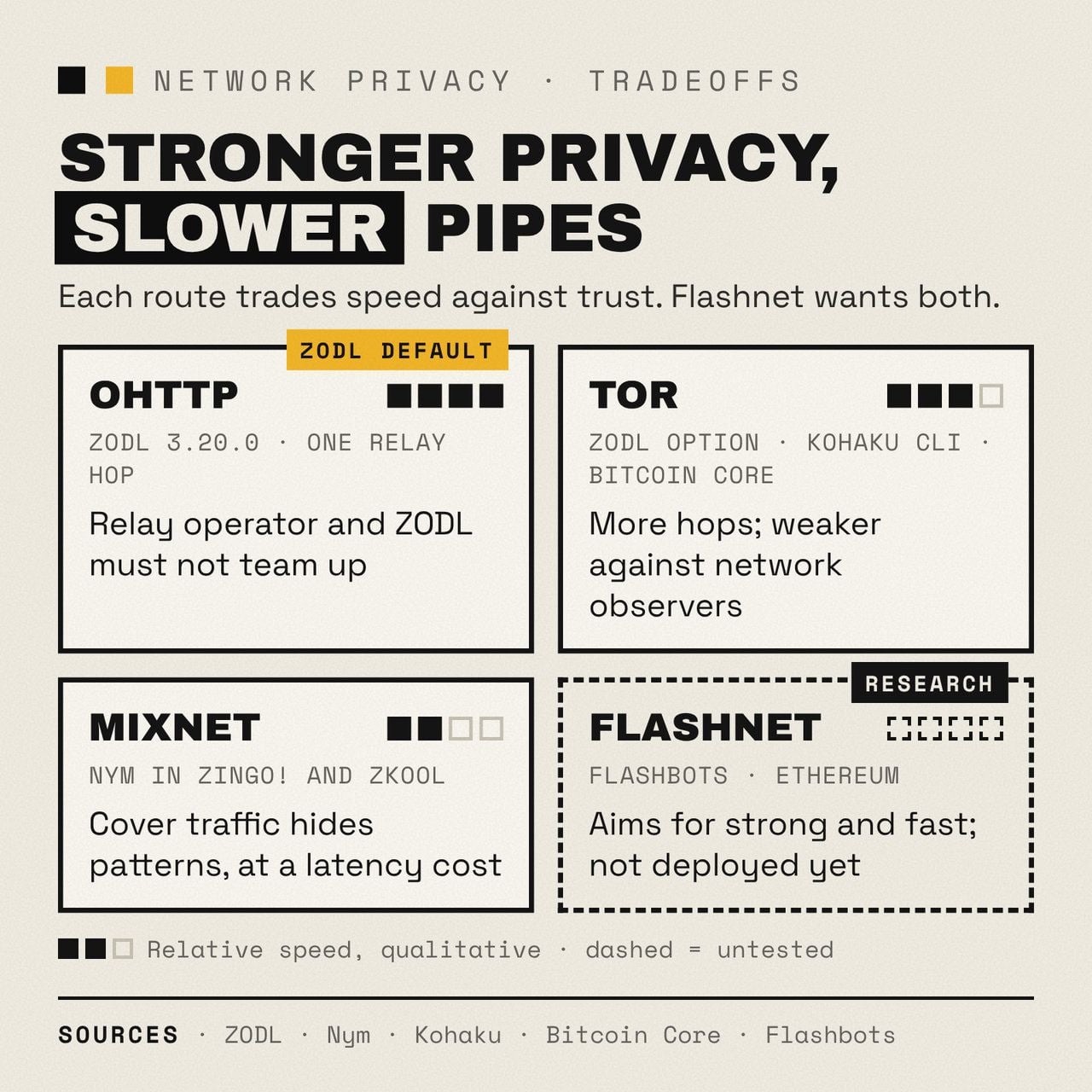
Image: Comparison of OHTTP, Tor, mixing networks, and Flashnet in terms of speed and trust trade-offs (Source: Bankless)
Conclusion and Outlook
So, is OHTTP the ultimate high-intensity privacy solution? When facing resource-rich state-level eavesdropping adversaries, relying solely on it is evidently insufficient, a consensus the industry has long reached. However, default configurations often cover the largest ordinary user groups.
Allowing every Zodl user to hide their real IP directly from their wallet server without any complex configurations inherently raises the privacy baseline for the entire industry.
Of course, the new contradictions arising from infrastructure dependencies are also worth keeping an eye on. The Ethereum Foundation's anon-rpc article once viewed the heavy reliance of wallets on centralized cloud gateways like Cloudflare as a single-point vulnerability, reasoning that these centralized gateways have both the authority to peer into request traffic and the power to directly refuse service; yet Zodl precisely chose Cloudflare to serve as half of its privacy splitting framework.
To be fair, the risks targeted by these two designs are not the same: OHTTP focuses on constraining the information pieces held by a single company, while anon-rpc is more concerned about who has the power to cut off services at any time, and Zodl still allows users to switch back to community nodes in advanced settings.
Even so, if in the future all crypto privacy products' default paths rest on just a few cloud giants, this concentration risk cannot be underestimated.
It remains to be seen whether other mainstream wallets will swiftly follow Zodl's default configuration strategy. Regardless, the direction of the industry's evolution is unmistakably clear: the battle for crypto privacy has officially ignited at the network transport layer, the most urgently needing improvement.
免责声明:本文章仅代表作者个人观点,不代表本平台的立场和观点。本文章仅供信息分享,不构成对任何人的任何投资建议。用户与作者之间的任何争议,与本平台无关。如网页中刊载的文章或图片涉及侵权,请提供相关的权利证明和身份证明发送邮件到[email protected],本平台相关工作人员将会进行核查。


