
Author: Azuma, Odaily Planet Daily

Bitmine is just one final step away from completing its 5% ETH holding target.
On November 10, digital asset reserve company Bitmine (NYSE: BMNR) disclosed its latest holding report. In the past week, the company increased its holdings by 9,587 ETH, bringing the total holdings to 6,070,092 ETH, worth approximately $13.6 billion, accounting for 4.97% of Ethereum's current total supply. According to official figures, this ratio has reached 99% of its strategic goal of “holding 5% of ETH's total supply.”
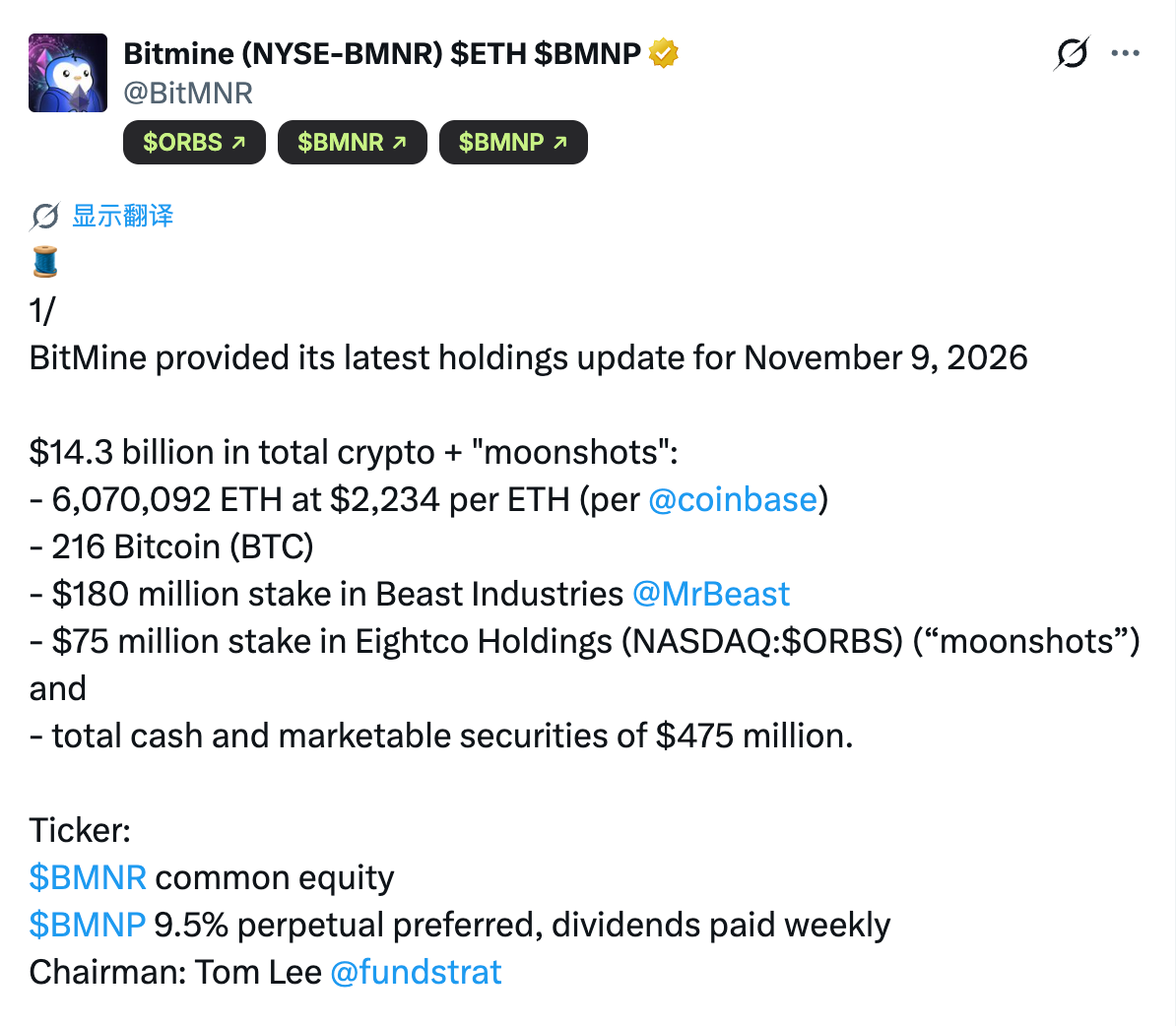
The 5% holding target is a long-term plan proposed by Bitmine when it launched its ETH treasury strategy on June 30, 2025. Bitmine officially calls it "The Alchemy of 5%"—the reason for this figure is that in the traditional US stock market, 5% is the threshold for triggering SEC 13D mandatory disclosure, representing that a single shareholder begins to have substantial voting rights.
At this year's Token2049 conference in October, Bitmine Chairman Tom Lee once again emphasized that 5% will become the hard cap for Bitmine's ETH holdings, and the company will not continue to acquire ETH beyond this ratio. In other words, once the final 1% purchase is completed, Bitmine's ETH buying activity, which has continued for over a year, will be put on pause.
The net buying pressure will inevitably decrease; no one can replace Bitmine
As Bitmine approaches its holding limit, the market is constantly looking for potential "successors"—for example, pinning hopes on second-tier Ethereum treasuries (DATs) like SharpLink (holding about 870,000 ETH), The Ether Machine (holding about 496,000 ETH), or expecting substantial inflows from spot ETFs.
However, objectively, relying on these forces to "replace" Bitmine is unrealistic for a simple reason: second-tier DATs and spot ETFs are not incremental narratives; they already exist at the table right now.
Over the past year and more, every price game of ETH has already accounted for the combined strength of Bitmine, second-tier DAT treasuries, and ETF funds. Moreover, ETF funds have a strong pro-cyclical nature (chasing high when prices rise and redeeming when prices fall), while second-tier treasuries are limited by their own market capitalization and mNAV discount, making it difficult to replicate Bitmine's early ability to ignore market conditions and execute a consistent buying strategy.
Therefore, we do not need to seek psychological comfort by looking for "other forces to step up" for ETH. Once Bitmine reaches the 5% limit and stops acquisitions, on a mathematical level, it objectively means that the market will lack a continuous and rigid net buying force.
The real core issue worth discussing is: how substantial is the impact of this disappearance of net buying on ETH?
While the volume of 6 million ETH is huge, the "violent buying period" has long passed
If we only look at the total amount, 6.07 million ETH and a holding scale of up to $13.6 billion will certainly have a massive impact on ETH. As the second largest cryptocurrency treasury globally, only second to Strategy (formerly MicroStrategy), Bitmine alone has absorbed nearly 5% of the entire network's chips and has locked over 80% of its ETH in staking nodes. The exit of a buyer of this magnitude from the secondary market certainly sounds like a "bloodletting bearish signal."
However, if we look back at Bitmine's true accumulation curve over the past 16 months, we will find a fact that is much closer to the current situation—Bitmine's "violent accumulation period" has long passed; the closer it gets to the 5% target, the slower its accumulation speed becomes.
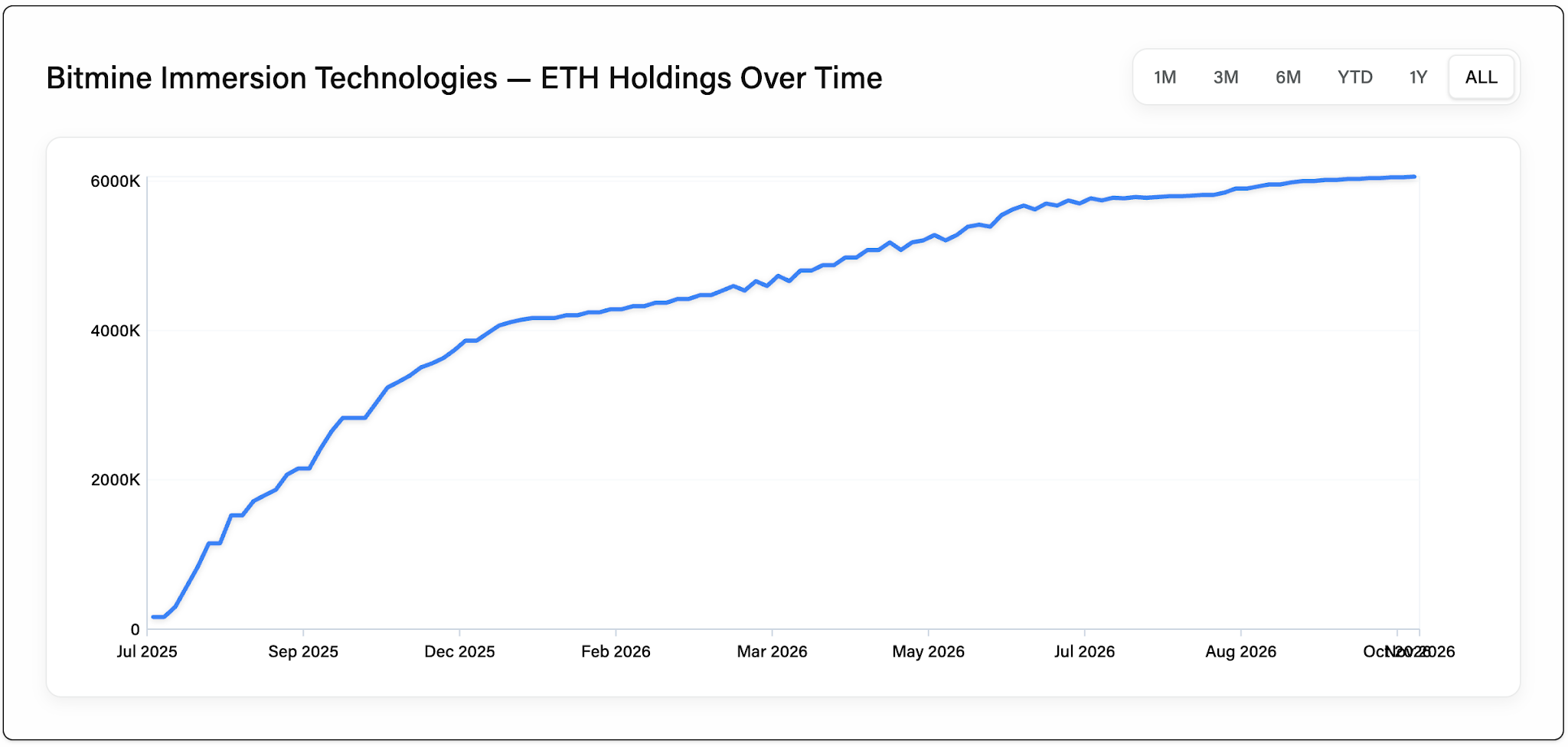
By combining data from The Block’s treasury tracking and Bitmine’s previous holdings disclosures, we can visually see the changes in Bitmine's purchase slope each quarter.
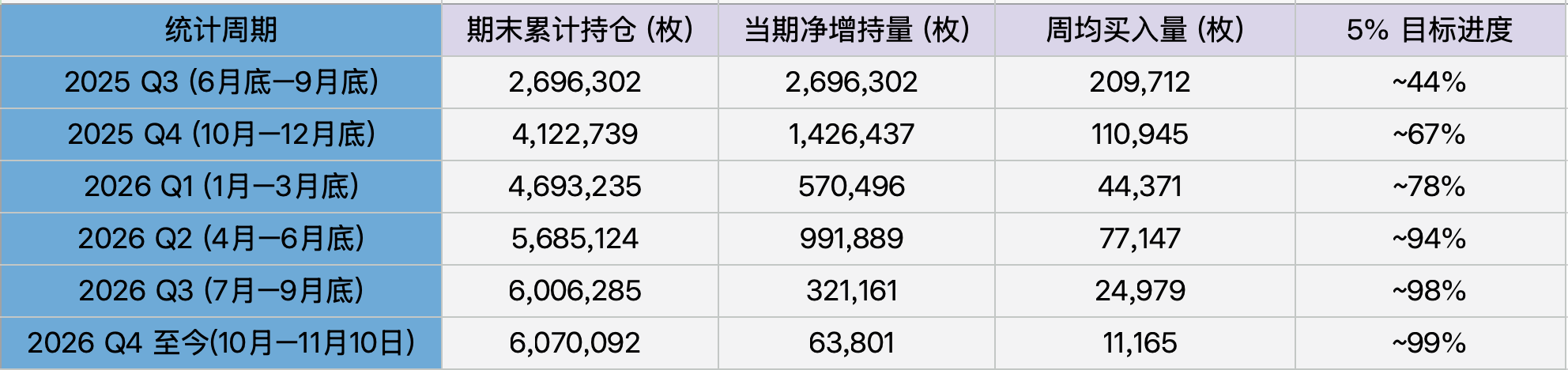
The data clearly shows that Bitmine's true "violent accumulation" was almost entirely concentrated in the second half of 2025—at that time, it consumed more than 4.1 million ETH at an astonishing rate of 100,000 to 200,000 ETH per week over a six-month period.
However, entering the second half of 2026, especially since the third quarter, as its holdings approach the 5% target and BMNR itself has entered a discount zone, its pace of accumulation has significantly slowed. Over the past two months, Bitmine's weekly net increase of ETH has only remained within the range of 8,000 to 15,000 ETH, translating to only about $20 million to $30 million per week.
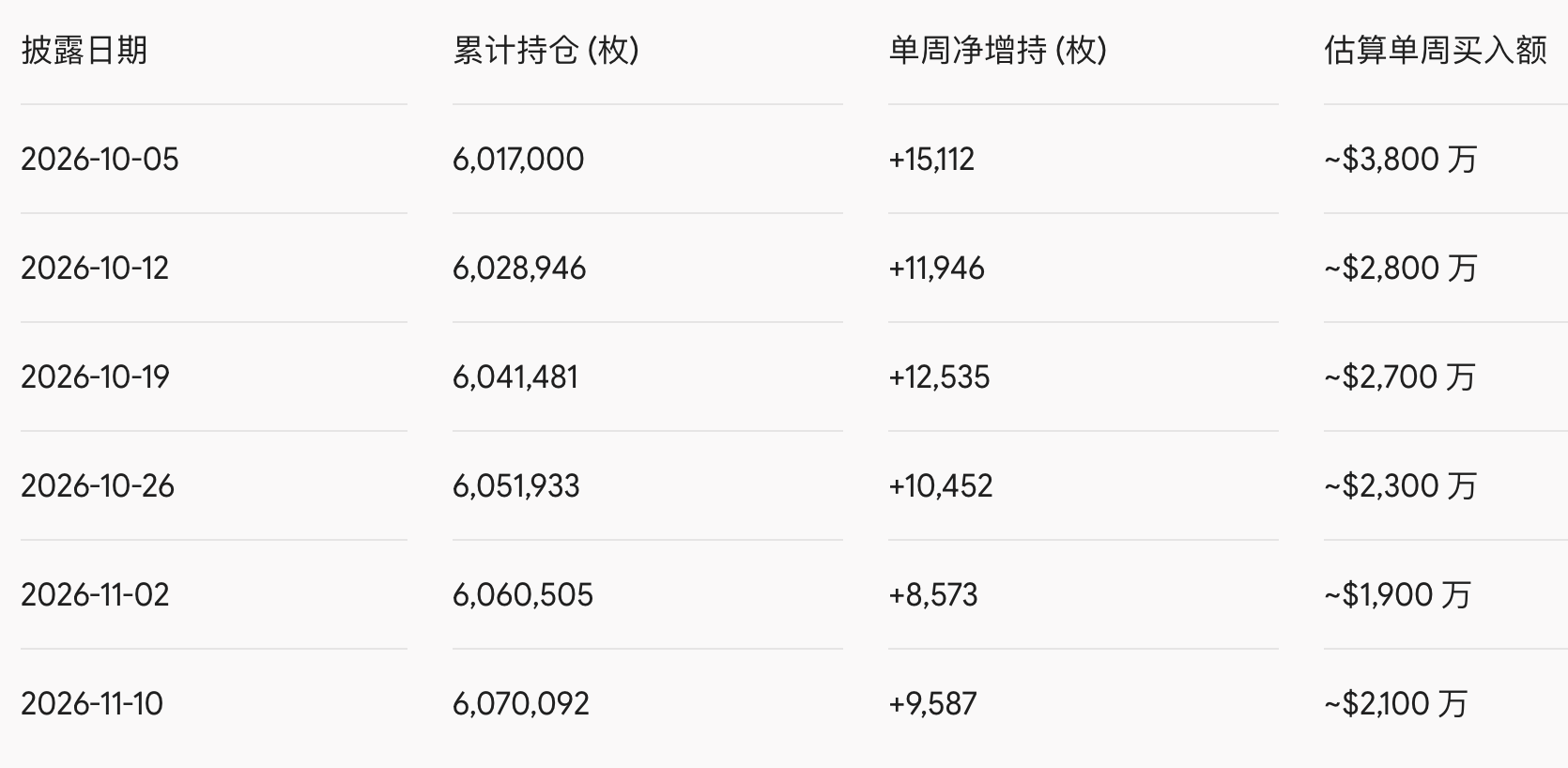
For a market like ETH, where the average daily trading volume easily reaches hundreds of billions of dollars and spot ETF net inflows/outflows can easily exceed $100 million in a single day, a weekly buying pressure of $20 million has had very limited actual influence on ETH prices in recent months.
No need to panic; the market has already adapted to life without Bitmine
In summary, Bitmine is about to complete the final progress bar of "The Alchemy of 5%," which indeed means that ETH has lost a symbolic off-market net buyer on paper, but the market need not fall into a panic of "buying interruption"—because the most intense incremental buying has already receded more than half a year ago, and the secondary market has actually adapted and digested the absence of Bitmine's net buying during the fluctuations of recent months.
As the last approximately 35,000 ETH gap is filled, what disappears is merely a weak marginal buying of about 10,000 ETH per week; while what is left for Ethereum is 6.07 million ETH locked long-term in treasuries and staking nodes.
The narrative of Bitmine as a "buying engine" may soon turn a page, but this chip locking experiment that has lasted a year and a half has already completed its historical mission.
免责声明:本文章仅代表作者个人观点,不代表本平台的立场和观点。本文章仅供信息分享,不构成对任何人的任何投资建议。用户与作者之间的任何争议,与本平台无关。如网页中刊载的文章或图片涉及侵权,请提供相关的权利证明和身份证明发送邮件到[email protected],本平台相关工作人员将会进行核查。


