Compared to cats and dogs, the US stock market is obviously more appealing.
Written by: Eric, Foresight News
On the evening of November 9, Beijing time, Formation Securities filed with the US Securities and Exchange Commission (SEC), planning to operate a tokenized securities trading venue on Solana based on the five-year innovation exemption to be issued by the SEC in September 2026, with trading expected to start in early 2027. The first tokenized stocks to be launched will include Exodus Movement, Forward Industries, and Galaxy Digital.
In October 2026, Solana's two major DeFi protocols, Orca and Loopscale, announced their merger to form Formation. At that time, Formation aimed to provide a complete path from issuance to financing and liquidity for emerging assets while expanding the range of assets and strategic options available to capital allocators.
As the leading Solana DEX from 2022 to 2023, Orca is once again taking the lead in tokenized stocks.
From Trading to On-chain Capital Networks
Before meme tokens became popular across the internet, Orca was arguably a standout DEX on Solana in terms of liquidity and token coverage. Since its inception in 2021, Orca has surpassed a total trading volume of $55 billion, with its core feature allowing liquidity providers to customize price ranges through a mechanism similar to Uniswap v3's Whirlpools.
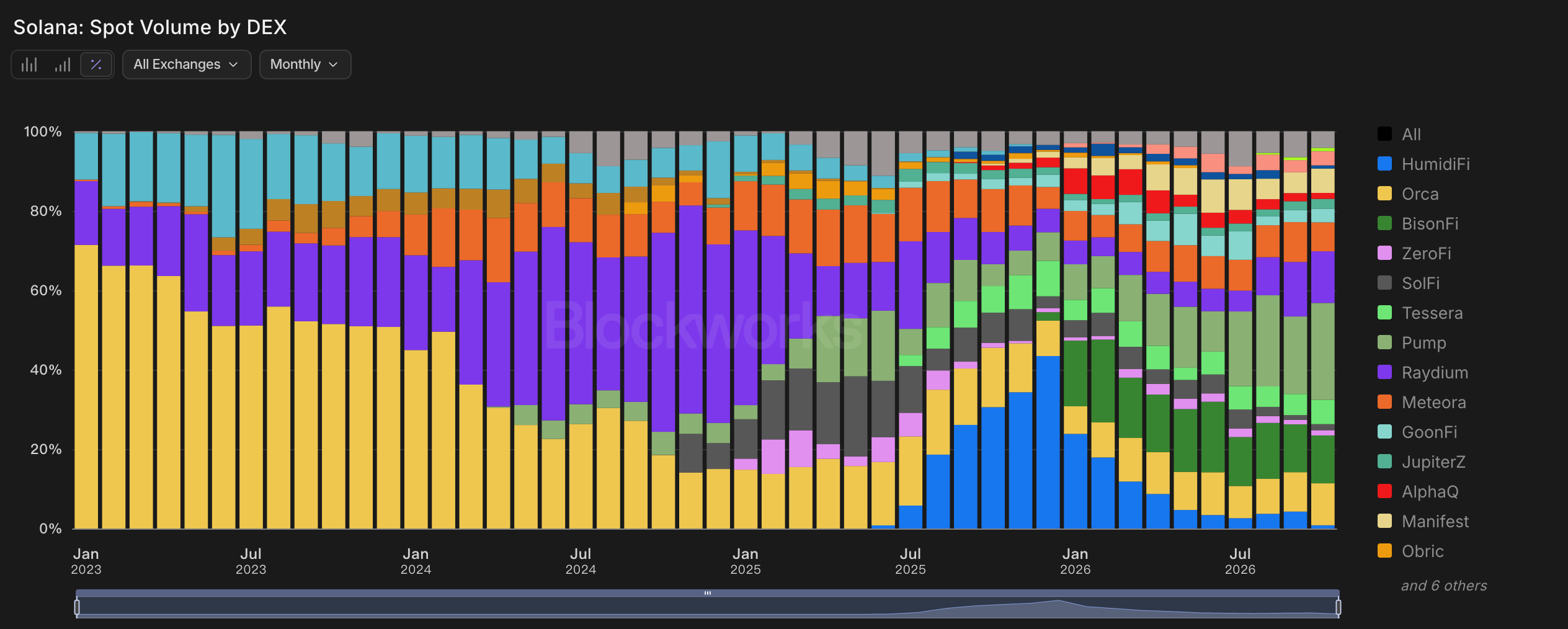
According to Blockworks data, until February 2024, Orca's market share based on trading volume remained above 50%, with a peak TVL exceeding $1.4 billion at the end of 2021.
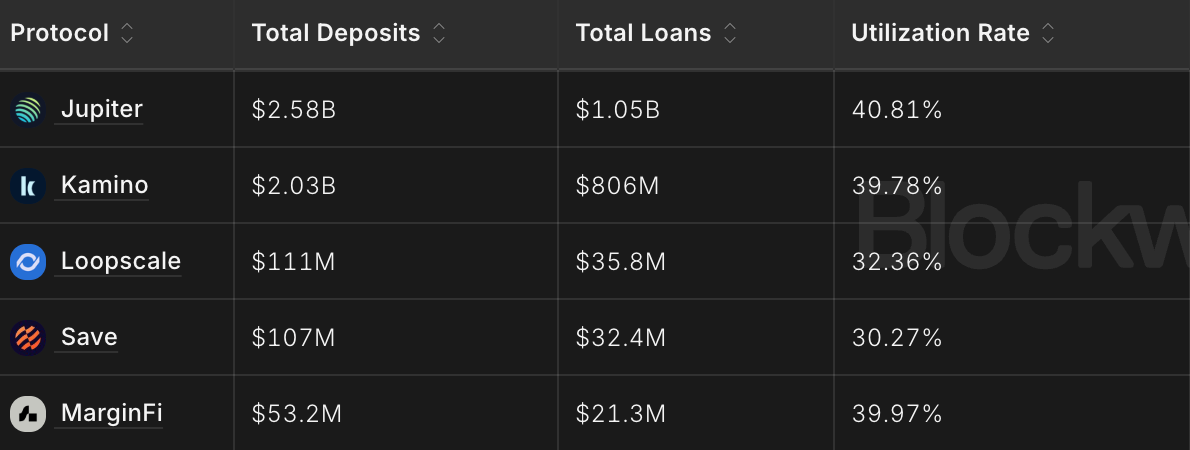
Loopscale's performance in the lending market is not as remarkable as Orca's, but it is still the third largest lending platform on Solana, despite a considerable gap in data compared to the top two. Unlike basic lending protocols like Aave, Loopscale is a modular lending protocol based on an order book, supporting fixed rates, fixed terms, and over-collateralized loans by directly matching borrowers and lenders rather than relying on funding pool algorithms.
The merged Formation is led by Loopscale co-founder Luke Truitt as CEO, while Orca's Chief Strategy and Legal Officer Christopher Montagano serves as President.
Montagano clearly stated that the company plans to collaborate with issuers to jointly build a tokenized stock market, providing an integrated network from capital formation to allocation for cutting-edge economic fields such as AI, robotics, defense, and energy, and has received support from institutions like Figure, Shinhan Asset Management, Superstate, R3, and Securitize.
Formation will not issue new tokens but will use Orca's token ORCA, with no changes to the token quantity, release conditions, or the xORCA staking mechanism. Loopscale has not previously issued tokens and only launched a points program. The merger announcement also mentioned that Loopscale's points conversion into tokens is expected to be announced by the end of the year.
From ORCA's market performance, it appears that the news of the merger with Loopscale and the promotion of compliant tokenized US stock trading has had almost no impact on the token price fluctuations. As of the time of writing, the ORCA price is around $1.35, with an FDV slightly over $100 million.
Operational Framework under SEC Innovation Exemption
The core regulatory basis for Formation Securities is the five-year innovation exemption issued by the SEC. According to this framework, qualified tokenized stocks can be traded in a conditional secondary market through permitted automated market maker (AMM) liquidity pools within recognized trading venues. This design seeks to balance regulatory sandboxes with technological innovation: on one hand, trading venues must meet SEC compliance requirements; on the other hand, the advantages of round-the-clock trading and atomic settlement brought by blockchain technology are retained.
Specifically, tokenized stocks on the Formation platform will enjoy the same voting rights and dividend rights as other shareholders, allowing investors to trade using qualified assets such as stablecoins 24/7, with atomic settlement on-chain. On the distribution side, relevant stocks will be offered to verified investors through channels like Superstate, Formation Securities' own platform, Alpaca, and custodians such as Anchorage and BitGo.
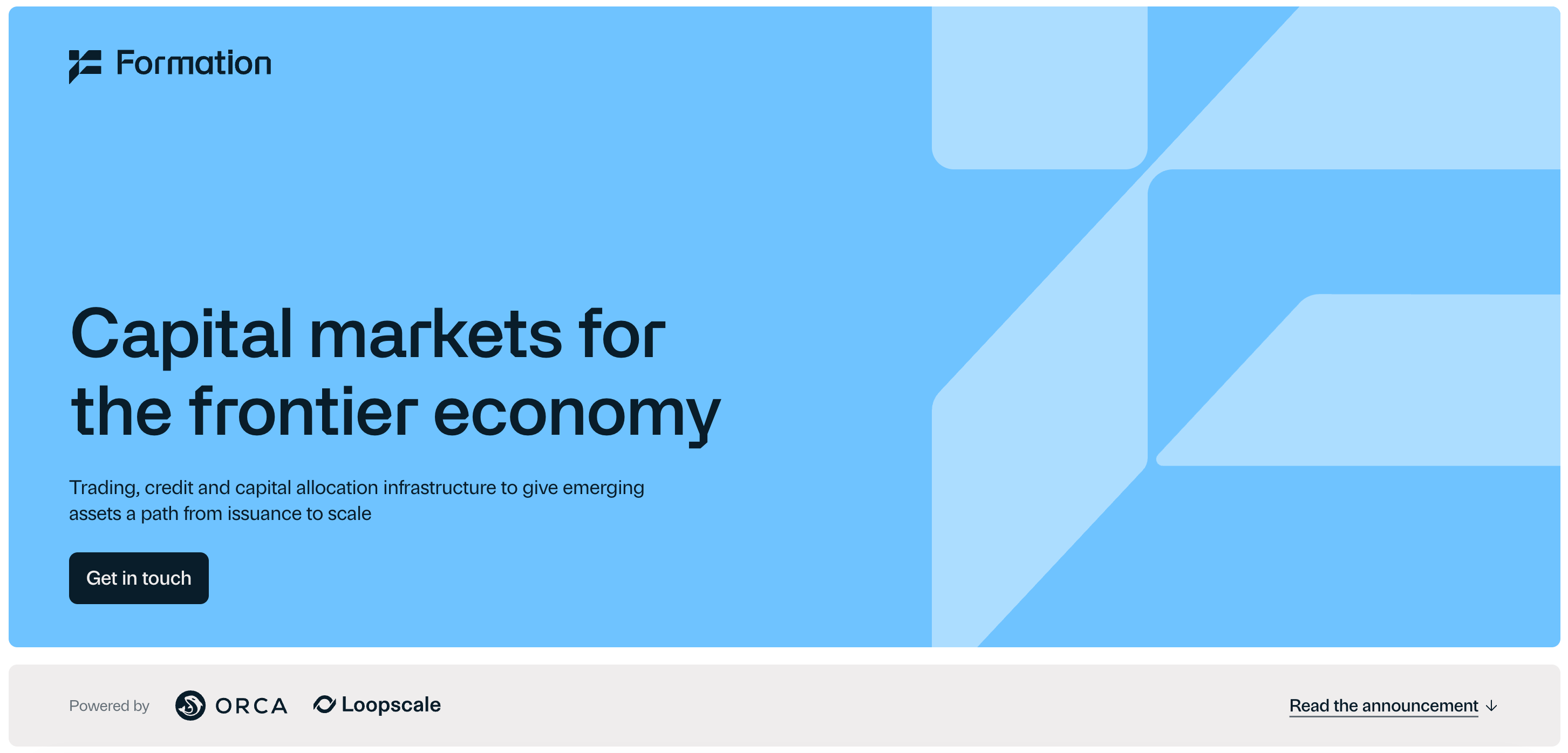
At least for now, Formation does not seem to fully integrate Orca and Loopscale; the two DeFi protocols still exist independently, with their original crypto businesses remaining operational. The existence of Formation may serve more as a foundational infrastructure for compliant tokenized US stock trading, presenting a unified entity for external promotion and collaboration.
However, unlike simply launching tokenized stocks on a DEX and lending market, Formation's business also encompasses the upstream issuance rights of tokenized stocks, having already stepped one foot into the traditional finance door.
Realistic Resistance to Tokenization of US Stocks
Although the regulatory framework provides an experimental window for tokenized securities, it seems that not all companies listed on the US stock market support such changes.
Previously, under the same SEC innovation exemption framework, the OKXICE tokenized securities platform, a collaboration between OKX and the Intercontinental Exchange (ICE), faced significant opposition from issuers. This platform initially proposed to include stocks from about 62 companies, but a majority of companies (over 80%), including Microsoft, Alphabet, Goldman Sachs, McDonald's, Nvidia, Tesla, Amazon, and Apple, formally raised objections.
The concerns of listed companies mainly include four points: first, the tokenized platform is led by a third party, and issuers worry that investors may mistakenly think the tokens have official endorsement from the company; second, the impact on stock prices, liquidity, and volatility is uncertain; third, the third-party platform charges fees while issuers bear potential risks, leading to asymmetry in control and rights to profits; fourth, the 24/7 trading mechanism may result in fragmented price discovery, while the on-chain execution path for shareholder rights (such as voting rights and dividend rights) remains unclear.
It is noteworthy that this mechanism adopts a principle of "default consent," meaning that if there is no objection within 30 days of notification, it is considered agreement; however, many large listed companies have actively withdrawn, indicating that the current third-party-led model faces severe resistance from issuers, reflecting that market participants' caution toward tokenization is not derived from the technology itself, but from the misalignment of business models and responsibility structures.
Unlike OKXICE's third-party platform path, Formation has explicitly adopted a "collaboration with issuers" strategy, which may alleviate the trust deficit of issuers to some extent. By conceding some control of the platform, ensuring equal shareholder rights, and on-chain transparent settlement, Formation aims to establish a more collaborative ecosystem for tokenized securities.
Attempts to Expand Boundaries
Formation can be considered a milestone for Solana ecological projects moving towards institutional-grade financial infrastructure. Through the merger of Orca and Loopscale, the platform attempts to combine the liquidity advantages of DEX with the capital allocation capabilities of on-chain credit, exploring a feasible path for the tokenization of US stocks within the SEC's innovation exemption regulatory framework. Compared to the collective resistance faced by previous third-party platforms, Formation's advocated cooperation model, equal rights design, and on-chain transparent settlement may provide a more sustainable business paradigm for the realization of tokenized securities.
In the long run, tokenized securities are expected to achieve more efficient price discovery, round-the-clock global access, atomic settlement, and integration with the on-chain DeFi ecosystem, driving capital markets towards modernization. However, the realization of this vision depends not only on the improvement of technological infrastructure but also on the rebalancing of the rights and responsibilities structures among regulatory agencies, issuers, and trading platforms. Formation's experiment can provide a reference for the on-chain transformation of global securities markets.
免责声明:本文章仅代表作者个人观点,不代表本平台的立场和观点。本文章仅供信息分享,不构成对任何人的任何投资建议。用户与作者之间的任何争议,与本平台无关。如网页中刊载的文章或图片涉及侵权,请提供相关的权利证明和身份证明发送邮件到[email protected],本平台相关工作人员将会进行核查。


