Data may spark a relief rebound, but the hawkish tone is hard to change.
Written by: Xu Chao, Wall Street Insights
The October CPI data, released tonight, will become the key basis for the Federal Reserve's last interest rate decision of the year. Against the backdrop of strong employment data opening the door for hawkishness, the trend of inflation data will directly determine whether Federal Reserve Chair Warsh pulls the trigger on interest rate hikes on December 9.
The market currently prices in a roughly 86% chance of a rate hike in December. Last Friday, non-farm payrolls significantly exceeded expectations, adding 165,000 jobs, far above the market estimate of 70,000. The unemployment rate fell to 4.1%, providing ample support for hawkishness from the labor market. The last FOMC meeting maintained rates unchanged with a vote of 10 to 2, but Fed officials Cook and Hammack clearly voted in favor of a rate increase, indicating internal divisions. Inflation data has thus become an overwhelming variable.
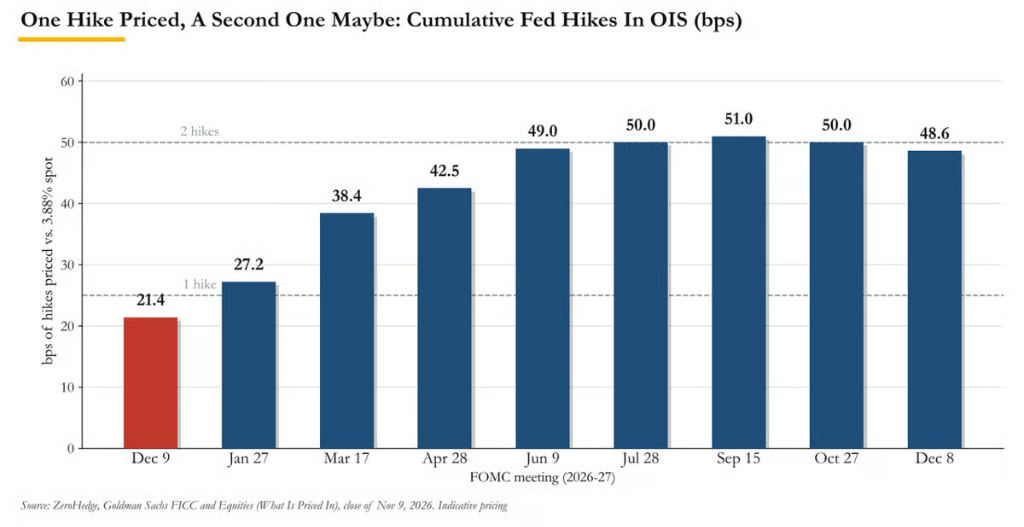
Goldman Sachs predicts that the core CPI for October will only increase by 0.16% month-over-month, far below the market's general expectation of 0.20%; UBS predicts 0.23%; and JPMorgan economist Mike Feroli also predicts 0.23%.
There are significant discrepancies among forecasts, and tonight's data will trigger considerable market volatility—according to data from Goldman Sachs' trading division, the implied volatility range for the S&P 500 on that day is about 80 basis points, with a contract value of about $60. It is noteworthy that this report will not be able to calculate year-on-year growth due to the lack of October data collected by the BLS because of last year’s government shutdown; the market trading will focus on the month-over-month core CPI data to two decimal places.
Three Subcategories Dragging Down Core Inflation
Goldman Sachs predicts that the core CPI this month will significantly decline from 0.33% in September, mainly driven by three subcategories.
In terms of airfare prices, the online fare data tracked by Goldman Sachs shows a month-over-month flat trend for October. Due to a substantial increase in aviation fuel prices, airfare prices averaged a monthly increase of 2.5% over the first nine months of this year, but growth stopped this month.
Regarding health insurance, the BLS will include a semi-annual update of source data from insurance companies in the October report. Goldman believes this update will lead to a 2.5% decrease in health insurance prices, which will continue to record large negative values over the next six months until the next reset in April of next year. This will cause medical service prices to decline overall by 0.1%, and medical services make up about 9% of the core CPI, making this impact significant.
It is noteworthy that this subcategory uses source data different from PCE, so this downward effect will not transmit to the core PCE metric that the Fed prioritizes.
In the automotive sector, Goldman Sachs predicts that used car prices will decline by 1.5% (based on auction price data), new car prices will increase by 0.1%, and auto insurance prices will drop by 0.3%. Estimating with a 3% weight, the used car category alone could lower the core CPI by about 4.5 basis points.
The Statistical "Ghost" Left by the Government Shutdown
A technical factor complicates the interpretation of this data.
Due to last year's government shutdown, the BLS could not collect price data for October 2025, necessitating a recalculation of seasonal adjustment factors. The BLS used the geometric average of the indices for September and November 2025 to fill the gap, inadvertently lowering this month's seasonal adjustment baseline.
Goldman Sachs estimates that this statistical distortion will inflate the seasonally adjusted core CPI reading for October by about 5 basis points, with especially clear impacts on subcategories like public transportation, clothing, and hotel accommodations.
If this 5 basis points of statistical noise is stripped away, Goldman’s "actual" core inflation is closer to 0.11%. Bloomberg Economics has specifically constructed an independent price tracking index to compensate for the rupture in the official series.
Key Divergence Between CPI and PCE
Even if tonight's CPI data appears weak, whether this is enough for the Fed to halt rate hikes remains an open question.
Goldman Sachs points out that the core PCE month-over-month increase corresponding to its CPI prediction is 0.23%, higher than the core CPI's 0.16%. The reason is that the weight of used cars in PCE is relatively low, while source data for categories like airfare, auto insurance, and health insurance are expected to still show increases. UBS also predicts the core PCE for October to be 0.20%, corresponding to an annual rate of about 3.1%.
This means that even if CPI data signals a cooling of inflation, the core PCE, which the Federal Reserve focuses on, may still remain relatively high, making it difficult to provide sufficient justification for pausing rate hikes.
Market Trading Patterns and Asymmetric Risks
The core judgment of Goldman Sachs' interest rate strategist is that a strong labor market is a "prerequisite" for further Fed rate hikes, rather than a "deciding factor." Employment data opened the door, but only inflation data can guide the Fed inside.
Against a backdrop of highly priced hawkish expectations, there exists a clear asymmetry between market reactions triggered by soft data versus hard data.
Goldman Sachs assesses that if tonight's CPI surprises to the downside, the market may experience a relief rebound, but this rally might be erased after Friday's PPI data release—JPMorgan predicts a substantial month-over-month increase of 0.6% for October PPI; if the CPI data is unexpectedly strong, it could lock in December rate hike expectations under the pressure of systematic selling by CTAs, triggering a more intense market response.
From a broader macro perspective, the core factors driving the CPI softening—the reset of methodologies for health insurance and the decline in used car prices—have limited transmission to the Fed's preferred core PCE indicator. Meanwhile, consumer inflation expectations remain close to three-year highs, with PPI significantly above CPI. To two FOMC members who have clearly supported rate hikes, a core CPI of 0.16% might only evoke momentary market cheers, failing to fundamentally change their policy stance.
免责声明:本文章仅代表作者个人观点,不代表本平台的立场和观点。本文章仅供信息分享,不构成对任何人的任何投资建议。用户与作者之间的任何争议,与本平台无关。如网页中刊载的文章或图片涉及侵权,请提供相关的权利证明和身份证明发送邮件到[email protected],本平台相关工作人员将会进行核查。


