Author: Nancy, PANews
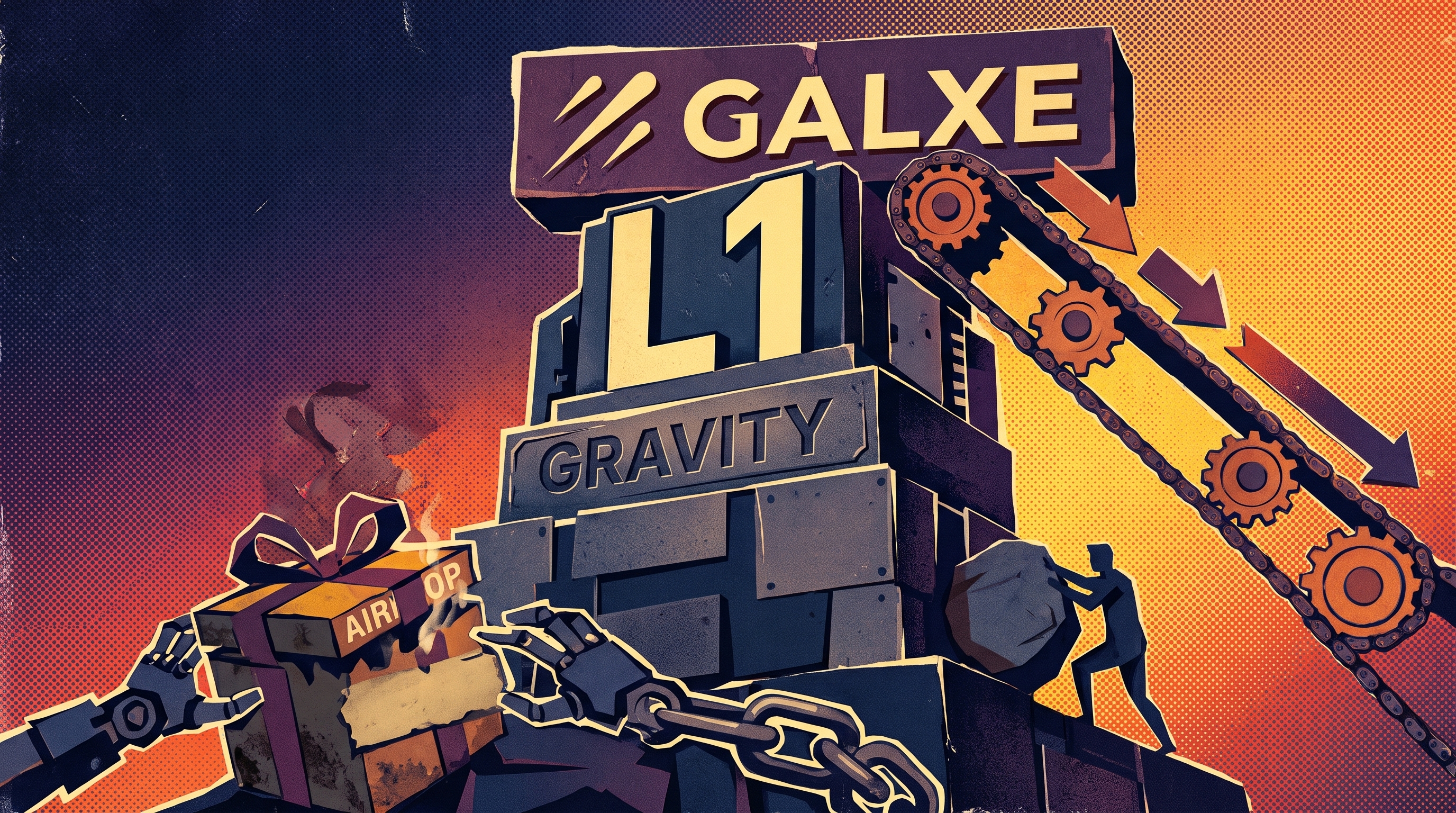
The once "magic tool" for harvesting rewards, Galxe, has now also come to the point of shutting down its services.
From the normalization of abuse to the spread of shutdowns, reward hunters have long sensed the chill. After POAP announced its shutdown in August, now this veteran task platform that has accompanied countless users has also pressed the stop button, marking the end of a collective memory from a cryptocurrency cycle.
As it bids farewell to the airdrop era, Galxe is shifting its focus to the L1 public chain Gravity, attempting to open a new growth story. However, faced with numerous strong competitors in the public chain arena and the reality that its own ecosystem still needs improvement, the transition for Gravity is likely not going to be easy.
Galxe presses the stop button, 36 million users' airdrop memories
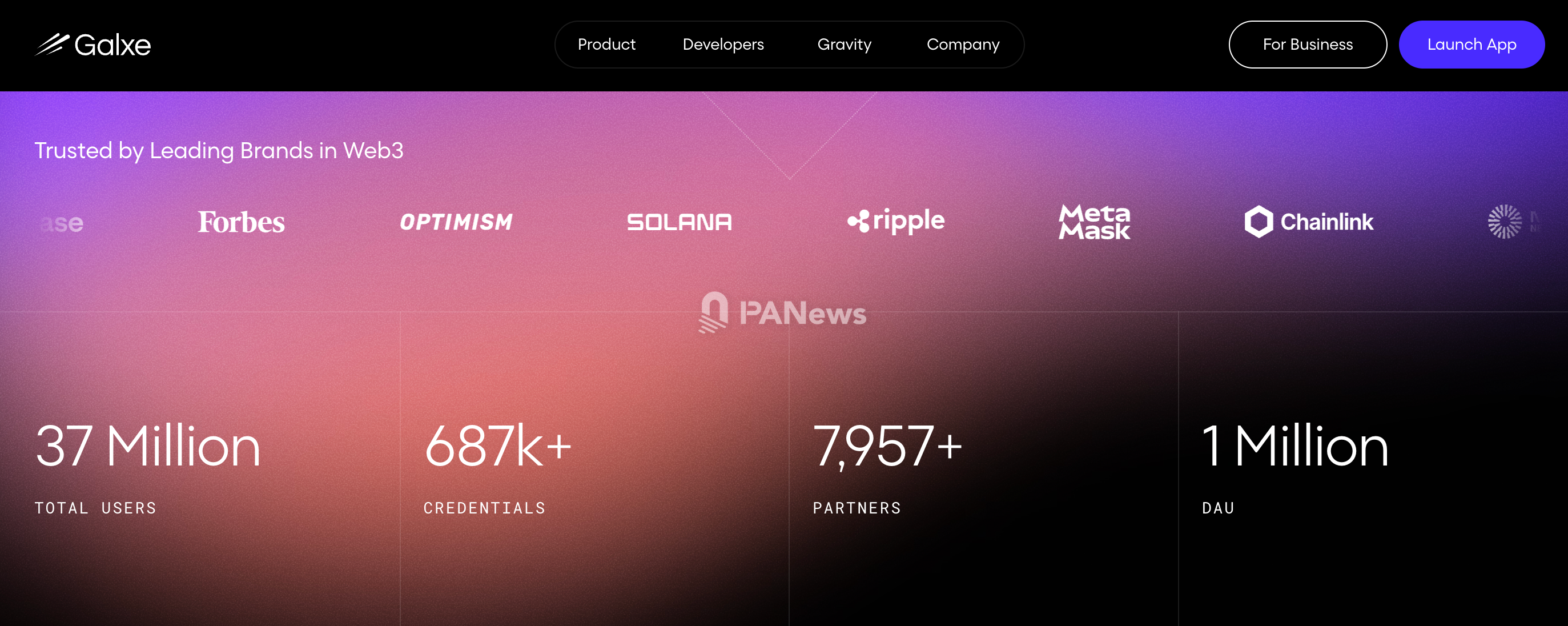
36 million users, over 7,700 cooperative projects, and more than five years of time, these figures record the glory of Galxe and witness the process of the rise and fall of the Web3 airdrop economy.
On November 9, Galxe officially announced that its team and brand would be integrated into Gravity. As part of this adjustment, Galxe Quest, Galxe ID, Galxe Passport, and related services will gradually cease operations, while Gravity will continue to run normally, and the G token will not change due to this adjustment.
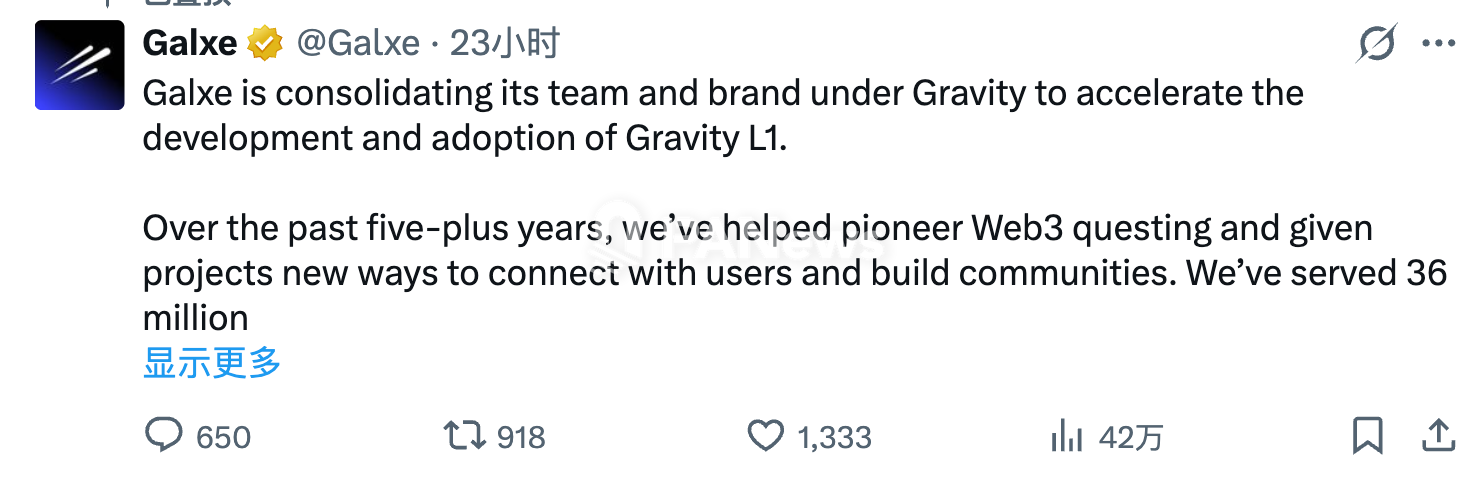
Currently, Spaces has stopped creating new events, Galxe+ and Galxe Score no longer accept new subscriptions, and Galxe Passport has also ceased minting. December 5, 2026, will be the last day for users to participate in events, at which point the reward collection channel will also be closed, and the entire website will subsequently enter read-only mode. Users need to claim any rewards that have not yet been credited before this deadline.
Galxe stated that Smart Savings balances, unclaimed staked G, and G tokens in the Gravity Alpha mainnet wallet are all safe, and the process and timeline for claiming related assets will be announced separately.
The end of Galxe is somewhat lamentable. For many reward hunters, Galxe was almost the representative entry point for interacting with tasks and airdrops in Web3 over the past few years. From early sign-ins and social tasks to later on-chain interactions and point accumulation, countless users have left their interaction records here.
After the shutdown news was announced, some displayed their accumulated Passport badges and high-score records over the years, while others shared their previous airdrop earnings and reminisced about those late-night task-running days, lamenting that their youth had come to an end; some expressed that this was their first stop after entering the circle, and the place where they seriously engaged in tasks. Even if they ultimately did not achieve major results, those experiences of participation and interaction became a part of their crypto journey.
Once favored by capital, Galxe's five-year rise and fall
The story of Galxe began in 2021.
Initially named Project Galaxy, the project was originally positioned as an open credential data network, transforming user behavior into verifiable Web3 on-chain resumes by integrating on-chain and off-chain behavioral data, helping project teams identify users, build user profiles, and conduct community growth activities. In this phase, Project Galaxy launched certificate NFTs, OATs, and other products.
In September 2022, Project Galaxy officially rebranded to Galxe, upgrading its positioning to a Web3 community growth infrastructure and continuously expanding its product line with the introduction of Quest, ID, Passport, Score, and other products, gradually forming a product matrix covering task activities, identity verification, user data, and community incentives.
For Web3 projects at that time, Galxe provided a relatively mature set of user growth tools, significantly lowering the barrier for project teams to reach users, making it an important entry point for community operations and airdrop activities. During that time, many mainstream Layer2 projects and emerging public chains leveraged Galxe to conduct early user growth activities. For ordinary users, Galxe was an important channel for discovering new projects, participating in early interactions, and acquiring potential airdrops, with the platform fostering a culture of multi-account interaction, task accumulation, and credential collection.
As the number of crypto users and projects grew rapidly, Galxe welcomed large-scale expansion, becoming one of the representative infrastructures for Web3 tasks and community growth. During this period, Galxe cumulatively secured over $25 million in financing, with investors including well-known institutions such as Dragonfly, Multicoin Capital, Coinbase Ventures, Spartan Group, and Solana Ventures.
However, the growth model built on the airdrop craze could not sustain its early prosperity indefinitely. As the market environment changed, user demands shifted, and industry competition intensified, the growth dividends that Galxe relied on gradually faded, and the once bustling task ecosystem began to cool down.
On one hand, airdrop expectations gradually weakened, and the input-output ratio for harvesting rewards continued to decline. As participants increased and rewards diluted, coupled with projects significantly cutting back on airdrops or even reversing them, users invested substantial time and money without necessarily seeing returns, leading to a decline in participation enthusiasm.
On the other hand, project teams began to reassess the actual conversion effects of task activities. The proliferation of bot accounts and bulk interactions led to a disconnect between task data and real user needs, with many users participating solely for rewards and not retaining afterward, making it difficult for the traffic brought by task platforms to convert into long-term users and ecological value.
Furthermore, as the crypto market continued to cool, project financing and ecological expansion slowed down, leading many projects to scale back operations or even halt. The growth flywheel driven by airdrop incentives gradually lost its momentum.
To some extent, the demise of Galxe is a microcosm of the withdrawal of the Web3 airdrop economy from the traffic frenzy.
Fully betting on L1, can Gravity take over the growth banner?
This former Web3 growth star, after bidding farewell to the airdrop era, is shifting its focus for the next stage of development to Gravity, attempting to initiate a new growth path by accelerating Gravity L1's development and ecological adoption.
As early as 2024, Galxe announced the launch of the Gravity Alpha Mainnet built on the Arbitrum Orbit technology stack, swapping the original governance token GAL for the new token G at a ratio of 1:60.
Initially, Gravity was primarily developed by Galxe to address Web3 multi-chain interactions, cross-chain settlements, and user experience issues, serving as a technical support role for Galxe's product ecosystem. To further promote ecological development, Gravity launched a $5 million developer grant program and a $50 million ecological fund in succession, attempting to attract more developers and projects to join.
As the project progressed, Gravity began its gradual transition to an independent L1. Compared to the previous Alpha Mainnet, the new mainnet underwent architectural upgrades in execution, consensus, and data validation, with the core goal of enhancing the network's transaction processing capability and finality.
Among these, the most attention-grabbing is Gravity's self-developed parallel EVM execution engine, Grevm. This engine improves network execution efficiency by processing transactions in parallel. At the same time, Gravity also introduced the AptosBFT consensus mechanism and native oracles, aiming to enhance network performance while reducing reliance on external infrastructure. According to official plans, Gravity L1 aims for a processing capacity of over 12,000 TPS and sub-second finality.
From a technical route perspective, Gravity is no longer satisfied with merely providing supporting services for Galxe, but hopes to become a general-purpose high-performance public chain. In July of this year, the Gravity L1 mainnet was officially launched. Meanwhile, the original Alpha mainnet Layer2 network will officially cease operations on November 1, 2026.
However, completing the technical and network architecture transition is just the first step. Now, mature public chains already occupy a significant market share, making it difficult for Gravity to break through in the fiercely competitive L1 track.
· The ecosystem heavily relies on Galxe, independent growth capability still needs to be established
The user and project resources accumulated by Galxe are a significant advantage for Gravity relative to other emerging public chains. By leveraging Galxe's task platform, Gravity can attract platform users for on-chain interactions. This model can bring transaction activity to Gravity in the short term and provide a relatively low-cost cold start channel for the new network. However, task-driven transaction activities do not equate to real application needs, nor do they mean that participants will stick around long-term.
At the same time, as Galxe's original task business gradually ceases, Gravity will also lose an important user reach and growth channel, needing to establish its own user growth mechanism and ecological appeal.
How to convert past accumulated traffic into real users, and further attract developers and applications to settle, pushing on-chain activities from short-term incentives to sustained real demand, will be key for Gravity to achieve independent development.
· The practical competitiveness of high-performance technology still needs to be tested by the market
Gravity positions high throughput, low latency, and parallel EVM as core technological advantages, but the high-performance public chain track is already highly competitive. In such an environment, merely increasing TPS is not sufficient to form a long-term competitive barrier.
For developers, choosing a public chain depends not only on execution efficiency but also on user scale, capital depth, infrastructure completeness, and application customer acquisition costs. For users, technical parameters themselves are also not likely to be a reason for continued use of a public chain; what truly decides users’ retention is whether there are sufficiently rich applications, liquidity, and actual usage demands on-chain.
· Token value capture still needs improvement
For a public chain, the network performance and ecological scale ultimately need to translate into real token demand to support its long-term value. The long-term performance of the G token also depends on the development of the Gravity network itself. However, at present, Gravity has not established a clear token value capture mechanism.
Meanwhile, the continued unlocking of the G token may also bring some supply pressure to the market. According to the token distribution and unlocking arrangements, the total supply of G is approximately 12 billion tokens, with about 15 million tokens still locked, and the unlocking process will continue until 2028.
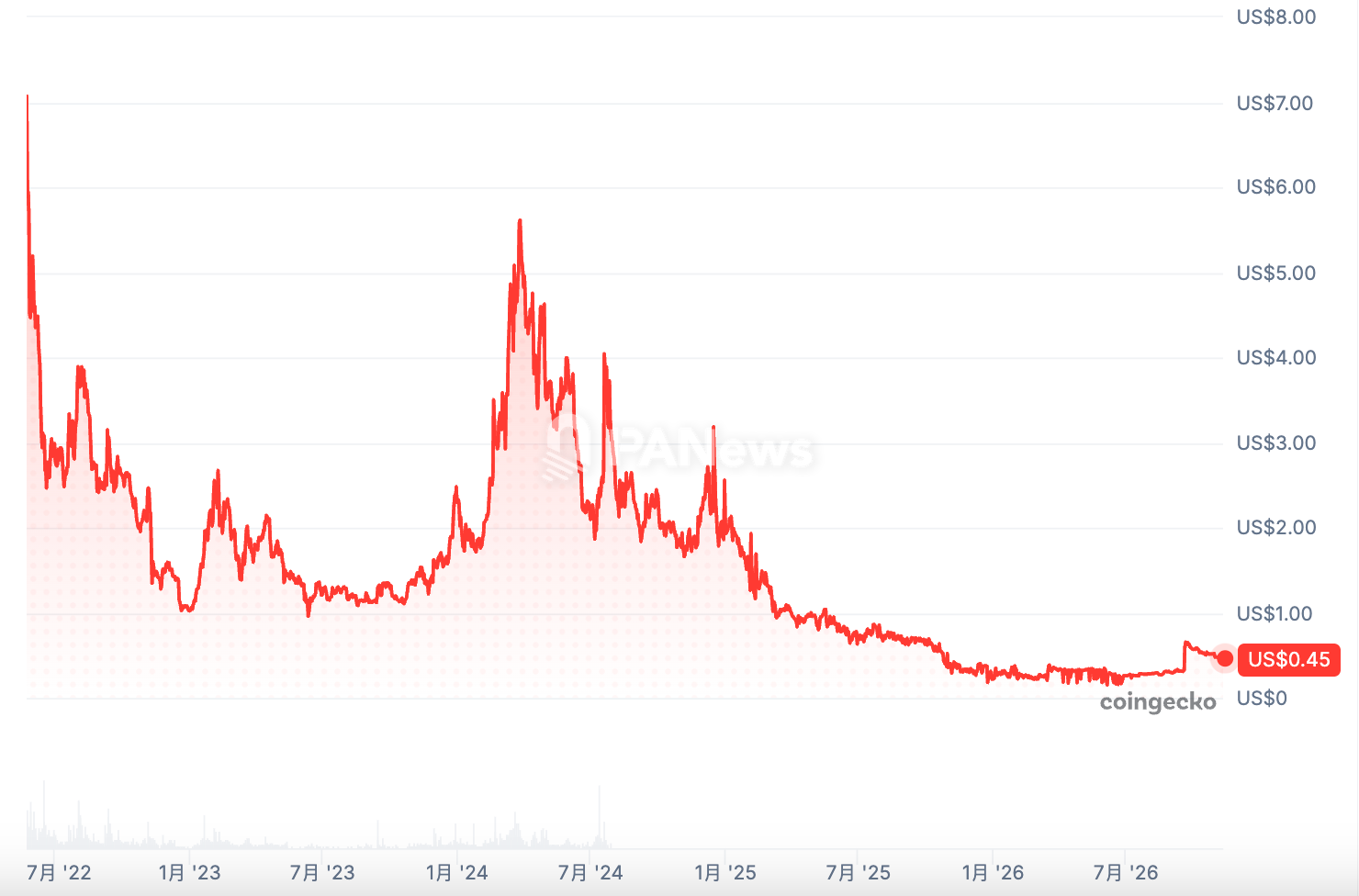
From a market performance perspective, the G token has continuously retracted significantly since its peak of $18.3 in 2024, with a cumulative decline of over 97.5%, and the current price has dropped to around $0.45.
In summary, for Galxe, shutting down its old business may signify the end of a phase; but for Gravity, the real test is just beginning.
免责声明:本文章仅代表作者个人观点,不代表本平台的立场和观点。本文章仅供信息分享,不构成对任何人的任何投资建议。用户与作者之间的任何争议,与本平台无关。如网页中刊载的文章或图片涉及侵权,请提供相关的权利证明和身份证明发送邮件到[email protected],本平台相关工作人员将会进行核查。


