Author: rektdiomedes
Translation: Deep Tide TechFlow
Deep Tide Introduction: Since the U.S. Federal Reserve's interest rate hike in 2022 and the successive collapses of Luna and FTX, the crypto industry has shifted towards emphasizing cash flow and "real yield," even valuing Ethereum using traditional price-to-earnings ratios. Recently, as Vitalik reiterated that $ETH should be based on decentralization and the core narrative of "store of value," the market has begun to reassess the imaginative space compressed by pessimism.
Specifically, the author uses the decentralized stablecoin $fxUSD created by Aladdin DAO as a starting point, analyzing its censorship resistance, privacy-based cost-free transfers, and zero-interest leverage structure against the five major principles of CROPS. Looking towards the future of AI-powered high-frequency trading, this article discusses what market capitalization Ethereum and decentralized stablecoins will ultimately point to.

In recent days, two tweets have truly resonated with me and made me think deeply.
The first came from Vitalik regarding $ETH, where he articulated why the market should further rely on and reinforce Ethereum's narrative as a "store of value".
Citing @VitalikButerin (View Original Tweet): "Let’s discuss why I believe focusing on '$ETH as a store of value asset (SoV)' is much more reasonable than positioning it as a 'fee-burning token'."
"There are three core reasons: First, the logic of $ETH as a fee-burning token has never been as solid as it appears on the surface; second, the relentless pursuit of fee burning will inevitably force Ethereum to make compromises in mechanisms that conflict with decentralization and anti-capture."
"Third, optimizing around SoV completely aligns with Ethereum leveraging its most unique advantages (decentralization and CROPS)."
"EIP-1559 and its burning mechanism are good and should be retained, but even if the fee burning is below the breakeven point of 10% in the long run, there's no need to be discouraged. Ethereum's true moat lies in the certainty derived from decentralization and CROPS; in the age of upheaval brought by AI, this stability will be highly valued."
Seeing Vitalik's tweet made me very excited, not only because I highly agree with the reasoning presented, but because it urged me to reevaluate the entire crypto industry from a more macro perspective.
My core judgment framework is: essentially, since 2022, we have been in a long "dark age" of cryptocurrency.
It was in that year that Federal Reserve Chairman Powell initiated a radical interest rate hike (which, in my view, the still high rates are the biggest variable in the current market); shortly thereafter, Luna and FTX crashed one after the other.
The entire crypto industry was once declared dead by mainstream opinion, becoming a laughingstock for many, and was constantly tagged with labels like "air concept" and "debunked worthless".
Because of this, in the face of this chaotic and highly scrutinized industry wasteland, we were eager to grasp anything that seemed "real".

Image: A meme depicting Jerome Powell, the U.S. Federal Reserve Chairman in 2022, riding a nuclear bomb in black and white.
The Emergence of "Real Yield" Narrative
The industry's dilemma and survival anxiety directly prompted us to embrace the narrative of "real yield".
We started to enthusiastically promote tokens like $GMX and $GNS that genuinely generate organic protocol income and distribute cash flow dividends to holders (I must add that both are high-quality assets I was very proud to hold).
Suddenly, the market submerged itself in the obsession of viewing $ETH as a "yield-maximizing machine", and this new narrative was elevated as the core bullish basis for Ethereum.
To be fair, the industry's shift to focus on "real yield" was overall a good thing and an important step toward maturity for the crypto market.
However, the reality is that the value embedded in cryptocurrencies far exceeds this. As this "dark age" continues to prolong, we have forgotten a higher-dimensional value proposition, and the current debate surrounding $ETH's valuation logic vividly reflects this collective amnesia.

Image: A community meme from late 2022 to early 2023, where three girls pray devoutly towards a GMX-style blue avatar in a picture frame, reflecting the market's worship of "real yield", even valuing $ETH like a traditional railroad stock.
Fully Amplifying Imagination
It is understandable to use the "real yield" framework to interpret $ETH, but the fundamental issue is:
Ethereum is neither a chain self-service laundry nor a pest control company, and certainly not a competitor of Walmart or Home Depot.
The traditional "price-to-earnings ratio (P/E Ratio)" is simply not an effective valuation model applicable to Ethereum.
On the contrary, $ETH is the decentralized and permissionless economic aether behind the forming human "hive mind consciousness" of the internet.
Our species has evolved a completely new level of consciousness, which is precisely the era picture shaped by the internet and AI.
Within this new framework, Ethereum occupies the core position of the foundational economic infrastructure, set to serve billions of humans and billions of AI entities to perform value transactions, exchanges, creations, and storage.
And $ETH not only represents the "fuel" that drives the rapid operation of this magical universe, but also signifies "partial ownership" of this large network ecosystem itself.
This is the foundational root of Ethereum's value, and it is the essence of the "store of value" narrative that Vitalik vigorously defends in the previous tweet.

Image: A meme showing Pepe the Frog in a blue wizard's robe waving in a library, invoking the glow of a magical tome, symbolizing how crypto natives hold the "magic" that can change the financial landscape.
What we truly need to do is to open up the framework and escape the current mindset of being in the "crypto dark age".
From this perspective, $ETH truly deserves a market cap on par with gold and should far exceed any single tech giant like Apple ($AAPL) or Microsoft ($MSFT).
This judgment might seem overly ambitious now, but 30 years ago when people first envisioned the internet or even just 10 years ago when general AI was discussed, wasn't the external world also filled with skepticism about such lofty dreams?
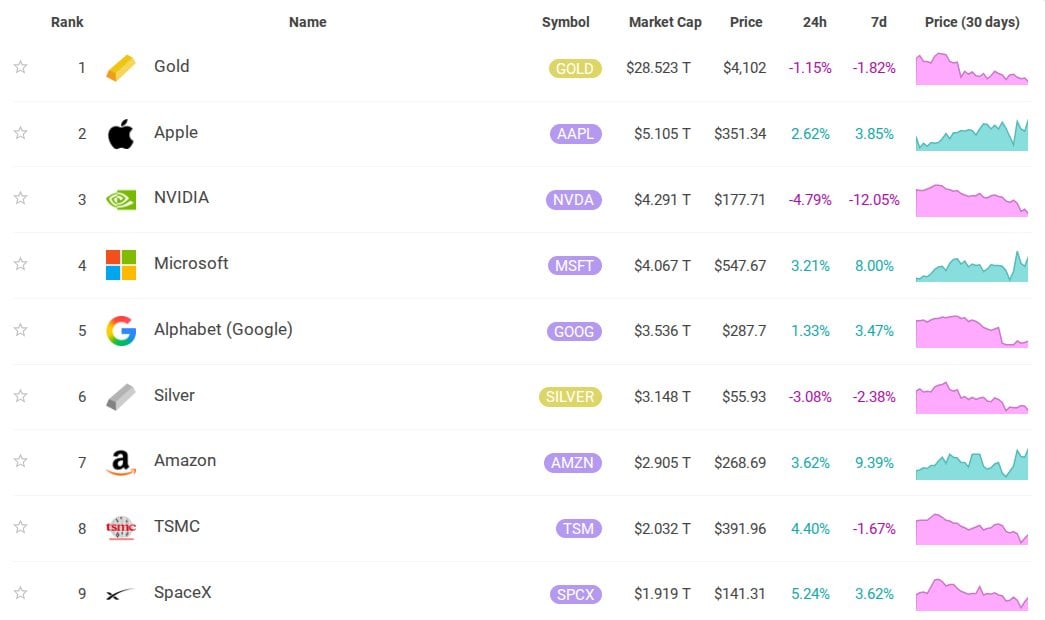
Image: A screenshot from the global asset market value ranking, where gold ranks first with $28.52 trillion, while giants like Apple, Nvidia, and Microsoft follow, the author believes $ETH's ultimate market value should be among the top alongside gold.
Entry and Evolution of Stablecoins
The second tweet that resonated strongly with me came from my friend @cyrille_briere (working at @protocol_fx), focusing on the decentralized stablecoin $fxUSD developed by their team.
This tweet perfectly aligns with Vitalik's viewpoint since the development of stablecoins itself is closely intertwined with $ETH and the aforementioned "economic aether".
In this sense, stablecoins can be seen as a culmination of hundreds of years of monetary history and countless free currency ideologies.
As Austrian School economist Friedrich Hayek once wrote: "I believe we can never have really good money again until we take the issuance of money out of the hands of government."
"We cannot simply use violence to forcefully take money from the government; the only feasible way is to introduce something through some clever detour that they cannot stop."
This spark of the idea to build a "permissionless, decentralized alternative to escape government fiat manipulation" was the core driving force behind Bitcoin's inception.
However, relying solely on Bitcoin itself is still not sufficient to support all the financial conditions needed to unlock the full potential of cryptocurrencies.
As pointed out by an early industry participant in an early discussion article on decentralized stablecoins: "Many enterprises have extremely thin profit margins and cannot withstand BTC's drastic price fluctuations; low-income groups often lack the ability to save and highly depend on cash for stable purchasing power between paydays."
"Therefore, stablecoins with censorship resistance will become extremely valuable financial tools that can replace physical cash and bank accounts, as well as serve as short to medium-term savings assets, complementing BTC which acts as a long-term savings vehicle. Perhaps one day BTC will stabilize to the point where stablecoins are no longer needed, but until then, decentralized stablecoins supported by BTC occupy a legitimate and significant position."
Clearly, this discussion was primarily centered around $BTC at that time.
However, since then, I believe $ETH has replaced the role that $BTC once held on various practical dimensions.
Today, Ethereum has become the main underlying economic settlement network for holding and circulating stablecoins, and is also the core on-chain store of value collateral supporting decentralized stablecoins.
As I jokingly noted in the following "Ethereum Chef" meme: while Bitcoin certainly has a mythically "flawless genesis" origin that makes it hard to completely forsake; facing reality, the vast majority of true "crypto activity" now occurs on Ethereum, which is rapidly becoming a better value storage vehicle.
If back then it had been possible to run "EVM" on Bitcoin, everyone would have been pleased; but the fact is that this path has never been feasible, and Ethereum has clearly established itself as the "world computer".

Image: A tough guy image in black and white wearing a chef hat with the Ethereum logo, metaphorically suggesting that Ethereum has taken over as the "world computer" for on-chain economy and stablecoin settlement.
Meanwhile, decentralized stablecoins have also faced many heavy lessons along their evolutionary path, with the most memorable being the brutal collapse of Luna and its $UST.
This disaster prompted Vitalik to write a special article exploring the principles of decentralized stablecoins in May 2022, in which he commented:
"Indeed, there are many automated stablecoin designs that simply do not work and are destined to collapse, as well as many theoretically viable yet extremely fragile high-risk models; yet there are also numerous stablecoins that are theoretically extremely robust and have withstood extreme market conditions in reality. What we need is neither blind fervent praise nor total pessimism but a return to rigorous designs based on first principles."
Almost concurrently with Vitalik writing this passage, I myself plunged into a fervent study of stablecoins, at that time I believed stablecoins were the most core and bullish super variable of the entire crypto industry.
Author's Retrospective Old Post (@rektdiomedes): I published a long post titled "Ten Reasons Why Stablecoin Market Cap Will Eventually Exceed $10 Trillion" back in August 2022, explaining the economic and social structural motives behind the explosive growth of stablecoins in the next 5 to 10 years.
The Current Landscape: The Birth of $fxUSD Amid Crisis
In the years since Vitalik made the above judgments, although the entire crypto market has continued to languish in the so-called "dark age", the stablecoin space has never stopped iterating, with increasingly sophisticated technology and risk control mechanisms. As of 2026, most of the mechanism issues that previously plagued the industry have been overcome.
Currently, the industry naturally faces new challenges (such as North Korean hacker attacks, quantum computing threats, and recent rampant spy rumors), but strictly speaking in terms of stablecoin design, we already have mature industrial-level solutions and a range of excellent products.
On one end of the product spectrum, there are more centralized yet enormous giants (like $USDT and $USDC), whose growth ceilings are almost limited only by the underlying amount of U.S. Treasury holdings; on the other end are highly decentralized, permissionless protocols that directly leverage native crypto value storage assets like $ETH for full collateralization.
Among this latter class of decentralized camp, I believe the most outstanding representative is the $fxUSD launched by @protocol_fx.
$fxUSD was meticulously crafted by the top tech team of Aladdin DAO, and from the very first day of the project, it has aimed to become the ultimate choice for all users seeking genuine decentralization and permissionless censorship resistance.
As the team describes in their official declaration: "f(x) Protocol was born at the height of the USDC decoupling crisis, with a simple yet radical original intention: to build a 'last line of defense' stablecoin that can operate as usual in any extreme environment."
"fxUSD does not rely on any commercial bank, does not depend on any sovereign government, nor requires manual intervention in operations. It is fully backed by ETH and WBTC collateral, and every line of its operational logic can be publicly verified on-chain, even if the entire centralized financial system comes to a halt, it can still operate indefinitely."

Image: Gothic church stained glass artwork with @protocol_fx logo, $fxUSD developed by AladdinDAO team.
Why $fxUSD Is the Best Stablecoin in Today's DeFi
I firmly believe that $fxUSD has become the most excellent stablecoin in today's DeFi ecosystem and is poised for a comprehensive surge in scale in the coming years.
This is precisely the main topic of the tweet from @protocol_fx core member @cyrille_briere mentioned earlier.
Click here to see the full tweet, and below is a brief screenshot of the key data it presents:
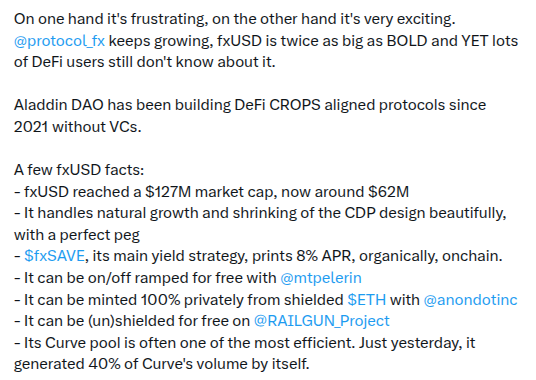
Image: Screenshot of @cyrille_briere's tweet introducing AladdinDAO's zero venture capital involvement since 2021, along with the progress of $fxUSD reaching a peak of $127 million (around $62 million at the time), and around 8% organic annualized and zero-fee fiat deposits and withdrawals.
As he emphasized in the tweet, AladdinDAO, as a long-term builder, has always stood at the heart of Ethereum's alignment with the "CROPS" concept, and if we apply this assessment system to evaluate $fxUSD, its score is remarkably high across all dimensions.
To briefly review, the five letters in "CROPS" represent the five principles that Ethereum values most:
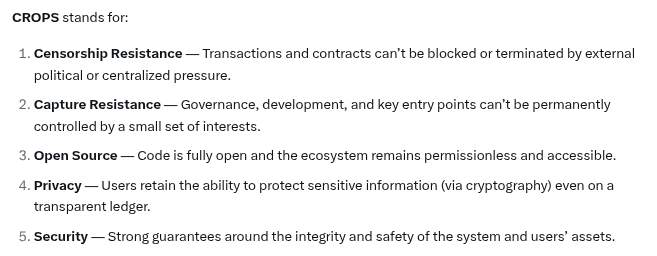
Image: Screenshot of the list of CROPS' five core values, which are censorship resistance, capture resistance, open source, privacy, and security.
Censorship Resistance and Capture Resistance: $fxUSD does not have a centralized issuer like $USDT or $USDC that can freeze accounts or blacklist addresses.
Its minting and redemption operate in a permissionless manner relying entirely on $ETH and $WBTC collateral; no single entity can unilaterally seize funds or shut down the system.
Open Source: It is a complete open-source engineering model, with smart contract code running on the Ethereum mainnet and Base network fully visible, supported by transparent and comprehensive technical documentation, and all asset-liability status realizable on-chain in real-time.
Privacy: Besides naturally inheriting the permissionless attributes of on-chain DeFi, $fxUSD has also run at the forefront of the new narrative of "stablecoin × privacy payment" through deep collaboration with @RAILGUN_Project (see the two dynamic posts below for details).
Citing @cyrille_briere (Original Tweet): In May 2026, for the first time in DeFi history, a privacy-focused decentralized stablecoin was minted on Ethereum, achieving a fully untraceable on-chain collateral lending process (see view on-chain transaction hash).
Citing @protocol_fx (Original Tweet): Many have given up on Ethereum's privacy features due to high costs, yet $fxUSD deployed on @RAILGUN_Project comes with fully subsidized entrance and exit pool fees by the protocol using $FXN monthly, making it the lowest-cost trustless privacy transfer tool on Ethereum.
Security: This might be the most solid defense for $fxUSD. The protocol uses the f(x) constant formula to achieve endogenous over-collateralization, pioneering a soft liquidation/rebalancing and "liquidation brake" mechanism to avoid cascading liquidation events, along with a concrete repayment safety net that provides ensure clear repayment pathways.
Moreover, thanks to AladdinDAO team's extreme and rigorous requirements for engineering safety, over the past five years they have built and maintained multiple complex protocols while still maintaining a zero-security-vulnerability theft record (as always, knock on wood for blessings).
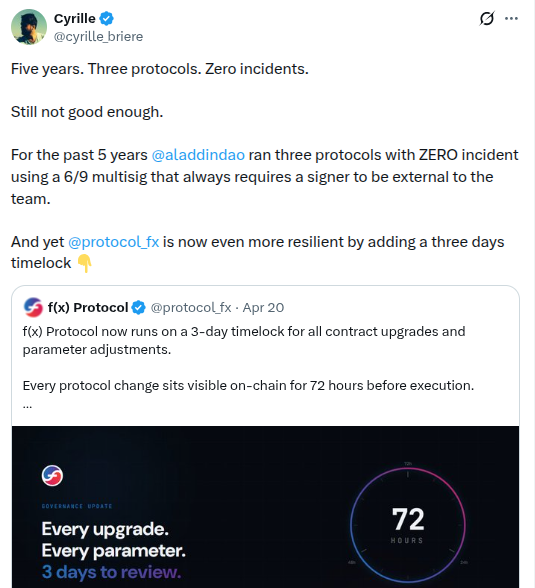
Image: Screenshot of @cyrille_briere retweeting @protocol_fx, emphasizing five years and three protocols of zero-incident record, disclosing that contract upgrades and parameter changes have introduced a 72-hour time lock and multi-signature protection.
Furthermore, fundamentally, $fxUSD has shown dominant performance in exchange rate anchoring.
While many decentralized stablecoins on the market experience severe fluctuations alongside market volatility, even in recent extreme market conditions, $fxUSD's price anchoring has remained solid as a rock (see the actual tweet feedback from my good brother @PhilMrlo below, and don’t forget to follow him too).
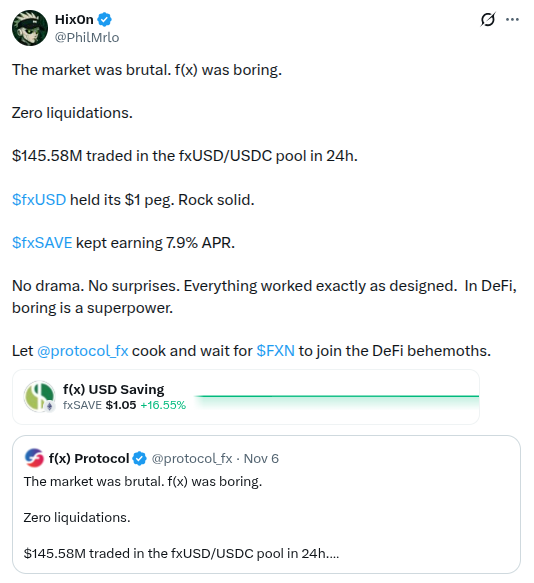
Image: Screenshot of tweet shared by user @PhilMrlo, praising that even amidst drastic market fluctuations, $fxUSD still maintains its $1 peg and zero forced liquidation; the Curve platform's fxUSD/USDC pool hit a 24-hour trading volume of over $145 million.
Not only does it exhibit remarkable stress resistance, but as shown in his post, recently $fxUSD's trading volume on Curve has also surged explosively, with the fxUSD/USDC liquidity pool frequently topping the daily trading volume leaderboard of this established decentralized exchange:
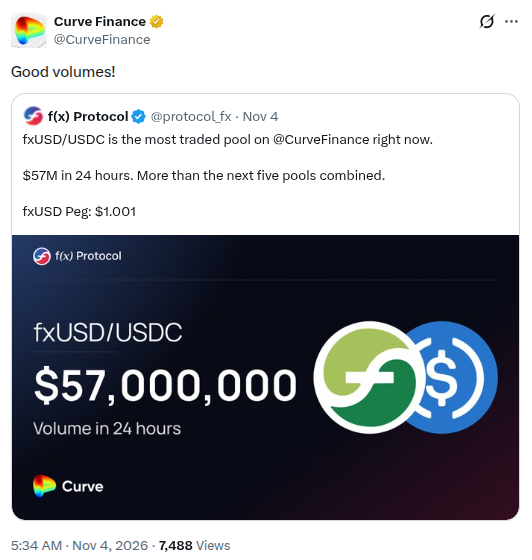
Image: Screenshot of Curve's official Twitter reposting @protocol_fx's data poster, showing that the fxUSD/USDC single pool had a 24-hour trading volume of $57 million, ranking first across the entire platform, with the pegged exchange rate at $1.001.
Even more exciting is that @protocol_fx's intricate protocol structure and solid practicality continue to create the most fertile yield strategy soil in today's crypto market.
The root of all these yields comes from the stable organic annualized yield (APY) of 6% to 9% from fxSAVE. Once leveraged through circular loan strategies, this yield can be significantly magnified; if further linked with Pendle for yield splitting (Pendle-maxxing), the ceiling becomes astonishingly high.
The following tweet from early October clearly dissected the specific operational path, and in the subsequent weeks up to today, this highly cost-effective high-yield strategy has been running steadily:
Citing @protocol_fx (Original Tweet): Teaching how to disassemble over 43% of stablecoin annualized yield.
On Morpho, borrowing USDC while collateralizing fxSAVE at a cost of 4.13% and depositing back into fxSAVE (base yield 6.59%), when leveraged 10 times, can reach 28%+, and then switching to Pendle's PT-fxSAVE can exceed an annual return of over 43%.
Additionally, as @protocol_fx becomes better known, more DeFi traders are discovering a particularly enticing feature: they can directly collateralize $ETH or $WBTC here to enjoy 0% borrowing interest (only requiring extremely low opening and closing fees), which also drives the long-term market value of $fxUSD upward.
Citing @protocol_fx (Original Tweet): A direct comparison of funding costs for holding leveraged long positions in $ETH or $BTC.
Borrowing USDC on Aave incurs an annual interest rate as high as 10.4%; borrowing $1 million requires paying about $104,000 in annual interest; instead, using f(x) xPOSITION has a funding fee rate of 0%, directly reducing annual interest expenses to zero.
More Bullish Catalysts for the f(x) Ecosystem
Beyond the aforementioned fundamentals, @protocol_fx is currently advancing construction in multiple promising new directions.
First, the team is highly focused on the upcoming AI intelligent economy (agentic economy), aiming to establish $fxUSD as the preferred settlement stablecoin for transactions between machine intelligences.
In fact, earlier this year, the team wrote a thought-provoking and deep article focusing on this track worth reading:
Citing @protocol_fx X Long Article (Click Here to View Original Post): "The Great Decoupling: Why AI Agents Won't Use 'Human' Money", which sharply points out the complete disruption of traditional human financial systems as core commercial and payment subjects transition from humans to high-speed autonomously operating AI agents in the future.
Second, the team is moving to mature its specialized clearance protection technology (previously supporting up to 7 times low-friction leveraged trading in CDP architecture) and completely transplant it to the new sister project @FX100Perp.
@FX100Perp has just completed a well-received testnet practical phase and is now pushing full speed for the upcoming mainnet launch.
It will continue to rely on this anti-liquidation protection core while allowing up to 100 times maximum leveraged trading and providing a 15-minute golden liquidation protection window, fundamentally eliminating the injection failure pain points of traditional perpetual contract leverage models.
This design is extremely cutting-edge, and interested friends can explore further through the tweet below or by visiting fx100.club.
Citing @FX100Perp (Original Tweet): Just as an F1 car can save the entire race by making a precise pit stop, FX100's unique 15-minute liquidation buffer allows traders to rescue their positions calmly; the team is currently in a six-week pre-mainnet practical task season at Guild.
Overall, I believe that the $FXN ecosystem has already firmly established its position as one of the most exciting DeFi projects in the current crypto world and perfectly demonstrates how far we should look when evaluating the industry's future.
A Vast Incremental Future Before Us
Let me reiterate: In my view, we have been trapped in the dark age of the crypto industry for the past four years.
As for when this dim period will truly flip the page (though I vaguely suspect that it all roots back to the Federal Reserve's interest rate cycle, waiting for capital costs to decline naturally to welcome a turning point), I cannot give a precise date; but my long-term belief in the crypto industry's final outcome is entirely different from its current lethargy.
I genuinely believe that in the future real world, the vast majority of physical and daily "real work" will be carried out by AI and robots, leading to a structural radical shift in the focus of human economic activity.
Indeed, there will still be some economic activities based on genuine face-to-face interactions between people offline, but the vast majority of value creation and circulation will irrevocably migrate into the internet's "hive mind consciousness" network that covers all of humanity.
In fact, this migration has already begun: 15 years ago, very few people could rely solely on the internet for all their income, but today this group of digital natives has become a considerable force to be reckoned with.
Looking ahead 15 years, I believe that the vast majority of humanity will primarily rely on the online world to generate income, and alongside them will be billions of uncountable AI entities initiating transactions every second.
When that era arrives, Ethereum will naturally serve as the foundational economic settlement layer and the driving fuel for that colossal online world.
It will become the magical "aether" blood that maintains the smooth flow of this global consciousness economy, and at that time, the corresponding market value it carries is entirely expected to leap upward by 100 times or more, and it is quite possible that it will surpass gold.
And on the same historical timeline, stablecoins will also fully realize their fate of "devouring the traditional financial world".
By that time, the vast majority of sovereign fiat currencies in the world will either have already disappeared or be on the brink of accelerating decline, and in their place will be various shapes and types of efficiently circulating stablecoins.
In this new currency landscape, there will still be giants like $USDC and $USDT backed by U.S. Treasury, but at the same time, fully collateralized native stablecoins that align perfectly with CROPS principles, decentralized, and permissionless, relying on high-quality crypto assets like $ETH will also hold a significant portion of the market.
Looking across the entire DeFi space, I believe no other decentralized stablecoin is more suited to take up this banner than $fxUSD.
Following this ultimate blueprint, $fxUSD has ample room to achieve another 100 times, 1000 times, or even more exaggerated expansions based on the current foundation; if that comes to pass, the governance token $FXN supporting the @protocol_fx ecosystem and many high-quality crypto assets praised by you and me will also usher in unimaginable waves of revaluation.
Ultimately, it seems that all our current ambitions are too small and too conservative.

Image: An illustration of a golden sailboat shrouded in colorful neon clouds symbolizing "amplifying imagination".
Disclosure of Interests and Disclaimer: I hold a substantial amount of $ETH and $FXN, and I am continuously and actively adding to these two assets while also being deeply involved in the collaborative work of the @protocol_fx team! Therefore, my projections in this article are 100% biased, and this article is also a rallying cry for my favored assets.
That said, every word I write is heartfelt and sincere: I am indeed a thoroughly, unabashed permabull.

Image: A meme of the author self-mocking as a "long-term permabull", pointing at the left tail of the normal distribution intelligence curve, marked "I'm here".

Image: A meme of the author self-mocking as a "long-term permabull", featuring a cartoon bull confined in a padded isolation room wearing a tight straitjacket.

Image: A real photo of a Belgium Blue cow with extremely exaggerated muscles, used by the author to self-mock as a "long-term permabull".
Conclusion
The "crypto dark age" that has lasted for years has unconsciously tamed all of us, locking everyone's imagination tightly within an extremely narrow cage.
We have learned to humbly pray every day for the market to rise just a little, to actively lower our grand dreams and aspirations for the industry, and even subconsciously equate "idealism" with "niche scale" and "doomed to struggle for mainstream recognition".
Yet all of this is fundamentally backward.
It is precisely the intrinsic idealistic brilliance of the crypto industry and the "big-picture perspective" that dares to reshape the old order that constitute its original captivating spirit.
Humans inherently long to believe in something that can truly change the world, and that is the most true mission of cryptocurrencies.
In the past few years, AI has undoubtedly stolen the spotlight of the entire world, but it is essentially just a side of the truth of a larger era: technological progress is racing forward at lightning speed, and the entire world is undergoing unprecedented thorough transformation.
It's just that in this brief period of confusion, we forgot that cryptocurrencies were also a brilliantly shining point in this technological upheaval; however, it won't be long before everything will once again become self-evident, and at that time, we will probably chuckle at our former doubts and hesitations.

免责声明:本文章仅代表作者个人观点,不代表本平台的立场和观点。本文章仅供信息分享,不构成对任何人的任何投资建议。用户与作者之间的任何争议,与本平台无关。如网页中刊载的文章或图片涉及侵权,请提供相关的权利证明和身份证明发送邮件到[email protected],本平台相关工作人员将会进行核查。


