
Author: stein
Translation: Shenchao TechFlow
Shenchao Guide: In the accelerating fusion of crypto assets and real-world assets (RWA), tokenized U.S. stocks have quietly surpassed the $4.6 billion mark. However, beneath the surface of prosperity lies a highly concentrated underlying fact: over 91% of real stocks are held in the same U.S. compliant brokerage, Alpaca.
The decades-long pride of Wall Street in its "issuance, trading, brokerage, clearing" four powers separation structure is being completely disrupted by the end-to-end vertical integration model of crypto institutions. From immediate tokenization clearing workflows to top-tier institutions jointly pushing the SEC to modernize transfer agent rules, a fundamental reshaping touching the core arteries of traditional finance has already begun.

The Highly Concentrated Hidden Fact: Alpaca Monopolizes 91% of Tokenized U.S. Stock Custody
The real-world asset (RWA) sector is experiencing astonishing growth, with the tokenized U.S. stock market quietly climbing to a total scale of $4.6 billion.
However, it is little known that this seemingly vast ecosystem, built by dozens of decentralized protocols and financial technology platforms around the world, is highly reliant on a single entity.
According to the latest on-chain and regulatory filings, of the $4.6 billion circulating tokenized U.S. stocks in the market, as much as $4.17 billion (over 91%) of real underlying stocks are concentrated and held under a single licensed U.S. brokerage, Alpaca Securities.
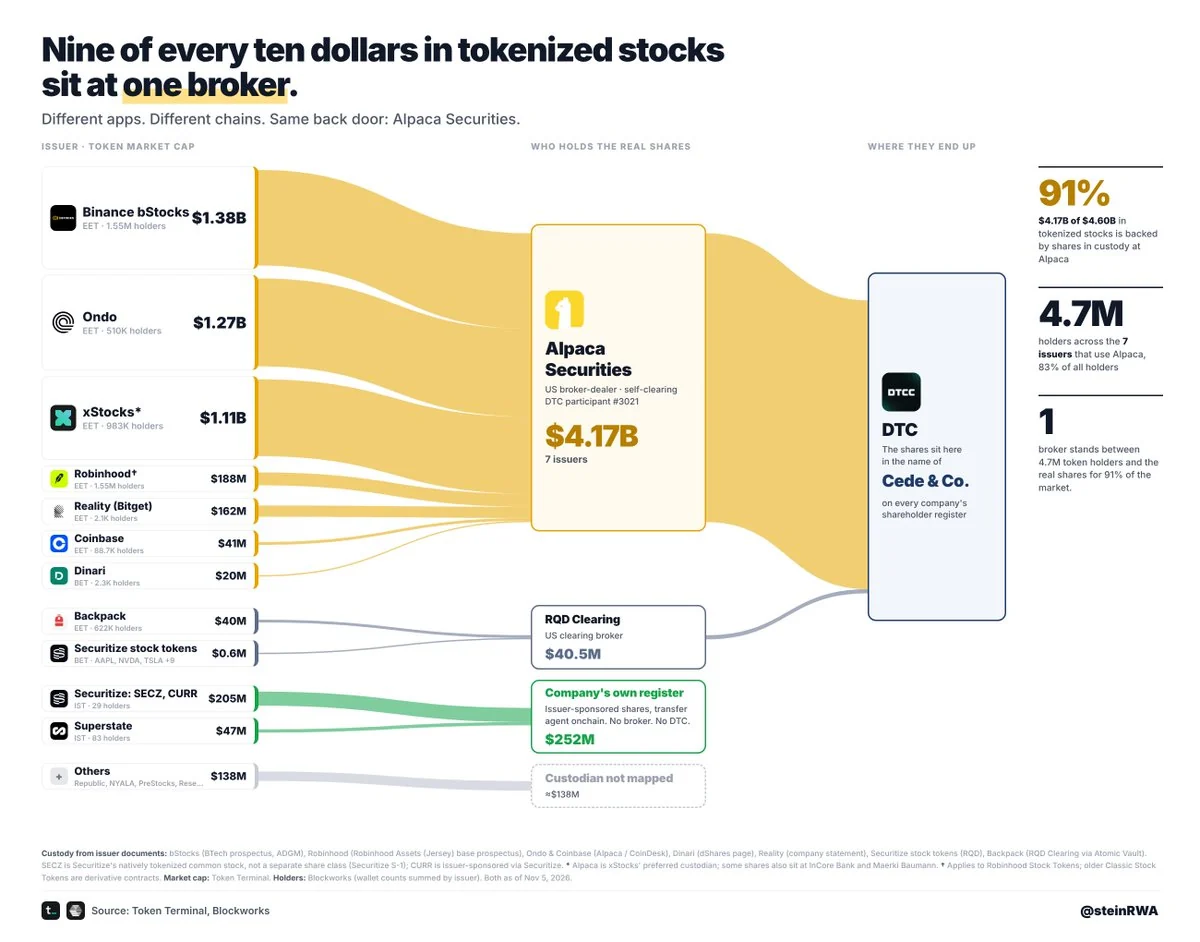
Figure: Distribution of underlying brokers for global tokenized U.S. stock issuers and Alpaca's market share
Whether it is Binance bStocks incubated by leading global crypto exchanges, mainstream RWA protocols like Ondo Finance, emerging synthetic platforms like xStocks, retail trading giants like Robinhood, or institutions like RealityFi and Coinbase, all have, without exception, deeply integrated into Alpaca's brokerage custody network.
Why do industry giants collectively choose Alpaca? The fundamental reason lies in Alpaca's successful development of a developer-friendly brokerage API, hailed as the "Stripe of the securities trading world."
In the traditional financial world, to conduct U.S. stock trading and custody services for global users, institutions must spend years applying for the extremely complex cross-jurisdiction brokerage and clearing licenses, facing extremely high compliance and technical thresholds.
Alpaca allows various on-chain issuers to directly complete compliance account opening, bulk purchase of real U.S. stock spot as institutional entities, and achieve legally compliant segregated custody with just a few lines of concise code, greatly shortening the product launch cycle.
Traditional Wall Street vs. On-Chain Paradigm: Exchanges Are Consuming the Stock Market
Under the mature legal framework of Wall Street for a century, the operation of the securities market strictly follows the professional checks and balances of the "four powers separation" logic.
Listed companies are only responsible for issuing compliant securities; regulated securities exchanges (like the NYSE and Nasdaq) are responsible for listing matching and price discovery; compliant brokerages are responsible for managing client funds and accounts; while depository trust companies (DTC) control the centralized custody and cross-institution clearing of all physical stocks.
This structure ensures that no single market entity can dominate, effectively preventing misappropriation and conflicts of interest.
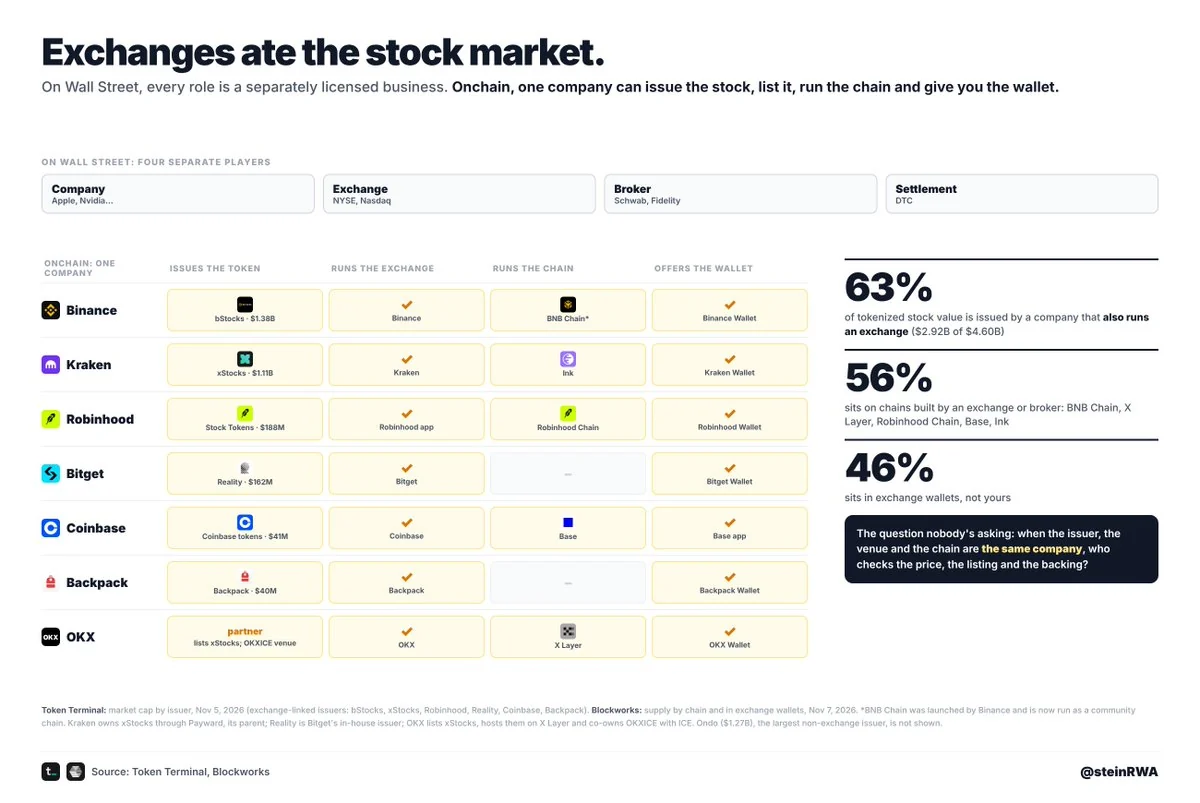
Figure: Comparison of the traditional securities division system in Wall Street vs. on-chain vertical integration model
However, in the world of blockchain and Web3, this century-old division of labor is being completely overturned: a single commercial entity now has the capability to achieve full-process "end-to-end vertical integration."
Taking Binance's bStocks as an example, the platform acts as both the initiator and issuer of tokenized assets, while also being the core venue for listing and organizing secondary liquidity trading, even directly controlling the clearing loop through integrated underlying brokerage channels.
The vertical integration model brings extreme capital turnover efficiency, entirely eliminating the clearing friction of long inter-institution chains, achieving T+0 or even instant settlement and 24/7 uninterrupted trading.
However, at the same time, this high level of concentration has raised deep concerns among regulators and institutional investors: in the event of a single point of failure or compliance review, the systemic overflow risks of centralization would be multiplied.
The Character of Issuers: Where Tokens Stay Determines Their Real Use
Although major issuers map the same underlying S&P 500 stocks like Apple, Nvidia, or Tesla, their existence trajectories and ecological niches on-chain are strikingly different.
Observing the specific address distribution where these tokenized stocks ultimately settle on-chain can provide the clearest insight into the usage scenarios and business intentions of the real holders.
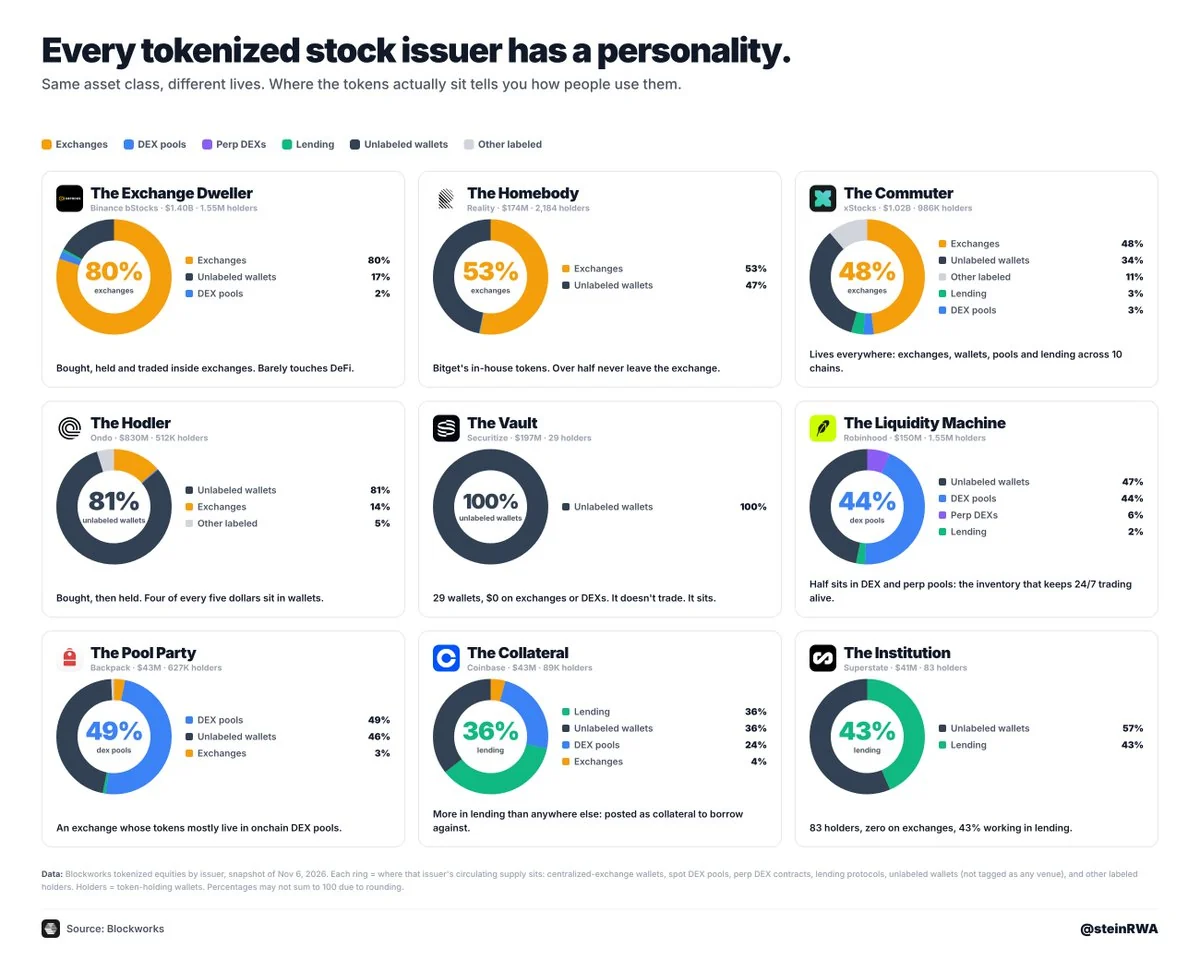
Figure: Analysis of the on-chain asset distribution and holding forms of various mainstream tokenized stock issuers
Products represented by Binance bStocks belong to the typical "exchange dwellers." Their $1.4 billion circulation scale is characterized by over 80% remaining in the official exchange deposit addresses and market makers' hot wallets, effectively serving as derivative trading tools for crypto retail investors to circumvent fiat currency foreign exchange controls, multi-currency collateral lending, and high-frequency contract arbitrage.
In stark contrast are projects like RealityFi, whose issued tokens exhibit extremely decentralized "DeFi native" characteristics, broadly settling in personal self-custody wallets and various decentralized lending protocols and liquidity pools, truly integrating into the synthetic asset stack of decentralized finance.
Instant Tokenization System Breakdown: Alpaca's Workflow and Settlement Logic
The core supporting the cross-border flow of these tens of billions in assets lies in the instant tokenization clearing workflow built by Alpaca.
The entire business chain spans the off-chain fiat banking system, DTC centralized clearing system, and smart contract automation state machines, with standard flow logic divided into four stringent steps:
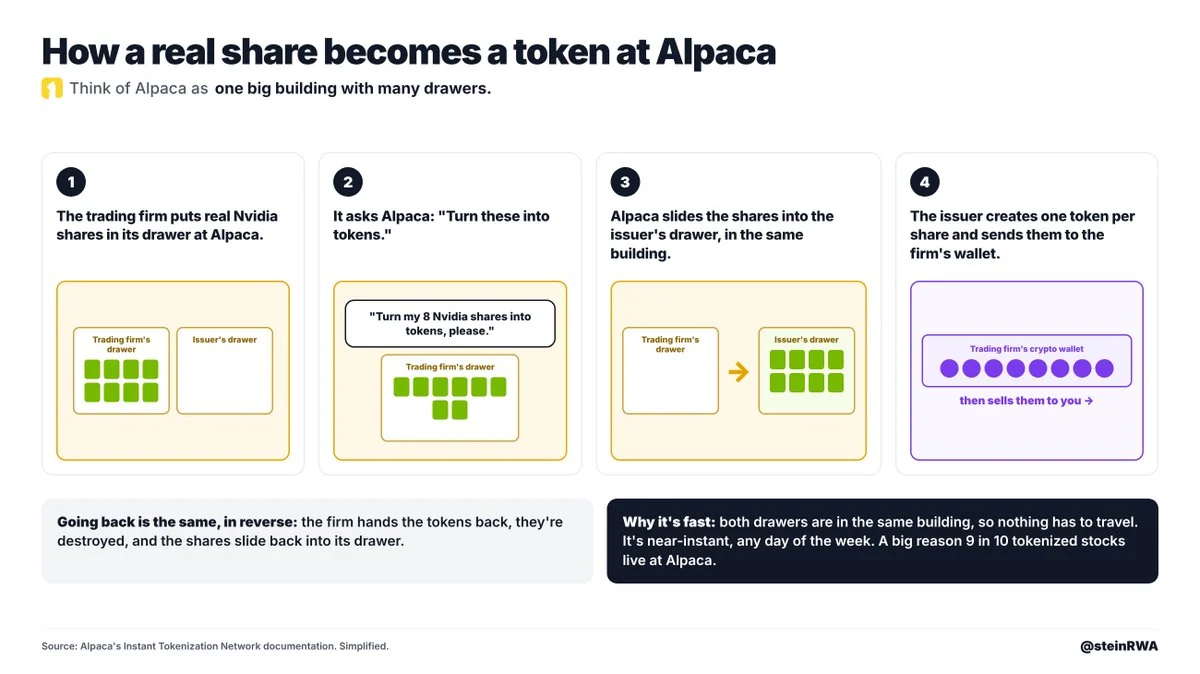
Figure: Alpaca's instant tokenization system architecture and inter-institutional settlement workflow
Step one, the market-making trading institution sets up a dedicated corporate account with Alpaca, purchases the real U.S. stocks intended for tokenization through legally regulated channels, and completes T+1 spot delivery through the DTC official clearing system, recorded in Alpaca's custody ledger.
Step two, the trading institution initiates a minting request to the tokenization protocol through a restricted signature, and the smart contract nodes read the compliance custody proof from Alpaca's API in real-time to confirm that the underlying spot is adequately locked.
Step three, the smart contract mints equivalent tokenized stocks on the target blockchain (like Ethereum, BNB Chain, or Arbitrum) at a 1:1 ratio and distributes them to market makers or investor accounts, achieving full-process transparency and traceability.
Step four, when investors initiate a reverse redemption, the smart contract automatically destroys the corresponding number of on-chain tokens while triggering the API to notify Alpaca to sell an equivalent amount of stock spots in the secondary market, with fiat principal returned through the original path after deducting a tiny fee, forming a perfect closed loop.
The Ultimate Lifeline Battle: Four Giants Jointly Push for Transfer Agent Reform to the SEC
As tokenized U.S. stocks make rapid progress, top industry professionals have long realized: if the underlying legal ownership remains anchored in the centralized ledgers of the old era, tokenization will forever be merely a "derivative synthetic product" and cannot truly ascend to prominence.
Recently, four large institutions deeply engaged in compliance finance—Figure, Securitize, Bullish/Equiniti, and Plume Network—formally submitted a milestone joint petition to the U.S. Securities and Exchange Commission (SEC).
The petition strongly urges the SEC to comprehensively advance the modernization revision of the existing regulatory rules for transfer agents.
In Wall Street's legal definition, transfer agents are an indispensable institutional cornerstone for all publicly traded companies. Public companies must designate licensed transfer agents, and the shareholder register they maintain is the only statutory basis for determining who are the legitimate owners of the company.
Once the SEC approves that statutory ownership registers can be maintained and updated in real-time through public chains or compliant licensed chains, the entire underlying clearing of the securities industry will undergo fundamental reshaping. At that point, tokens will no longer just represent indirect claims on stocks; tokens themselves will represent immutable legal stock ownership. This will not only clear the regulatory fog that has troubled the industry for years but will also pave the ultimate pathway for mainstream Wall Street assets worth trillions of dollars to be fully on-chain.
免责声明:本文章仅代表作者个人观点,不代表本平台的立场和观点。本文章仅供信息分享,不构成对任何人的任何投资建议。用户与作者之间的任何争议,与本平台无关。如网页中刊载的文章或图片涉及侵权,请提供相关的权利证明和身份证明发送邮件到[email protected],本平台相关工作人员将会进行核查。


