Author: Four Pillars
Translation: TechFlow
Deep Tide Overview: In the U.S. midterm elections held on November 3, the Democratic Party regained control of both the Senate and the House of Representatives, leading to a legislative deadlock for comprehensive market structure bills due to “divided government.” Although Congress shifts its focus to investigate conflicts of interest, the rulemaking by the SEC and CFTC continues.
At the same time, the CFTC historically approved the launch of regulated individual stock perpetual futures, and Wall Street giants like the Intercontinental Exchange are accelerating their involvement in on-chain derivatives. This week's report also covers the changes in coin listing data on South Korean CEXs, reflections on Binance's $6.36 billion security incident, and Hyperliquid's core performance report for the first half of the year.

Major News: With the Democratic Party in Control of Congress, Where is U.S. Crypto Regulation Headed?
What happened?
In the U.S. midterm elections held on November 3, the Democratic Party successfully secured control of the Senate and the House of Representatives, flipping at least seven seats in the Senate and gaining more than 20 seats in the House.
When the new Congress officially takes office in January 2027, the Democratic Party will have full control over the legislative agenda and key congressional committees, thereby gaining more authority to balance Trump's policy priorities during the remainder of his term.
This election outcome significantly weakens the prospects for comprehensive cryptocurrency legislation, particularly the CLARITY Act. This bill aims to establish a federal market structure framework for digital assets and clarify the regulatory jurisdiction boundaries between the Securities and Exchange Commission (SEC) and the Commodity Futures Trading Commission (CFTC).
Previously, the bill was passed by the House of Representatives in July 2025 but was stalled in the Senate in September of the same year with a procedural vote of 49 to 50 and failed to advance. Negotiations between the two parties about stablecoin yield rewards, the responsibilities of DeFi developers, and ethical provisions regarding conflicts of interest for government officials have remained stagnant.
With the Democratic Party in control of Congress, it is expected that scrutiny will increase regarding Trump family’s crypto business landscape. Several Democratic legislators have previously expressed concerns about potential conflicts of interest involving World Liberty Financial (WLFI), its issued USD1 stablecoin, and the TRUMP Meme coin.
Whether the financial interests of the presidential family have influenced the direction of the government's digital asset policy is expected to become a priority for investigations in the new Congress.
Meanwhile, despite the legislative halt in Congress, federal regulatory agencies are continuing to advance the cryptocurrency regulatory framework. In August this year, the SEC proposed the Regulation Crypto Assets, introducing targeted registration exemptions and a conditional safe harbor related to “investment contracts” for specific token issuances.
Following this, the CFTC initiated the rulemaking process for the Crypto Asset Trading Regulation (CTX) and the Crypto Asset Market Regulation (CAM) in October, aiming to establish a dedicated regulatory framework for crypto commodity trading targeted at retail users.
Analyst Commentary
The most direct impact of the midterm elections is likely a slowdown in the congressional process for crypto legislation, rather than an outright reversal of U.S. crypto policy. Even when the Republican Party controlled both chambers, the CLARITY Act failed to make significant progress.
Now, with the Democratic Party leading the legislative agenda, it will become quite challenging to push the bill through in its current version unless there are significant enhancements to consumer protection, illegal financial controls, and conflict of interest provisions.
The Trump family's deep involvement in the crypto space is likely to continue to pose a core political obstacle. For the Democratic Party, voting to support industry-friendly legislation can easily be interpreted as indirectly benefiting the president’s personal business interests. Therefore, Congress’s focus may shift from broad market structure reforms to accountability investigations, hearing oversight, and stricter conflict-of-interest safeguards.
However, a slowdown in legislative progress does not mean that the institutional development of the U.S. crypto market will come to a halt. The SEC and CFTC have already shown a clear willingness to use their existing statutory authority to build a clear regulatory framework through administrative interpretations, rule-making, and exemption relief.
As exemplified by the SEC’s proposal for Regulation Crypto Assets and CFTC’s initiatives to promote CTX and CAM, significant regulatory progress remains feasible even in the absence of comprehensive congressional legislation.
Of course, this approach to regulatory advancement has its limitations. Compared to formally enacted laws by Congress, administrative rules and interpretations from regulatory agencies are more vulnerable to the impact of future government transitions or changes in committee leadership, and the regulatory agencies themselves are also constrained by existing statutory authority boundaries.
But as long as the current leadership of the SEC and CFTC maintains policy consistency, gradual institutional rule-making is expected to become a central force in promoting regulatory clarity in the near future.
Ultimately, the core issue after the midterm elections is not just whether the CLARITY Act can be revived, but whether the SEC and CFTC can turn their ongoing initiatives into final rules and create substantial market access. The congressional deadlock may slow the pace of comprehensive reforms, but it may not be able to block the overall trend toward a mature regulatory framework for digital assets.
CFTC Opens the Door to Individual Stock Perpetual Futures in the U.S.
What happened?
On November 3, the Commodity Futures Trading Commission (CFTC) cleared the way for the first time by allowing perpetual futures contracts linked to individual stocks to be traded on U.S. regulated exchanges. According to the new framework, CFTC-licensed futures exchanges that have completed securities futures trading registrations with the SEC can launch perpetual contracts tracking individual stock performance.
Unlike traditional futures, perpetual contracts have no fixed expiration date, allowing traders to gain price exposure without actually holding the underlying stock. While such products have rapidly expanded on offshore crypto platforms like Hyperliquid, their local implementation in the U.S. has long been hindered by regulatory uncertainty between the SEC and CFTC.
Under the Commodity Futures Modernization Act of 2000, the contracts approved for launch are legally defined as “security futures” and are jointly regulated by the SEC and CFTC.
Market participants have responded swiftly. On November 5, Kalshi became the first U.S. platform to launch regulated individual stock perpetual futures, covering over 50 companies, including Nvidia, Meta, and Palantir, and reported over $300 million in trading volume shortly after going live.
Payward, the parent company of Kraken, is also preparing to launch individual stock perpetual contracts through its regulated exchange Bitnomial, initially targeting 10 major U.S. stocks; additionally, Coinbase Derivatives and Crypto.com affiliated exchanges are also advancing similar products.
Traditional financial institutions are equally eager to join the fray. On October 29, the Intercontinental Exchange (ICE), the parent company of the New York Stock Exchange, announced a strategic investment and partnership in the perpetual futures platform Trade[XYZ] built on Hyperliquid, with plans to jointly create a U.S. regulated trading venue and clearing infrastructure leveraging Hyperliquid's underlying technology.
Additionally, Hyperliquid Strategies, a publicly listed company holding HYPE tokens, is applying for a futures commission merchant (FCM) license to facilitate access to the Hyperliquid perpetual market. Both of these plans are currently pending regulatory approval.
However, this regulatory decision has also encountered legal resistance. An industry alliance formed by the Chicago Board Options Exchange (Cboe) and Citadel Securities has filed a lawsuit challenging the CFTC's statutory authority to approve individual stock perpetual contracts under the current framework.
Analyst Commentary
This decision's significance extends far beyond simply adding a new derivative tool. Initially emerging as a crypto-native trading tool, perpetual futures are beginning to establish their compliant trading structure within the U.S. mainstream financial system.
Following the earlier approval of Bitcoin perpetual futures this year, the regulatory guidance has further extended to individual stocks, indicating that perpetual contracts are increasingly recognized as a flexible universal trading tool that can span multiple asset classes.
Particularly noteworthy is the substantial participation of established traditional financial institutions. The collaboration between ICE and Trade[XYZ] conveys a clear signal to the market: traditional exchanges are beginning to view decentralized trading infrastructure as a strategic opportunity rather than simply a competitive threat.
By combining on-chain trading matching technology with regulated clearing, customer identity verification, and compliance systems, these institutions are exploring a new model that integrates the design of crypto-native markets with traditional financial regulatory mechanisms.
This development presents both opportunities and challenges for decentralized perpetual exchanges like Hyperliquid and Lighter. Once a regulated U.S. market is established, it is expected to unlock a massive flow of retail and institutional funds previously blocked from offshore perpetual platforms due to policy barriers.
With Hyperliquid leveraging the HIP-3 protocol, which allows external deployers to set up multi-asset perpetual markets on its infrastructure, it is well-positioned to directly benefit from the compliance process.
However, it is important to note that the acceptance of perpetual contracts by the regulatory system does not automatically mean that decentralized exchanges will be approved to service U.S. customers. Platforms seeking to access compliant markets must still meet registration, custody, market surveillance, and clearing compliance requirements.
Consequently, future competition will not only depend on matching execution speed and trading fee rates but also on the ability to seamlessly connect existing on-chain infrastructure into compliant market frameworks. Lighter similarly faces a comparable development window but still needs to establish comparable compliance breakthrough paths.
Legal actions from traditional financial market incumbents may also slow the implementation process. However, overall, the CFTC's move represents a substantial shift in mainstream regulatory understanding of perpetual contracts. Traditional stock markets typically operate around fixed trading hours and spot ownership, while perpetual contracts provide an alternative interface for traders to flexibly manage exposure across assets.
In the long run, perpetual futures have the potential to evolve from crypto-specific derivatives into universal trading interfaces for stocks, commodities, foreign exchange, and other financial assets. As the U.S. takes the lead in introducing them into regulated markets, other jurisdictions may follow suit; if this trend continues, perpetual futures are likely to become an important component of global financial market access and trading infrastructure.
This Week's Important Industry News
Crypto Ecosystem
- NEAR governance voted to approve a proposal to cut the token issuance inflation cap to 1.6%
- Binance CFO resigns nine days after record hack, co-CEO says the transition was planned six months ago
Institutions and Regulation
- CFTC approves individual stock perpetual futures to begin compliant trading in the U.S. for the first time
- Democratic sweep in Congress forces the crypto industry to rethink Washington lobbying and policy strategy
- Samsung Wallet launches USDC accounts based on the Solana network for U.S. Galaxy users
- Hyperliquid Strategies files applications to become a CFTC registered FCM and discloses quarterly revenue of $13.3 million
- Trump administration moves forward on plans to allow crypto assets in 401(k) retirement plans
Investment and M&A
- Payward affiliated funds and clients purchased AAVE token shares in the secondary market
- Bullish Capital and 21Shares earn BTC through Stacks as Bond 3 of Bitcoin staking sells out
- Aave Labs acquires financial engineering team Avon to enhance on-chain fixed-rate lending
Data Focus: How Regulation Reshapes the Coin Listing Landscape of South Korean Centralized Exchanges
Original Research Report Link: How Regulation Reshaped Korea CEX Listings (Four Pillars)
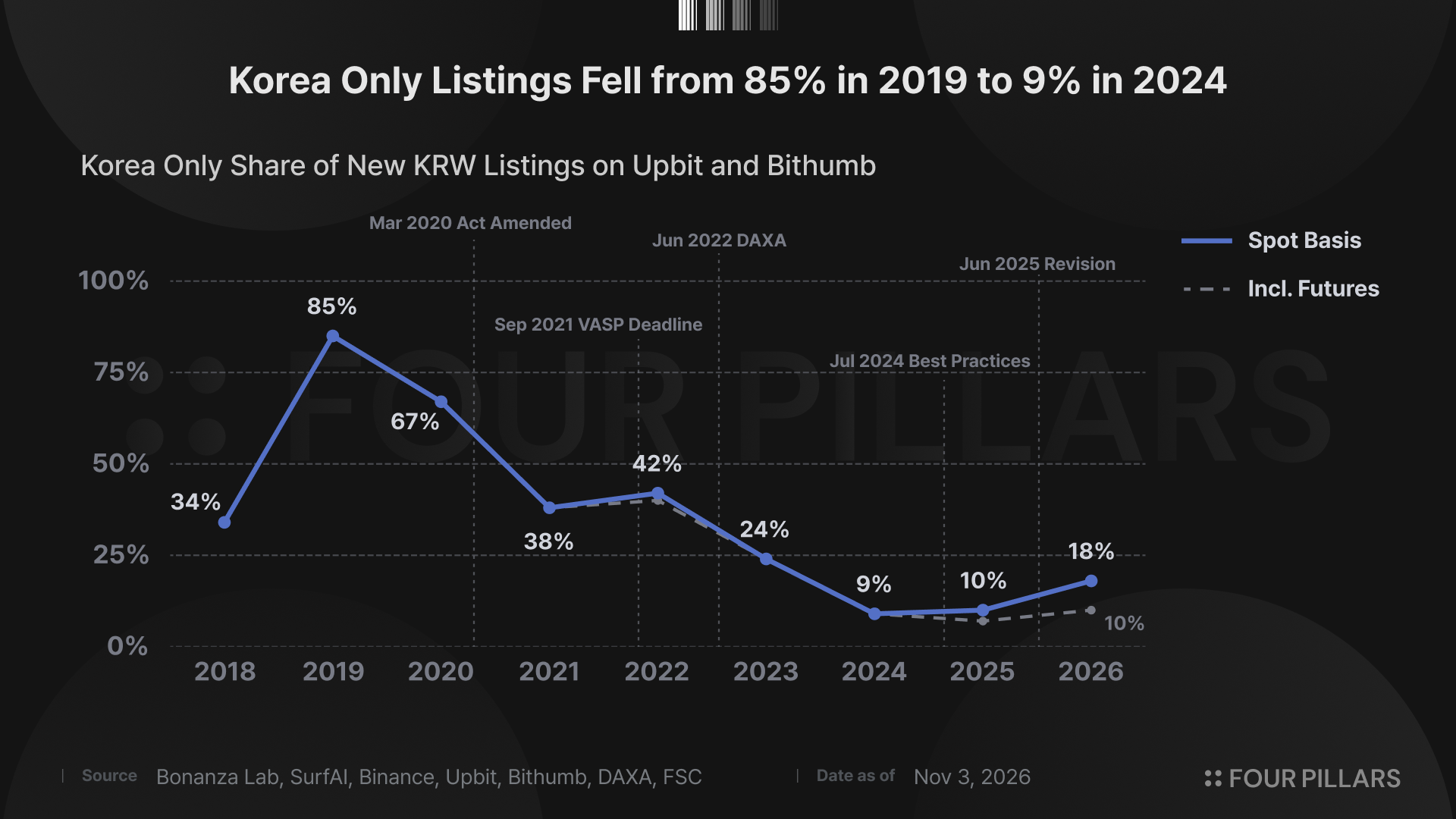
Chart: The proportion of "only listed in South Korea" new coins in KRW trading pairs on Upbit and Bithumb decreased from 85% in 2019 to 9% in 2024 (currently 18% in 2026, including regulatory key nodes), data source: Bonanza Lab, SurfAI, Binance, Upbit, Bithumb, DAXA, FSC
Four Pillars Weekly Depth: Reflections on the Binance Security Vulnerability Incident
Original Research Report Link: Reflections on the Binance Exploit (Four Pillars)

Chart: Cover Image for Four Pillars Topic "Reflections on the Binance Exploit"
- On October 30, 2026, at 5:04 AM, Binance's hot wallets spread across 10 public chains were hacked, with a total of assets stolen amounting to $6.36 billion, setting a record for the highest amount ever in similar theft cases. The vast majority of assets were moved away in about 20 minutes. The FBI attributed this incident to the North Korean hacking group TraderTraitor; as with several recent exchange attack incidents caused by this group, the breach was not of a single private key but rather of the exchange's internal signature infrastructure.
- Less than an hour after the incident, Tether and Circle quickly froze about $2.4 billion of the stolen stablecoins; after the Arbitrum security committee and several token projects activated admin privileges to assist with the intervention, more than $2.8 billion of the stolen assets have been frozen or recovered to date. Binance raised $6.34 billion in funds for full compensation without external borrowing and plan to reopen withdrawals in phases starting November 1, aiming to limit net outflows on the first day to about 2.1% of total assets according to their own statistics. However, it must be noted that the stability of this resolution largely depended on the fact that the involved party is the capital-strong Binance; had it been a smaller exchange with weaker financial buffers, it would have been nearly impossible to avoid a bank run.
- After reopening withdrawals, about 90% of the funds flowing out of Binance did not move to other top ten centralized exchanges, highlighting a growing market demand for self-custody of assets. However, as demonstrated by recent tampering of Ledger devices and malicious updates to Trust Wallet, personal wallets are not absolute safe havens either. As such thefts and supply-side attacks become more frequent, users have an increasing demand for open-source wallets that can be publicly audited for system design and internal architecture.
2026 First Half Hyperliquid Semiannual Report
Original Research Report Link: 2026 H1 Hyperliquid Half-Year Report (HRC / Four Pillars)
Chart: Cover of the report titled "2026 H1 Hyperliquid Half-Year Report" jointly published by Four Pillars and GLC Research under the Hyperliquid Research Collective
- Hyperliquid reported protocol revenue of $351 million for the first half of the year, a year-on-year increase of 6.4%; during the same period, the price of Bitcoin fell by 33%, while HYPE surged against the trend by 155%. Although revenue decreased by 38% compared to the record second half of 2025, the exit growth momentum at the end of the period showed significant improvement: revenue rose to $71 million in June, marking the best monthly performance since last November. The protocol accumulated $288 million in funding for HYPE repurchase during the first half of the year, and the combination of strong profit resilience and ongoing capital return is driving the market to increasingly reassess HYPE's intrinsic value from an operational fundamentals perspective.
- The HIP-3 mechanism significantly expanded the market reach of the trading platform. In the first half of the year, the platform facilitated a trading volume of $324 billion through HIP-3, accounting for 25.1% of the platform's total matching trading volume, with this share rising further to 32.0% in the second quarter as trading targets smoothly expanded to commodities, stock indexes, and individual stocks. However, in comparison to the large nominal trading volume, its current direct revenue contribution remains modest: affected by fee subsidies pricing, HIP-3 contributed only 7.4% of the platform's total protocol revenue, while native crypto perpetual contracts still account for 85.6% of the revenue. The key opportunity ahead lies in effectively monetizing the trading activity of diverse assets into protocol profits; at the same time, attention must also be paid to deployer concentration (in June, only Trade[XYZ] alone accounted for 97% of the total transaction volume of HIP-3).
- The USDC yield calibration mechanism introduced considerable potential incremental returns for token holders. By the end of the period, the total supply of stablecoins on the HyperEVM chain reached $5.6 billion, with 96% being USDC. According to AQAv2's rules, about 90% of reserve interest income will be allocated to the Assistance Fund after cost adjustments. Based on the current benchmark interest rate and stablecoin balance, this interest’s annual funding contribution is estimated to reach $135 million to $200 million, which is expected to provide an additional token repurchase funding pool beyond trading fees. However, the revenue from this item has yet to be confirmed in the first half report, and as of the publication date, the actual distribution of economic benefits remains to be verified; its core sensitive factors include stablecoin reserve balances, interest rates, and the final actual split ratio.
- Along with a slight contraction of the net circulating supply, institutions have further strengthened their demand for configuring HYPE. By June 30, three U.S. spot ETFs had accumulated net inflows of $309 million; according to the report's statistical caliber, ETFs, asset financial and treasury listed companies, and the Assistance Fund combined hold about 82 million HYPE tokens, accounting for 8.2% of the total supply. The team’s restraint in claiming unlocked shares also positively impacts the supply side, as the team only withdrew 4.7% of the established unlocking quota in the first half of the year. However, despite the current favorable supply-demand landscape, the $4.3 billion worth of shares that have been allocated but remain unclaimed still represent a potential supply pressure that cannot be ignored.
- This semiannual report is authored by the Hyperliquid Research Collective (HRC), jointly initiated by GLC Research and Four Pillars, and is dedicated to independent investment research on the Hyperliquid ecosystem.
This Week's Short Commentary (Comments)
- No One Needs Blockchain
- Monad’s Quantum Cadence: Why Monad’s Quantum Strategy Differs from Ethereum's
- Why Mantle Was Mentioned in Anthropic’s FlashProve (also discussing zkSNARKs)
- Can Injective SICI Become the Pricing Hub of Decentralized Computing?
Macro Environment and Core On-Chain Indicators
The following monitoring charts are powered by CryptoQuant. For further in-depth analysis of the underlying raw data, CryptoQuant offers a comprehensive on-chain and market data analysis suite for institutional participants.
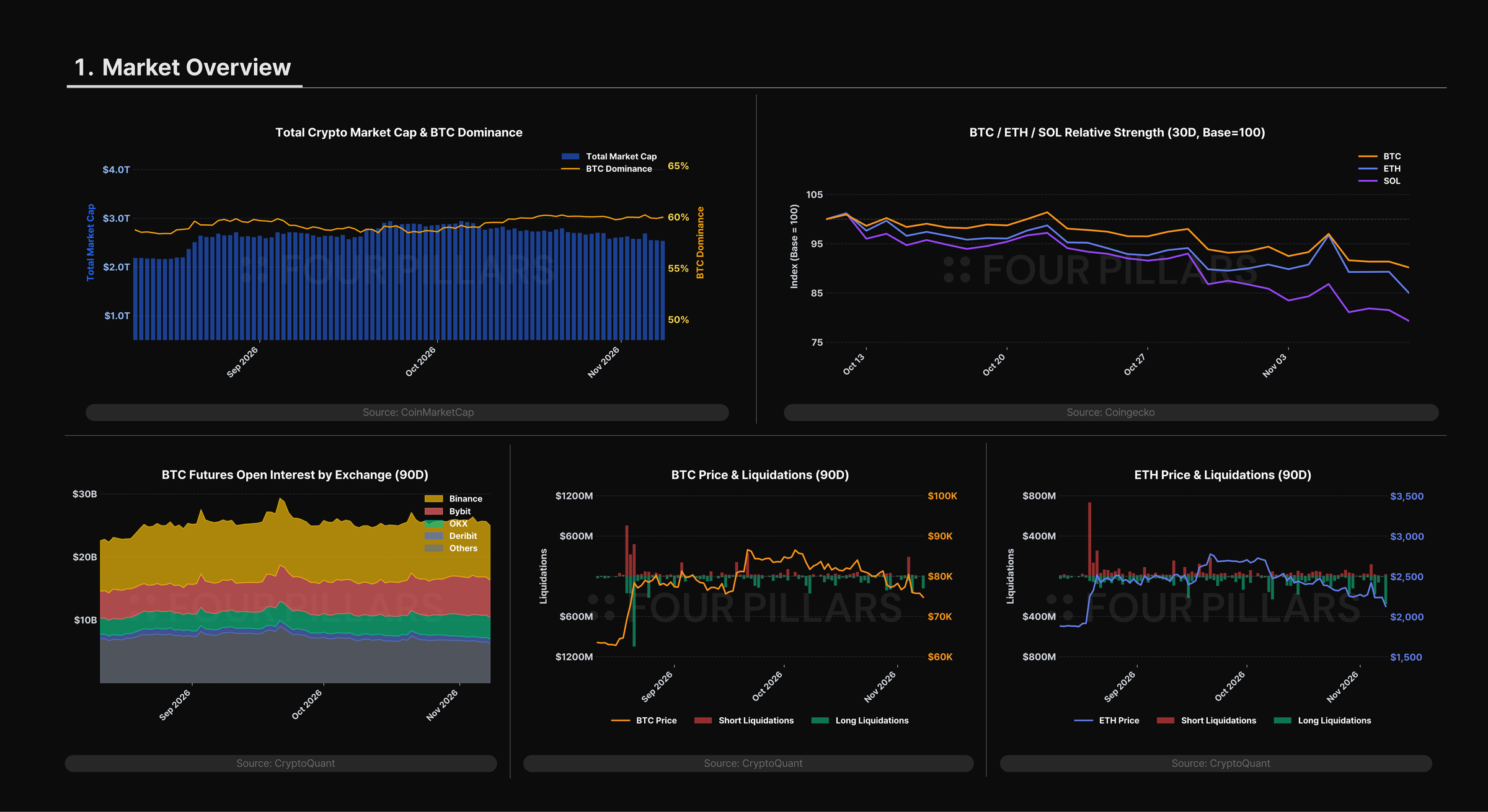
Chart: Market Overview Data Dashboard (including total crypto market capitalization and BTC market share, BTC/ETH/SOL relative strength index over the past 30 days, 90-day BTC futures open interest by exchange, BTC and ETH price trends over the past 90 days and long-short liquidation trends), data source: CoinMarketCap, CoinGecko, CryptoQuant
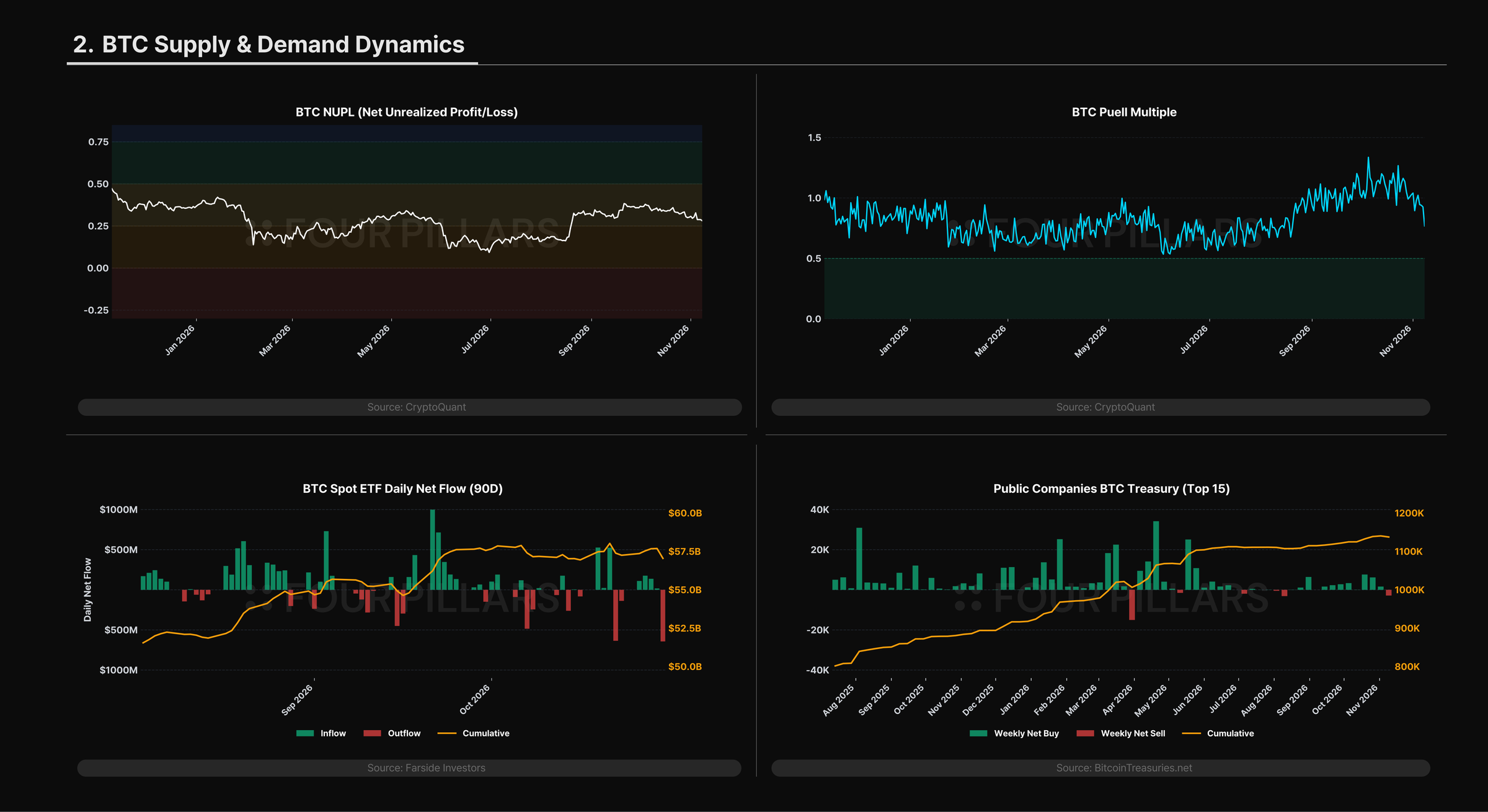
Chart: Bitcoin Supply and Demand Dynamics Dashboard (including BTC NUPL metric, Puell Multiple metric, 90-day BTC spot ETF daily net inflow and cumulative scale, weekly net increase and cumulative positions of the top 15 listed companies’ BTC financial reserves), data source: CryptoQuant, Farside Investors, BitcoinTreasuries.net
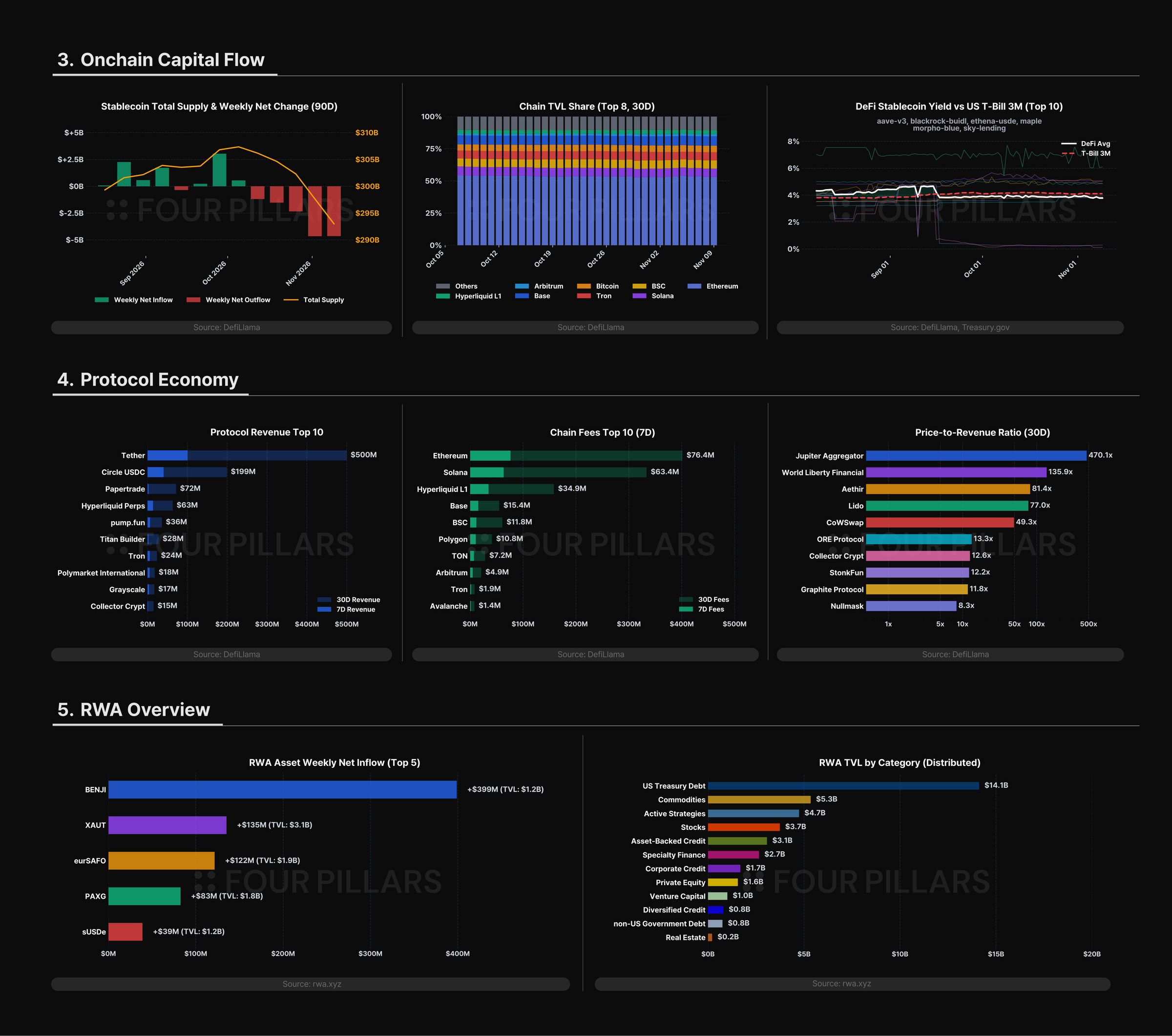
Chart: On-chain Fund Flows, Protocol Economics, and RWA Overview Dashboard (including total stablecoin supply and net changes, TVL share of leading public chains, DeFi stablecoin yield comparison with 3-month U.S. Treasuries, protocol income and public chain fee and market-to-sales ratio rankings, RWA asset weekly net inflow and classification TVL distribution), data source: DefiLlama, Treasury.gov, rwa.xyz
免责声明:本文章仅代表作者个人观点,不代表本平台的立场和观点。本文章仅供信息分享,不构成对任何人的任何投资建议。用户与作者之间的任何争议,与本平台无关。如网页中刊载的文章或图片涉及侵权,请提供相关的权利证明和身份证明发送邮件到[email protected],本平台相关工作人员将会进行核查。


