
You plug in a small machine at home, and after 7 hours, suddenly over a million RMB appears in your account.
It sounds like a fairy tale, but this actually happened in the Bitcoin community.
On November 7, two ordinary retail investors used a small home mining machine and managed to mine two Bitcoin blocks in less than 7 hours, taking home a total of $476,000.
However, this is just the tip of the iceberg in a series of recent “retail mining riches” stories.
As early as October 27, a machine with a computing power of only 6.5 TH/s (most likely a Canaan Avalon Nano 3S) mined 3.14 BTC worth $250,000 in solo mode on CKPool.
This little box is sold online for only two to three hundred dollars.
Even more incredible is that this improbable wealth myth has happened repeatedly this year:
On May 30, a same-model Nano 3S mined $232,000;
On July 10, a $150 open-source box Bitaxe Gamma also succeeded in solo mining, taking home $200,000.
In just a few days, stories of retail investors hitting the jackpot have made countless people envious.
Spending a few hundred dollars to buy a little box and accidentally hitting the jackpot for a down payment on a house? Is it still worth getting in now?
1. What Was Mined Was a Home Machine
The reason this incident became sensational is that the probability of ordinary people mining Bitcoin on their own is almost impossible.
To understand this, one must first grasp how Bitcoin is mined.
All the mining machines in the world are simultaneously competing to answer an extremely difficult math problem, with an average of one machine solving it every 10 minutes.
The first to solve it gets to package the latest ledger (that is, "mine a block"), and the system rewards them with over 3 Bitcoin.
Currently, large mining farms have tens of thousands of professional machines competing together.
Ordinary people only have one or two machines, making their chances of winning virtually zero.
As a result, everyone typically connects their machines to a "mining pool," akin to thousands of people collectively buying lottery tickets and sharing the winnings based on effort, earning a small and stable amount of money daily.
But on November 7, these two individuals chose to go solo, using the single channel on CKPool.
Going solo means: not partnering with anyone, if you don’t mine a cent, you don’t get anything, and if you hit millions, it’s all yours.
As a result, miracles occurred twice within 7 hours.
First, one person mined block number 974893, taking home about $237,000.
Shortly after, at 7:41 PM on November 7, the other person mined block number 974930, packaging 1964 transactions, taking home 3.143 Bitcoin, worth about $239,000.
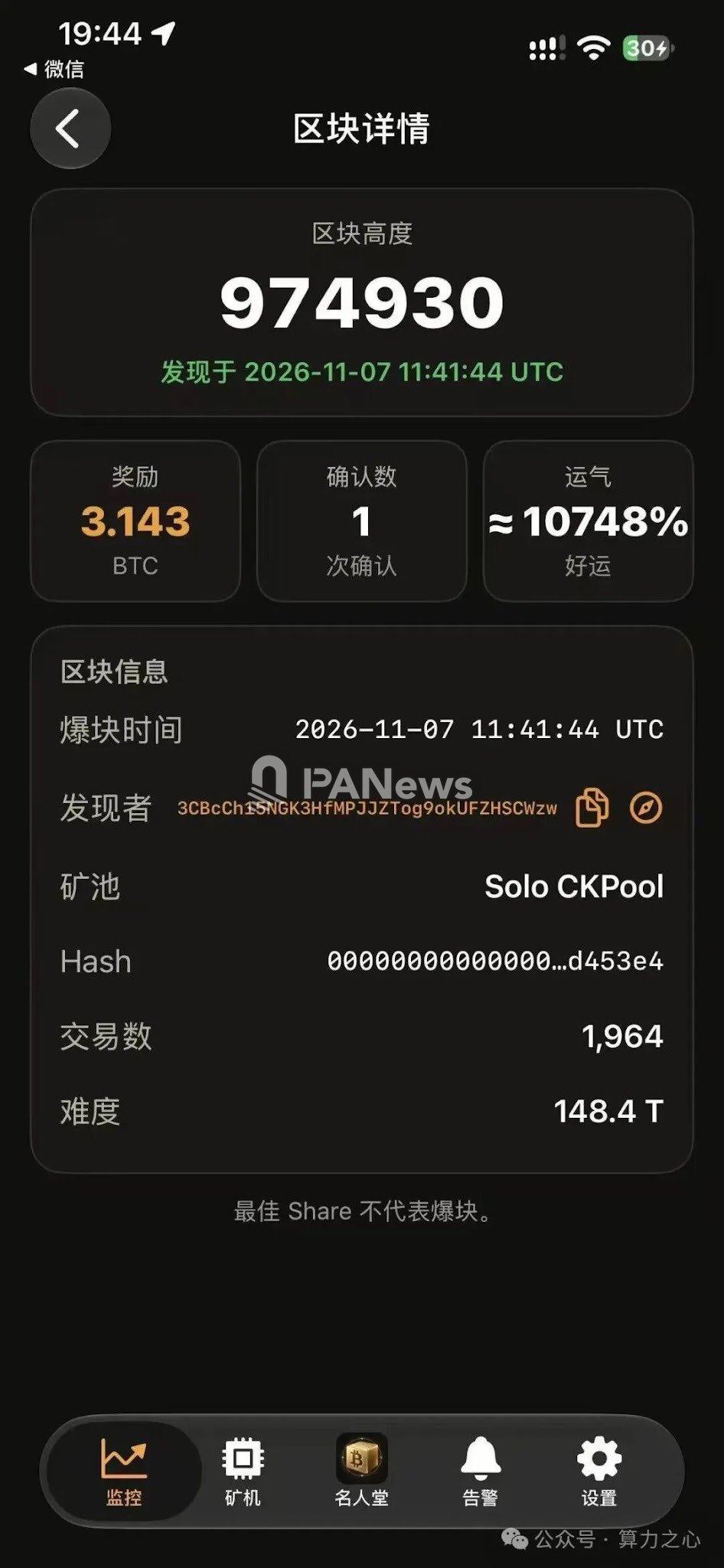
(Details of block 974930)
The two of them together made a total of $476,000.
The machine that won in the evening had the clearest data, and the winning process was astonishing.
This was just a home mining machine produced by Canaan Technology.
It looks very much like a small home appliance, with the selling point being that it can mine at home.
Backend data shows its computing power is 80.8 TH/s in 5 minutes, 83.9 TH/s in 1 hour, and 86.8 TH/s in 1 day.
Currently, it seems that only their products achieve this level of computing power.
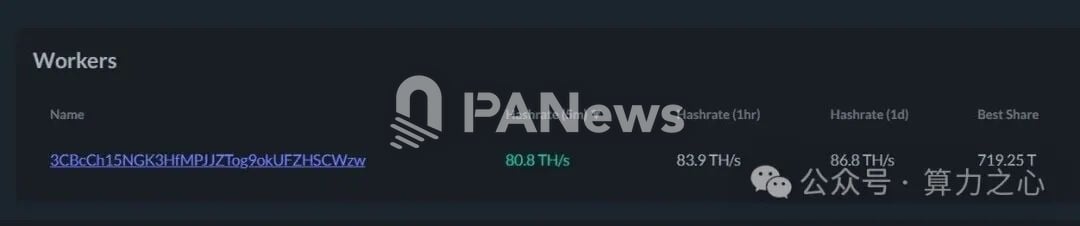
(Winning machine computing power data)
Currently, the required difficulty for answering globally has reached 148.4 trillion. Compared to industrial mining farms with dozens of thousands of machines, this small machine doesn't even make a splash when thrown in.
According to normal odds, this machine would need to run non-stop for over a hundred years to have a chance to hit the jackpot.
But it just happened to strike it lucky today.
Monitoring software calculated the "luck value" for this winning event reached 10,748%.
This means that the speed at which they hit the jackpot was over a hundred times faster than normal.
More concretely, this money has already been credited immediately.
From the mempool's on-chain audit page, it clearly shows: of the 3.143 Bitcoin rewards issued by the system, about 0.0629 Bitcoin (almost 2%) went to another address, which is likely the service fee collected by the single channel platform CKPool.
The remaining 3.0798 Bitcoin has securely landed in this miner's own wallet.
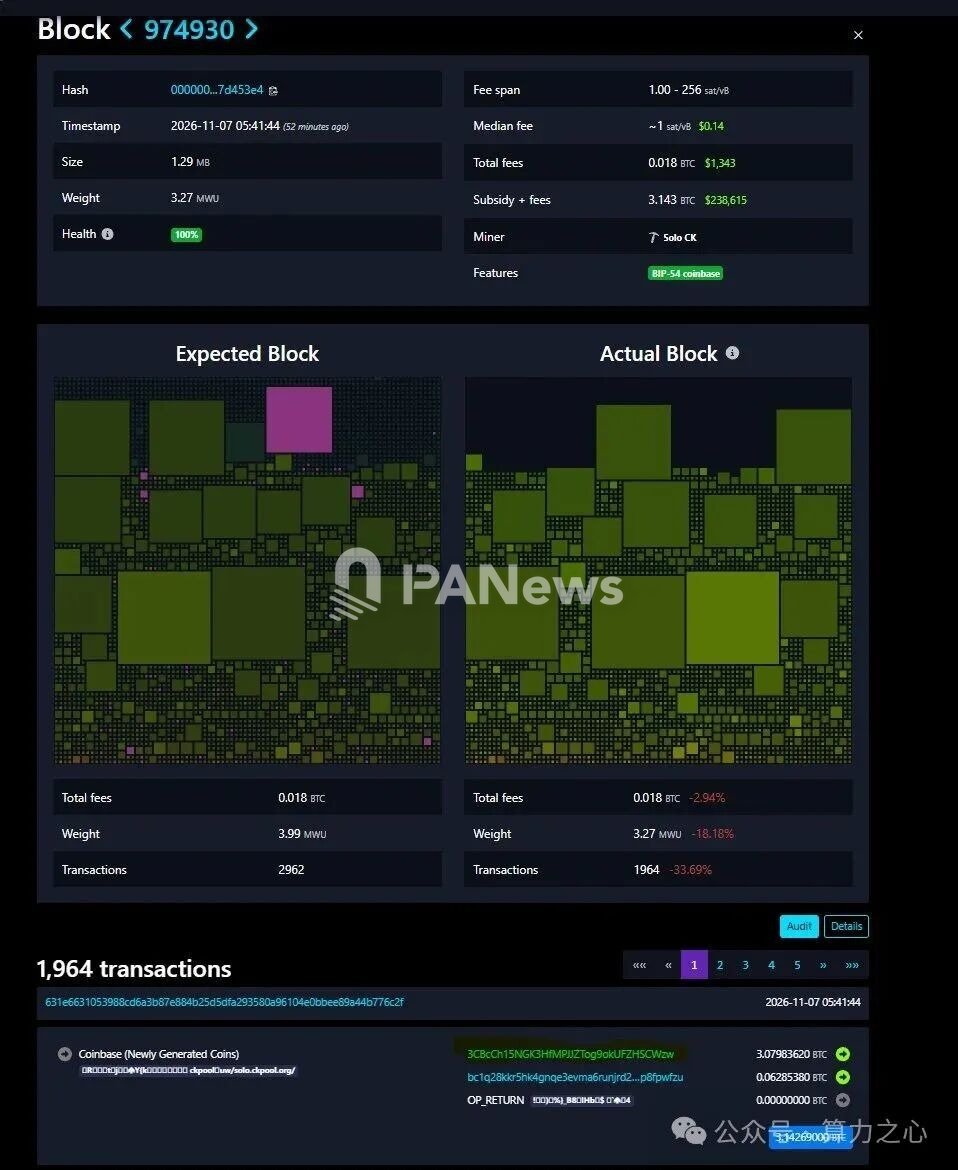
(mempool on-chain audit page)
What should have taken a hundred years for this home machine to win, suddenly earned $239,000.
Seeing this, many people are bound to be tempted; since it’s also a game of luck, wouldn’t buying a mining machine to keep at home be much more cost-effective than buying a lottery ticket?
2. Mining and Lotteries, Which Is Easier to Win?
If you only count the winning rate, solo mining at home is indeed much easier to hit than buying a lottery ticket, but it also burns money much faster.
People in the circle call this "electricity-powered lottery."
Based on today's global difficulty, having a 1.2 TH/s mini mining machine at home means a winning probability of about 1 in 16,000 per year.
If you get two or three larger machines to reach 0.5 PH/s, the annual probability can improve to 1 in 40.
In comparison, the probability of winning the jackpot in the American Powerball lottery is 1 in 292.2 million, and even buying 156 tickets a year only gets you 1 in 1.87 million.
This means that the probability of "hitting the jackpot" by mining at home is several hundred or even thousands of times higher than by buying a lottery ticket.
However, the calculations can’t only be based on probability; costs also have to be considered.
Buying a lottery ticket only costs a few dollars each time, while solo mining is a game that genuinely burns money, as decent machines start at several thousand dollars, and with electricity, it can eat up $400 to $1100 a month.
Worst of all, as long as you don’t successfully mine, your income is zero - not that you earn little, but you earn nothing at all, and this state could last for several years.
At the same time, wealthy institutions are continually buying new machines to increase, pushing the overall difficulty up, and making it increasingly hard for individual miners to win.
Therefore, while the news reports stories of hitting the jackpot twice in 7 hours, what isn’t seen is that thousands of home mining machines are running idly for years, ultimately just handing over a pile of high electricity bills to the power company.
Yet, if there’s a high probability of losing on electricity bills, why are there more and more people opting to mine solo with home machines?
3. Who Is Profiting from the Wealth Myths?
Because every news story about individual winners serves as free advertising for the entire industry chain, several groups are making a profit from this narrative.
The most discussed word in the community this time is actually one word - "again," as everyone is saying "won again."
Data shows that from 2026 until now, solo miners have mined a total of 36 blocks, with almost one lucky winner every week.
Just in April this year, a retail investor hit the headlines, and on November 7, it happened again with two wins in 7 hours.
Every time a winning screenshot spreads through mining groups, it has a far more powerful promotional effect than spending money on advertisements.
Following these 36 wins, it’s clear to see that the money is flowing to three groups:
The first group is the mining machine manufacturers.
Manufacturers present the machines as consumer-grade appliances, but effectively sell the opportunity for "what if I also win."
The more sensational the winning news, the more ordinary people will feel compelled to place orders.
The second group is the solo mining channel platforms.
For example, the roughly 2% (0.0629 BTC) taken from this round, the platform doesn’t need to buy machines or pay electricity; it just takes a cut from each winner, ensuring profit regardless of the outcomes.
The third group is the entire Bitcoin network.
Currently, computing power is highly concentrated in large mining farms, and there has been continuous skepticism about whether Bitcoin has lost its original intent of "everyone can participate."
But as long as there are still retail investors hitting blocks every week, the story of “ordinary people mining their way to wealth” can continue to be told.
These 36 block rewards equate to the entire system's advertising costs for keeping up popularity and maintaining its "decentralized" reputation.
In this chain, the lucky winners take home hundreds of thousands of dollars, manufacturers receive a steady flow of orders, platforms take a 2% cut, and the Bitcoin network retains its brand - every link is a winner.
▌▌▌▌▌▌▌▌▌▌
So, who is footing the bill for all of this?
The answer is those ordinary people who see the winning screenshots, feel excited, immediately pull out a few thousand dollars to order mining machines, and quietly pay several hundred dollars in electricity each month.
Just like how street-side lottery stations never lack customers, even if everyone understands how low the odds are, they are always willing to pay for the three words “what if?”
免责声明:本文章仅代表作者个人观点,不代表本平台的立场和观点。本文章仅供信息分享,不构成对任何人的任何投资建议。用户与作者之间的任何争议,与本平台无关。如网页中刊载的文章或图片涉及侵权,请提供相关的权利证明和身份证明发送邮件到[email protected],本平台相关工作人员将会进行核查。


