Author: Rejamong, Four Pillars
Translated by: Deep Tide TechFlow
Deep Tide Introduction: Recently, Vitalik clearly defined ETH as a "store of value (SoV)" asset, attempting to break away from the previous valuation trap that relied on fee burning. However, Ethereum has long been viewed as a high-frequency iterating tech stock, while the core premise of a store of value asset is extreme certainty and immutability, creating a natural paradigm conflict.
This article deeply analyzes the three core deadlocks ETH faces after shifting to the SoV narrative: the loss of perpetual inflation pressure after burning, a pending and potentially changeable monetary policy, and the ultimate paradox that technology must continuously iterate while assets must remain stable. Without hard commitments, relying solely on positive assumptions is far from sufficient.
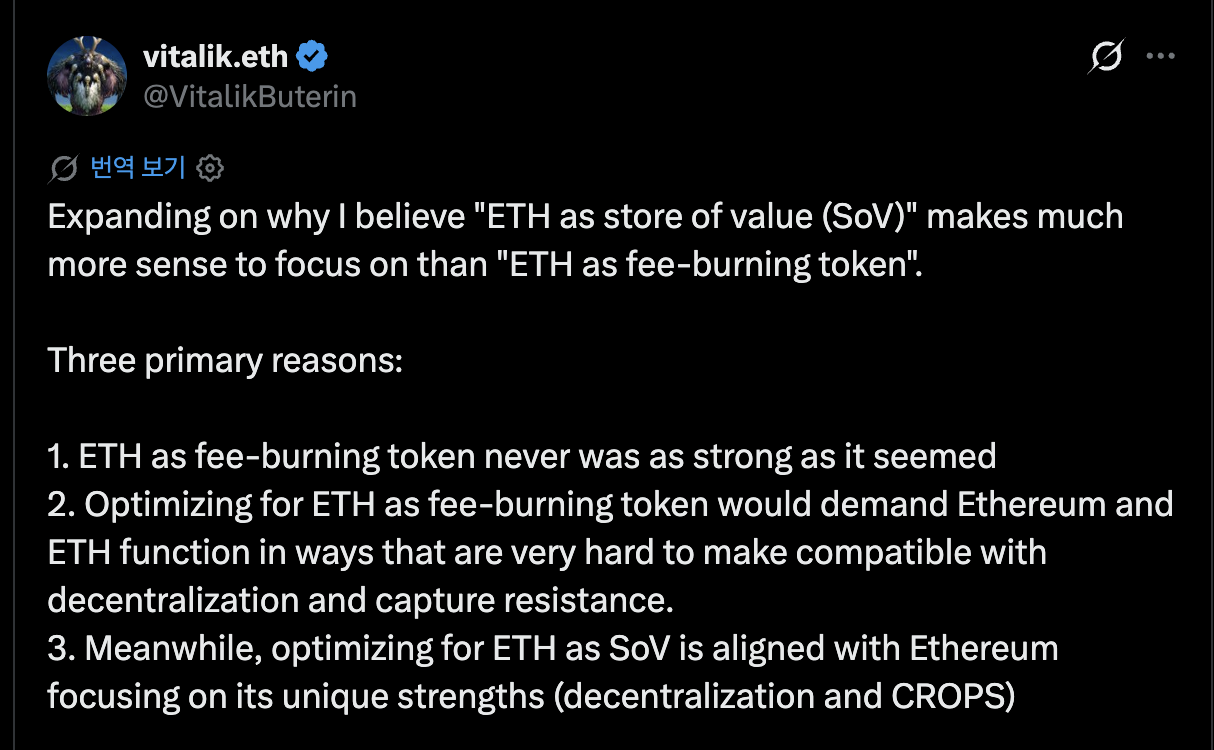
On November 8, Ethereum co-founder Vitalik Buterin published a lengthy tweet on social media, explicitly advocating that ETH should be viewed as a "store of value" asset, rather than a so-called "fee-burn token" supported by burning.
The debate over the asset characteristics of ETH is not new in the crypto industry. However, most past discussions were either limited to marketing positioning or restricted to abstract philosophical speculations.
Vitalik's lengthy article clearly goes further. It not only concerns the token itself but also redefines the underlying genes of the Ethereum network and its future evolutionary direction.
For a long time, Ethereum has been regarded by the industry as a foundational computing platform for smart contracts, with capital markets habitually valuing it according to high-growth tech stock logic.
Ethereum has always been at the forefront of blockchain technology leading innovation. However, tech stocks must constantly innovate and iterate quickly to survive; while a store of value asset's foundation lies in maintaining as much constancy and immutability as possible.
Now, Vitalik personally anchors ETH as a store of value asset, attempting to end the long-standing confusion in the community.
However, a core question looms over everyone: if the underlying network attempts a major protocol hard fork every six months, with its future technical roadmap always in dynamic flux, can the capital market truly accept ETH as a store of value asset?
Vitalik's Core Argument: ETH is a Store of Value Asset
Delving into Vitalik's macro reasoning, his core logic relies on four progressive pillars:
First, relying solely on fee burning for ETH pricing actually backfires, limiting Ethereum's valuation ceiling.
In traditional net present value (NPV) valuation models, annual burning amounts divided by the discount rate can provide bottom support for the network's market value. However, this logic holds only if the network's fees primarily come from net inflow from outside the ecosystem.
However, even during the peak bull market period from 2021 to 2023 when token burning reached its height, most on-chain fee consumption still came from endogenous transactions within the crypto ecosystem. Once the token's secondary market price encounters a correction, on-chain fees will sharply contract, causing the previously anticipated valuation floor and token price to plummet together.
Second, if maximizing burn is set as the ultimate goal, it will force Ethereum to transform into a highly centralized commercial company.
Using tech giants with similar market capitalization as a reference for R&D expenditure, Ethereum would need at least 700,000 ETH of internal protocol funding each year, in addition to centralized decision-makers intervening to adjust development direction whenever market trends change.
Moreover, blindly driving up gas fees to pursue burning contradicts Ethereum's initial technological intent to promote scalability and significantly reduce user transaction costs.
Third, optimizing store of value attributes resonates completely with the core traits currently recognized by the market for Ethereum.
Global users embrace Ethereum for its unbreakable decentralization and the CROPS principle (Censorship-Resistance, Open-source Transparency, User Privacy, and Underlying Security), rather than its slim burning deflation rate.
The first major test facing store of value assets is extreme survival capability. In engineering technical details, this means careful selection of cryptographic algorithms, localized ossification of the protocol core layer, minimal governance political interventions, an on-chain censorship-resistant mechanism based on FOCIL, and a verification node threshold lightweight enough for ordinary laptops to operate independently.
Figure: Framework for aligning Ethereum's decentralization with store of value proposed by Vitalik
Fourth, the more diverse types of underlying assets issued on Layer 1 mainnet, the stronger the actual utility of holding ETH.
Whether exchanging real-world assets (RWA) and emerging crypto assets for ETH on-chain, or using ETH as core collateral to leverage and release liquidity, it all comprehensively enhances the rigid demand for holding and settling ETH. The expansion of the network ecosystem aligns entirely with the asset's store of value attributes at the foundational level.
Vitalik ultimately concludes that Ethereum’s uniqueness lies in its inherent decentralization and the CROPS principle; and the core belief in holding ETH for the long term must also sprout from these fundamental values. He hopes the long-term value of the underlying network and the pricing logic of the asset itself can be fully unified on the same solid foundation.
Technology Network That Must Change, Yet Underlying Assets That Must Not Change
We fully agree that fees and token burning have never been the source of ETH's value. However, before ETH can be truly accepted as a traditional store of value asset by the global mainstream market, several tricky issues remain to be resolved, particularly three challenges that are most severe.
Challenge of Perpetual Inflation After Losing Burning Expectations
The first challenge is the net issuance rhythm of the token.
Once the obsession with achieving deflation through high-frequency burning is abandoned, ETH effectively becomes a perpetual asset with annual net issuance and no hard cap on total supply.
In this context, the value capture of the token must rely entirely on a new macro expectation: that the continuous expansion of the underlying network can spontaneously drive up the frequency of ETH usage and attract global capital for long-term holding.
Previous fee and burning data were clear, transparent, and could be precisely measured in real-time financial indicators. Unfortunately, there is currently no clear data model that can directly map the on-chain scale of RWA assets or traditional institutions’ adoption of Ethereum to the net demand for holding spot ETH.
In other words, ETH's asset valuation is shifting from quantifiable cash flow models back to purely relying on whether the market is willing to sustain a holding consensus as a matter of faith.
Figure: Historical evolution of Ethereum's inflation rate and the EIP-1559 burning mechanism
Ethereum's Monetary Policy Subject to Change at Any Time
The second core challenge lies in the alterability of token supply rules.
Even today, interests surrounding Ethereum's inflation control continue to engage in intense negotiations. For instance, the EIP-8363 proposal to modify Ethereum’s issuance curve has been temporarily removed from the initial scope of the Hegota upgrade, but the proposal's authors are still advancing through independent governance pathways.
Historically, Ethereum has experienced several drastic shifts in monetary policy: the London hard fork in 2021 formally introduced the EIP-1559 burning mechanism, and in 2022 during the merger to proof-of-stake (PoS), substantially reduced the newly issued volume of blocks.
If an asset is to be recognized by all of humanity as a medium of value storage that transcends cycles, then regardless of how democratic or decentralized its on-chain governance system is, no one should have the power to rewrite its issuance monetary policy at any time.
The Ultimate Coexistence Dilemma of Tech Stock Positioning and Store of Value
The final core contradiction is: can Ethereum as a continuously evolving technology network coexist peacefully with ETH as an absolute store of value asset?
Aiming for store of value means gradually reducing Ethereum's technological upheavals at the engineering end. This convergence tendency is quietly unfolding at the micro level.
The scale of the Ethereum Foundation is continually shrinking. After reaching the technical roadmap (Strawmap) planned until 2029, its ultimate vision is to achieve a "Walkaway Test": that even if the foundation and the current core development team completely exit, the Ethereum network can still operate autonomously.
However, the irreconcilable contradiction is that Ethereum is essentially a set of software technology architecture, and as long as it is technology, it must inevitably face changes in the external environment.
Threats from quantum computing could compel upgrades at any time; just as Ethereum is currently making significant strides from full node repeated execution to zero-knowledge proof (ZK) validation, it must respond in real-time to the cutting-edge advances in global computer science.
Technical iteration is endless, so the underlying network of Ethereum may face drastic architectural reconstruction again at any time. Throughout this long evolutionary process, ETH as a financial asset will inevitably continue to be impacted by factors such as whether the roadmap can be delivered on time, potential security vulnerabilities, and competition from new technological directions.
Figure: Trade-off between maintaining complex technical architecture costs and asset credit
Bitcoin has certainly gone through technical upgrades such as SegWit and Taproot. However, the reason Bitcoin can solidify the belief in digital gold lies in the fact that no matter how its technical details are tweaked, holders firmly believe that its core underlying contract will never waver.
Ethereum is an extremely intricate complex distributed network. Its architectural complexity not only far exceeds that of Bitcoin but also significantly surpasses that of most high-performance public chains represented by Solana. The system's extreme complexity inherently implies high maintenance costs and potential attack vulnerabilities.
The greater the magnitude and frequency of protocol upgrades, the harder it becomes to maintain an unchanging commitment to the underlying asset. Whether such a complex system can uphold the sacred invariance of its asset credit while maintaining high-frequency self-renewal remains a significant question.
In Conclusion: The Rigid Commitment Ethereum Truly Needs to Fulfill
Even those currently viewing ETH as a store of value asset secretly expect Ethereum to demonstrate the explosive force of a high-growth tech stock.
They thirst for ETH to embody the sacred credit of constant assets while eagerly demanding Ethereum deliver exponential growth and disruptive technological results.
Therefore, Ethereum must clarify at its core: which core principles regarding ETH's store of value are sacred and inviolable, with the foremost being the complete solidification of its token issuance policy.
The CROPS principle regulates the underlying operational mechanism of the Ethereum network, but it does not provide any rigid economic repayment commitments regarding the token ETH itself.
A vision based solely on the beautiful assumption that "as the ecosystem adoption grows, token usage naturally increases" can no longer convince experienced investors who have gone through multiple bull and bear cycles. Ethereum now urgently needs to clearly demonstrate to the world: why every inch of ecological expansion in the underlying network can seamlessly transform into the irreplaceable value of the ETH token itself.
免责声明:本文章仅代表作者个人观点,不代表本平台的立场和观点。本文章仅供信息分享,不构成对任何人的任何投资建议。用户与作者之间的任何争议,与本平台无关。如网页中刊载的文章或图片涉及侵权,请提供相关的权利证明和身份证明发送邮件到[email protected],本平台相关工作人员将会进行核查。


