Kuri, Deep Tide TechFlow
Deep Tide introduction: The "burning deflation" narrative, once seen as the cornerstone of Ethereum's valuation, is being deconstructed by its creator.
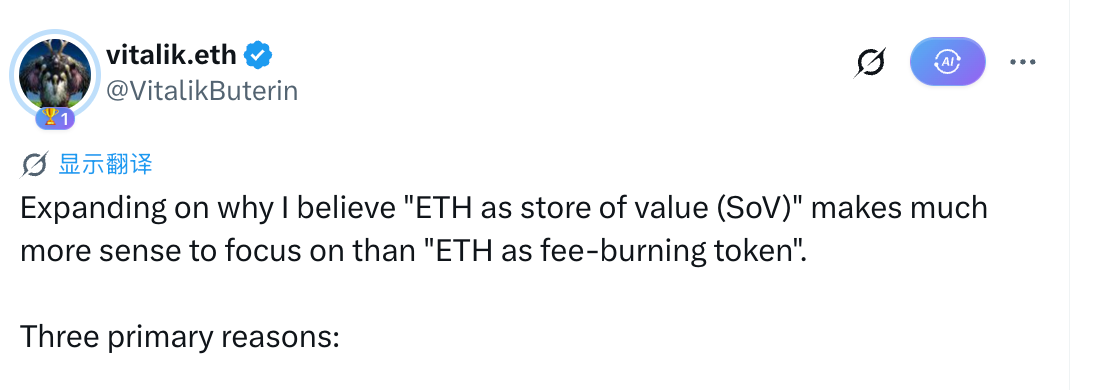
On November 8, Vitalik Buterin published an article clearly stating that the logic of relying on transaction fee burning to support ETH valuation has never truly been valid. With the main network's burning volume declining dramatically and U.S. spot ETFs experiencing six consecutive weeks of net outflow, if burning were to support the current massive market cap of about $272 billion, Ethereum would have to become an extremely aggressive business. To maintain the baseline of decentralization, Vitalik attempts to forcibly shift ETH's value anchor from "cash flow generating asset" to "store of value (SoV)."
During the bull market cycle from 2021 to 2023, the transaction fee burning brought by the EIP-1559 mechanism allowed the market to create a perfect net present value (NPV) valuation model for ETH: the market cap of ETH equals the annual burned transaction fees divided by the discount rate.
According to this logic, as long as on-chain activity is prosperous enough, the continuously destroyed ETH can provide a solid "theoretical floor price" for the currency value.
But Vitalik has punctured this illusion in his latest long article. He points out that this floor price has never truly existed because the vast majority of burning fees come from leverage and speculation within the crypto ecosystem (for example, Yuga Labs' virtual land sale burned $180 million in fees in a single day). Once the ETH price plummets, the profits and purchasing power from these on-chain activities will also shrink simultaneously.
The harsher reality is written in the latest ledger.
With the complete withdrawal of Layer 2 traffic from the main network, Ethereum's burning mechanism is now virtually nonexistent. Data shows that Ethereum burned about 1.48 million ETH in 2022;
while from 2026 until now, this number sharply decreased to 19,200 ETH. As of the past 30 days up to November 8, only 2,694 ETH (approximately $6 million) were burned across the network, which completely fails to offset the new issuance during the same period.
Vitalik did the math: to support the current market cap of about $272 billion at a 4% discount rate, Ethereum needs to burn about 4.89 million ETH annually. The reality and theory gap is as high as 149 times.
Refusing to become "L'Oreal"
When purely relying on natural traffic cannot support a market cap of $270 billion, Ethereum is left with only one path: to actively compete like a world-class multinational company and spend money to buy growth.
Vitalik made a comparison with L'Oreal, which has a similar scale. If Ethereum wants to operate like a real giant, it must invest heavily in research and development and market expansion (approximately 700,000 ETH per year for internal financing) and establish a highly interventionist governance system to actively cater to new markets and trends.
But this touches Ethereum's reverse scale.
Actively entering the "business" means needing to raise gas fees to increase the burning amount, which will directly push out users who need privacy and security the most from the main network; while establishing "internal financing" and "strong intervention governance" to maintain revenues would directly destroy the foundational principles of Ethereum's existence—decentralization and anti-capture ability.
In the face of "high fee income" and "decentralized neutrality," Vitalik clearly chose the latter.
Valuation logic forcibly switches, ETH as a store of value (SoV)
Since the path of being a "token that burns fees" is not feasible, where should ETH's premium come from?
Vitalik's answer is: returning to the store of value (SoV).
In his view, what people value most about Ethereum is decentralization and CROPS (anti-censorship, anti-capture, open source, privacy, security). In the past, these attributes were often seen as an ideology of the geek community; but now, with institutional funds entering the market and AI disrupting various industries, these attributes have essentially transformed into indicators that asset holders value the most—stability and the ability to survive.
When the market no longer expects the Ethereum main network to be a "super printing press" that generates high transaction fees, the core demand of ETH holders becomes secure and private asset holding, along with freedom from censorship in transactions.
Finally, the author believes this narrative switch is not a whimsical decision by Vitalik, but rather the most honest route adjustment in the face of the dual pressures of "burning volume plummeting" and "weak currency value."
As Ethereum fully embarks on a rollup-centric expansion path, the exhaustion of main network fee income has already been determined. Vitalik's long article is essentially a form of expectation management for the entire community:
Abandon the logic of calculating ETH's cash flow with "ultrasonic currency" and accept ETH as a base digital gold 2.0 with "security and anti-censorship" as its moat.
This shift from "pursuing high-growth cash flow" to "pursuing defensive value storage" will inevitably be accompanied by repricing and growing pains in the secondary market. However, in the long-term survival game, discarding false valuation models may be the first step for Ethereum to mature.
免责声明:本文章仅代表作者个人观点,不代表本平台的立场和观点。本文章仅供信息分享,不构成对任何人的任何投资建议。用户与作者之间的任何争议,与本平台无关。如网页中刊载的文章或图片涉及侵权,请提供相关的权利证明和身份证明发送邮件到[email protected],本平台相关工作人员将会进行核查。


