Binance's new CFO Justin Yek has previously worked at Morgan Stanley and Airwallex, and has personally developed AI financial tools. He will now take over financial responsibilities at a time when compensation and reserve issues are drawing significant attention.
Written by: angelilu, Foresight News
Following the $6.3 billion theft incident, news of a CFO change at Binance inevitably raises questions: does this personnel shift relate to the security incident?
Bloomberg reported on November 7th that Justin Yek will succeed Kaiser Ng as the Chief Financial Officer of Binance. Binance co-CEO He Yi stated that Ng's departure is for the purpose of pursuing new ventures, and the transition plan has been in place for the past six months.

This indicates that, according to Binance, the change was pre-arranged. The outgoing Kaiser Ng is a veteran in exchange finance, having served as CFO at Kraken for about five years and as Binance's CFO since January 2022.
Kaiser Ng also revealed his next plans in his resignation statement: shifting from financial management to entrepreneurship, advancing multiple real-world asset tokenization projects. The areas he mentioned include basketball, music, GPUs, robotics, gold, and collectibles, inviting interested individuals to join his team. He hopes to further engage in AI and Web3 through entrepreneurship, though he has not disclosed specific project names or launch timelines.

Kaiser Ng's resignation statement (screenshot only)
From Tech Banking to Payment Companies
Successor Justin Yek’s experience spans tech investment banking, software entrepreneurship, and the payment industry. He graduated from Columbia University with a degree in financial engineering and has worked in technology investment banking at Citigroup and Morgan Stanley. Before leaving Morgan Stanley, he had worked at the firm for over four years as an executive director responsible for Southeast Asia's tech investment banking.
In September 2022, he joined Airwallex in Singapore. This fintech company provides services such as cross-border payments, foreign exchange, and expense management for businesses. Subsequently, Yek transitioned from investment banking to financial management at payment companies, serving as Vice President of Finance at Airwallex before joining Binance.
A Financial Executive Who Builds Tools
Another aspect of Yek's experience is related to software. According to his personal introduction, he founded and sold a software development company and still introduces himself as a software engineer on his personal website. This technical interest extends to his finance work: under the title "Binance CFO" on his profile, he showcases an AI financial analysis tool he developed.
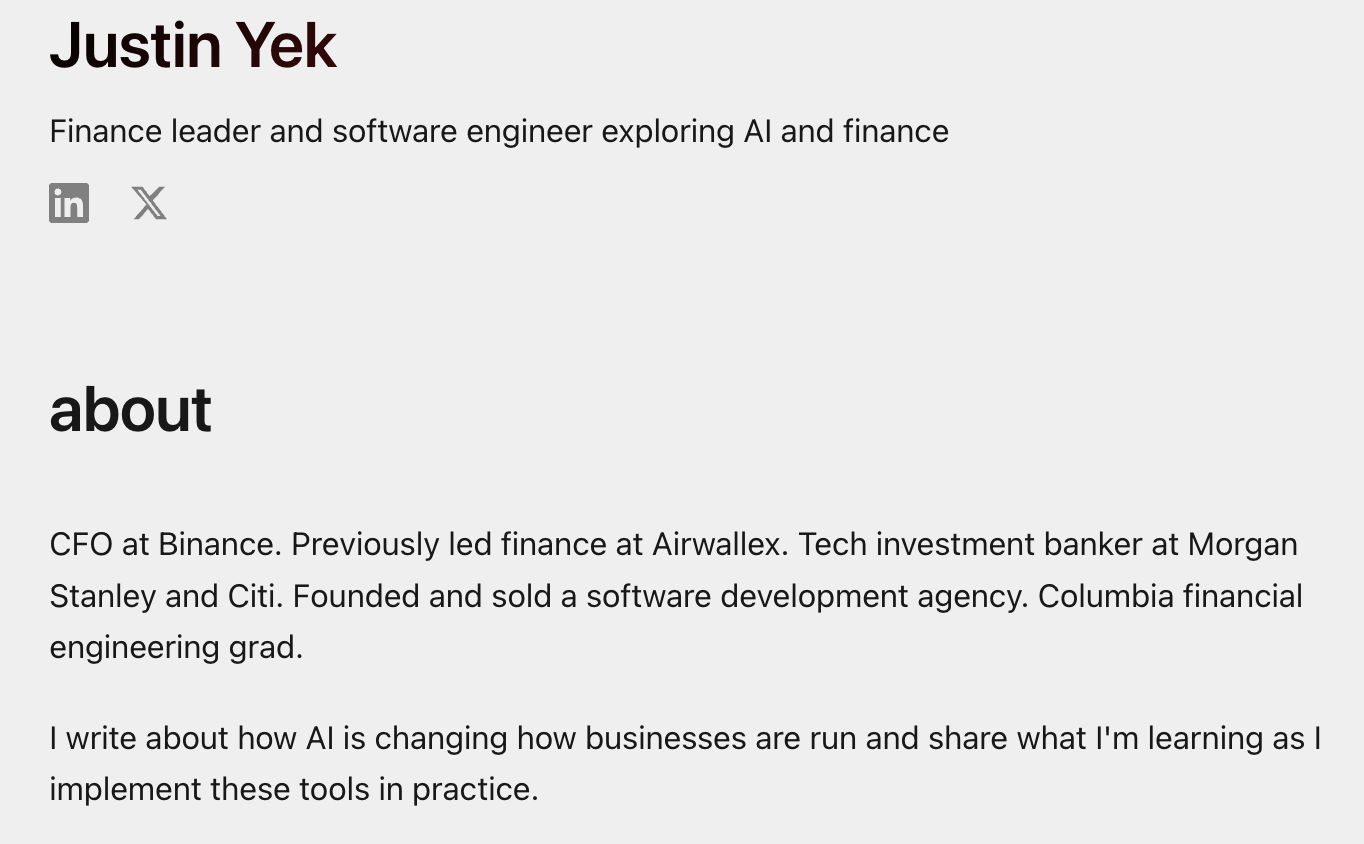
Homepage of Justin Yek's personal website
A question he frequently discusses is: how should finance teams reorganize their work now that AI can read spreadsheets and write code?
Justin Yek's interest in AI has translated into specific workflows.
In April of this year, he demonstrated on his personal website how to review financial models using Claude Code: users provide an Excel file, and the tool identifies the structure, metrics, and time frames of the spreadsheet, extracts the data, and generates interactive charts that can switch between annual and quarterly views. Metrics like revenue, profits, and cash flow thus become easier to compare while the original Excel file remains unchanged.
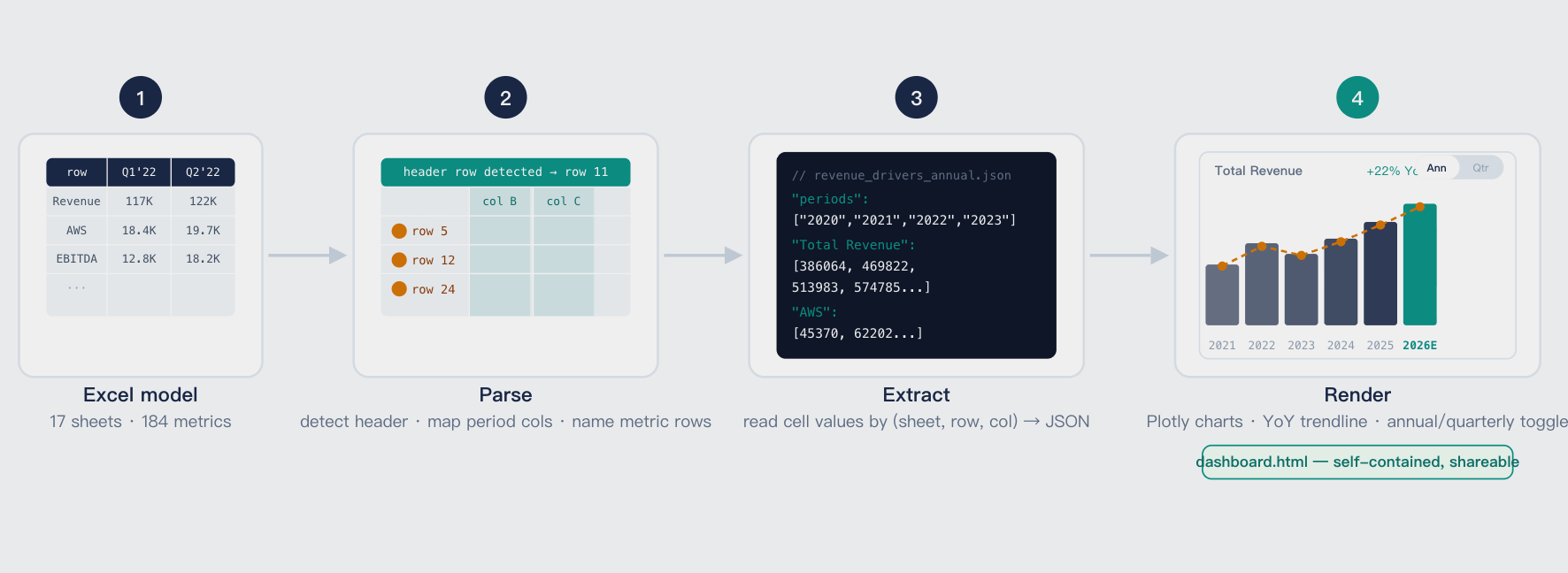
AI financial analysis example demonstrated by Justin Yek
He used an Amazon financial model to demonstrate this process, hoping to reduce the time finance staff spend searching for numbers and organizing charts, allowing trends and anomalies to emerge more quickly.
This feature is part of his publicly available finny project on GitHub. According to the project description, finny also supports comparable company analysis, financial document retrieval, and organizes analysis results into projects and visual pages.
In the project description, he summarizes his daily work as company comparisons, financial model reviews, and drafting analysis materials for transactions like investments and acquisitions. This also explains why he took the initiative to develop tools: he aims to shorten the process from obtaining data to forming analysis.
Behind the tools is his perspective on the finance role. In March of this year, Justin Yek proposed in "The Modern Finance Team" that finance personnel need to combine product management skills with financial expertise. Beyond completing month-end closing, they should also participate in designing systems that support the closing, understanding where the data comes from, how results are output, where processes may go wrong, and how to test them.
He also emphasized that AI tools require consistent data standards, clear sources, and testable processes. The finance department should have its own tool system and development plan, rather than continually adding patches to old processes. These articles showcase his willingness to apply technology to finance work.
Next, the new role must focus on specific financial tasks
The work Justin Yek is taking on comes at a time when Binance is fulfilling its compensation promises and managing the aftermath of events. Decisions regarding capital allocation, when recovered assets can be utilized, and how reserve changes are explained to users all require collaboration between finance and legal, security, and operations teams.
For users, whether the financial leader is familiar with AI ultimately must result in more concrete outcomes: whether data can be verified in a timely manner, whether anomalies can be detected earlier, and whether capital arrangements and disclosures can stand up to scrutiny.
This also raises real-world challenges to the financial philosophy Justin Yek publicly discusses. He emphasizes unified data standards, clear data sources, and testable processes; large exchanges particularly need to reconcile records across different currencies, wallets, and business lines. AI can help improve processing efficiency, but asset ownership, capital permissions, and verification responsibilities must still be clearly defined by systems and personnel. For Justin Yek, how to apply the financial automation he advocates to Binance's actual business will be a key question following his new appointment.
From investment banking to payment companies, and now to cryptocurrency exchanges, Yek brings diverse experience from different financial services. Exchanges are also recruiting talent with similar backgrounds for other professional roles. In March of this year, OKX appointed Diana Miller, who previously handled HSBC's North American litigation, regulatory enforcement, and investigation affairs, as the head of global related business. Although their responsibilities differ, both have experience working in large financial institutions.
免责声明:本文章仅代表作者个人观点,不代表本平台的立场和观点。本文章仅供信息分享,不构成对任何人的任何投资建议。用户与作者之间的任何争议,与本平台无关。如网页中刊载的文章或图片涉及侵权,请提供相关的权利证明和身份证明发送邮件到[email protected],本平台相关工作人员将会进行核查。


