Author: Gu Yu, ChainCatcher
On November 9, Kinetiq's Layer2 network Elysium officially launched its mainnet.
Unlike many new public chains that require significant effort to find ecosystem projects when launching, Elysium had already attracted a batch of mature infrastructure and applications that announced support ahead of its official opening. From Uniswap, KyberSwap, 0x, to OpenSea, Derive, xStocks, and cross-chain protocols like Wormhole and Mayan, covering multiple areas such as trading, liquidity, derivatives, NFTs, tokenized assets, and data services.
The "showcase" of this launch recalls two other new chain releases this year: Circle's institutional-level Layer1 Arc launched its mainnet on September 16, gathering over 190 ecosystem partners on its first day, supported by 11 traditional financial and payment institutions like Mastercard and Visa; Robinhood's Robinhood Chain saw nearly a hundred projects announcing support on the day it launched its mainnet on July 1.
The launch of Elysium is almost a rerun of the same script. What makes Elysium special is that it does not attempt to create a new financial ecosystem from scratch but hopes to leverage the trading liquidity, users, and market structure that Hyperliquid has accumulated to further expand its application capacity.
This difference can be traced back to its origins.
1. Origins: Hyperliquid's "insider" fills the shortest board
Elysium is not a product made by an external team to ride a trend; it is built by Kinetiq—Hyperliquid's top liquidity staking protocol and the issuer of kHYPE.
Kinetiq's position within the Hyperliquid ecosystem is quite solid: TVL exceeds 1.2 billion USD, and its business lines have expanded from a single liquidity staking to institutional staking products iHYPE, yield products Earn, HIP-3 perpetual trading platform Launch, and its own perpetual platform Markets. The publicly visible co-founders include anonymous developer Omnia, Co-CEO Magnus Lai, and CTO Justin Greenberg, who previously raised a 1.75 million USD seed round led by Maven 11, with participation from institutions like Pier Two, Chorus One, IMC, Flowdesk, and Susquehanna Crypto.
More critically, it addresses a structural imbalance that has long existed in Hyperliquid: perpetual contracts are dominating, while spot and DeFi applications have struggled to gain traction. On-chain monitoring data indicates that Hyperliquid's spot trading volume relative to Binance has fallen to a 15-month low, and the activity of the HIP-2 self-market-making mechanism has dropped to its lowest level since Q4 2024; in stark contrast, on Solana, the on-chain spot trading volume dominated by PropAMM is consistently over 30 times that of HyperCore's spot volume, with even the nascent Robinhood Chain achieving about 10 times the volume of HyperCore's spot trades.
The absence of a price discovery function for spot trading is becoming Hyperliquid's greatest weakness in challenging top CEX ambitions. Elysium is targeting this gap: it attempts to establish a complete asset transportation pathway—token issuance → AMM liquidity initiation → HyperCore spot order book → HIP-3 perpetual contract market, allowing PropAMM-type applications to access HyperCore's order book data directly.
In other words, Elysium is not merely "adding an L2 to the Hyperliquid ecosystem"; it represents a crucial step in Hyperliquid's evolution from "perpetual contract trading platform" to "trading infrastructure + application chain." This also explains why projects within the ecosystem are willing to treat it as "their own business."
2. Technology: Widening the "lane" of HyperEVM by 600 times
The reason Hyperliquid needs an L2 stems from its deliberate design choice: the blocks of HyperEVM are intentionally kept small, making the base layer sufficiently streamlined but also limiting the throughput ceiling for applications.
Elysium's solution is a combination of "standard component assembly + ecosystem-native customization": it is a high-throughput chain based on Arbitrum Orbit (Nitro + standard ArbOS), but its settlement layer is not Ethereum; it is HyperEVM—the smart contract environment of Hyperliquid—and deployed in coordination with HyperCore, which is responsible for transactions.
In terms of performance parameters, Elysium aims for 300 million gas per second, 30 million gas per block, and a standard block interval of about 100 milliseconds—officially, this is compared to HyperEVM's approximately 30 million gas every 60 seconds, stating that the difference is 600 times. Data availability adopts the AnyTrust committee solution and provides complete data to HyperEVM as an automatic fallback; withdrawals use a standard optimistic withdrawal mechanism. In terms of the sorter layer, the network operates the G2 sorter of Conduit, with its underlying architecture meeting SOC II Type 2 security standards.
The most ecologically significant design is that Elysium does not have its own token and does not establish a points program, with the native Gas token being HYPE. The launch configuration features a single sorter, neutral priority fee ordering, and no privileged transaction channels; MEV telemetry, Timeboost, and permissionless fraud proof and auditing based on BoLD are listed as future strengthening items.
For developers, this is almost a "zero migration cost" chain: standard EVM compatibility means MetaMask, Solidity contracts, and Uniswap-style pools are ready to use; for users, the only perceivable differences are speed and transaction fees.
3. Economic Model: The demand black hole of HYPE, the value flywheel of KNTQ
The design of "HYPE as the only Gas" means Elysium does not need to cultivate a separate Gas token economy but binds the use of the network directly to Hyperliquid's economic system. Each transaction will generate actual demand for HYPE.
At the same time, sorter revenue is also designed as a bidirectional feedback mechanism. According to Kinetiq's disclosed plan, about 50% of sorter revenue will be used for public market buybacks and the destruction of KNTQ, with approximately 25% directed as rewards for applications that bring traffic to the network, and the remainder entering Kinetiq Treasury.
This distribution mechanism attempts to form a closed loop: Gas consumption is captured by HYPE, some network revenue is cycled back into KNTQ through buybacks and destruction, and applications receive incentives through revenue sharing.
For Kinetiq, Elysium is not just an independent infrastructure product but an amplifier for its existing business: staking, launching, trading, and network usage can further form synergies.
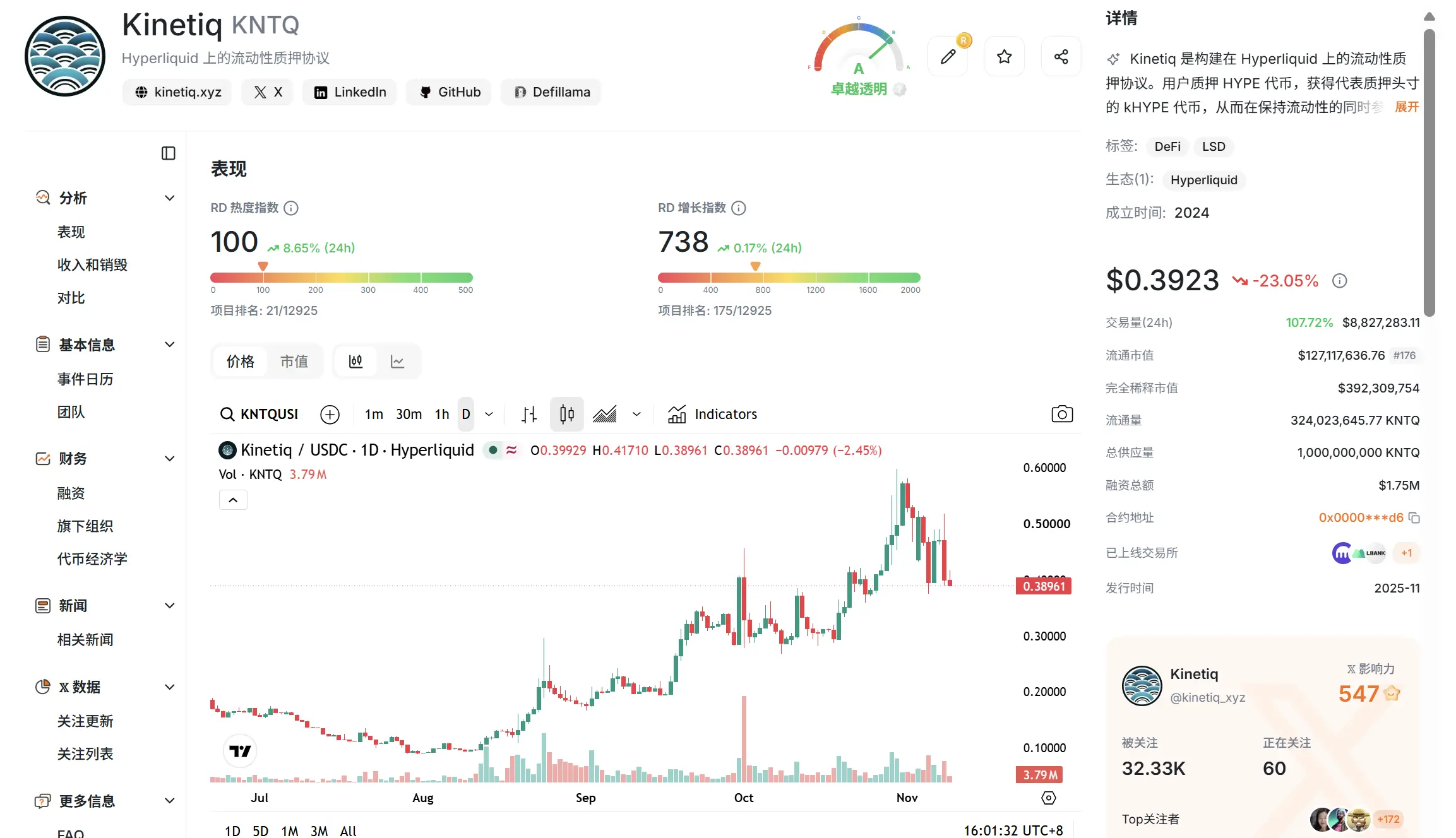
On the day the announcement was made, KNTQ surged 30%, as the market had reacted in advance to this economic model. However, whether the buyback mechanism can truly create long-term value ultimately depends on network transaction volume and actual revenue, rather than purely on the design of the mechanism.
4. Ecology: The "hundred-team battle" of Launchpad and hidden concerns
The most striking feature of the Elysium ecosystem is the intensive rush of Launchpads. Within weeks of the testnet launch, over ten launchpads announced their entry, and thousands of tokens were created—the emergence of data tools like ElyScreener is due to the fact that "no one can see all coins in one place."
The ecological landscape on the first day of the mainnet launch can be broadly categorized: in trading infrastructure, Uniswap, KyberSwap, Aero, ArcherSwap, etc., provide liquidity layers; the issuance layer is the most competitive, with aka.fun (previously launched on Arc mainnet), BunnyPad, PerpMe, Oxley, Neuriio, Ascend (official partners) each employing unique strategies—auction pricing, single-transaction launches, AI Agent self-token issuance, social account tokenization; derivatives and prediction markets are filled by Derive V3 and Speculate (linked to the HIP-4 result market); NFTs and gaming are covered by AtlasHL, slymz, TORPOR, Frog Flip, Eloscape, among which Eloscape supports both Robinhood Chain and HyperEVM alongside Elysium—choosing to position itself among several "peer new chains" indicates that Elysium has been placed in a new chain competition coordinate system alongside Arc and Robinhood Chain.
However, the prosperity has its underlying concerns. First, the ecosystem structure is evidently "top-heavy"—more than half of the nearly 30 projects consist of Launchpads and Meme infrastructure, applications with short user lifecycles and limited value accumulation, raising questions about whether they can support the grand narrative of "filling the spot trading gap." Second, the network's initial phase is governed by a single permissioned sorter, and the permissionless fraud proof has yet to be launched, meaning security remains a "commitment" in the roadmap. Third, as the official has clearly stated there are no tokens or points, the various "Elysium tokens" pre-sales appearing on-chain need to be treated with suspicion—the official has repeatedly warned that any Elysium tokens, pre-sales, or point claims are questionable.
Conclusion
Looking back at the launch of Elysium, what truly deserves attention is not a specific technical metric but the industry trend it reveals: the threshold for competition among new chains is being redefined—Arc relies on Circle's institutional credit and compliance narrative, Robinhood Chain depends on exclusive scenarios for U.S. stock tokenization, while Elysium leverages internal "circulation to support external circulation" within the Hyperliquid ecosystem: using the cash flow and user mindset of perpetual contracts to feed back into the shortcomings of spot trading and applications.
In the past six months, from Solana's PropAMM to Robinhood Chain's RWA spot, Hyperliquid's lag in the spot track has been repeatedly highlighted. The success or failure of Elysium will determine whether Hyperliquid can transform the assets and traffic of the "king of perpetual contracts" into the foundation of a complete trading empire. The grand spectacle on the launch day is just a ticket to entry—the true test lies in whether spot trading volume can be genuinely activated, which is the first exam this chain must pass.
免责声明:本文章仅代表作者个人观点,不代表本平台的立场和观点。本文章仅供信息分享,不构成对任何人的任何投资建议。用户与作者之间的任何争议,与本平台无关。如网页中刊载的文章或图片涉及侵权,请提供相关的权利证明和身份证明发送邮件到[email protected],本平台相关工作人员将会进行核查。


