The prerequisite for free heating is that the price of Bitcoin is higher than $70,000.
Written by: Shaurya Malwa
Translated by: Chopper, Foresight News
In the small town of Nokia, Finland, a 180 square meter house has completely disconnected from the regional central heating and now relies entirely on Bitcoin mining machines for heating.
This setup is the "Bitcoin boiler" launched by SunBit. For every 1 kilowatt-hour of electricity consumed by the mining machine, nearly all the energy is converted into heat. The device stores the heat in water, which can reach temperatures of up to 60 degrees Celsius, and then delivers it throughout the house via radiators and underfloor heating pipes, operating on the same principle as oil and gas boilers, while simultaneously mining Bitcoin.
In simple terms, if the Bitcoin earnings from mining can cover the electricity costs, the residents effectively enjoy heating without having to continuously pay for energy. However, the installation cost for this system is over $20,000, and whether it is profitable depends on the price of Bitcoin, electricity rates, and the competition difficulty of the total network hash rate.
SunBit founder Suomi stated, "The heating function itself is not affected by market conditions; only the payback period changes."
This model also has an unavoidable time node. Bitcoin is expected to undergo its next halving in the spring of 2028, reducing block rewards by half. Many residents may not have recouped their equipment costs before the halving occurs, which will directly impact the business model of this "mining heating."
SunBit will deliver its first batch of mass-produced Bitcoin boilers in 2025. Currently, there are 30 systems in operation, CEO Elmeri Suomi told CoinDesk during an interview. Apart from one set overseas, all the others are in Finland and are already being used to replace or reduce the use of gas, oil, firewood, and municipal central heating.
In 2025, they will launch their first overseas project in the Netherlands at Leekum, replacing gas heating with mining machines. In the port city of Kotka, with a population of about 50,000 on the southeastern coast of Finland, a 200 square meter residence combines mining machines with an existing oil boiler to form a hybrid heating system.
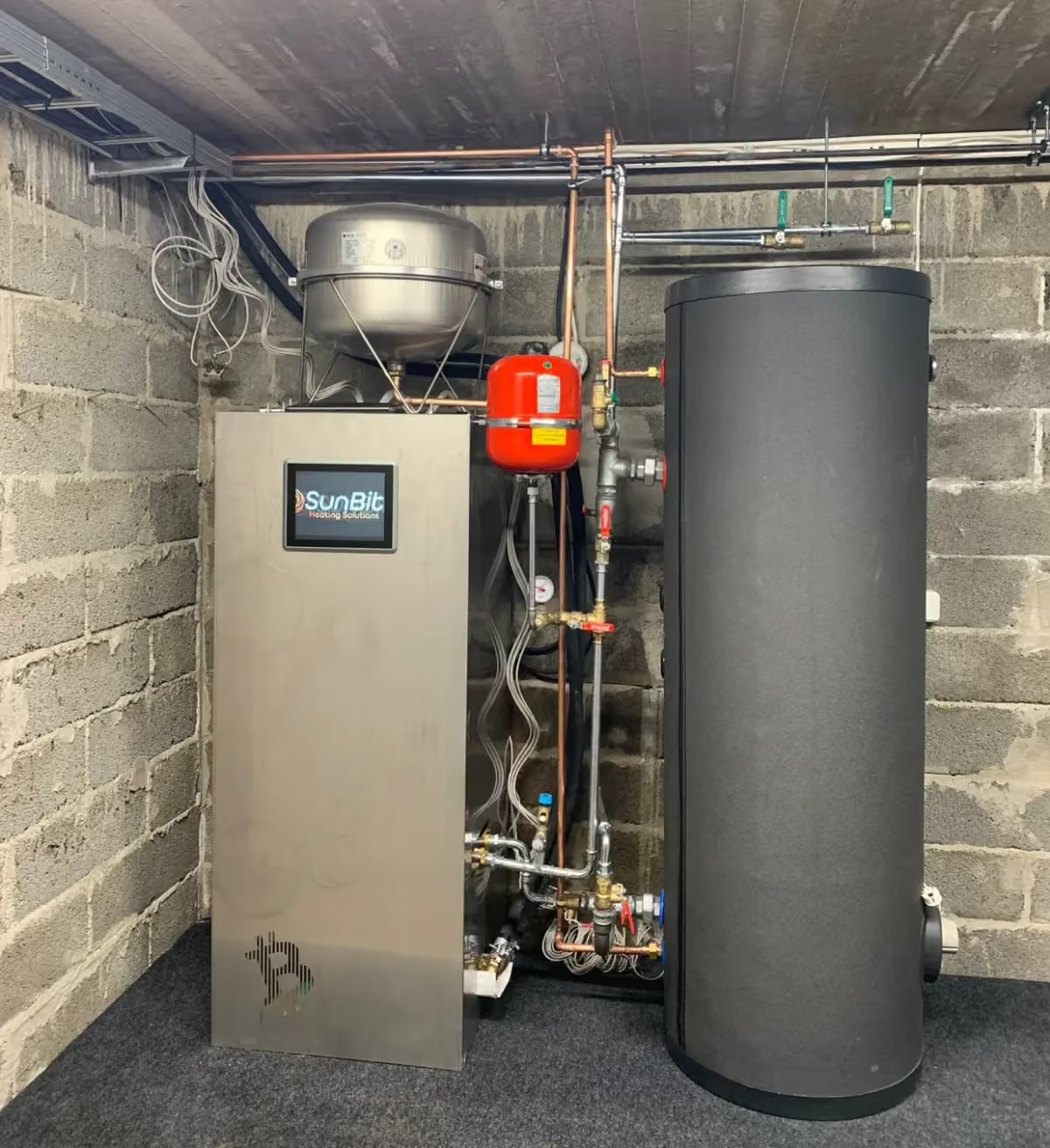
A SunBit device installed in a household in Finland
In an old manor in Tampere, Finland's third-largest city, mining machines have replaced firewood for heating, keeping a 1500-liter water tank between 50°C and 60°C. A similar heating system is also in operation in a 3000 square meter industrial plant in Vimpeli, equipped with an air source heat pump and also utilizing surplus power from a 30-kilowatt solar array.
Finland has become a testing ground for heating from mining waste heat. The local company MARA also collects waste heat from mining machines to connect to the municipal heating network for residents.
SunBit's solution leans more towards regular consumers, where homeowners purchase the mining machines themselves, replacing the existing boiler location, and the equipment belongs to the residents. They pay for their own electricity, and the Bitcoin mined is entirely theirs. The noise from the mining machines is quite loud, so they are generally placed in basements or separate soundproof rooms.
The Profit Calculation of One Mining Machine
Taking the homeowner in Nokia as an example, the core is a simple comparison of incomes and expenditures: Can the mining income cover the electricity costs?
SunBit's calculation model uses Bitmain's water-cooled mining machine Antminer S21 XP Hydro, which has a hash rate of 495T and runs third-party firmware Braiins OS. The equipment operates continuously 24 hours a day, consuming about 5.3 kilowatts of power, for an annual electricity consumption of about 46,400 kilowatt-hours. Calculating electricity rates at 11 cents per kilowatt-hour, the annual electricity cost is about $5,200.
Assuming the price of Bitcoin is $82,000 and the total network hash rate is 1040EH/s. Under these conditions, one mining machine could mine about 1/12 of a Bitcoin in a year. After deducting a 10% service fee from SunBit, the homeowner would receive Bitcoin valued at about $6,100; the mining pool also deducts a 0.5% fee.
This service fee is optional and includes 24/7 remote monitoring, automatic optimization strategies following Finland's fluctuating electricity price, and a supporting mobile app. Future plans also include power grid peak-shaving features. If the homeowner opts not to purchase this service, they can receive the full 1/12 of a Bitcoin, which would be worth about $6,800 annually.
If the paying service option is chosen, after deducting electricity costs, there would still be a surplus of about $900, and the associated heating would be essentially free. Of course, regular homes cannot fully utilize all the heat produced by the mining machines.
Suomi told CoinDesk, "Currently, the income generated from mining for every kilowatt-hour of electricity consumed is slightly above the electricity price, so the heat is essentially a free by-product." At the time of reporting, the price of Bitcoin was around $81,500. SunBit's breakeven point (where mining income minus service fees equals electricity costs) is approximately $70,000. This figure does not include the purchase cost of the equipment itself and assumes the total network hash rate remains unchanged. If more mining machines come online, the revenue from a single mining machine will decrease.
Suomi provided a screenshot from the mining pool backend of an early customer, who purchased a 358T hash rate water-cooled mining machine S21+ Hydro, which mined 0.039 Bitcoin in the past year, valued at approximately $3,160 at the time. This set of equipment can replace about 2,000 liters of heating oil per year. SunBit can only see data from the first batch of trial users; subsequent customers use independent private mining pool accounts, so the platform cannot access their data.
More Appealing than Oil Boilers, but Can’t Compete with Heat Pumps
SunBit made a comparative calculation for the reporter: a standalone house consumes 2,300 liters of heating oil annually, with an oil price of about $2.19 per liter, resulting in an annual oil cost of about $5,000.
Switching to mining machine heating theoretically allows the elimination of this oil expenditure. According to the model calculations, after deducting electricity costs, there would also be a surplus of about $920 annually. The total installation cost of the equipment is quoted at about $20,200, excluding additional accessories. Without considering maintenance or loan interest, the payback period is about 3 and a half years. The original oil boiler can still be kept as a backup for the coldest days.
However, there is a drawback: more than half of the heat cannot be utilized by the house. The external dry cooler (a heat dissipation device with a fan) will vent excess heat directly outdoors, especially in summer (from late May to mid-September in southern Finland). Finland's heating season is long, with about 100 days of severe winter in the southwest and up to 200 days in Lapland.
Air source heat pumps are a stronger competitor. For every kilowatt-hour of electricity consumed, heat pumps can transfer heat from the air or soil, producing 2.5 to 3 degrees of thermal energy; whereas the mining machine can only convert 1 degree of electricity into 1 degree of heat.
For example: a house needs 25,000 degrees of heat in a year. SunBit calculates that the annual running cost of an air source heat pump is about $1,100, while municipal central heating costs about $3,170. If the mining machine does not run continuously all year but only operates to just meet the heating demand of 25,000 degrees, the mining income after deducting electricity costs could still earn $490 more.
The choice between the two is clear: heat pumps use less electricity and have higher heating efficiency; mining machines consume more electricity but the earnings from mining can offset the electricity costs. The advantage of mining machines comes entirely from mining profits, not from heating efficiency itself.
Suomi stated that mining machines have an advantage in severe winter, "The heat-generating capability of mining machines is not affected by the outdoor temperature. The efficiency of air source heat pumps drops dramatically at minus 25°C, but mining machines are different: every kilowatt-hour is consistently converted into heat up to 60°C, 365 days a year." However, the operational profits of mining machines are tightly bound to the Bitcoin market and the difficulty of mining across the network, while heat pumps are not affected by the price of coins at all. The installation price for the entire setup ranges from $20,400 to $31,400, with an estimated payback period of 3 to 6 years.
The 2028 Halving is the Biggest Risk
Users who place orders for installation now are likely to encounter the 2028 Bitcoin halving before recouping their costs. The block reward will drop from 3.125 Bitcoin per block to 1.5625 Bitcoin.
SunBit's profit calculator does not account for the impact of the halving and calculates payback time based solely on current mining income; regardless of whether the price is $100,000 or $20,000, the company does not promise fixed earnings.
Suomi said, "I will not predict the price of coins or trends in hash rates. We will clarify the historical halving with every customer and inform them of the impact that halving has caused to earnings in the past."
Under the same calculation conditions, after the halving, the mining income per kilowatt-hour will drop from 13 cents to 7 cents, falling below the electricity price of 11 cents. At this point, heating will require out-of-pocket expenses, with the cost of heat being about 4 cents per degree, close to the operating cost of an air source heat pump with the same efficiency.
Residents who install the equipment this winter will likely have about 18 months to enjoy the current high-profit margins. According to this formula: to continue to achieve "free heating" after the 2028 halving, the price of Bitcoin would need to rise to approximately $131,000.
Thus, in Finland, these dozens of houses have a special heating solution: relying on the continuous rise in Bitcoin prices.
免责声明:本文章仅代表作者个人观点,不代表本平台的立场和观点。本文章仅供信息分享,不构成对任何人的任何投资建议。用户与作者之间的任何争议,与本平台无关。如网页中刊载的文章或图片涉及侵权,请提供相关的权利证明和身份证明发送邮件到[email protected],本平台相关工作人员将会进行核查。


