Subsequently, 2027 will face the largest net stock supply shock since the internet bubble burst in 2000.
Written by: Xu Chao, Wall Street Watch
The market turning point is approaching. Tony Pasquariello, global head of Goldman Sachs' hedge fund business, issued a warning: although the main trend of the U.S. stock bull market has not yet broken, it has entered a countdown. He predicts that the S&P 500 index will complete its last round of gains, and then in 2027 will face the largest net stock supply shock since the internet bubble burst in 2000.
In the latest weekly report, Pasquariello pointed out that the three core variables driving the strong performance of U.S. stocks over the past four years—earnings growth, capital flow, and AI narrative—have all deteriorated in marginal direction. He clearly stated, "It is expected that the S&P will complete the final surge before the turning point, but 2027 is destined to be a year with poorer returns," and warned that the baseline level of index volatility will trend upward.
Notably, in the same week, another strategist at Goldman Sachs, Rich Privorotsky, also referenced comparisons to the internet bubble peak in his report titled "1998 or 2000?"—which indicates that there were two implicit echoes of the 2000 tech stock crash within Goldman Sachs in the same week. Meanwhile, this week the Nasdaq 100 index saw a one-day decline of 6.36%, the largest one-day decline since the COVID-19 pandemic began, and hedge fund returns for the year have almost completely reversed.
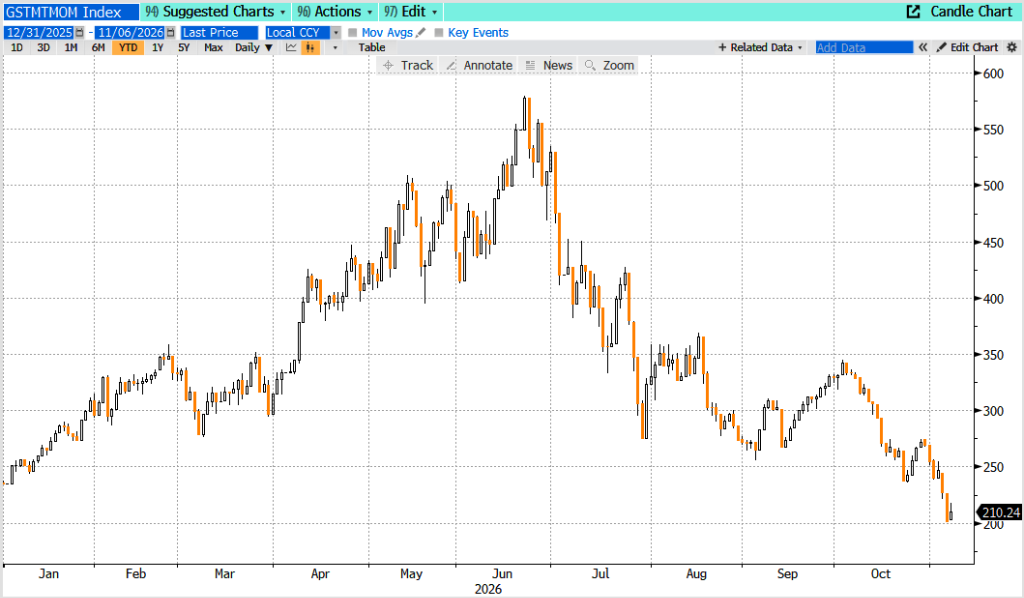
Earnings growth peaks, upward momentum difficult to sustain
On the earnings side, the S&P 500 index saw an earnings growth rate of 33% in the second quarter, with an expected rise to 35% in the third quarter. He noted, "This is the fastest earnings growth in 30 years, aside from recovery periods after economic recessions."
However, the slowdown in growth has become a high-probability event. Pasquariello admitted that the market is highly sensitive to rates of change, "the tension between the second derivative and the first derivative is the core contradiction I repeatedly weigh, and this contradiction is becoming increasingly complex." Although Goldman Sachs predicts that the S&P EPS can still achieve about 18% growth next year, historical data indicates that the bullish win rate still exists, but he clearly stated: "It is becoming increasingly difficult to imagine that earnings can provide the kind of upward convexity we have enjoyed in recent years."
He also specifically pointed out that Goldman Sachs' earnings forecasts are "extremely sensitive to AI capital expenditures," and developments this week have significantly increased the downside risk to those forecasts.
Deteriorating capital flow, 2027 net supply peaks since 2000
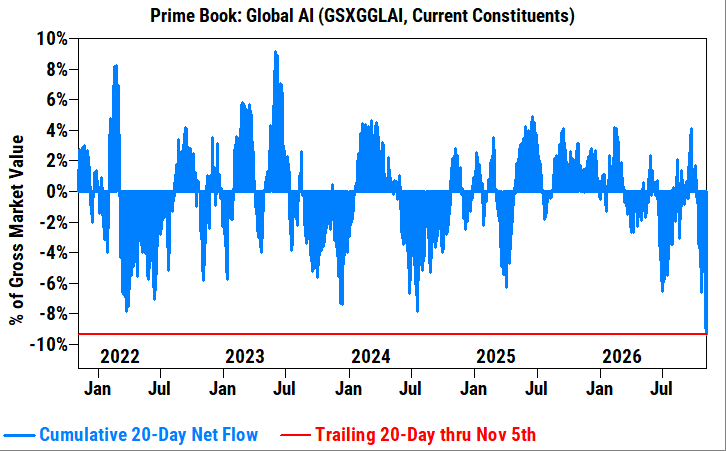
The signals at the level of capital flow are even more severe. Pasquariello wrote that over the past three months, the market has continued to absorb widespread and deep selling pressure, and this week the sell-off has entered a "full-blown" state. According to data from Goldman Sachs' main broker, over the past 20 trading days, hedge funds have sold global AI stocks at the fastest rate in over five years, deviating from the mean by more than 3 standard deviations.
Buyers have also collectively retreated. The weakening of corporate buybacks, the contraction of overseas investor buying, and the mechanical following sell-off by quantitative strategies like CTAs have all contributed to a "buyer strike."
More alarmingly is the supply pressure in 2027: Pasquariello explicitly stated that the increment of net supply in U.S. stocks is expected to reach its highest level since 2000. The resonance of large IPO pipelines like SpaceX and Anthropic with corporate cash flow shifts (which prioritize capital expenditures over buybacks) will simultaneously create pressure on both supply and demand. Although he holds a relatively optimistic view on the funding situation in the last eight weeks of the year and noted that buyback scales have rebounded to about $5 billion per day, this short-term support cannot conceal the structural pressure of 2027.
AI narrative shows cracks, left tail risk expands
Pasquariello categorized the AI narrative as "the most difficult variable to clarify." As the market entered this week, there was a widespread expectation that the growth rate of capital expenditures by tech giants had peaked—market consensus showed that the relevant growth rate would drop from 96% this year to 44% next year; meanwhile, large-scale cloud service providers had a net cash flow consumption of $31 billion in free cash flow in the third quarter, and market anxiety over their continued "negative free cash flow" continues to accumulate.
He summarized the impact of this week's events on the AI outlook in four points: first, AI capital expenditures were previously the "rocket fuel" for the market, but the market is now forced to seriously examine whether the intensity of construction can be sustained; second, the prospects for AI capital expenditures have broadened the distribution of potential outcomes, "introducing more left tail risk to a market that had almost solely pursued right tail risk"; third, if the pace of construction cools, the cycle may lengthen, but there remains cautious optimism in the medium term; fourth, the upward convexity of "shovel and pickaxe" related targets in AI infrastructure is unlikely to remain uncompressed.
For the optimistic Rich Privorotsky, he tends to liken this adjustment to 1998 rather than 2000, believing that this is a liquidity event rather than the end of a cycle, "delaying data center construction does not equate to destroying demand for computing power." But he also acknowledged, "The disconcerting similarities to 2000 lie in the sheer scale of spending and the uncertainty of returns"—which aligns with Pasquariello's warning about supply in 2000.
Valuation repair provides a buffer, but credit market has sounded an early alarm
Pasquariello did not shy away from the core arguments of the bulls: after this valuation destruction, "the market is currently at a reasonable valuation level." He pointed out that the forward P/E ratios of the Nasdaq 100 and the Philadelphia Semiconductor Index are both below the levels before the release of ChatGPT in November 2022, approximately cheaper by four valuation multiples, with the forward P/E ratio of the Nasdaq 100 dropping to 18.4 times, the lowest since 2020.
However, at the end of the report, he disclosed a deeper concern: recently, two investors he deeply respects told him that "the stock market is overly complacent relative to the credit market." In conjunction with discussions about a rate hike in December being reintroduced, the pressure on AI-related high-yield bonds, and the triple overlap of the maximum net supply pressure in 2027, the credit market is pricing in financing issues for construction ahead of time—whether the stock market has adequately reflected this remains a core unresolved issue.
Pasquariello's ultimate conclusion is clear and cautious: the main trend of the bull market still exists, there may be a last surge at the end of the year, but the "turning point" has already been written into the outlook judgment, and 2027 will be a trading environment "requiring greater flexibility."
免责声明:本文章仅代表作者个人观点,不代表本平台的立场和观点。本文章仅供信息分享,不构成对任何人的任何投资建议。用户与作者之间的任何争议,与本平台无关。如网页中刊载的文章或图片涉及侵权,请提供相关的权利证明和身份证明发送邮件到[email protected],本平台相关工作人员将会进行核查。


