Author: David, Shenchao TechFlow
Jensen Huang admitted it.
On November 8, Nvidia publicly released a letter he wrote to all employees. The 63-year-old Huang acknowledged infidelity to his wife and wrote, “I owe my family and all of you an apology.” Subsequently, Nvidia's board announced an independent investigation the same day.
The letter did not mention any names, but everyone knew it referred to Alice Huang, a former executive at the Singapore company Megaspeed.
The intersection of the two has actually shown signs long ago.
In June 2024, someone shared a photo on LinkedIn of Alice Huang and Huang at a bar in Taipei, with executives from suppliers such as Gigabyte at the same table. According to foreign media citing a participant's recollection, Alice Huang said in front of everyone that she could invite Huang over, and he really came.

Last month, in an interview with Bloomberg, Huang also said their interactions were related to Megaspeed's business, “completely normal.”
So throughout the day, the most discussed topics were Huang's private life and Nvidia (NVDA)'s stock price.
However, few questioned how an unknown Singapore company could manage to bring the CEO of the world's highest market value company to drink?
Megaspeed was established in 2023 and had hardly been known outside the circle until last month; but what you might not know is that it is Nvidia's largest partner in Southeast Asia.
According to trade records cited by The New York Times, from June 2024 to February 2026, its affiliated company in Malaysia purchased at least $4.8 billion worth of AI devices containing Nvidia chips.
These devices were housed in data centers in Malaysia and Indonesia, and the computing power was rented out. According to reports from The New York Times and other media, one of the major clients is Alibaba.
It is clear to observant people that this business is exploiting a loophole in U.S. export controls.
The U.S. controls the transit of chips but has no reach over the online rental of computing power. As long as the GPU remains in Johor, Malaysia, and engineers in Hangzhou submit training tasks online, it doesn’t count as export under current U.S. rules. The industry refers to this as "external training, internal inference," where training runs overseas, and inference runs back in the domestic market.
The chips have not left the country, but the computing power has gone abroad.
If Megaspeed were only doing this, it would at most be a computing power sub-landlord navigating the gray area. But what made the U.S. Department of Commerce uneasy was an on-site inspection at the end of 2024. Investigators entered its data center in Malaysia and found a batch of Nvidia servers still sealed in boxes.
Chips Sealed in Megaspeed's Boxes
For companies in the computing power rental business, the worst fear is having idle equipment.
GPUs depreciate daily, new models are released yearly, and leaving an unplugged card for an extra day costs money. So when investigators saw the sealed servers in Malaysia, their suspicions were only natural:
This batch may not have been intended for use here at all.
A year later, Bloomberg revealed more details in a report. Customs records from Malaysia and Indonesia show that Megaspeed imported about 136,000 Nvidia chips, more than half of which are the latest generation Blackwell, most of which had arrived over six months ago.
Yet when Nvidia sent people to its data center, they could only count a few thousand Blackwell chips on site.
Nvidia's explanation at the time was that the uninstalled chips were stored in the warehouse, each with a specific destination, and there was no evidence that any had been shipped to China. A Nvidia spokesperson also stated that Megaspeed operates a "small commercial cloud," which, like many similar companies worldwide, operates within the permissible boundaries of U.S. rules.
Simultaneously, Megaspeed itself issued a statement denying participation in any illegal transportation.
However, the origins of this company aren't small at all. According to foreign media, it is a spinoff of the Chinese gaming company 7road (0797.HK) in Singapore, split five months after the U.S. implemented chip bans against China; first transferred to a British Virgin Island company controlled by Alice Huang, and in November 2023 sold to a shell company Swiftdata owned by Singaporean businessman Tan Yong Pong.
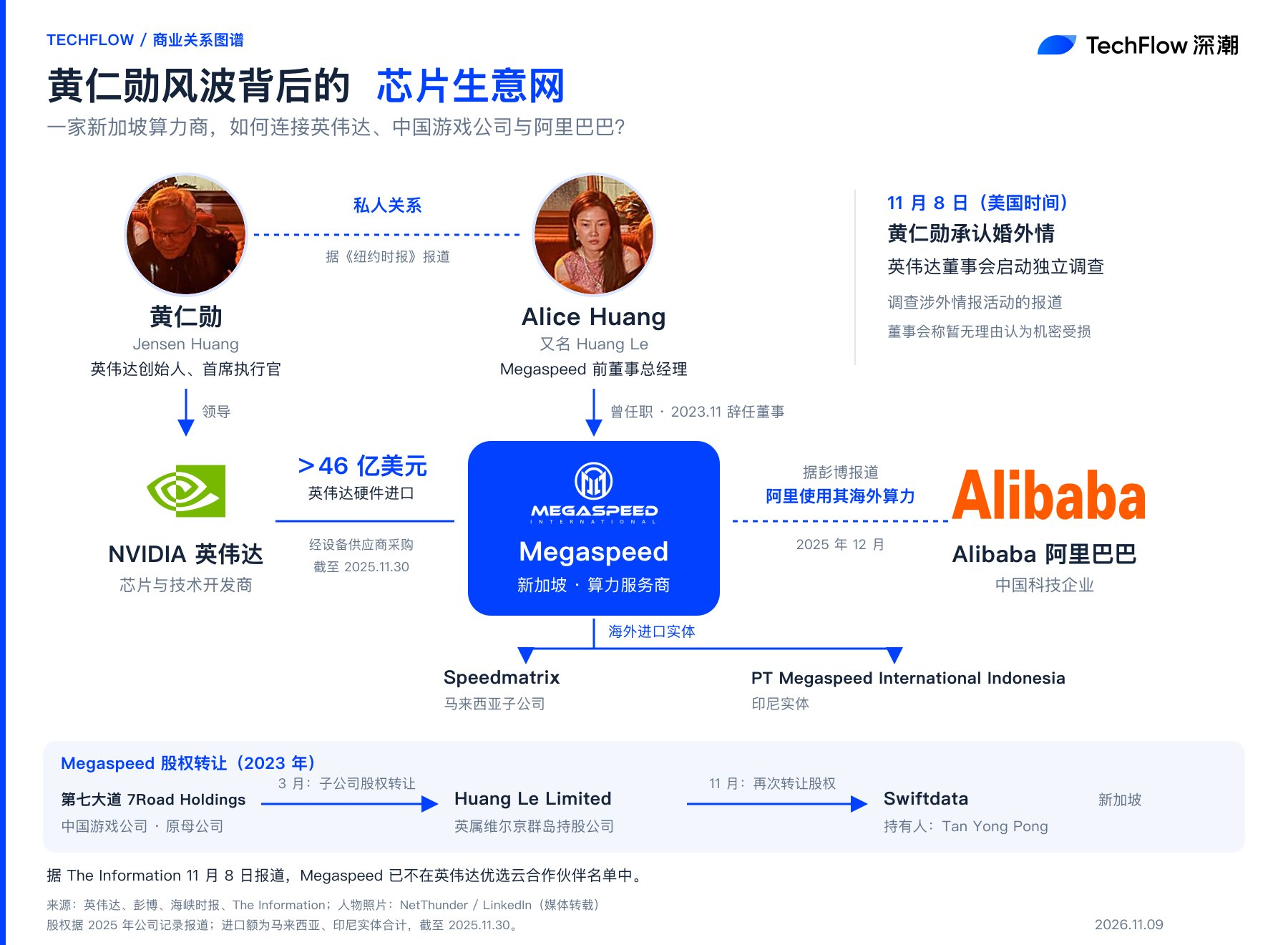
Just four days after the ownership transfer, it became a cloud partner of Nvidia.
A company that had just changed ownership could acquire this identity so quickly, indicating that Nvidia sees it as a significant client. However, judging by the standards of a normal computing power company, nearly all aspects don’t add up.
Firstly, the most baffling aspect is the money. At the end of that year, the company had only $5.7 million in cash, yet in less than two years, the value of Nvidia equipment it imported was more than 800 times its cash on hand.
Computing power rental is inherently a capital-intensive business, with financing and customer prepayments being common, but who filled such a huge gap remains unclear.
The source of the goods can be traced, but the findings could make U.S. authorities uneasy. Megaspeed ordered the chips from its U.S. affiliate Aivres, a subsidiary of Inspur.
Inspur is one of China's largest server manufacturers, previously on the U.S. Entity List, but its U.S. affiliate can still get Nvidia's goods. This means that this batch of chips, from manufacturing to being sent to the data center, involved several companies linked to China, none of which are on the U.S. blacklist.
At the same time, Megaspeed itself shows few signs of handling such a large business.
New York Times reporters visited its office and found only two employees in Singapore, who were unaware of the business; the office in Malaysia was also very small, and there was not a single engineer in sight.
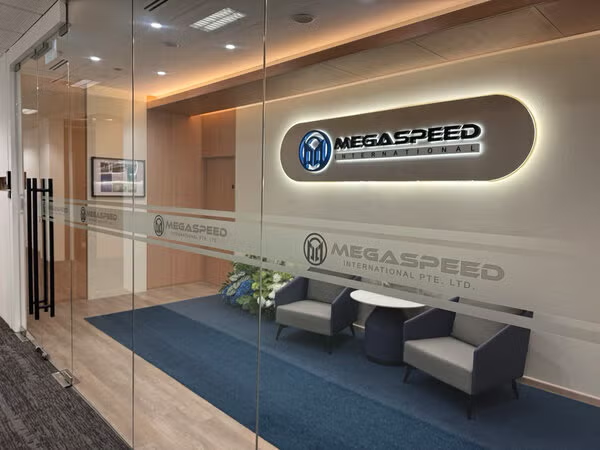
The official website claims the data centers are in Malaysia and Indonesia, but according to a 2024 financing document provided by Bloomberg, it introduced a data center located in a “specific region” to potential investors, but did not specify the country.
Perhaps what truly gives Megaspeed value is this structure.
A company with hardly any visible employees supports a multi-billion dollar computing power business. Clients may be in China, the machines located in Malaysia, with equity registered in Singapore and the British Virgin Islands, every link falling outside the reach of U.S. chip export controls.
Computing Power Going Abroad, Uncontrollable Remote Flow
Amid rising physical embargoes and massive computing power demand, capital and technology are constantly seeking the most efficient avenues for flow.
From an enforcement perspective, the U.S. Department of Commerce controls where a chip is shipped from, to whom it is sold, but once the chips are installed in data centers, renting out the computing power over the network exists in a shadow zone of export control.
Thus, there might be more than just Megaspeed doing this.
According to reports from foreign media, INF Tech rented 2,300 Blackwell chips through a data center in Indonesia; Tencent signed a contract worth $1.2 billion corresponding to 15,000 Blackwell chips with Japan's Datasection; and this summer, there were reports that Moonlight used GB300 via facilities in Thailand...
These transactions do not appear to cross any lines; the chips have not left the country, and those using the chips do not own them.
In fact, the U.S. is also aware of this loophole. In January of this year, the U.S. House of Representatives passed the Remote Access Security Act by a vote of 369 to 22, intending to classify remote use of controlled chips as exports, but this bill is still stalled in the Senate.
According to The Information, the Department of Commerce is also drafting rules regarding remote computing power, which have not yet been announced.
For domestic AI companies relying on “external training, internal inference” to fill gaps in computing power, this path is still feasible for the time being, but it is becoming increasingly expensive and unreliable. This scandal involving Huang has pushed Megaspeed into the spotlight, and every Southeast Asian sub-landlord supplying computing power to Chinese clients is likely reevaluating its customer list.
This reminds me that not long ago, people were discussing tokens going abroad, with domestic models selling cheap tokens worldwide. But few have considered that some of the computing power used to train these models may itself have been rented from overseas.
Before the gossip about Huang, Megaspeed's own expansion had not ceased either.
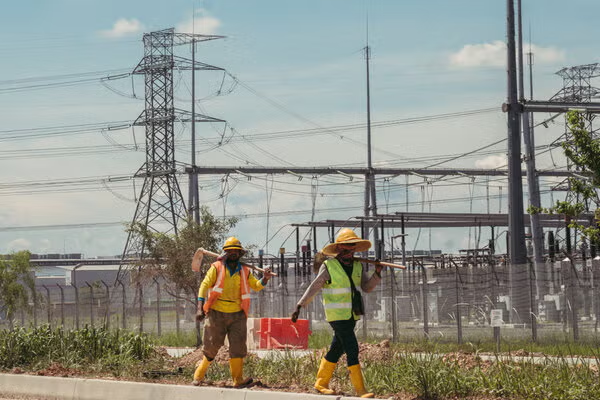
It stopped purchasing Nvidia hardware in July 2025, but according to The New York Times, its large data center in Johor is still under construction, with new AI data centers being built amidst oil palm plantations. The report also mentioned that it already possesses the key chips needed for the expansion.
The Questions the Apology Letter Cannot Answer
Looking back at that apology letter, what Huang acknowledged was, in fact, the easiest part of the whole issue to recognize.
Infidelity is a matter of personal ethics, hurting his family and personal image. A spokesperson for Nvidia stated more directly that today’s news will not slow Nvidia down.
Admitting personal life mistakes is a different magnitude than a company acknowledging that its major client may be problematic. The former is Huang's personal business; the latter is Nvidia's concern.
Clients like Megaspeed are precisely the part of Nvidia's growth over the past two years that has rarely been brought to the surface. Huang himself has stated that Nvidia's market share in China has dropped from 95% to 0. The most advanced cards cannot be sold directly in China, yet the demand for computing power from Chinese companies remains, only the address has changed, perhaps continuing to place orders from data centers in Southeast Asia.
If this scandal is ultimately deemed to involve Nvidia being infiltrated, it would not only tighten scrutiny on Megaspeed, but also on the entire channel of "Southeast Asian data centers catering to Chinese clients." For Nvidia, all the orders flowing through this channel are real business.
Chips can be confined within national borders, but computing power can flow out over a single network cable. In the AI era, the computing power business no longer considers borders at customs.
Huang acknowledged his mistakes in the letter. As for the business along this channel, it is not a question that an apology letter can answer.
免责声明:本文章仅代表作者个人观点,不代表本平台的立场和观点。本文章仅供信息分享,不构成对任何人的任何投资建议。用户与作者之间的任何争议,与本平台无关。如网页中刊载的文章或图片涉及侵权,请提供相关的权利证明和身份证明发送邮件到[email protected],本平台相关工作人员将会进行核查。


