A valuation consensus lasting several years has come back to the basics.
Written by: Zack Abrams
Translated by: Saoirse, Foresight News
Editor's note: "Ultrasound Money" was once the most compelling story of the Ethereum bull market, and many investors have become accustomed to pricing ETH based on a fee-burning model. Vitalik’s recent comments have effectively slowed down this popular narrative. He does not deny the EIP‑1559 burning mechanism itself but reminds the market that burning should not be the basis for valuation. Ultimately, the value of Ethereum must return to its foundational qualities of decentralization, censorship resistance, and long-term network sustainability. The following is the content of this article:
On Sunday evening at 8 PM (Beijing time), Vitalik posted on the X platform stating that compared to "viewing ETH as a fee-burning token," it would be much more reasonable to focus the narrative on "ETH as a store of value." He affirmed the EIP‑1559 mechanism implemented in 2021: This mechanism burns a portion of transaction fees, and this mechanism itself operates well. Ethereum should retain it, even if the amount burned can only partially offset new ETH issuance. He wrote, "Even if the long-term fee burn rate is below the breakeven point of 10%, we need not feel disappointed; ETH's value has other sources."
Vitalik believes that when users recognize Ethereum, they essentially acknowledge its decentralized attributes, as well as the continuous efforts the project makes in censorship resistance, privacy protection, and network security; the core real value Ethereum brings to the financial ecosystem is stability. He wrote, "In an era of disruptive change brought about by artificial intelligence, stability will become a highly valued trait."
The "Valuation Floor" under the Burning Mechanism
Fee burning is the foundation of the "ultrasound money" theory that became popular among ETH holders during the bull market of 2021. Vitalik unpacked the valuation model of such burning tokens in his post: the token market cap equals the annual total burn divided by the discount rate. According to this model, if a token burns $1 billion in value annually, with a discount rate of 4%, the corresponding theoretical valuation floor would be $25 billion.
"But the problem is: this so-called floor has never been a solid real support." Vitalik wrote. The large amounts of ETH burned from 2021 to 2023 mostly came from internal demand scenarios within the crypto ecosystem, which contracted in sync with ETH prices. He illustrated that there was an instance when an NFT sale activity exploded the network, reaching a daily fee-burning amount of $180 million. "Only when the demand that generates fee income comes from the real outside world can this valuation floor logic hold."
(Note: The sale that Vitalik referred to was the Otherside metaverse land sale launched by the Bored Ape Yacht Club development team, Yuga Labs. At that time, users paid upwards of tens of thousands of dollars in fees to buy Otherdeed NFTs, while the current market price of that NFT is around $150.)
Vitalik stated that with the continuous growth of the tokenization of real-world assets, Ethereum now has a better external demand foundation. However, such businesses belong to mature and stable routine operations, making it difficult to replicate the past surges in fee revenue.
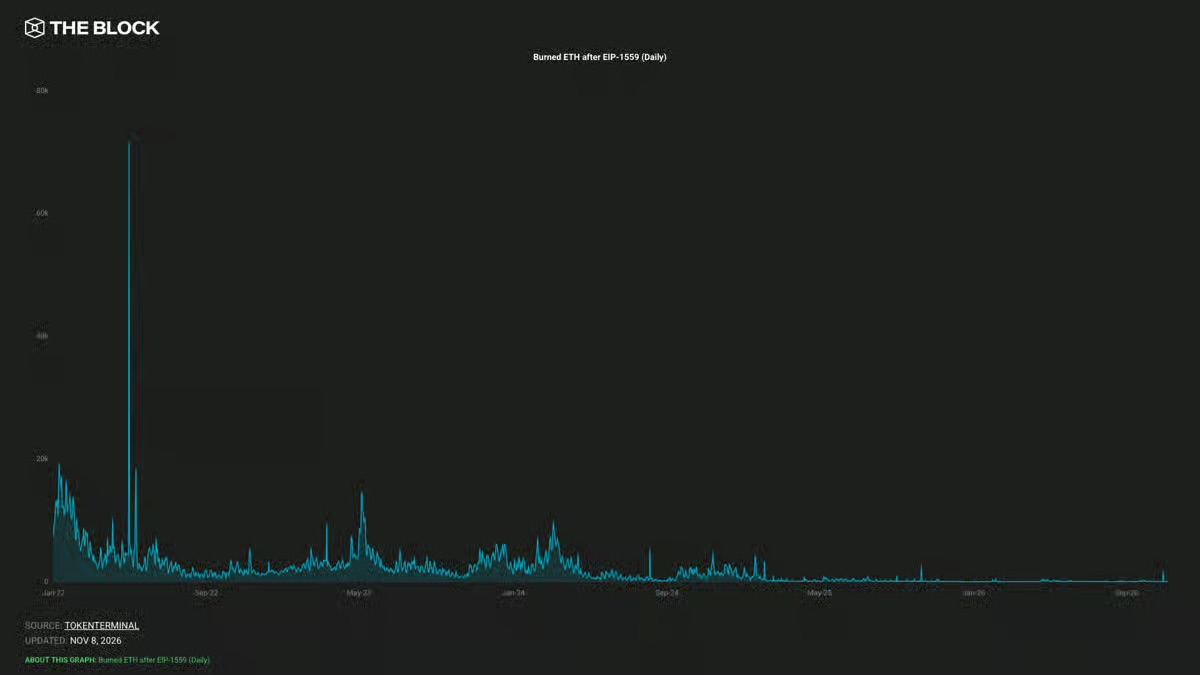
The daily ETH burned after the implementation of EIP-1559 saw a surge during the Otherdeed sales period. Source: The Block
Data from The Block shows that since then, the daily amount of ETH burned has significantly decreased. In 2022, Ethereum burned approximately 1.48 million ETH, valued around $3.6 billion; while so far this year, the burned amount is only about 19,200 ETH, worth $43 million.
Comparative Business Perspective
Vitalik expressed that if Ethereum’s market cap of approximately $270 billion were solely supported by fee burns, the operating logic of Ethereum would be similar to large enterprises like L’Oréal. Data from The Block indicates that on Sunday morning, ETH’s market cap was $273.3 billion.
He explained that enterprises of this scale would need to invest enormous funds annually to maintain their competitiveness. An AI estimated result showed that L’Oréal invests about 0.58% of its market cap in R&D each year. If Ethereum tries to match this investment ratio, the Ethereum Foundation’s funds would almost immediately be exhausted; it could only resort to protocol grants, allocating approximately 700,000 ETH annually as operating funds, which would directly reduce validators' earnings by two-thirds.
What Vitalik did not specify is that the scale and usage of funds from the Ethereum Foundation have been a contentious topic within the crypto community.
The Foundation’s selling of ETH has long faced criticism from holders, including a notable instance in April to May of this year when the Foundation sold 20,000 ETH worth about $47 million to Bitmine within two weeks. In May, Vitalik mentioned that he frequently receives community feedback, many believe that the Foundation's actual actions do not align with its publicly stated commitments.
Earlier this year, the Ethereum Foundation began staking part of its treasury reserve assets to generate income; in March, it released an accountability document, positioning itself as one of the many custodians of the network. During the departure of several core employees in May, Vitalik stated that the Foundation would streamline its structure, reduce ETH sales, and focus on public infrastructure work that no other entities were willing to undertake.
Vitalik further suggested that if Ethereum has long-term optimization goals centered around token burns, it must adopt a highly interventionist governance model; and these two points conflict with his pursuit of network capture resistance and decentralization goals. He added that prioritizing fee burns, to some extent, is equivalent to raising Gas fees, which will increase the usage thresholds and exclude certain users, particularly those most in need of privacy and security assurances.
Using Network Longevity as a Measurement Scale
Vitalik stated that when he asks community members what they value most about Ethereum, the most commonly mentioned qualities are decentralization, along with his summarized CROPS criteria: censorship resistance and capture resistance, open source, privacy, and security. For investors treating ETH as a store of value, "the primary and most important indicator of the value storage attributes is the longevity of the network."
He linked this goal with cutting-edge topics from developer conferences, including post-quantum security, moderate solidification of underlying protocols, and raising the entry barriers for new precompiled or protocol rewards. Vitalik provided examples of ongoing key projects like multi-signature wallets, the Kohaku privacy project, FOCIL's censorship resistance solution, and lightweight nodes; he also mentioned that he runs a node on his laptop, taking less than 6 hours to sync and occupying only one-eighth of hard drive space.
Vitalik noted that the ongoing growth of Ethereum's underlying native assets (including real-world tokenized assets) has a strong synergistic effect with ETH's narrative as a store of value — it expands the application scenarios for ETH, such as its use as collateral.
In Vitalik's view, Ethereum is no longer just an ordinary blockchain, but a hybrid architecture that integrates blockchain technology with modern cryptography. In September, he announced Ethereum’s development roadmap through 2030 and stated that the upcoming Hegota upgrade is likely to be Ethereum’s last regular hard fork.
Industry Reactions
Vitalik’s post received recognition from several notable figures in the crypto industry. Solana co-founder Anatoly Yakovenko stated that Vitalik was entirely correct, that transaction fees should not be treated as a core product. MetaLeX attorney Gabriel Shapiro commented that this tweet marked "a moment of rationality's return to the industry"; Moonrock Capital founder Simon Dedic believed that the narrative of ETH as a store of value is the strongest bullish logic for Ethereum and is also the story that is easiest to communicate to institutional capital.
Five weeks before this tweet was published, several co-authors of the controversial proposal EIP‑8363 had withdrawn the proposal, no longer including it in the upcoming Hegota upgrade review scope; the Hegota upgrade will launch after the postponed Glamsterdam hard fork. The proposal originally aimed to gradually increase the proportion of validator rewards used for burns as ETH staking amounts rose. The proposal’s authors believed that excessively high staking rates would threaten "ETH's attributes as a currency," and the proposal faced opposition from SharpLink CEO Joseph Chalom and Aave founder Stani Kulechov. The proposal authors plan to schedule a relevant topic discussion during the EthCC conference in April.
免责声明:本文章仅代表作者个人观点,不代表本平台的立场和观点。本文章仅供信息分享,不构成对任何人的任何投资建议。用户与作者之间的任何争议,与本平台无关。如网页中刊载的文章或图片涉及侵权,请提供相关的权利证明和身份证明发送邮件到[email protected],本平台相关工作人员将会进行核查。


