The story of RWA has not ended; it has merely changed hands in terms of narrative control.
Written by: Liu Honglin
According to news reports, on November 3, Pan Gongsheng, the governor of the People's Bank of China, reported on the financial work situation since October 2025 to the 25th meeting of the Standing Committee of the 14th National People's Congress on behalf of the State Council. The report typically covers monetary policy, financial reform, and risk management, but there is a segment regarding virtual currencies and RWA that needs to be examined word by word:
Improve the regulatory policy framework for virtual currencies, strengthen the assessment of clues related to underground money laundering involving virtual currencies, establish a regular rectification mechanism for the entire chain of virtual currency "mining," and strengthen the regulation of the tokenization of real-world assets (RWA).
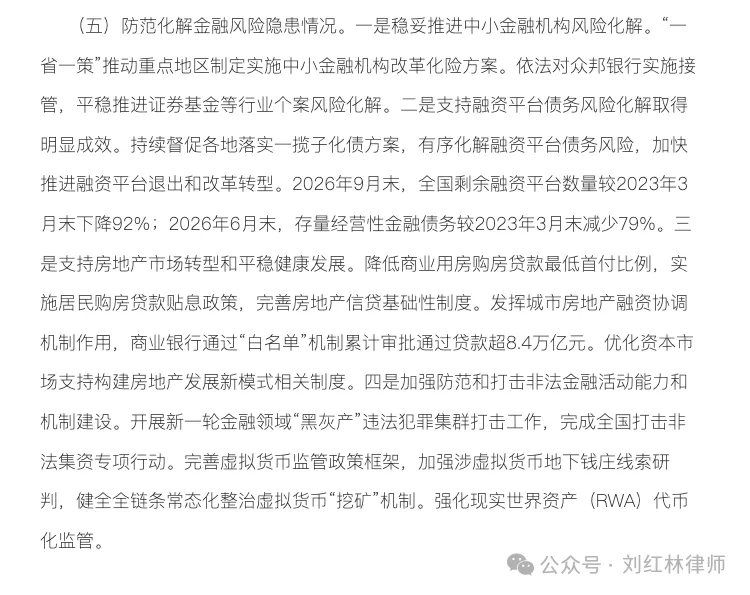
"Report on Financial Work Situation from the State Council," reprinted from the People's Bank of China
RWA (Real World Assets) represents a business model that maps real-world assets such as real estate, bonds, and carbon assets onto the chain for issuance and circulation; it has been a term used cautiously in regulatory language over the past few years.
This time, being included in the State Council’s financial work report has led to two interpretations in the market: some read it as tightening, feeling that regulation will be intensified again; others reverse the interpretation, thinking that being included in such a formal document might mean establishing rules and providing pathways.
Both interpretations may have overlooked the same fact—what has truly changed is who manages RWA and how it is managed.
First, let’s discuss where this passage is found.
Within the first part of the report, titled "Major Progress and Achievements in Financial Work," there is a section called "Prevention and Resolution of Financial Risk Hazards," which contains this segment. In the same paragraph are the crackdown on illegal criminal syndicates in the financial sector and a national special operation against illegal fundraising, with the subtitle "Strengthen the Capacity and Mechanism for Preventing and Combating Illegal Financial Activities."
The placement of these subsections itself signifies a regulatory classification: RWA has been categorized as a risk associated with illegal financial activities that need to be prevented and combated, and it has not entered the agenda for financial innovation and openness.
How RWA Became Part of Regular Regulation
RWA is not the first time it has been named by a regulator. In February this year, the People's Bank of China and eight other departments jointly issued the "Notice on Further Preventing and Resolving Risks Related to Virtual Currencies" (Yin Fa [2026] No. 42), which for the first time listed RWA tokenization alongside virtual currencies as objects of risk management. In the report on implementing the review opinions by the State Council, this approach was summarized as "strictly prohibited domestically, strictly regulated overseas."
In terms of execution: companies and individual business operators are no longer allowed to have terms like "RWA" or "tokenization of real-world assets" in their names or business scopes; internet platforms may not provide venues for related businesses, display, market, or direct users; financial institutions and payment institutions may not provide services such as account opening, fund transfer, and clearing settlement.
The aforementioned notice addresses the issue of "blockages" by closing off domestic business channels one by one.
The change in the November report is that RWA has been placed together with underground money laundering assessments and comprehensive rectifications of the mining chain, included in the annual work report from the State Council to the National People's Congress, and such inclusion is made in the summary of the past year's work—this has become daily execution for regulators.
In other words, RWA is no longer merely a new term referred to in a special notice; it has been incorporated into the regular agenda of financial regulation. In the future, constraints on such businesses will not need to rely on special documents; routine regulatory and law enforcement actions will cover them.
Technical Services No Longer Just Neutral?
This change affects practitioners in terms of regulatory attribution.
Over the past year and more, many clients have inquired about RWA, with most plans being similar: the underlying assets are real estate, debts, carbon assets, or rights to equipment yields, topped with a layer of technical services or data on-chain structures, rephrasing the issuance and fundraising phases in an attempt to define the entire matter as a technical or data business, avoiding financial regulation.
This packaging has already become very tenuous after Document No. 42; this time, the report removes any remaining imaginative space.
The issuance, trading, and settlement of assets on the chain are clearly regulated within the financial framework. The criteria revert back to a few straightforward questions: where does the money come from, where does it go, who promises returns, and who are the promotions targeting. No matter how intricate the structure is, as long as these questions point to public fundraising and return commitments, the statement "we are just doing technology" will not help.
There is another detail in the report that is easily overlooked: strengthening the assessment of clues related to underground money laundering involving virtual currencies.
This sentence targets the channels for capital return. Some teams have placed their issuances offshore, believing that an offshore structure separates them from domestic regulation; however, as long as the promotions target domestic users and the returns flow back into the domestic market through exchange channels, they fall squarely within this line.
Overseas strict regulation does not focus on registration locations, but on where users are and how money flows.
In the same report, there is another statement to be compared. In the section on "Financial Reform and Opening Up," this sentence is placed alongside cross-border payment channels, RMB swap arrangements, and panda bonds: the digital RMB's positioning has smoothly shifted from cash to deposit currency.
One is written in "Preventing and Combating Illegal Financial Activities," while the other is in "Financial Reform and Opening Up." The chapter placements themselves categorize regulatory paths on two chains.
This switch was completed earlier this year; at the Beijing Financial Street Forum in October, Pan Gongsheng publicly confirmed that writing it into this report means it has transitioned from a pilot arrangement to an established framework.
This matter appears unrelated to RWA but is essentially two sides of the same chess game.
The original positioning of digital RMB was as a digital substitute for cash, not accruing interest and not entering the credit derivation system, mainly for small payments. After switching to a deposit currency, the digital RMB used by banking institutions falls under deposit reserve management, the balance in real-name wallets can accrue interest, and commercial banks can integrate it into all-scenario businesses of savings, loans, remittances, and investments.
The digital RMB international operations center is already exploring the on-chain issuance, registration, custody, and fund settlement of assets such as bills, trade finance tools, and carbon emission rights—these are precisely the application stories the RWA industry has been repeating over the past few years.
Viewing both lines together, the direction becomes clearer: regulation does not deny the process of assets going on-chain itself. Domestic prohibition means blocking spontaneous public tokenization issuance; the digital RMB system establishes an official, recognized track for on-chain assets.
For private RWA, this presents a two-way squeeze—on one side is prohibitory action, while on the other is the alternative of official infrastructure. Expecting regulation to first block then release, and to reopen avenues for private issuance, lacks any basis at least from this report.
How Should RWA Business Teams View This?
For teams that are currently engaged in or preparing to engage in RWA-related business, Lawyer Honglin's assessment has three layers.
For domestic business, do not package issuance and fundraising actions under the guise of technical services and data on-chain. Regulation has clearly defined such business as financial activities; packaging will merely increase the cost of post-facto explanations without changing the nature.
For overseas issuance, first clarify what the regulatory environment looks like. Article 14 of Document No. 42 outlines a path under regulation: based on the ownership and yield rights of domestic assets, engaging in asset securitization-like, equity nature tokenization businesses overseas will be strictly regulated by the National Development and Reform Commission, the China Securities Regulatory Commission, and the State Administration of Foreign Exchange based on their duties according to the "same business, same risk, same rules" principle; the regulatory guidelines released by the China Securities Regulatory Commission the same day require domestic enterprises with underlying assets to first file with the Commission, and intermediaries providing services must also get approval or registration. In other words, going overseas is not prohibited, but it must follow the registration route. Circumventing this route while promoting to domestic users, with returns flowing back through exchange channels, aligns perfectly with the line of assessing clues related to underground money laundering—structuring offshore is never a safety net.
In terms of timing, there is no need to panic, but planning should align with direction. The report currently expresses policy, but does not have matching specific rules or effective timelines—businesses in hand do not need to adjust processes immediately based on this. However, if your business model is based on the assumption that "regulation will eventually relax domestic tokenization issuance," this report makes it clear that this assumption is not valid within a foreseeable period. The real opportunities lie in segments that do not involve capital or issuance: technical services, compliance tools, custody auditing, data services, and directions connecting to official tracks.
Conclusion
The story of RWA has not ended; it has merely changed hands in terms of narrative control. Over the past few years, the industry has been accustomed to framing tokenization as a transformation of the financial system through technology; this report gives the answer that within China's framework, assets are either tokenized on recognized regulatory tracks or they have no tracks at all.
免责声明:本文章仅代表作者个人观点,不代表本平台的立场和观点。本文章仅供信息分享,不构成对任何人的任何投资建议。用户与作者之间的任何争议,与本平台无关。如网页中刊载的文章或图片涉及侵权,请提供相关的权利证明和身份证明发送邮件到[email protected],本平台相关工作人员将会进行核查。