In 2026, Derive achieved two things simultaneously: it made trading cheaper while also increasing the proportion of each trading fee used to repurchase DRV.
Written by: @PDmytriiev
Translated by: AididiaoJP, Foresight News
Notes: Derive (formerly Lyra Finance) was founded in 2021 by Nick Forster and others, initially as a decentralized options protocol on Optimism. It was renamed and expanded in August 2024 to support options, perpetuals, and structured products as an on-chain derivatives platform. The DRV token officially launched on January 15, 2025 (originally LYRA migrated at a 1:1 ratio with user airdrops), used for governance, staking, and protocol fee repurchase. As of November 3, 2026, the market cap is approximately 320 million dollars.
In 2026, Derive achieved two things simultaneously: it made trading cheaper while also increasing the proportion of each trading fee used to repurchase DRV.
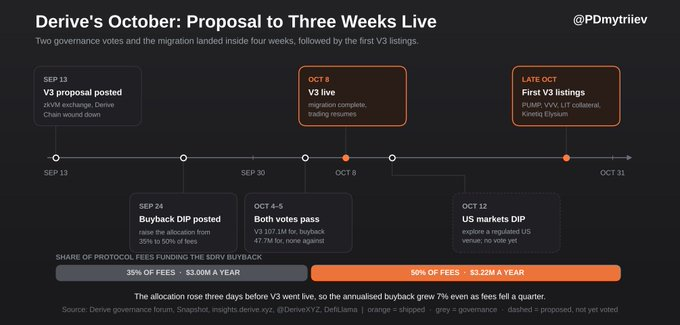
The options munch fee dropped from 0.04% to 0.0075%, and large market makers went from being charged to receiving rebates; the proportion of the protocol's actual disposable income used to repurchase DRV rose from 25% in January to 35% in April, and then to 50% in October. V3 launched on October 8, just three days before the DAO ended that repurchase vote.
Reducing execution costs was the purpose of the V3 rebuilding. Options trading venues need to rely on cheaper, deeper markets to attract traffic; the trade-off is thinner margins, but the proportion allocated to $DRV has increased, serving as compensation for the tokens. This affected short-term revenue, and the data reflected this: during the three weeks after migration, fees decreased by about a quarter, yet repurchase amounts continued to rise.
V3 Rebuilding: From Derive Chain to zk Exchange
V3 replaced Derive Chain with a zero-knowledge exchange. Order matching remains off-chain, maintaining sub-millisecond speeds; however, margin, pricing, and settlement now occur within zkVM, with proofs validated on Ethereum L1 and state changes published to Celestia. Custody is placed in Ethereum contracts rather than a rollup; deposits come directly from wallets or multi-signature addresses; there is also an escape route mechanism: if withdrawal requests time out and are not processed, another operator can take over settlement.
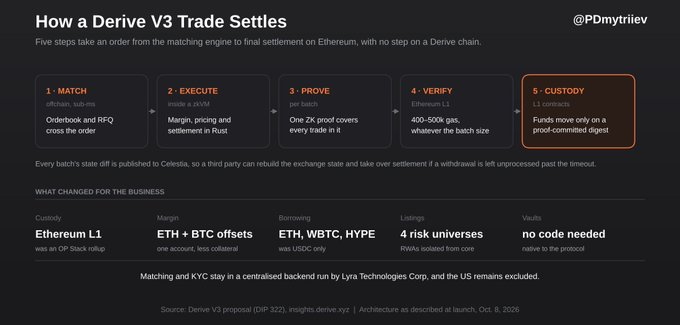
Changes on the commercial level are more important than architectural ones. Cross-margining between ETH and BTC is supported, requiring less collateral for hedged books. Borrowable assets expanded from USDC to ETH, WBTC, and HYPE. The risk domain separates high-risk listed assets from the core market, allowing new assets to be launched in stages. Vaults also became a native feature that can be deployed without writing code.
Within three weeks of going live, Derive added PUMP and VVV markets, supported LIT as collateral, launched RFQ price protection, integrated Kinetiq Elysium, and even held a HYPE options competition with a prize pool of around 40,000 dollars.
Fees decreased, why did repurchases increase
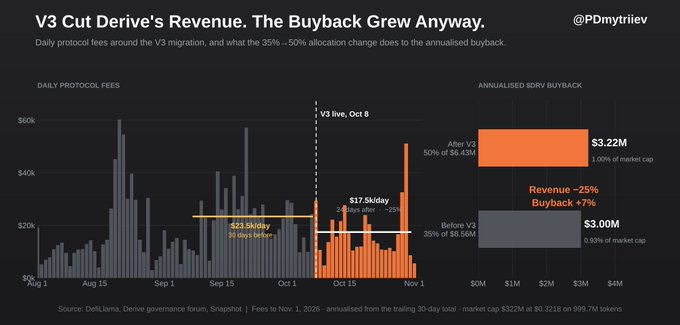
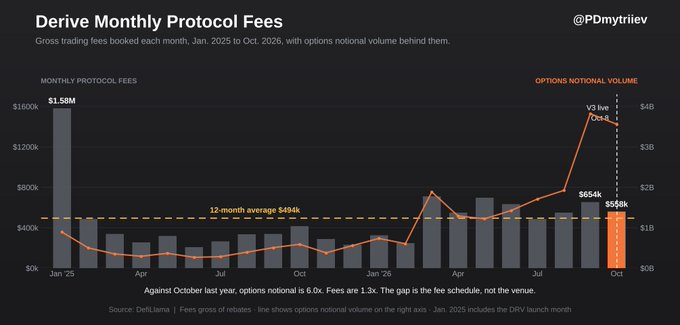
After the launch of V3, protocol fees clearly declined. The daily average was 23,500 dollars in the 30 days before launch, dropping to 17,500 dollars over the next 24 days, a decrease of 25%. For the entire month of October, protocol fees were 558,000 dollars, down from 654,000 dollars in September; while still the second-best month in 2026, it is lower than the peak. Based on the past 30 days, annualized revenue fell from 8.56 million dollars before the migration to 6.43 million dollars.
Trading volume is also declining: the notional trading volume of options in October was 3.56 billion dollars, while it was 3.82 billion dollars in September. The commission rate, however, is another matter, dropping from 1.71 basis points to 1.57 basis points, making October the month with the lowest trading costs on Derive this year. This reflects the July fee schedule in action, which is unrelated to V3. In the short term, it sacrificed protocol income; but trading venues buy depth based on this.
Considering the longer term is more meaningful: the notional trading volume of options in October is six times that of last October, while fees are 1.3 times higher than last October.
The two adjustments nearly offset each other. Before V3, repurchase funds accounted for 35% of the annual fee base of 8.56 million dollars, equivalent to about 3 million dollars annually; after V3, repurchase funds accounted for 50% of the 6.43 million dollar base, equivalent to about 3.22 million dollars. Revenue fell by a quarter, yet repurchase still grew by 7%, as the increase in allocated proportion outweighed the revenue decrease.
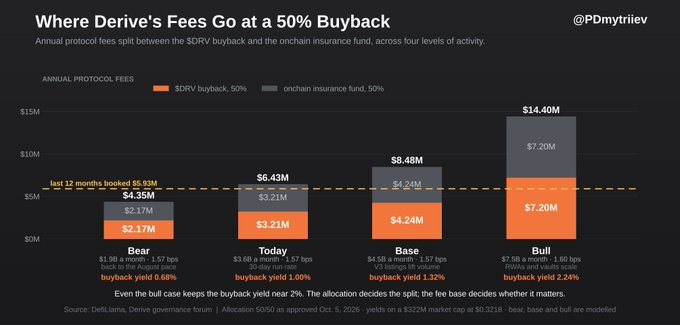
The gray section represents the on-chain insurance fund, which safeguards the protocol and prevents funding gaps in the margin system. It used to take 65% of trading fees but now takes 50%. V3 integrates it into a security module and allocates funds based on four risk categories: 65% to Prime tokens, 20% to HYPE tokens, 10% to Alt tokens, and 5% to RWA tokens. Thus, when the long tail market crashes, the risk is covered by its own funding pool, rather than being borne by ETH and BTC traders.
This chart highlights one point: the percentages are not as important as they seem. At the current fee levels, half allocated to repurchase can only repurchase about 1% of the market value annually; if options trading volume doubles, that could reach about 2%. Further increasing the allocation ratio yields only slight effects; what really drives growth is expanding the fee base.
Market Position: On-Chain Options Are Still a Small Pool
Derive's share of the on-chain options premium dropped from 93.1% to 89.6%. The total open contracts for all on-chain trading venues fell from 2.41 billion dollars to 1.64 billion dollars, with Derive still accounting for 95% of that.
Compared to Deribit, the entire on-chain options platform remains quite small. In the past 30 days, the combined notional trading volume from all on-chain platforms was 3.6 billion dollars, while Deribit accounted for 60.45 billion dollars. On-chain only represents 6.0%, with Deribit being 16.8 times the size of on-chain platforms. This ratio has improved from 5.1% in September.
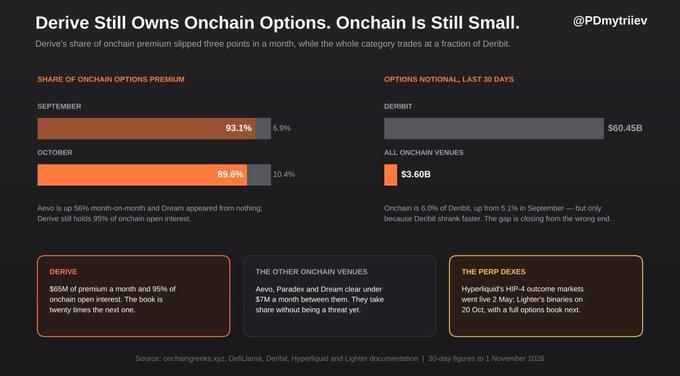
The exchanges currently holding market shares are not the focus. Aevo, Paradex, and Dream together have a net premium of less than 7 million dollars per month, while Derive reaches 65 million dollars. More interestingly, large decentralized exchanges have begun rolling out their own options.
Both have released binary options versions. Hyperliquid launched the HIP-4 result market on the mainnet on May 2, initially offering daily settled BTC contracts, with settlement values of 0 or 1, fully collateralized, no leverage, no forced liquidation, sharing margin with perpetual contracts; trading fees were activated in late August. Lighter previewed options products on October 16, and four days later launched BTC and ETH binary options on Lighter Core, stating that the next step is complete options.
Neither of these are options contracts. Result contracts lack strike prices and Greek letters; Hyperliquid's documentation explicitly states that they will not replace traditional options. What matters is the direction.
Jeff Yan clearly articulated this at DAS. He said if he doesn't build the infrastructure, he will focus on options; he no longer believes option traders will favor perpetual contracts; in his view, HIP-4 is the natural foundation for options trading—it inherits the spot order book and combined margin, allowing market makers to hedge delta exposure on perpetual contract platforms.
The U.S. Market: An Option Yet to Be Priced
On October 12, the foundation released DIP, authorizing the use of existing treasury funds to advance the regulated U.S. market, and submitted a comment letter to the CFTC in the same month. On October 29, Derive tweeted further clarification, indicating that the comment letter addressed the CFTC's proposed rules regarding conflict of interest and affiliations. Derive supports the committee in establishing clear and consistent regulatory standards.
This remains noteworthy. Applications and APIs are currently closed to U.S. individuals, while the U.S. is the largest derivatives market globally. The proposal considers the global OTC derivatives notional size of about 846 trillion dollars as a potential target. If this route opens, the market will not just be an on-chain options pool, but a market several orders of magnitude larger; if it does not open, the treasury spends money to buy an answer, with neither outcome reflected in the price.
Conclusion: Trading Short-Term Income for Long-Term Depth
In 2026, Derive simultaneously made itself a cheaper trading option with more holding value. These two things usually have a trade-off, but Derive pushed both ends.
The actual commission rate fell from 4.41 basis points in January to 1.57 basis points, a decrease of 64%. The July fee schedule reduced the options munch fee to 0.0075% and began providing rebates to top market makers. In the same year, the proportion of repurchase funds from fees rose from 25% to 35% in April, and then to 50% in October. Traders are now paying about one-third of what they paid in January; holders receive half of every dollar spent by traders, whereas they only received a quarter at the beginning of the year.
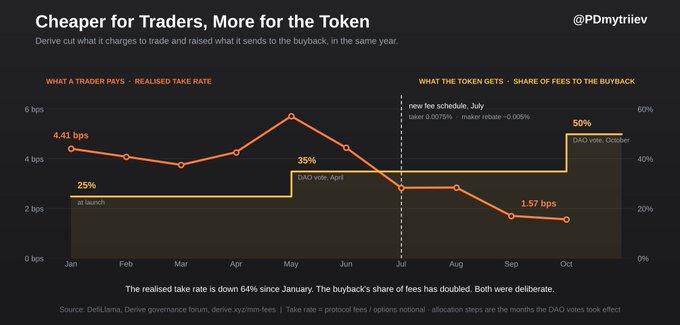
These are not two unrelated votes, but part of a coherent strategy. The options trading venue wins on depth, and depth needs to be bought with cheap execution costs; the tokens rely on taking a larger share from smaller commissions to compensate.
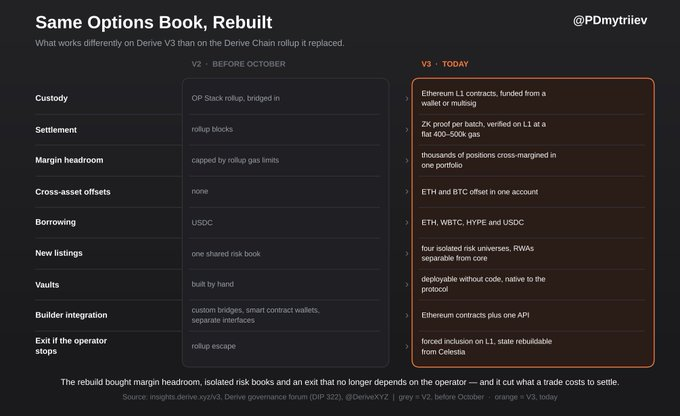
These changes are not visible to retail traders but are significant for trading desks and integrators. V2 needed to list RWA by squeezing it into the same risk book as ETH; V3 can separate them. Building a vault creator in V2 required navigating three systems; in V3, one system is sufficient.
These kinds of changes will not be evident in the fee charts from three weeks post-launch. However, they pave the way for growth opportunities: assets that V2 might have had to refuse can now be listed; builders only need one API instead of three; trading desks can run the entire ledger in one margin account. This foundational work will yield compounding effects, and Derive has already put it in place.
免责声明:本文章仅代表作者个人观点,不代表本平台的立场和观点。本文章仅供信息分享,不构成对任何人的任何投资建议。用户与作者之间的任何争议,与本平台无关。如网页中刊载的文章或图片涉及侵权,请提供相关的权利证明和身份证明发送邮件到[email protected],本平台相关工作人员将会进行核查。


