
Source: “Anthony Pompliano”
Compiled by: Felix, PANews
Recently, Anthony interviewed Jan Van Eck, the CEO of the asset management company VanEck. The interview explored the profound impact of various macro trends on investment portfolios, focusing on the rapid rise of the Indian economy, the integrated application of AI technology within enterprises, and the long-term debt and inflation risks brought about by excessive fiscal spending in the United States.
The interview also discussed the significant asset allocation value of gold and Bitcoin as defenses against systemic financial crises. He further shared his views on the cryptocurrency ETF market, suggesting that the expansion phase of single cryptocurrency token ETFs may be nearing its end, with actively managed products becoming the new direction for development. Additionally, as blockchain drives the upgrade of traditional financial infrastructure, around-the-clock trading, asset tokenization, and the integration of AI agents with financial services will also become significant changes in the industry’s future.
PANews has summarized the highlights of the conversation.
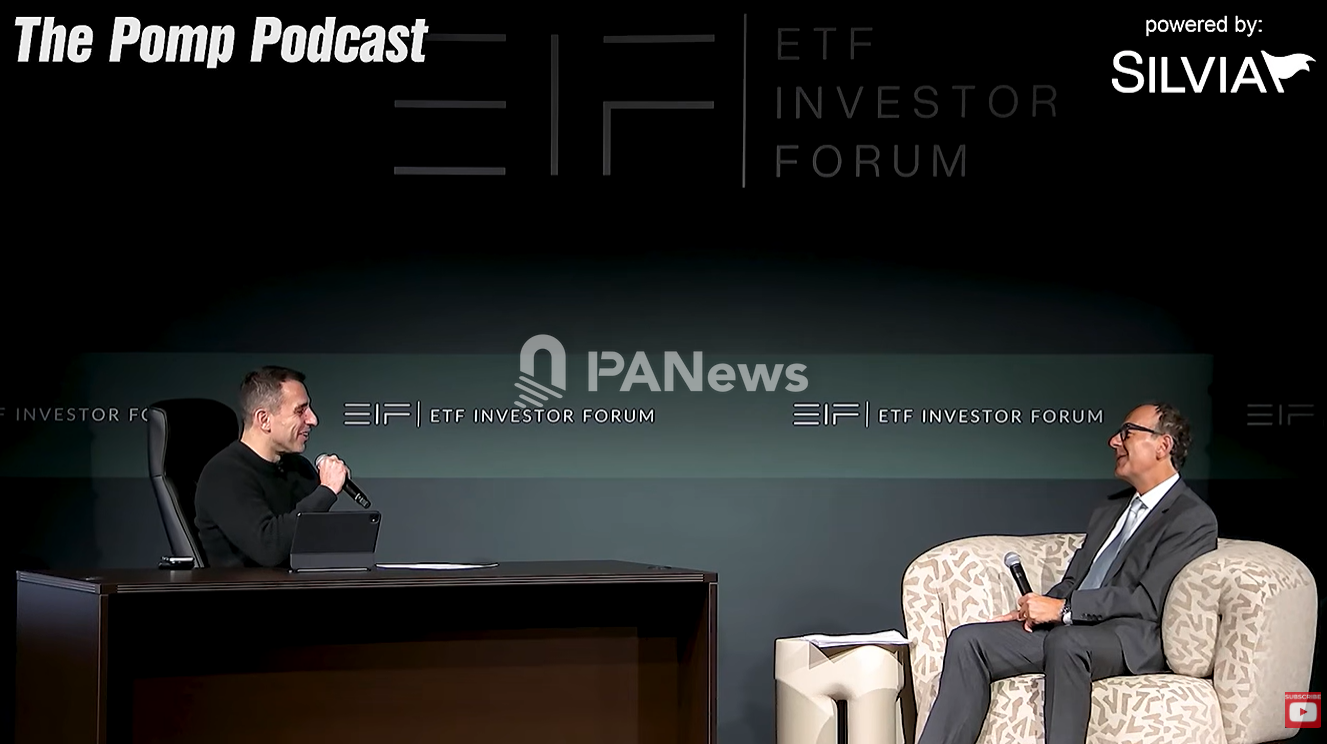
Host: VanEck is a very large global asset management company. Could you first share about the current management scale and overall business of the company?
Jan Van Eck: Currently, our Assets Under Management (AUM) is approximately $235 billion. Notably, in recent years, about half of our net inflows have come from outside the United States, particularly from Europe and Asia. The company has about 550 employees globally. As everyone knows, we primarily focus on ETF business, but we also have traditional public fund operations and are actively expanding into the private market, including early-stage technology investments and equity investments in later-stage projects like SpaceX.
10-Year Macro Trends and Four Major Shifts
Host: When facing various market hotspots and themes, what is your judgment framework for participation or avoidance? I know you have a “10-year macro framework” for planning long-term investments; could you elaborate on that?
Jan Van Eck: VanEck’s overall investment philosophy is: it is impossible to know what will happen every day. Therefore, as you mentioned, we tend to look for major 10-year trends because asset allocation is crucial for investment portfolios.
Within our framework, we are mainly looking for four major shifts: significant changes in government spending; substantial shifts in monetary policy; changes in regulatory policies; and technological innovations.
Take regulation as an example; many people do not understand its power. China’s transition to market capitalism and pricing mechanisms was the biggest deregulation initiative we experienced in our careers; similar changes have since occurred in India, and now it is just a matter of how it evolves. I am very confident that in 10 years, the economic scale of India will reach that of Europe.
We focus on three 10-year trends: AI, India, and government spending as the biggest risk to the portfolio. As an ETF issuer, our work largely relies on judgment. As for artificial intelligence, we have not completely grasped it yet.
The Economic Scale of India Will Reach Europe in 10 Years
Host: Let’s delve into these trends one by one, starting with India. What makes you believe it can reach Europe’s economic scale in the next 10 years?
Jan Van Eck: The Modi government has fundamentally implemented two significant reforms.
The first is the digitalization of the economy for all citizens. In India, almost everyone can afford a smartphone, and the tariffs are extremely low, costing only a few dollars per month. At the same time, the government has put all national identification online, achieving digital proof of identity. For example, during the pandemic, the government mandated that opening a securities account no longer required filling out paper forms, allowing it to be completed online. At the brokerage firms I visited, there were about 1 million new accounts opened each month. Although the average amount per account is low, this perfectly demonstrates the significant effect of digitalization in reducing economic friction in India.
The second major reform is the reform of tax systems and regulations. In the past, they had peculiar labor laws that stipulated completely different rules for companies with 100 or more employees. This led to all companies having either 9 people or 999 people, which was completely unreasonable. Therefore, the Modi government has successively reformed labor laws, bankruptcy laws, and a series of regulations to unleash business vitality completely. Based on historical patterns, I firmly believe this trend will be fully manifested over time.
AI: Token Demand Forecast and Internal Application
Host: Let’s talk about AI. There are many ways to participate in AI, and in the past two to three weeks, there have been some concerns and pullbacks in the market. How do you think people should filter out the noise and focus on the core trends that span a decade?
Jan Van Eck: AI is essentially what I call a leap upgrade of “better, faster, smarter software that can write software.” I dislike casually using the term “intelligent” because I do not know how to define it, but it truly is better software.
I believe the logic of trading is changing. In the past, it was simple; demand was here, supply was there. There are tremendous dynamic changes within the ecosystem, for example, in the fourth quarter of last year, the stock prices of CoreWeave and Oracle both dropped by 50%. The public market is extremely ruthless; once it senses financing difficulties or technological route changes, it will show no mercy. The trading landscape is highly turbulent, but the overall demand is still extremely large relative to supply.
I think we are entering a new phase: we can start to predict the future demand for tokens. For any other traditional industry, you can predict how many hamburgers it can sell, or how many Netflix subscriptions it can get; now we have enough visibility to start predicting token demand. We analyzed our user base and calculated user adoption rates: in the first year, the token usage of users will grow 8 times, and thereafter it will compound at about 25% annually. We extrapolated this model across the entire industry, and the estimated total demand for industry tokens aligns closely with the macro conclusions drawn by others. This is the future’s rule of the game.
Host: I believe many in the ETF industry would like to know how VanEck is using AI internally. Have you found unique new application scenarios specific to the ETF industry, or is it mainly using Claude to write code, or using it as an “upgraded version of Google”?
Jan Van Eck: I think there is no mysterious magic. I often say AI is “data + software + people.” Eighteen months ago, AI still could not read PDF formats; 6 to 7 months ago, I frequently got angry at the IT department, asking why these intelligent agents couldn’t read my emails and calendar to improve my work efficiency, but now these have become standard.
This is just a gradual process of accessing more and more databases within VanEck and empowering users (employees). We are now working hard to ensure that when people build applications, there isn’t a case where 5 people are developing the same application or agent simultaneously; we are promoting this experience sharing. This involves a lot of education and communication.
Host: Have you specifically hired personnel to manage AI spending or AI intelligence-related business, or are you just letting existing employees start adopting new technologies?
Jan Van Eck: I believe our IT department has been completely reshaped. In the past, they had to write code; now we rely on many third-party applications, and about 20% of the personnel continue to do coding. The rest have been reassigned to do the things I just mentioned.
I really like a statistic shared by the CEO of PNC Bank in an interview about a year ago. He felt very frustrated because they had done many acquisitions, but the processes were too costly. To clean up and standardize data, they spent $2 billion annually for ten consecutive years to organize the data.
This is the current situation in American enterprises. This is also why Accenture's stock rebounded significantly after experiencing substantial pullbacks because everyone found that organizing data is indeed very costly.
Host: Does VanEck currently limit employees’ usage? Or do you hope everyone uses it as frequently as possible?
Jan Van Eck: There are currently no restrictions.
Host: Will there be possible restrictions in the future?
Jan Van Eck: My Chief Financial Officer (CFO) once said: “Yes, do you know how much everyone is spending on AI?” I said, “I don’t want to restrict anyone.” Meanwhile, our Chief Technology Officer (CTO) said: “Let them fill out a form to apply.” I said: “No, don’t create friction for the adoption of this technology.” Their first instinct is always to complicate things, while my philosophy is: never make employees fill out a bunch of fields they don’t understand to use a technology.
Host: Have you publicly disclosed how much you spend on AI?
Jan Van Eck: A few quarters ago, I revealed that annual spending is approximately $2 million.
Host: So that’s a significant amount, but not extravagant.
Jan Van Eck: Yes, I’m not saying this is money that can be thrown away casually, but if you want to encourage adoption among everyone, you must be extremely careful when signaling. There needs to be a lot of management collaboration between the IT team and the business team to promote positive examples and conduct extensive education. One significant personnel arrangement we made was to establish a person in a role similar to COO to connect the dots within the company and help everyone navigate various nodes.
Gold and Bitcoin: Important Allocations to Combat Long-term Fiscal Risks in the U.S.
Host: Next, let’s talk about the third major trend, where we can say we are “fighting comrades”: the government will never stop printing money.
Jan Van Eck: Yes. From an investor's perspective, this is very frustrating because you never know when this will truly bring catastrophic damage to the financial markets, which could be in 3 months or in 30 years.
In the summary of the third quarter, I firmly believe that the recent rise in U.S. Treasury yields is not driven by a credit crisis. There are only three possibilities in the market: inflation concerns, economic growth, or credit risk. I believe this is driven by economic growth resulting from the increase in nominal GDP. Previously, the 10-year U.S. Treasury yield fluctuated with oil prices, but looking back at the period of conflict with Iran, the 10-year U.S. Treasury yield actually rebounded during the early stage of the conflict. Therefore, it cannot simply be attributed to oil prices, but this indeed places pressure on investors’ other asset portfolios.
Host: What measures are you taking to help investors guard against excessive government spending?
Jan Van Eck: Whenever I have the opportunity, I emphasize: your portfolio must allocate physical hard assets: gold and Bitcoin. You don’t know when they will explode and bring huge returns, but at critical moments, they can save lives. My father founded VanEck in 1968 and launched the first gold fund in the U.S.; he was a staunch “gold enthusiast.” However, I personally am not; throughout most of my career, the price of gold has been declining.
But I believe the U.S. is facing irreversible structural risks. Throughout American history, financial crises originated either from the banking system or from real sectors such as agriculture, which then transmitted to the banking system; the next financial crisis will erupt directly from Washington, and no one will be able to save us.
I believe other countries around the world have seen this. The scale of U.S. Treasury bonds held by China has halved from its peak, and this year it bought nearly half of global gold production. This is not only the central bank buying; most of it is from private investors in China. The global market has already seen through what we are doing and is beginning to retreat from U.S. Treasuries.
Host: When you think from the perspective of gold or Bitcoin, what do you think is the likelihood that the U.S. will fail to meet its debt obligations (i.e., default) in the next 10 years?
Jan Van Eck: I am bullish on them in the long term, and prices will certainly be significantly higher in 10 years than they are now. When I ask many people: “When do you think the U.S. will be unable to fulfill its debt obligations (some call it default)? Will it happen in the next 10 years?” Literally 99% of people firmly answer “no.” Then I follow up with: “What about the Social Security fund? By 2032 (only 6 years left), it will be forced to cut back.” People will be extremely angry at that time. People then say: “The government will always find money from somewhere else.” I say: “Really? If it doesn’t trigger severe hyperinflation or bring immense economic risks, where will they find the money?” Just look at how voters punish politicians for inflation. So ultimately, we can only dilute the debt through massive inflation, which will be an extremely brutal process.
Host: Can the deflationary effect brought about by AI save government spending? Is there a possibility that the government continues to spend heavily, but the productivity bonus generated by AI helps them out?
Jan Van Eck: Impossible. Because government spending is directly handed out to individuals as pension and healthcare checks. Retirement spending cannot be reduced by deflation by definition, and I also don’t see the possibility of medical costs going down because new costly medications like GLP-1 (weight loss/diabetes drugs) keep emerging, and people are willing to pay for them. Some say AI is a new technology with deflationary effects, but weren’t personal computers that way? Isn’t the internet that way? Amazon significantly lowered the cost of goods delivery to homes. All technology is essentially deflationary. We had great technological breakthroughs in the 1970s, yet we still experienced rampant inflation. The two cannot be equated.
Cryptocurrency ETF, Tokenization, and 24/7 Trading
Host: Let’s talk about cryptocurrency ETFs. You have a Bitcoin ETF and are also actively promoting and creating many other altcoin ETFs. What is your analysis on this currently?
Jan Van Eck: We have launched 13 cryptocurrency ETFs in Europe and have been very aggressive in our layout before U.S. regulatory approval. But I think, the era of launching more single cryptocurrency token ETFs is basically over. We are currently vigorously promoting actively managed funds. The vast majority of financial advisors cannot distinguish between Avalanche and Ethereum, so we selected some Layer 1 public chains and leading crypto exchange ecosystems for our portfolio. Beyond these underlying infrastructures, the alternatives are to choose index funds or actively managed funds.
Host: A significant part of the vision in the crypto space is to disrupt Wall Street and tokenize everything. Do you think these technologies are a hindrance to the ETF industry, or can the ETF industry embrace this new technology and develop on its shoulders?
Jan Van Eck: I believe that leading institutions like Franklin Templeton and Fidelity are driving the transformation of Wall Street’s underlying clearing back office into a 24/7 operational environment. Franklin just launched a money market fund targeting Uber drivers, aiming for precise real-time pricing and transfers on weekends, fully supported by blockchain technology. The perfect realm of blockchain is that users are unaware of its existence; it quietly makes life more convenient and keeps the market running 24/7.
For the ETF industry, the most interesting aspect is the upcoming sports ETFs. Sporting events are held at night and on weekends, and you cannot wait until 10 AM on Monday to trade; you certainly want to trade the moment the game ends.
Host: Will 24/7 trading bring record inflows and volumes? Is it a significant boon for ETFs or does it bring potential risks due to human participation in processing?
Jan Van Eck: VanEck’s core business does not directly involve this speculative trading nature. However, platforms like Hyperliquid have already proven that retail investors have strong demand for trading popular assets on weekends. The biggest battle in the industry right now is that entrenched interests like CME (Chicago Mercantile Exchange) are suing the CFTC, vigorously obstructing this trend because they have traditional institutional clients and want to protect their barriers.
Host: Another interesting phenomenon is AI Agents. Many people want Agents to help them trade or manage asset allocation. There are even discussions about “bank runs caused by Agents.” If all Agents instantly transfer money from low-yield accounts to high-yield accounts, banks would face immense pressure. Does the ETF industry have similar concerns?
Jan Van Eck: There are no such concerns in the ETF industry. I am skeptical about the “bank run caused by Agents” because banks provide core services like fraud prevention and basic settlement, and people still need these assurances.
Host: If Agents dominate decision-making, is VanEck taking substantial actions internally to cater to Agents?
Jan Van Eck: When we completed our business review at the end of the third quarter, we found that global website traffic was either flat or declining. Some wanted to quickly flip pages to avoid this, but I said: “Don’t you see what is happening? This is the transformation brought about by AI!” We must maximally feed data to AI Agents.
We recently conducted a pilot with an RIA (Registered Investment Advisor) client: we opened the MCP (Model Context Protocol) interface so that their internal AI Agents can directly access all of VanEck’s documents and databases. Sales staff were somewhat nervous, fearing this would replace their jobs, but I firmly believe that people will soon grant Agents permission to access funding accounts, just like we set up automatic deductions for TV bills, essentially handing over permissions to software Agents.
Host: To summarize this RIA pilot: you established the MCP connection, enabling their Agents to directly access VanEck’s data, thus quickly resolving internal RIA questions, replacing the old process of calling sales to search Google.
Jan Van Eck: Correct. AI itself doesn’t have direct access to private data, so you have to establish connections for it. Within VanEck, we have integrated the database of our custodian State Street, allowing fund managers to generate various complex reports at their fingertips. This directly replaced a lot of mechanical work previously done by the IT department.
Host: If we have another conversation five years from now, what do you think will be the most significant change in the ETF industry?
Jan Van Eck: The proportion of distribution channels directly facing retail investors will sharply increase. Currently, our largest clients are financial advisors, but in the future, the proportion of retail investors buying directly through low-cost brokers will rise from around 25% now to 50%.
Host: What preparations are you making to embrace this trend?
Jan Van Eck: We are fully focused on producing high-quality content. This includes me participating in interviews, seminars, and so on. Retail investors do not need rigid product pitches; they want to hear real, deep insights to build genuine trust.
Related reading: Franklin Templeton Executives: Tokenization, AI, and Capital Allocation — What’s Next for On-Chain Finance?
免责声明:本文章仅代表作者个人观点,不代表本平台的立场和观点。本文章仅供信息分享,不构成对任何人的任何投资建议。用户与作者之间的任何争议,与本平台无关。如网页中刊载的文章或图片涉及侵权,请提供相关的权利证明和身份证明发送邮件到[email protected],本平台相关工作人员将会进行核查。


