The Paraguay banking crisis exposes the fragility of traditional finance, while also reflecting the shortcomings of crypto 'alternatives' — stablecoins, privacy, and identity all have vulnerabilities.
Written by: @hmalviya9
Translated by: AIdidiaoJP, Foresight News
1. A bank in Paraguay has issues, why the crypto industry should take note
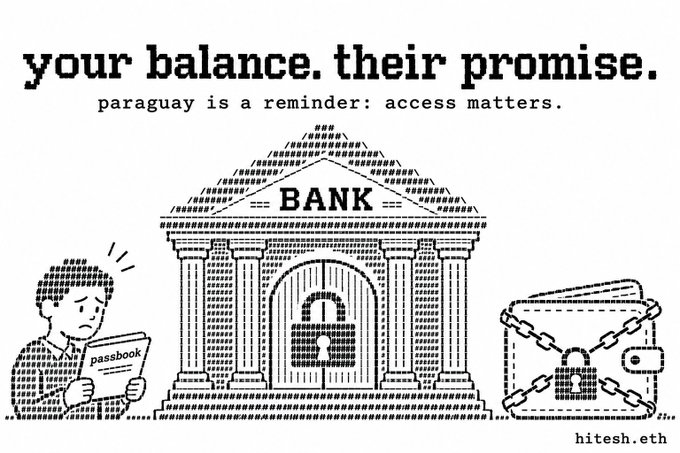
A bank in Paraguay claims to have about three million users, whose customers were once unable to access their accounts. People waiting to pay rent, buy food, or collect pensions suddenly found they could not withdraw their money.
According to Reuters, Ueno Bank manages approximately $850 million in public funds and has come under scrutiny for allegedly over-lending to companies associated with its major shareholder. On November 3, 2026, the Central Bank of Paraguay announced action against Ueno — after adjusting financial statements, its solvency ratio fell below half of the minimum requirement. The regulators stated that this was an issue for a single institution and not indicative of the overall condition of the national banking system.
But for someone waiting to pay rent, buy food, or collect a pension, the reassurance that 'the system is overall robust' does not unlock their account. Deposit protection is important, but how quickly people can truly access their own money is equally significant.
This incident in Paraguay should serve as a wake-up call for the crypto industry.
When people lose the ability to use their hard-earned money, the answer we provide must be something genuinely usable: a path to receive help, make payments, and have more control when rebuilding their lives.
However, before claiming to have such alternatives, we must first understand: which promises have failed? Can our own systems uphold them?
2. Banks are not piggy banks, and crises are not 'the end of all banks'
Banks lend to make a profit. However, who receives credit, the terms involved, and the intensity of scrutiny are all decisions made by human-run institutions. Financial statements matter, collateral matters, and sometimes relationships matter. Danger begins when relationships replace scrutiny — insiders get money, and everyone pays the consequences.
Corporate loans have limits. The Basel framework for large exposure commonly stipulates that exposure to a single counterparty or associated group cannot exceed 25% of the bank's Tier 1 capital, depending on scope and exemptions. Therefore, the issue is not just whether rules exist, but whether they are enforced, whether associated borrowers are acknowledged, and whether losses are disclosed before depositors discover them via a locked app.
Banks themselves are more complex than just 'accepting deposits and granting loans.' Banks create deposits when they lend, constrained by capital, liquidity, regulatory, and economic factors. Your balance is a claim against the bank, not a stack of cash with your name sitting in a box.
The capital shortfall revealed by Ueno is also worth clarifying. A bank with insufficient capital that cannot absorb losses is not the same as 'running out of reserves.' Distinguishing this point is crucial for identifying the actual problems at the troubled institution and evaluating the reasonableness of rescue plans.
But it is important to be precise: no bank is immune to failure, which does not mean that all banks are failing or that every country is turning into Paraguay.
A liquidity shortfall means institutions cannot meet obligations at maturity; insolvency means a financial position cannot sustain liabilities. Central banks can help to address liquidity, but actual losses must be borne by someone.
3. Global financial resilience is unevenly distributed; don't equate 'the worst' with 'the whole'
In the global picture, there is resilience but also real damage.
Banks insured by the Federal Deposit Insurance Corporation (FDIC) made $90.1 billion in the second quarter of 2026, with FDIC reports indicating strong capital and liquidity. The statement that the 'global banking system has completely collapsed' does not align with the data.
Before Ueno was disposed of, the IMF reported in May 2026 that Paraguay’s total system capital adequacy ratio was 17.3%, above the minimum requirement of 12%. However, a healthy overall ratio does not demonstrate that every bank is healthy.
In September 2026, IMF staff were still urging Lebanon to reorganize its banks and to protect depositors by appropriately distributing losses. Banking crises could evolve into a prolonged tug-of-war: who ultimately bears the losses.
The latest update from the World Bank shows that Sri Lanka's GDP has returned to pre-crisis levels, but the estimated poverty rate in 2025 is 16.9%, still higher than before the crisis. National output may have recovered, but that does not mean households have fully restored their well-being.
Regarding external debt in developing economies, the World Bank reports $9.4 trillion in unpaid debt in 2025, with $1.4 trillion required in principal and interest repayments that year. The pressure of debt service will consume resources that could have been used for investment and public services. The World Bank also reports that the average interest rate on newly issued bonds for the poorest eligible borrowing countries in 2025 will be 9.4%. Some governments are refinancing old debts at high interest rates. Borrowing can fund productive growth, but when repayments continue to crowd out investment, ordinary people experience diminished opportunities and reduced services.
This is not evidence of 'the worst economy we've ever had,' but rather evidence of 'uneven distribution of financial resilience.' The IMF's assessment in October 2026 stated that the global banking system was generally resilient, but simultaneously warned of weak banks, pressures on sovereign bonds, leverage, and liquidity risks in the non-bank sector. Both things can be true at the same time.
The maneuvering space for governments varies as well. Issuing local currency gives you options, but does not equate to unlimited purchasing power. Printing local currency cannot produce foreign exchange, imported fuel, food, or production capacity. The United States benefits from the international role of the dollar, but it cannot escape inflation, interest costs, and confidence issues.
4. After the collapse of trust, crypto must answer 'what does it replace'
When institutions break promises, people question not only the institutions but also the arrangement that makes them dependent on these institutions. A person's savings represent time, labor, and sacrifice. Losing the right to use them could turn financial failure into a legitimacy crisis.
This will not automatically lead to the widespread adoption of crypto. It may generate demand for stronger national protections, stricter regulations, or alternative systems. The outcome partly depends on which alternatives are truly effective.
Stablecoins can address urgent needs. Facing weak local currencies, people have reason to prefer a digital dollar, especially for cross-border payments. However, dollar-denominated tokens do not eliminate all dependence; they may introduce reliance on issuers, reserve custodians, redemption arrangements, and the dollar itself.
Circle explicitly states that it has the ability to prevent addresses from sending or receiving USDC. Having a private key does not necessarily equate to unconditional control of the token. Self-custody and resistance to censorship by the issuer are two different matters.
This raises a recurring question: are we building an alternative monetary economy or expanding the distribution channels of the existing monetary economy?
Both can produce useful products, but we must honestly face the differences. Stablecoins can improve access while retaining centralized control. Privacy can obscure a transaction but does not eliminate the issuer's right to freeze funds. Putting things on a blockchain does not resolve the ultimate question of who decides.
Zcash is noteworthy because shielded transactions can protect transaction information from public view. However, wallets and transaction paths are critical: Zcash also supports transparent transactions. Privacy will not ensure ZEC becomes a stable store of value. Those recently recovering from a banking crisis should not be sold the notion of 'buying volatility for guaranteed redemption.'
World ID addresses a different issue: proving a person is a unique real human without requiring them to disclose their identity. This can help distribution programs reduce duplicate claims. However, it does not generate funding for universal basic income; obtaining an identity credential does not equate to acquiring income rights.
There is a direction worth exploring here: a basic income safety net, combined with earning opportunities. But the source of income must be real. Fees, public revenue, cooperative profits, or a funded donation fund can sustain payments. Rising token prices are not a permanent social budget.
Even a $100 million fund has limits. Theoretically, distributing $1 could cover 100 million people, not counting costs. Sending $10 to one million people each month would require $12 million a year. The first experiment tests distribution, while the second requires a sustainable economic model.
5. "Human Commitment Market": Separate help from profit, and make verification substantive
This is precisely the connecting point of what I refer to as the "human commitment market."
Emergency support should help people without requiring them to 'earn' their right to survive. Meanwhile, communities can fund individuals to voluntarily make commitments: learn phone repair, complete apprenticeships, maintain open source tools, teach useful skills, or provide community services.
Before work begins, establish the details of the commitment, deadline, compensation, and evidence. Compensation is put into escrow. The obligations of the instructor must also be clearly defined. Learners should not lose money due to the instructor's disappearance, biased evaluators, or unfulfilled training commitments. Those without savings should be able to participate through sponsorship spots, rather than being blocked by mandatory deposits at the door.
The challenge lies in verification. Code can release funds after signature verification, but it cannot independently know whether a person has learned to fix phones. Practical assessments, multiple evaluators, appeals, and a dispute resolution framework with accountability are still important. Reputation should accumulate from fulfilled commitments, along with selective disclosures, rather than becoming a permanent public record of each failure.
This is the "sharing economy around tokens" I wish to explore: People use markets to coordinate useful work, accumulate skills, and share value. Tokens are only useful when they improve these relationships.
Crypto does not eliminate human trust. It can reduce certain forms of discretion, making some commitments easier to verify. Smart contracts may still have bugs, follow manipulated oracles, or give undue power to administrators. 'Code guarantees you will never be scammed' is marketing. The real question is: what promises does the code actually enforce, and who can change them?
Thus, let crypto autonomy accelerate — understood as voluntary coordination, privacy, and freedom to exit. Before people are forced to seek alternatives amid crises, let's first establish viable options.
6. Technology must be grounded; privacy, identity, and recovery cannot be lacking
Ethereum privacy needs to be worked on at multiple levels. Kohaku is a wallet implementation and SDK focused on privacy, whose wallet repository is currently marked as actively under development and only supports the Sepolia test network. It is a foundational component, not a consumer-grade emergency wallet. XMTP provides end-to-end encrypted messaging, its security documentation acknowledges observable connection metadata. Nym handles network metadata through mixnets. These tools address different issues and require careful integration.
Transaction content privacy, communication privacy, and network access privacy are three distinct requirements. Good design also requires usable recovery, reliable infrastructure, and clear limits on administrator powers. The strength of privacy guarantees depends on how much information is exposed around it.
The idea of physical QR codes can make this concept understandable. A person scans the code, receives a small payment, and learns to transfer or spend it. Using ERC-5564, a QR code can encode a stealth recipient address from which new payment addresses can be derived. This reduces public associations with the recipient, but does not hide transaction amounts, senders, or potential relinked identities afterwards. Printing QR codes must never expose consumption keys.
Start with small voluntary pilot programs, leveraging trusted local communities to advance, including support for those affected by banking disruptions. Assistance must not depend on participating in protests, supporting political positions, foregoing biometrics, or purchasing tokens. A useful demonstration is: a person can receive help, control it, regain access, and spend it.
A $1 transfer is an entry point, not evidence of financial independence. Meaningful questions will follow: has this person used the wallet again? Can they pay local merchants? Did fees eat into the payment? Can they recover it if they lose their phone? Does the app expose their social or financial relationships?
Community funds can pay developers via DAO, addressing these issues through phased grants, independent security audits, and publicly disclosed expenditures. Recipient identities can remain private, and spending organizations must be held accountable. Donor influence should not quietly turn into permanent control over infrastructure.
Issues of identity, reputation, and privacy should also be addressed in this manner: projects need to prove uniqueness when necessary, trust needs to demonstrate fulfilled commitments when required, and the rest should be disclosed as little as possible. A company should not become a mandatory gatekeeper for all three.
We were originally building a trustless system, yet people in the crypto world find it difficult to trust each other. Rebuilding trust requires useful commitments and must continue to be fulfilled after issuance: maintained software, accessible support, fair dispute resolution, transparent expenditures, and genuine freedom to exit.
If humanity has created institutions for communal life, we can also create alternatives. The test lies in whether these alternatives can give ordinary people more control when promises break.
A person should be able to receive help, learn skills, earn income, communicate privately, and participate in the community without handing over their entire identity to a single institution. That is a future worth building, and a more compelling reason for the existence of crypto — far more meaningful than just another token code.
免责声明:本文章仅代表作者个人观点,不代表本平台的立场和观点。本文章仅供信息分享,不构成对任何人的任何投资建议。用户与作者之间的任何争议,与本平台无关。如网页中刊载的文章或图片涉及侵权,请提供相关的权利证明和身份证明发送邮件到[email protected],本平台相关工作人员将会进行核查。


