The U.S. non-farm employment data for October exceeded expectations, reigniting Wall Street's enthusiasm for betting on a Federal Reserve rate hike in December. Traders now estimate that the chance of a 25-basis point rate hike in December has risen to over 80% following the report's release.
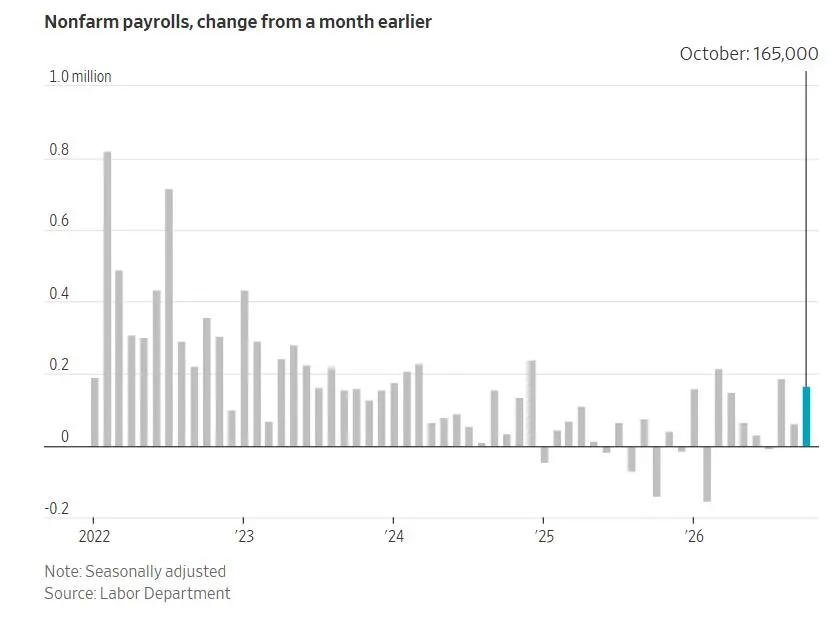
The report released by the U.S. Bureau of Labor Statistics (BLS) on Friday, November 6, indicated that non-farm payrolls increased by 165,000 in October, far surpassing Wall Street's forecast of a 70,000 increase; the unemployment rate fell to 4.1%, while the labor force participation rate rose to 61.9%, both not remaining flat as the market had anticipated in September. Average hourly wages rose by 0.4% month-on-month, with the pace of increase accelerating beyond market expectations compared to September. Overall, the employment, unemployment, and wage metrics are strongly oriented.
Several Wall Street insiders believe this report provides a stronger basis for the Federal Reserve to hike rates further in December. However, energy prices and subsequent inflation trends, along with the recent sell-off of AI-related assets and their impact on financial conditions, may still influence the Federal Reserve's next actions.
Journalist Nick Timiraos, known as the 'New Federal Reserve News Agency,' suggests that this employment report did not shake the Federal Reserve's judgment regarding economic growth and inflation, but whether the recent sell-off of AI-related assets will alter financial conditions may be another variable in the December policy decision. The focus will be on whether Fed Chair Waller prioritizes lagging employment data or forward-looking market signals.
December rate hike probability once soared to 85%, Wall Street believes strong employment provides room for Federal Reserve action
Following the employment report's release, the interest rate market rapidly adjusted its policy expectations. Reports indicate that traders' bets on a 25-basis point rate hike at the December Federal Reserve meeting rose to about 85%, up from approximately 75% before the report was published; market expectations for the timing of the next rate hike have also been brought forward.
Lindsay Rosner, head of fixed income investments at Goldman Sachs Asset Management, believes this non-farm report has cleared the obstacles for a Federal Reserve rate hike in December. She stated, "This non-farm data has removed the traffic lights before the Federal Reserve's policy crossroads in December." The ongoing tightening of the labor market provides room for the Federal Reserve to raise rates further without necessarily harming its employment goals.
Jeff Schulze, chief investment strategist at Franklin Templeton Institute, stated that the strong performance of the October employment report, against the backdrop of market concerns that AI-related construction slowdowns may diminish rate hike expectations following the mid-term elections, has renewed pressure on the Federal Reserve to raise rates.
Ryan Weldon from IFM Investors also believes that while another inflation report will be released before the Federal Reserve's December meeting, the strong economic performance and sticky inflation make it difficult for the Federal Reserve to avoid the option of a rate hike.
Analyst Olu Sonola from Fitch Ratings pointed out that this is a very strong labor market report. Coupled with robust GDP and consumer data, the U.S. economy remains resilient, and concerns related to AI have not significantly altered this judgment; as the labor market performs strongly, discussions on Federal Reserve policy may further shift toward inflation and a rate hike in December.
Employment and wages strengthen simultaneously, but there are still structural concerns in the labor market
In October, non-farm employment increased by 165,000, significantly exceeding market expectations, and marked the third highest monthly increase since March and August of 2026. The employment data for the previous two months were also revised upward: August's employment figure was revised from 133,000 to 186,000, and September's from 29,000 to 60,000, totaling an upward revision of 84,000.
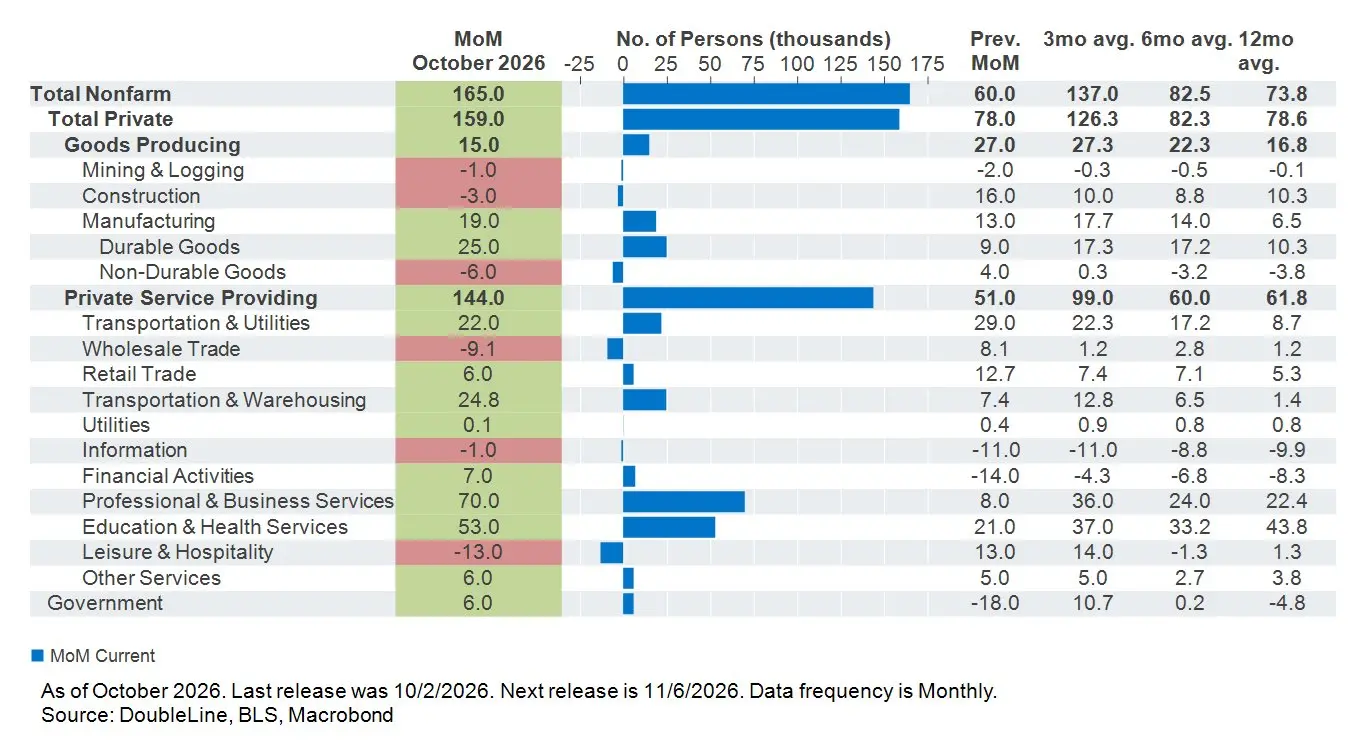
By industry, in October, professional and business services added 70,000 jobs, healthcare added 42,000, transportation and warehousing added 25,000, and manufacturing added 19,000; however, leisure and hospitality saw a decrease of 13,000 jobs. The significant acceleration in employment growth in professional and business services provides a counter-signal to concerns that AI is rapidly eroding white-collar positions.
Carl Weinberg, chief economist at High Frequency Economics, believes that the U.S. economy is at or very close to full employment. Strong demand for labor indicates that the Federal Reserve needs to be cautious about whether labor demand is exceeding supply.
Wage data further reinforces the signals of a potentially overheated employment market. Average hourly wages rose by 0.4% month-on-month in October, exceeding market expectations of 0.3%, and accelerated significantly from September's increase of 0.1%; the year-on-year increase was 3.1%. The labor force participation rate also rose from 61.8% in September to 61.9%, indicating that the increase in employment was not entirely driven by a decline in the labor force.
However, the report is not without concerns. The number of people forced to take part-time jobs due to economic reasons increased by 339,000, reaching approximately 4.84 million, showing that some workers still cannot obtain ideal full-time jobs.
Brian Jacobsen, chief economic strategist at Annex Wealth Management, pointed out that despite a year-on-year wage growth of 3.1%, if inflation exceeds this level, the real average hourly wage of workers will still decline. He termed this phenomenon as "one number presents an affordability crisis." In his view, rising energy prices increase the cost of living, which may further increase pressure on the Federal Reserve's policy.
Inflation and energy prices remain key variables on the rate hike path
Although the employment report has strengthened expectations for a rate hike in December, Wall Street insiders do not believe that a single employment data point can determine the Federal Reserve's policy path. The next inflation data, energy price trends, and the impact of high interest rates on financial markets and economic activities remain key variables.
Carl Weinberg, chief economist at High Frequency Economics, asserts that the economy is either at or close to full employment, and the Federal Reserve needs to guard against inflation risks brought about by labor demand exceeding supply.
Peter Cardillo, chief market economist at Spartan Capital Securities, argues that the drop in the unemployment rate to 4.1% and wages increasing beyond expectations indicate that the labor market remains strong. He predicts that the Federal Reserve's rate hike in December is difficult to avoid, and the remaining question is whether it will be a 25 or 50 basis point hike.
However, Anshul Sharma, chief investment officer at Savvy Wealth, cautions that attention should still be paid to inflation, particularly energy prices. Even if employment and wage data support a rate hike, if energy prices drop and inflationary pressures ease, the Federal Reserve may reassess its policy options.
Wall Street Divergence: Stock market volatility and AI investment prospects may constrain the Federal Reserve
Strong employment data has raised expectations for a rate hike, but recent fluctuations in financial markets have made some market participants cautious about whether the Federal Reserve will take action in December.
Joe Saluzzi, co-director of Themis Trading, believes that the new employment, wage growth, and prior data revisions have indeed strengthened the possibility of the Federal Reserve's next rate hike. However, volatility in the stock market has already increased significantly the previous day, and if the financial markets are in an unstable state, whether the Federal Reserve will choose to hike rates now is still worth observing. He stated that if the Federal Reserve were to meet tomorrow, he would not conclude that a rate hike is a certainty based solely on this employment report.
Tim Holland, chief investment officer at Orion, also noted that strong employment data might drive U.S. Treasury yields higher, putting additional pressure on the stock market. The current market is already affected by the prospects of AI capital expenditure cycles and policy uncertainties, and if interest rates rise further, risk assets may continue to be under pressure.
Susannah Streeter, chief investment strategist at Wealth Club, believes that the strong employment report has reduced the likelihood of a rate cut in the near term and has reinforced the judgment of rates being maintained at elevated levels for a longer time. The resilience of the labor market has also offset some concerns in the market about potential economic growth drag due to slower data center construction and increased AI regulation.
'New Federal Reserve News Agency' raises policy variables: Does the Federal Reserve focus on lagging employment data or forward-looking market signals?
Nick Timiraos pointed out on social media that the U.S. added 165,000 non-farm jobs in October, and August and September's figures were revised upward by a total of 84,000, with the unemployment rate slightly declining to about 4.14%. Regardless of the perspective used, U.S. employment growth has accelerated after nearly stagnating last summer.
However, Timiraos believes these data are insufficient for the Federal Reserve to reconsider its judgment on economic growth and inflation. What truly deserves attention is whether the sell-off of AI-related assets will alter financial conditions, thereby impacting the Federal Reserve's assessment of policy effectiveness.
The core contradiction he raises is: Fed Chair Waller has stated a preference for market signals that can reflect future economic trends over lagging economic data. Now, the employment report indicates that economic growth remains resilient, but the sell-off of AI-related assets may affect the financial environment through stock prices, financing conditions, and risk appetite. Before the December meeting, which type of signals the Federal Reserve prioritizes may become a key point of policy discussion.
This also means that although the October non-farm report has raised rate hike expectations, the ultimate decision is not just a simple extension of employment data. The next round of inflation data will test whether wage and employment resilience translates into more lasting price pressures, while changes in financial markets may influence the Federal Reserve's judgments about future economic conditions and policy transmission.
免责声明:本文章仅代表作者个人观点,不代表本平台的立场和观点。本文章仅供信息分享,不构成对任何人的任何投资建议。用户与作者之间的任何争议,与本平台无关。如网页中刊载的文章或图片涉及侵权,请提供相关的权利证明和身份证明发送邮件到[email protected],本平台相关工作人员将会进行核查。


