
Author: Cobo
AI is shaking the profit logic of Google search.
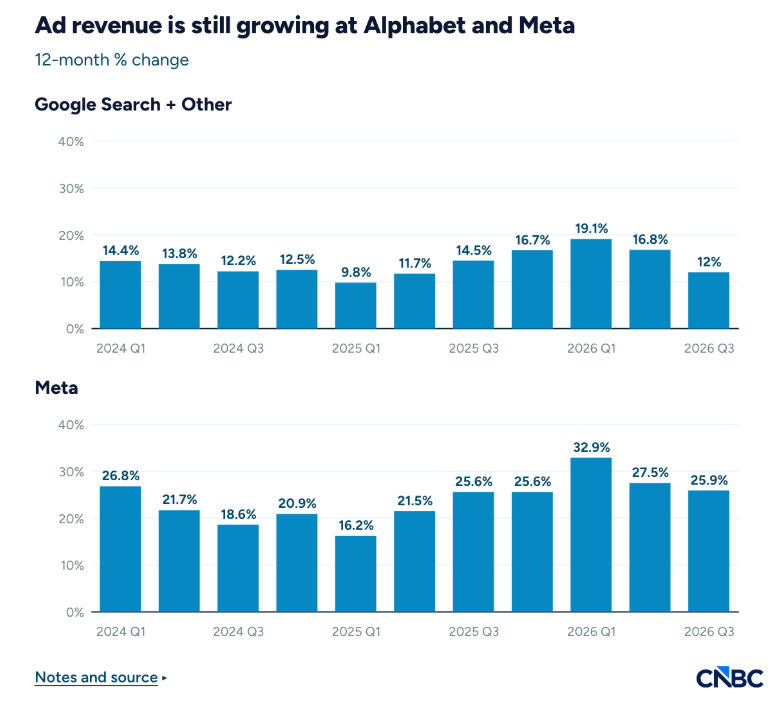
On October 29, Google's parent company Alphabet saw its stock price plummet by about 13%, with nearly $500 billion wiped off its market value in a single day. What worries the market is that artificial intelligence (AI) is eroding the search advertising model that supports Google's revenue. The latest financial report shows that despite the fastest growth rate in search query volume in five years, advertising revenue only grew by 12% year-on-year, with an increase of about $79 million compared to the previous quarter. Google's management acknowledges that the AI model still does not match traditional search in monetization ability.
This means that the frequency of searches is higher than ever, but Wall Street is beginning to question whether Google can translate this activity into real revenue.
The high value of search advertising comes from its ability to influence people's purchasing decisions. Brands pay for prominent positions in search results, and when users click, Google profits from it. Once AI begins to intervene in search, price comparison, and even directly place orders for users, users will no longer go through those ad positions. Even if people maintain their habits of searching and consuming, it may become harder for Google to earn revenue like it did in the past.
But AI Can't Even Complete a Simple Purchase?
Ironically, these AI entities that threaten the business model of internet giants sometimes can't even complete a regular shopping task smoothly.
X (formerly Twitter) platform user Maia recently tested three AI shopping agents, and none were able to complete the task successfully: Instinct was blocked by Sephora's bot detection mechanism; Poke could not complete an order on Uber Eats and couldn't even log into DoorDash; Dash managed to check out at AutoZone, but the order was canceled about 17 hours later. Ultimately, none of these tools could complete the tasks and suggested that users make their purchases manually.
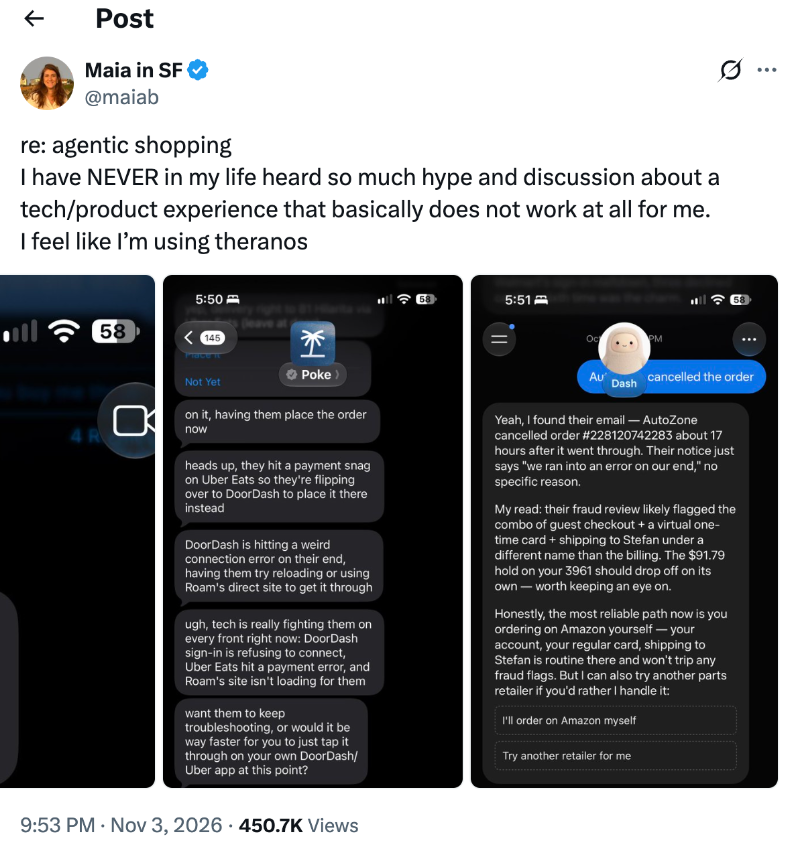
These three tools are a microcosm of the rapidly rising wave of "Personal Agents" designed specifically for consumers. Their ambition lies not only in providing suggestions but also in directly executing users' wishes, taking over the entire process from logging in, selecting products, and booking to payment. From ambitious startup teams to tech giants like Meta, all are rushing into this track. Given the frequency, quantifiability, and direct cash impact of shopping scenarios, it is naturally a perfect test for the practical capabilities of these AI avatars.
Taking Dash as an example: it uses a disposable virtual card to protect users' real card numbers; it checks out as a "guest," so there is no need to obtain the user's account password; it also allows for discrepancies between the shipping address and the cardholder information. From a security perspective, these designs are very reasonable. However, in the eyes of traditional payment fraud prevention systems, this combination of features looks very much like credit card fraud behavior—strange device, virtual card, and shipping address that doesn't match the cardholder's information, any one of which is enough to trigger an alert.
Dash's setbacks reflect a fatal flaw in AI shopping: Although AI entities have learned to "run errands" for humans, the entire commercial world is still not prepared for how to verify their identities. From Cloudflare's bot defense line to the payment side's stringent 3D Secure verification, existing anti-fraud firewalls are certainly strong but "blind"; they cannot distinguish whether the entity on the other side is a malicious bot or a compliant agent carrying real money to make purchases on behalf of its owner.
Of course, merchants' caution is entirely justifiable. If an AI books the wrong flight, enters the wrong address, or makes a purchase without proper authorization, who should bear the costs of refunds, chargebacks, and customer service? Due to ambiguous responsibility, accepting an unverifiable order could be riskier than intercepting that order. Even if the agent program (AI entity) brings in customers ready to place orders, many merchants would still consider it a more prudent choice to intercept the order.
Visa, Mastercard, and the "Agentic Commerce Protocol" launched by OpenAI and Stripe are currently working towards exploring how to identify these agent programs and authorize their payment behaviors. Until these standards are widely applied, merchants can only continue to follow existing anti-fraud rules, even if it means missing out on some legitimate orders.
Why Doesn't Amazon Welcome Shopping Agents?
However, security and responsibility issues only explain part of the resistance. For e-commerce giants like Amazon, allowing external AI agents to shop freely may also affect their advertising business that they rely on for profit.
Previously, Amazon went so far as to take Perplexity to court, forcing its "shopping agent" tool Comet to withdraw completely from the Amazon platform and successfully obtaining a preliminary injunction; in September of this year, Amazon also banned Meta's shopping agent Muse. Although Amazon's official rationale is concerns over authorization, privacy, and security, the challenges posed by external shopping agents clearly go beyond these.
The advertising business is one of Amazon's core revenue sources. Major brands bid for promotional positions in product search results, hoping consumers will see these ads while browsing, comparing, and filtering products. If everything is handled by artificial intelligence (AI) and can even autonomously select products with better price-performance ratios, then consumers will not see these ads at all. Every transaction bypassing the Amazon platform directly diminishes Amazon's control over user purchasing behavior.
Similar pressures are also arising for Google. As more and more consumers start searching and shopping through AI, traditional search advertising may no longer be a necessary part of the purchasing decision. Through protocols like AP2 and UCP, Google hopes users can complete product discovery, decision-making, and checkout directly within "Google Search" and Gemini. Although the monetization efficiency of search ads may decline, as long as shopping behavior occurs on Google's "territory," it can retain users and have the opportunity to profit from the transaction itself.
Advertising Giants Start Betting on Transaction Businesses
Also reliant on advertising revenue, Google and Meta are experiencing vastly different impacts from AI. The former is facing pressure on search advertising monetization, while the latter has already begun to reap substantial returns from AI investments. Meta's advertising revenue in the third quarter grew by 26% year-on-year, more than double that of Google's search business growth rate. Chief Financial Officer Susan Li stated that advertisers who adopted suggestions from Meta's AI business assistant had conversion rates nearly 5% higher than similar advertisers who did not take the advice, while the cost per conversion remained nearly flat, and those advertisers also increased their ad spending by 9%. AI not only enhanced the effectiveness of Meta's ads but also attracted more advertising budgets.
However, just as the advertising business continues to grow, this company, nearly 98% of whose revenue comes from advertising, has launched a shopping agent Muse that contains no advertisements at all. Approximately six weeks after its launch, Muse surpassed 10 million users in the United States and Canada. More than a quarter of its weekly active users shop through it, with an average order value exceeding $200. Zuckerberg mentioned that it may achieve profitability through transaction commissions or subscription fees in the future.
Meta is simultaneously using AI to increase advertising revenue while seeking new monetization methods for the potential loss of commercial value from advertising. As consumers gradually become accustomed to letting AI search, compare prices, and place orders, platforms that control transaction entry may not only sell ads to merchants but also earn a share directly from each transaction.
This change is beginning to ripple down to the payment phase, opening up new growth spaces for payment service providers like Stripe.
Meta's Muse, Grok Bot, and Instinct have all integrated with Stripe's Link proxy wallet. Data released by Stripe at the end of September showed that in the past month, AI agent purchases completed through Link increased 38-fold. Since Stripe serves a large merchant base, it can enable these shopping intelligences to have payment capabilities and assist merchants in collection processing. Consumers can shop through various intelligent agents while the underlying payment process is always handled by the same company.
As shopping points become increasingly fragmented, payment service providers like Stripe are likely to become the "default payment layer" connecting proxy tools and merchants. Regardless of which proxy tool ultimately prevails, every transaction must pass through processes such as identity verification, payment authorization, and settlement, and every step in these processes contains commercial value.
As Shopping Entry Shifts, Who Can Profit from Transactions?
Google hopes to keep shopping within Search and Gemini, Meta is beginning to explore transaction revenue beyond advertising, and Stripe is providing payment services for different shopping agents. As AI gradually participates in consumers' search, price comparison, and purchasing decisions, the revenue originally garnered by search engines and e-commerce platforms may also begin to flow to new participants.
For years, search engines and e-commerce platforms have held the "entrance" to consumers, converting users' attention into advertising revenue. Brands pay for impressions and clicks, and platforms already earn revenue before consumers place orders. In the shopping process dominated by "smart agents," consumers may only need to state their needs, and the remaining tasks of searching, filtering, and placing orders will be completely handled by the agents. The "discovery" and "recommendation" functions that used to be borne by ads are gradually shifting to these intelligent agents.
This change will give rise to new forms of advertising. Brands will still need to compete for consumer choices, and smart agents may also establish their own "paid promotion" mechanisms or charge referral fees. However, as purchasing decisions shift to the AI interface, at least a portion of the value originally captured by search result pages and product lists will flow to those who can guide decisions, facilitate transactions, or handle payments.
Looking back at the divergence between search volume and advertising revenue growth in Google's financial report, there is nothing more unsettling for a search giant that started with advertising: users are still searching and consuming, but the money is beginning to flow elsewhere.
免责声明:本文章仅代表作者个人观点,不代表本平台的立场和观点。本文章仅供信息分享,不构成对任何人的任何投资建议。用户与作者之间的任何争议,与本平台无关。如网页中刊载的文章或图片涉及侵权,请提供相关的权利证明和身份证明发送邮件到[email protected],本平台相关工作人员将会进行核查。


