This Issue Highlights
This week's magazine covers the statistical period from October 30, 2026, to November 6, 2026.
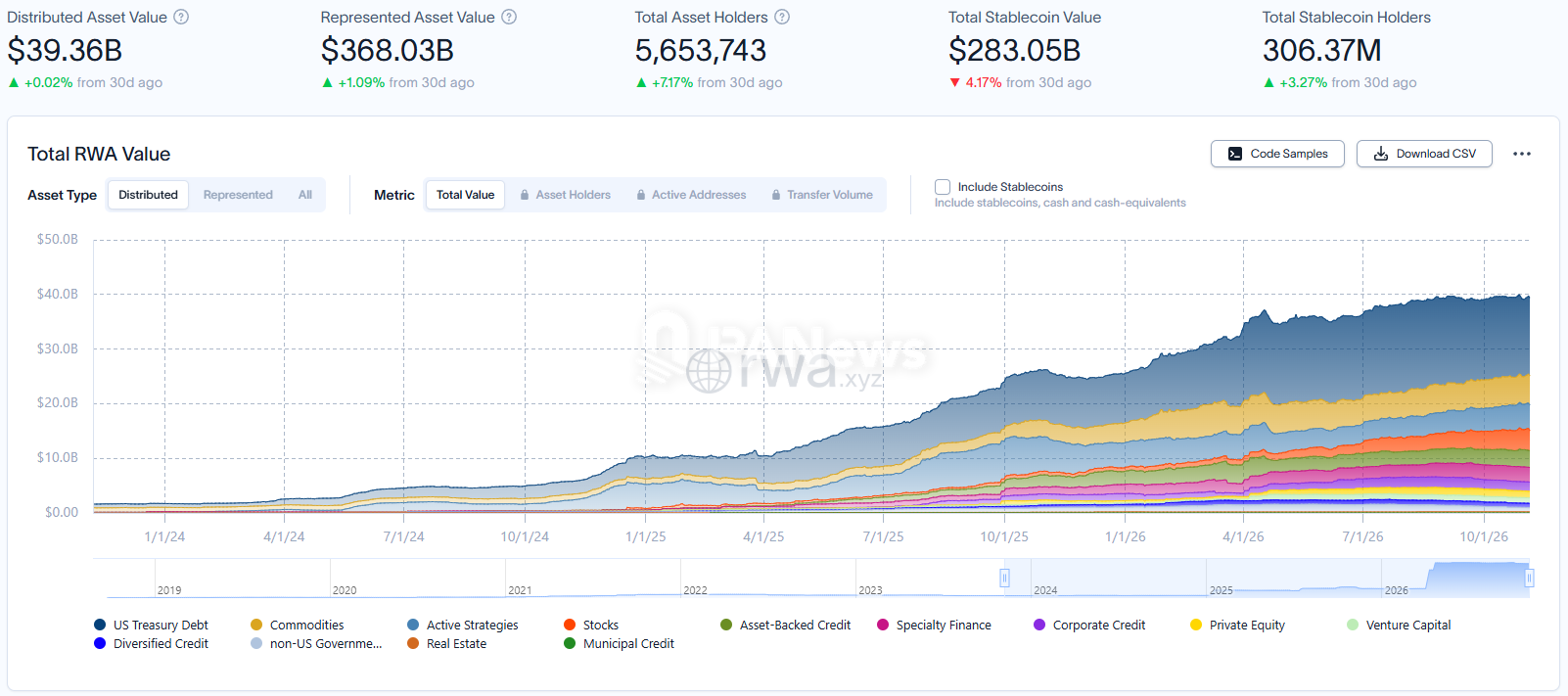
This week, the total market capitalization of RWA on-chain reached $39.36 billion, with a slight increase of 0.02% compared to the previous period. The number of asset holders climbed to 5.6537 million, up 7.17% from the previous period, showing a stable asset scale and continuous user expansion; the total market capitalization of stablecoins fell back to $28.305 billion, with a monthly transfer volume rising sharply by 46.11%, and the total number of holders reaching 306 million, but the number of monthly active addresses significantly decreased, reflecting active trading turnover of existing funds and a marginal weakening of new interactive user engagement.
On the regulatory front, China signed a currency swap and digital currency cooperation memorandum with Oman; the Hong Kong Securities and Futures Commission plans to pilot tokenized gold ETFs, and the Monetary Authority of Hong Kong's EnsembleTX completed tokenized deposit transactions in all weather and plans to expand to regulated stablecoins; French cryptocurrency tax amendments were shelved due to budgetary issues; the Dubai DIFC court proposed a dispute resolution oracle (DRO) to implement off-chain judicial decisions that drive on-chain asset execution; Nigeria's central bank rolled out regulations for non-securities virtual assets, clarifying high capital thresholds for foreign currency stablecoin issuers and delineating regulatory responsibilities between the central bank and SEC.
Locally, RWA construction continues to land in Hong Kong, Standard Chartered launched a tokenized deposit service aimed at businesses, the HKD stablecoin HKDAP will debut on Solana, and Fosun Wealth’s FinChain partnered with Plume to launch the FUSD leveraged cyclic income strategy.
On the project front, Canton Network's TSV LLC completed the first tokenized trading of US stocks under the SEC's innovative exemption framework, Morgan Stanley became one of the first banks to partner with DTCC for tokenized services, while the OKX-ICE third-party tokenized US stock program encountered opposition from Meta, S&P Global, and a total of 67 listed companies exercising dissent rights; The NYSE introduced Broadridge to provide on-chain shareholder voting and transfer services, and European asset management giant Amundi launched tokenized shares for index funds and money market funds on Ethereum.
On the financing front, tZERO finalized its SPAC merger plan, and tokenized securities and stablecoin payment service providers like Lombard Systems, Takenos, and Bloquo completed their financing rounds.
Data Insights
Overview of the RWA Track
According to the latest data from RWA.xyz, as of November 6, 2026, the total market capitalization of RWA on-chain reached $39.36 billion, with a slight increase of 0.02% compared to the same period last month. The total number of asset holders climbed to 5.6537 million, up 7.17% from the same period last month, showing that the growth elasticity of holders is significantly higher than that of asset scale itself, reflecting a stable rise in asset stock and continuous expansion of participating entities in the RWA track.
Stablecoin Market
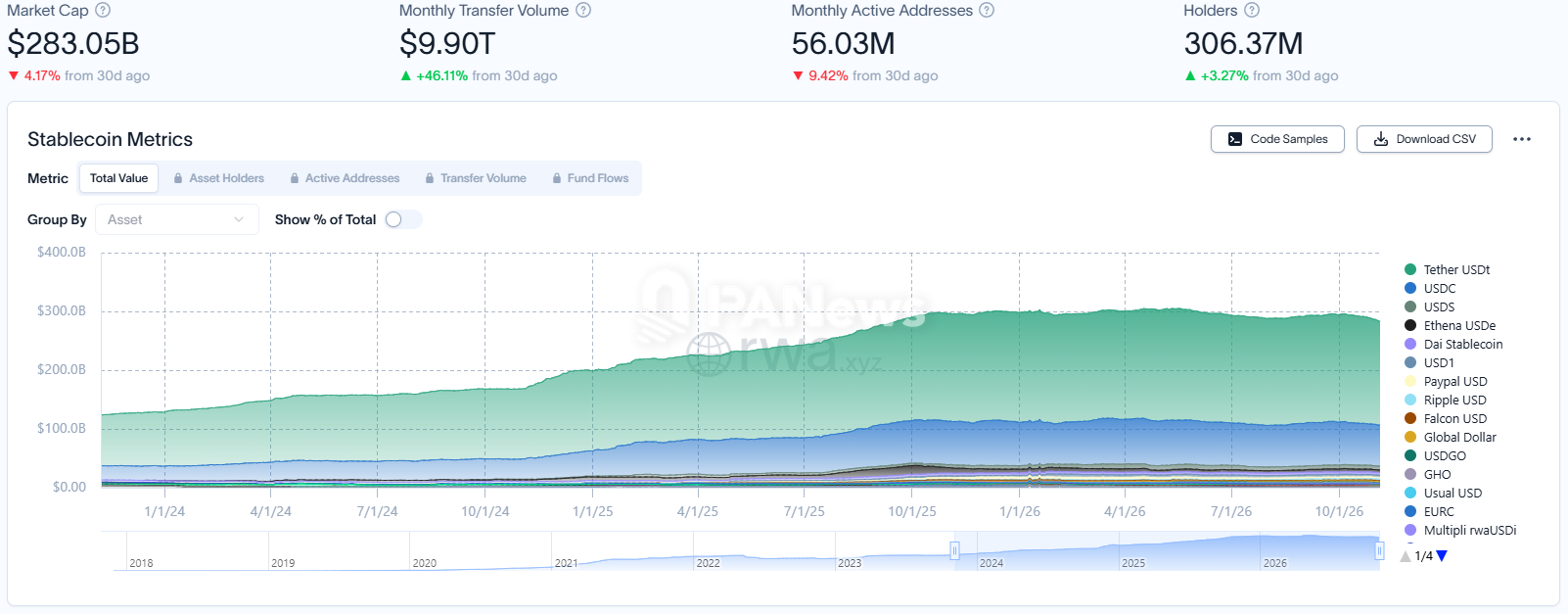
The total market capitalization of stablecoins reached $28.305 billion, down 4.17% from the same period last month; the monthly transfer volume was $9.9 trillion, up sharply by 46.11% from the same time last month; the total number of active addresses was 56.03 million, down 9.42% from last month; the number of holders reached 306 million, up 3.27% compared to last month. This month, the stablecoin sector shows characteristics of pressured stock size, significantly increased on-chain fund flow activity, continued expansion of new coin holders, but weakening active interactive addresses, reflecting increased frequency of existing fund trading turnover, while willingness for new active participation marginally declines.
The leading stablecoins are USDT, USDC, and USDS, with USDT's market valuation down 3.53% from last month; USDC's market valuation dropped 4.31% from last month; USDS rose slightly by 0.03% compared to last month.
Regulatory News
According to the People's Bank of China, recently, the bank's governor, Pan Gongsheng, signed the "RMB/Omani Rial Bilateral Currency Swap Agreement" and the "Memorandum of Understanding on Strengthening Cooperation on Digital Payments and Legal Digital Currency" with Ahmad Al Musalmi, the Governor of the Central Bank of Oman, under the witness of the two heads of state. The swap agreement has a scale of 30 billion RMB/1.5 billion Omani Rial and is valid for five years. The two sides also met on the same day to exchange views on bilateral economic and financial cooperation. The central bank stated that the purpose of the agreement is to deepen monetary and financial cooperation between the two countries, enhance the facilitation level of cross-border digital payments, and maintain financial market stability.
The Executive Director of the Investment Products Division of the Hong Kong Securities and Futures Commission, Wu Jiali, delivered a speech titled “Innovation Pathway: Expanding the Tokenization Landscape of Hong Kong Capital Markets” during Hong Kong FinTech Week, in which he announced the launch of the “Innovation Pathway” to merge tokenized funds with digital currencies to improve liquidity and efficiency in capital management.
Wu disclosed that the first batch of tokenized money market funds would be traded in the secondary market on licensed trading platforms, and that the tokenized gold ETF may be the next pilot project. Currently, there are 17 approved tokenized retail products in Hong Kong, covering money market funds, gold products, and ETFs, with a total asset management scale of $1.3 billion. In the medium to long term, the Hong Kong Securities and Futures Commission will also promote tokenized assets as collateral, expand stock and bond assets on-chain, and explore the application of smart contracts in automating investment decisions and trading processes.
The Hong Kong Monetary Authority stated that it has advanced Ensemble TX to a new phase achieving 24/7 real-value trading of tokenized deposits and plans to expand the experimental scope to regulated stablecoins. The Monetary Authority also completed a secondary market test transaction with tokenized foreign exchange fund notes conducted by recognized trading firms and partnered with Cyberport to launch the tConnect Launchpad to explore and validate tokenized application scenarios.
According to Cointelegraph, the French National Assembly rejected the “revenue” section of the 2027 national budget on Wednesday evening, causing the three cryptocurrency-related amendments previously included in the bill to be eliminated from the version of the bill that will be submitted to the Senate, although they may still be reintroduced during the Senate review stage in the future.
The National Assembly had previously passed three cryptocurrency-related amendments. On October 16, legislators approved an amendment stipulating that profits from converting cryptocurrencies into stablecoins would be subject to taxes. On Tuesday, lawmakers passed another amendment requiring taxpayers to declare their self-custody digital assets; if the total reached or exceeded €100,000 (approximately $112,000), they would need to declare it. The assessment baseline for this threshold is December 31 of the tax year. Additionally, another amendment proposed that if cryptocurrency platforms fail to provide relevant information as required by tax authorities, penalties would increase from €10,000 to €50,000.
According to CryptoBriefing, the Dubai International Financial Centre (DIFC) court on November 5 released a white paper on the “Dispute Resolution Oracle” (DRO), proposing a scheme that allows off-chain court or arbitration judgments to directly trigger the enforcement of tokenized assets on-chain. This mechanism is entirely based on voluntary principles, and parties need to designate a dispute resolution forum in advance, with the DIFC court serving as the first qualified provider. The DRO itself does not actively change assets but is responsible for verifying execution instructions and generating auditable execution records on participating blockchains; actual dispute adjudication, arbitration, and mediation continue to proceed in the traditional manner.
The white paper positions this framework as an open technical and legal standard, listing five core elements: a jurisdiction with enforcement capacity, adoptable open standards, a qualified provider registry, a controlled pilot program, and international dialogue on mutual recognition. This proposal was announced at the Dubai Future Tokenization Forum, forming part of the DIFC Court's growth strategy for 2026 to 2030.
According to the Nigerian Central Bank (CBN) issued “Regulations for the Operations of Non-Security Virtual Assets in Nigeria” (November 5, 2026), the CBN will regulate non-securities virtual assets and stablecoins for payment, settlement, and remittance purposes; securities remain under the Securities and Exchange Commission (SEC). Foreign currency-pegged stablecoins (Class 2) must be issued by locally licensed entities in Nigeria, with a minimum paid capital of 15 billion Naira (approximately $11.16 million); Naira-pegged Class 1 issuers must have 10 billion Naira; other entities providing non-securities virtual asset services need at least 1 billion Naira in capital, and those already holding SEC licenses cannot count this capital requirement towards those of the CBN. The P2P business facilitated by platforms must obtain special approval from the CBN and verify that the names of Naira payment and receipt accounts match the Bank Verification Number (BVN) before permitting the registration or crediting of regulated tokens. The issuance of algorithmic stablecoins and similar categories is prohibited, defining the boundaries of responsibilities between the CBN and SEC.
Local Observations
Standard Chartered Launches Tokenized Deposit Service for Corporate Clients in Hong Kong
According to CoinDesk, Standard Chartered Bank has launched a tokenized deposit service for corporate clients in Hong Kong, marking it as their first market to offer this service. This service is based on Standard Chartered's blockchain system and the Hong Kong Monetary Authority's EnsembleTX infrastructure, supporting real-time deposits transfers between participating banks at any time, and settling in central bank currency. Standard Chartered has also partnered with Fireblocks to connect this service with digital asset clients, and HashKey has also joined. Standard Chartered has not disclosed the completed transaction scale or the number of institutions able to use this service. Previously, the Hong Kong Monetary Authority announced that EnsembleTX supports 24/7 interbank settlement using tokenized central bank currencies, with the number of participating banks and industry pioneers increasing to 12 and 20, respectively.
HKD Stablecoin HKDAP to Be Launched on Solana, Supporting Native Minting and Redemption
Solana posted on X platform that Anchorpoint, a licensed stablecoin issuer in Hong Kong established by Standard Chartered Bank, Hong Kong Telecom, and Animoca Brands, will introduce the HKD stablecoin HKDAP to Solana. Solana claims this marks the first collaboration between HKDAP and a public chain. HKDAP will support native minting and redemption on Solana, with applications ranging from retail payments to tokenized assets. The memorandum of understanding (MOU) signed by both parties will also provide a regulated channel for global capital to enter HKD payments, products, and tokenized assets, with the Solana Foundation joining as a strategic partner alongside PwC in Anchorpoint's Tokenised Money Adoption Programme.
According to a press release, FinChain, an RWA platform incubated by Fosun Wealth, announced a collaboration with Plume to launch the on-chain yield enhancement strategy FLEX & FINO. Users can collateralize FUSD to obtain its native yield; then borrow USDC to invest in liquidity pools and earn additional yield. The product has a maximum utilization cap of 90%, expecting an annualized yield of up to 7.2% under benchmark assumptions. The redemption settlement cycle is T+2, with interest settlement ranging from T+14 to T+30. FUSD is supported by tokenized US Treasury short-term debts and compliant money market funds, with a collateral rate of no less than 100%. This product is the first tangible outcome of the strategic cooperation between both parties.
Project Progress
According to CoinDesk, the New York Stock Exchange (NYSE) announced a partnership with Wall Street financial services giant Broadridge Financial Solutions to provide on-chain governance and digital transfer agent services for its planned tokenized stock trading platform, including shareholder record management, investor communications, and proxy voting functionalities. In the future, investors can participate in shareholder voting through supported wallets, broker platforms, or Broadridge’s existing ProxyVote service.
Broadridge will help retain traditional market shareholder rights while trading tokenized stocks on-chain. The company currently serves over 10,000 listed companies globally, processing more than $15 trillion in securities transaction settlements daily. Previously, Securitize and tZERO have also been incorporated into NYSE's tokenized platform's transfer agent service layout.
Morgan Stanley Becomes One of the First Banks to Adopt DTCC Tokenized Services
Morgan Stanley announced that it has become one of the first banks to tokenize real-world assets after the launch of DTCC tokenization services (DTS), converting US stocks and US Treasury bonds into tokenized form. DTS was launched on October 28, allowing for the creation of tokenized representations backed by securities held in DTC custody, enhancing liquidity, collateral liquidity, and capital efficiency.
Bullish Selects Solana, Aptos, and Ethereum as Initial Networks for Stock Tokenization
According to an official announcement from Bullish, the NYSE-listed cryptocurrency exchange Bullish (BLSH) has chosen Solana, Aptos, and Ethereum as its initial network partners for stock tokenization services, allowing issuers to choose their network for launching tokenized stocks. The official equity registration records will still be maintained by the transfer agent. Solana is the first supported network, with Aptos and Ethereum to follow, though specific dates have not been disclosed. Previously, Bullish demonstrated the transfer of 61 million tokenized Bullish reserved shares on Solana to Equiniti on October 27. These shares are used for the completion of its acquisition delivery to Equiniti, with the transaction expected to be finalized in January 2027, pending regulatory approval.
Europe's Largest Asset Manager Amundi Launches Tokenized Stock Index Fund Shares on Ethereum,in Collaboration with CACEIS to Launch Tokenized Shares of AMUNDI FUNDS CASH EUR
According to Cointelegraph, Europe's largest asset management company Amundi launched tokenized shares for its STOXX Europe 600 equity index fund on Ethereum, with the tokenized infrastructure provided by the European asset service company CACEIS. The STOXX Europe 600 index covers large, mid, and small-cap companies in developed European markets. Amundi stated that the fund will still be sold through traditional channels and plans to launch more tokenized funds in the future. Previously, Amundi launched its first tokenized money market fund shares in November 2025.
European asset manager Amundi, in partnership with CACEIS, has launched the first tokenized shares of its "AMUNDI FUNDS CASH EUR" money market fund. The fund adopts a hybrid distribution model: investors can invest traditional channels as well as through tokenized shares "AMUNDI FUNDS CASH EUR - J28 EUR DLT (C)". This solution leverages distributed ledger technology on the public Ethereum blockchain, ensuring transparency in fund share records and enhancing the traceability of transactions.
Ondo Launches MAG7Xon Tokenized Index, Combining Technology Giants and Spot Crypto ETFs
According to BeInCrypto, Ondo Finance has launched MAG7Xon, a tokenized index combining the “Tech Giants” and spot crypto ETFs. The token packages stocks of Apple, Microsoft, Alphabet, Amazon, Nvidia, Meta, and Tesla with BlackRock's IBIT and ETHA into a single asset, running on Ethereum, BNB Chain, and Solana around the clock. This product is built on the Ondo Stocks infrastructure and can be accessed through decentralized venues and self-custody wallets such as MetaMask, Trust Wallet, Gate, and 1inch.
Canton Network Completes First Tokenized US Stock Trades under SEC's Innovative Exemption Framework
According to a press release from Canton Strategic Holdings, this Nasdaq-listed company (CNTN) has completed its first transactions on the tokenized securities trading platform TSV LLC on November 4 (Eastern Time), supported by tokenized common stocks. The company claimed this was the first batch of tokenized US stock trades under the SEC's innovative exemption framework launched on September 17. In this transaction, existing shareholder Five North acted as the seller, DRW Cumberland as the buyer, Flowdesk provided liquidity, and transactions were processed through the Tradecraft AMM protocol's licensed pool, with atomic settlement on the Canton network. The company stated that tokenized stockholders enjoy the same rights as those holding shares through Nasdaq. Crypto journalist Eleanor Terrett tweeted that TSV LLC is the first trading venue to notify the SEC of its intended operations under the innovative exemption.
According to CryptoBriefing, Shopify and Coinbase announced a joint development of the Commerce Payments Protocol for stablecoin payments on Base. This protocol aims to simplify the process for Shopify Payments merchants to accept stablecoins like USDC, allowing customers to pay from supported wallets without incurring ETH gas fees, while merchants can choose to receive payments in local currency or USDC.
Samsung Wallet Launches Stablecoin Account for US Galaxy Users, Supporting USDC on Solana
According to Decrypt, Samsung Wallet has launched stablecoin accounts for eligible Galaxy users in the US, allowing USDC usage on the Solana blockchain, covering about 82 million compatible devices. The service was built in collaboration with custodial service provider Bastion and Coinbase, supporting fee-free transfers and enabling bank account withdrawals in over 60 countries worldwide. Credit card top-ups incur a 4% fee; this service is currently not available in New York State. Samsung plans to further explore stablecoin payments and other market applications in the future.
Meta, Palantir, and Others Oppose OKXICE Tokenization, Increasing Opposition to 67 Companies
OKX and Intercontinental Exchange (ICE)'s joint venture tokenized securities trading platform OKXICE TSV released an updated public notice on November 5, with Palantir (PLTR), S&P Global (SPGI), KLA (KLAC), Supermicro (SMCI), and Meta (META) joining the ranks opposing the tokenized trading of their stocks on that platform, increasing the number of opposing issuers from 62 to 67 since November 4. Previously, companies including Apple, NVIDIA, Tesla, Amazon, and Microsoft had also raised objections.
MSX Token Trading Platform Launches 6 New US Stock Tokens
The US stock token trading platform MSX has launched spot and contract trading for US cloud restaurant management software company TOST, SaaS company DDOG, financial operations software company BILL, US cloud infrastructure and AI platform provider DOCN, biotechnology company $AMGN, and global clean energy ETF token ICLN.
Financing Dynamics
According to an official announcement, tokenization infrastructure company tZERO has signed a definitive business combination agreement with Nasdaq-listed SPAC company FG Imperii Acquisition Corp. (FGII), valuing tZERO's pre-merger equity at $350 million, of which up to $25 million is contingent on achieving specific milestones. Following the merger, the company's stock is expected to be listed on NYSE American under the ticker “TZRO.” Post-merger, the company could receive approximately $231 million in cash from FG Imperii's trust account (subject to public shareholder redemptions). Both parties' boards have unanimously approved the transaction, which is expected to be completed in early 2027. tZERO has indicated that in addition to listing on exchanges, it will also explore on-chain trading, custody, and other paths. Previously, ICE, the parent company of the NYSE, had invested in tZERO.
The on-chain stock trading platform StableStock recently completed a new round of strategic financing at a valuation of $75 million, with participants including Amber, Nomad Capital, Flow Traders, and Gate. Last August, StableStock completed YZi Labs' Easy Residency incubation program and secured seed round financing from investors including YZi Labs, Coatue Management, and Vertex Ventures.
Last August, it was reported that StableStock completed seed round financing, with participation from YZi Labs.
According to official news, tokenized securities financing infrastructure company Lombard Systems (formerly SemiLiquid) has completed a $4 million seed round financing, led by Ethereal Ventures, with ALPS Capital, First Commit, Veris Ventures, and ATKA participating.
Lombard Systems provides financing infrastructure for tokenized securities and maintains the “Delivery versus Lock” (DvL) standard. This standard allows banks, brokers, and transfer agents to accept tokenized and digital assets as collateral without removing assets from the original securities account, keeping them locked in the name of the owners, while the lenders obtain executable secured interests verified by crypto-signed credit certificates.
According to PR Newswire, Latin American stablecoin financial platform Takenos has secured $7 million in extended seed round financing, led by North Island Ventures and Road Capital Management, with existing investors Variant, Lattice, and Reverie participating. This round of financing brings Takenos' total funding to $12 million.
Founded in 2022, Takenos currently operates in six countries in Latin America, processing over $5 billion in transactions annually, with customers including global companies like LATAM Airlines. The platform has developed a full technology stack covering local payment rails, consumer applications, enterprise APIs, and institutional trading desks, partnering with Stripe, Mastercard, and Visa. The new funds will be used to expand services to over 15 countries by 2027.
Stablecoin Cross-Border Payment Platform Bloquo Completes $3.7 Million Seed Round Financing
According to Dealroom, stablecoin cross-border payment platform Bloquo completed $3.7 million in seed round financing, led by Crescera Capital and Triaxis Capital, with Lattice Fund participating.
Reportedly, Bloquo is a Brazilian fintech company aiming to build stablecoin-based financial infrastructure for banks and enterprises. Its platform integrates functions for cross-border payments, foreign exchange trading, and liquidity supply, supporting stablecoins like USDC and USDT, and can be accessed through APIs or dashboards. The company is registered with the U.S. FinCEN as a money service business and has applied to the Central Bank of Brazil for registration as a virtual asset broker.
According to Yellow Card's announcement, the company completed its acquisition of Brazilian virtual asset service provider GoMoney in October, with the transaction amount undisclosed. Founded in 2018 and headquartered in São Paulo, GoMoney will continue to be operated as a wholly-owned subsidiary of Yellow Card by the founding team after the acquisition. This acquisition marks Yellow Card's first direct operation in Brazil, enabling it to offer local Brazilian real payment services, including Pix, and settle in stablecoins. GoMoney has applied for a virtual asset service provider license from the Central Bank of Brazil and is allowed to continue operations under a transitional system during the approval process.
Insights Compilation
PANews Summary: Anthropic has submitted an IPO prospectus to the SEC, planning to list ANT on Nasdaq, with market expectations valuing it at $1.5-1.75 trillion. Its shares are highly sought after in Silicon Valley. Bitget's IPO Prime has opened rANT token subscriptions including VIP round and public round, starting with $100, where rANT is backed 1:1 by real shares but does not have shareholder voting rights; the public round service fee is 5%, while the VIP round is 12%, with historical allocation rates between 40-80% for reference only. This model draws upon its experience with related token projects of SpaceX and OpenAI, lowering the participation threshold for ordinary users in popular IPOs via crypto accounts, but the final returns depend on the allocation ratio and stock price performance post-listing, and the project itself remains uncertain.
Circle's Q3 Report Breakdown: USDC Runs Faster, Circle Earns Less
PANews Summary: Circle's Q3 report showed total revenue of $865 million, of which $182 million came from ARC token pre-sales. When excluding this one-time revenue, main operating revenue declined by 8% year-on-year, and reserve interest income also decreased by 8% year-on-year. The on-chain trading volume of USDC surged, with its trading volume share rising to 79%, but the stock share fell to 27%, accelerating fund turnover without directly benefiting Circle. Due to declining U.S. Treasury yields and revenue sharing pressures from high-priced channels such as Hyperliquid and Binance, the company's profit margins are under pressure. Circle is focusing on Circle payment network and acquiring Tazapay to expand cross-border settlements, but this business is not expected to generate substantial revenue until 2027; the primary income source at this stage still comes from reserve interest.
PANews Summary: The CFTC on November 3 released US stock perpetual futures, with four crypto institutions—Kalshi, Coinbase, Bitnomial, and OG.com—advancing related products under a mechanism that takes effect at the end of the 45-day review period, though this product still needs to complete SEC-related registration. Cboe and Castle Securities-backed CMA filed a lawsuit on the same day, disputing whether US stock perpetuities should be classified as security futures or security swaps; if categorized as the latter, sales to retail investors will be restricted. The lawsuit reflects a commercial interest battle; US perpetuals would divert traditional options order flow, threatening traditional institutions' market making and options business. Traditional institutions worry about regulatory arbitrage and aim to raise entry barriers and standardize competition rules. The subsequent development of this product category hinges on regulatory rulings, liquidity, and investor protection factors.
免责声明:本文章仅代表作者个人观点,不代表本平台的立场和观点。本文章仅供信息分享,不构成对任何人的任何投资建议。用户与作者之间的任何争议,与本平台无关。如网页中刊载的文章或图片涉及侵权,请提供相关的权利证明和身份证明发送邮件到[email protected],本平台相关工作人员将会进行核查。


