The proportion of first-issued tokens on South Korean cryptocurrency exchanges dropped from 85% to 9%, as regulation reshapes the listing logic, leaving exchanges facing new challenges.
Written by: @heytranks
Translated by: AididiaoJP, Foresight news
1. Regulation Takes Effect, Significant Shrinkage of New Coins in Korea
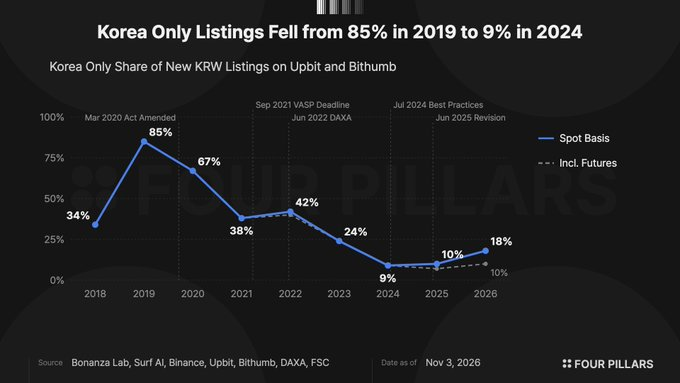
The listing structure for new coins on South Korean cryptocurrency exchanges has completely changed in recent years.
First, let's explain a concept. "First-issued" refers to a coin that first launches on the Upbit or Bithumb Korean won markets and then goes live on global exchanges like Binance, OKX, Bybit, and Coinbase; or it may not have ever been listed on these four at all. The proportion of such new coins among newly listed ones was 85% in 2019, but it has fallen to only 9% by 2024.
This decline coincides almost perfectly with the development of the regulatory framework for virtual assets in Korea.
The turning point was the Act on Reporting and Using Specified Financial Transaction Information. In March 2020, the National Assembly passed an amendment requiring virtual asset service providers to register and fulfill anti-money laundering obligations, with exchanges needing to complete their registration by September 2021. Additionally, the Korean won market has added a hard threshold: it must use real-name bank accounts. This means that exchanges must operate according to the anti-money laundering standards of traditional finance. We estimate that these standards have directly influenced listing decisions. Data supports this: the number of local first issuances per quarter plummeted from 19 to just 3 in the third quarter of 2021—the very quarter when registration deadlines occurred. Following this, the focus of new listings shifted to assets that had been traded overseas first.
The second step was the establishment of review standards agreed upon by exchanges. In 2022, five Korean won exchanges formed the Digital Asset Exchange Alliance (DAXA) and established unified review guidelines. The best practices for listings will take effect in July 2024. These rules do not mandate that coins need to be listed overseas first, but they provide a shortcut: assets traded on qualified overseas exchanges for over two years can be considered as meeting the white paper and disclosure requirements.
By 2026 (as of October), the proportion of first-issued coins has rebounded to 18%. However, if we exclude assets that were first traded on overseas futures markets from the "local first issuance" metrics, this proportion is still only 10%.
2. Total Listings Increase Despite Decreasing First Issuance Proportion, Timing Follows Market Trends
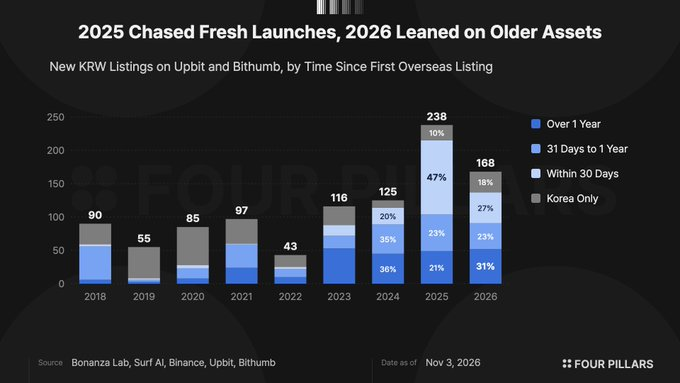
While the proportion of first issuances decreases, the total number of listings is increasing. The number of new coins listed on Upbit and Bithumb's Korean won market was 43 in 2022, 116 in 2023, 125 in 2024, and is expected to surge to 238 in 2025.
How long a token has been traded overseas before entering Korea depends on market conditions. In 2025, when the price of Bitcoin in Korean won approached its high point, 111 coins entered Korea within 30 days of being listed overseas, accounting for 47% of the total. By 2026, the trend reversed: tokens that had been traded overseas for over a year became the largest group, with 52 tokens (31%). Even older tokens like CRV and RSR, which have been traded overseas for over six years, were introduced to Korea.
Thus, South Korea's listing practices have shifted. The framework of "first traded overseas" has been established amid regulatory formation, while the timing of listings swings with the market's ups and downs.
3. Improved Stability, Yet Exchanges Face Challenges Beyond Listings
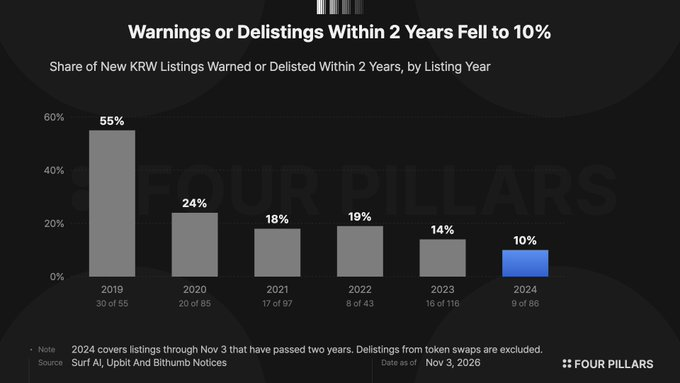
With more coins that have "first traded overseas," the stability post-listing has also improved. The proportion of coins listed that received investment warnings or were announced for delisting within two years was 24% for those listed in 2020, but this dropped to 10% for those listed in 2024.
This rate varies significantly based on the type of listing. Out of all assets listed from 2020 to 2024, 44 out of 148 first-issued tokens (30%) received investment warnings or were announced for delisting within two years; while among the 279 coins that were traded overseas first, this number was 26 (9%), less than one-third of the first issuance rate.
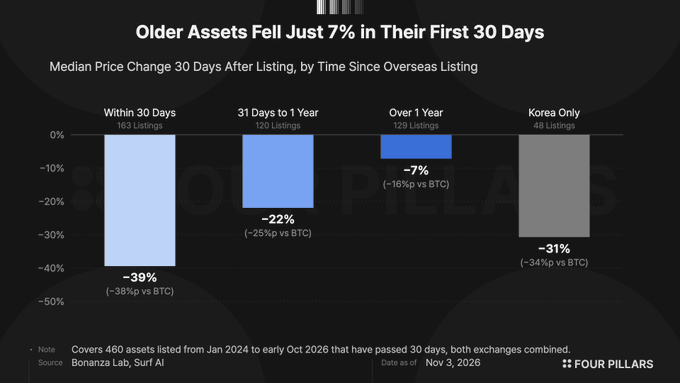
Duration of overseas trading also affects post-listing prices. On average, tokens that could enter Korean exchanges within 30 days of being listed overseas experienced a 39% drop in price within 30 days after listing; while tokens traded overseas for over a year only dropped by 7%.
In summary: tokens that were first traded overseas have a lower probability of receiving warning or being delisted post-listing; the longer the duration of overseas trading, the less they tend to drop in price after listing. The best listing practices also alleviate the burden of review for such assets, so it is highly likely that the focus of listings in Korea will continue to lean towards coins that have been trading abroad for a long time, but the timing will still fluctuate with market conditions.
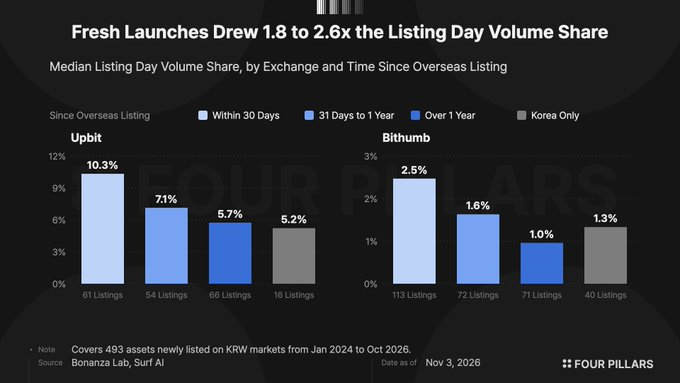
However, this set of "prioritize overseas trading history" rules is not entirely good news for exchanges. The reason is simple: coins that have been traded overseas for a long time often see thin trading on the first day of listing.
Exchanges mainly earn revenue from transaction fees, and a lack of trading on the first day naturally drags down performance. Of course, if the market heats up again, the situation may improve with more newly issued coins from overseas entering Korea, potentially alleviating pressure. But relying solely on a listing structure that fluctuates with the market is unlikely to support a stable business.
After the establishment of the regulatory framework, there has indeed been an improvement in listing stability. However, the real challenge for South Korean exchanges now is how to create new trading demand and revenue sources beyond just listings.
免责声明:本文章仅代表作者个人观点,不代表本平台的立场和观点。本文章仅供信息分享,不构成对任何人的任何投资建议。用户与作者之间的任何争议,与本平台无关。如网页中刊载的文章或图片涉及侵权,请提供相关的权利证明和身份证明发送邮件到[email protected],本平台相关工作人员将会进行核查。


