Organization & Compilation: Deep Tide TechFlow
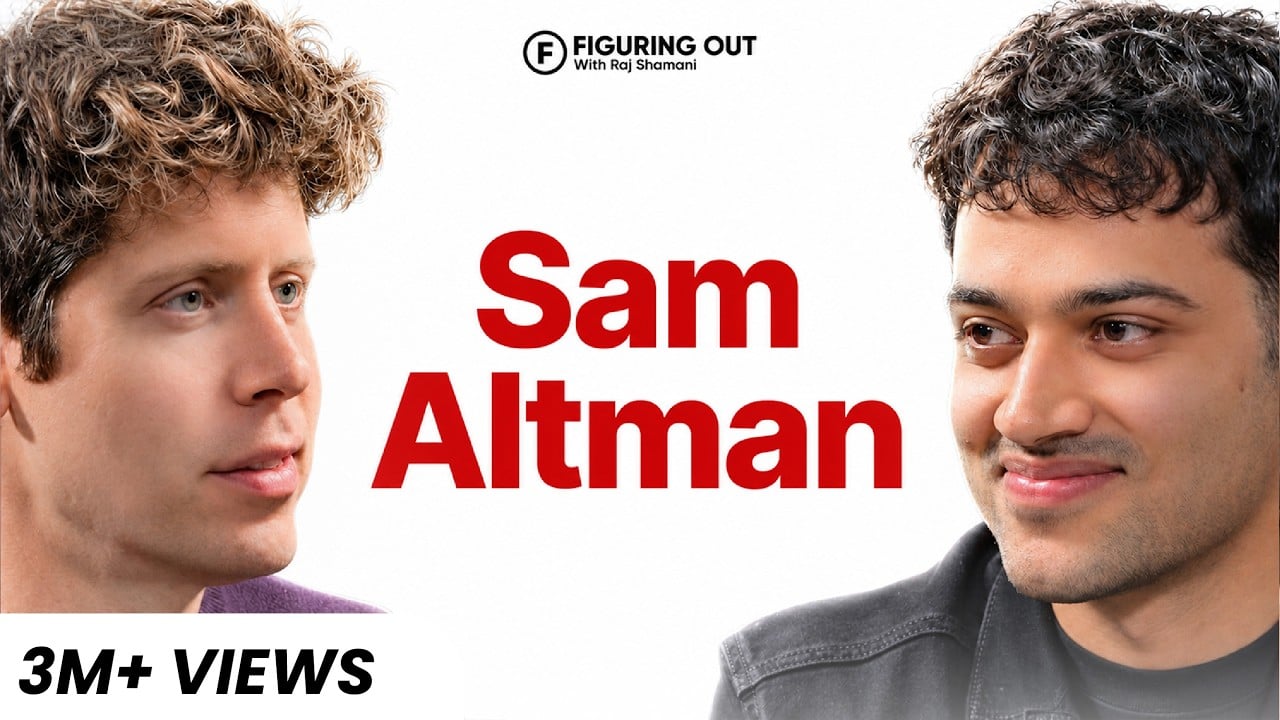
Deep Tide Guide: As the evolution of Artificial General Intelligence (AGI) and Superintelligence (ASI) becomes the forefront of global technology competition, OpenAI CEO Sam Altman appeared on India's renowned podcast "Figuring Out," engaging in a nearly 70-minute deep conversation with host Raj Shamani. The discussion systematically reviewed how the Scaling Law evolved from an intuitive hypothesis to a scientific consensus and, more rarely and candidly, addressed the public's misunderstandings and media whirlwinds stemming from OpenAI's power gamble, executive turnover, and his lack of direct shares in the company.
From betting the company's fate on a crazy accumulation of computing power during the chaotic period after the completion but before the launch of GPT-4, to pushing through internal resistance to launch the first generation ChatGPT with a retention rate of only 5%, Sam Altman deeply dissected the underlying principles of non-consensus innovation and high-leverage decision-making. Meanwhile, he further explored the ambition cultivation methods honed during the Y Combinator era, the exponential compounding logic of personal career growth, and the mental and physical costs behind humanity's ultimate achievement of AI-driven scientific discoveries (from the Navier-Stokes equations to fundamental mathematics).
Guest: Sam Altman (CEO of OpenAI, former president of Y Combinator)
Host: Raj Shamani (renowned Indian podcast host, entrepreneur)
Podcast Source: Figuring Out with Raj Shamani (https://www.youtube.com/watch?v=TjPPIf-M6KE)
Original Title: Sam Altman On AI Revolution, Superintelligence & Future Of Humanity | FO583 Raj Shamani
Broadcast Date: November 3, 2026
Key Points Summary
- Reflections on Giving Up Equity and Social Misunderstanding: Sam Altman frankly admitted that the decision to not hold any equity in OpenAI was a practical mistake. This initial intention was born out of pure mission, viewing it as an artistic pursuit, but the inherent cognition of the commercial society could not comprehend this unconventional behavior, instead breeding public suspicion and confusion about hidden power motives.
- Superlinear Returns of Computing Power: A core understanding throughout Sam Altman's investment and entrepreneurial career is the astonishing magic of scale. From the network of companies incubated by YC to early neural networks, things that work well at a small scale often exhibit returns far exceeding linear expectations when massively scaled up; this is the first principle behind OpenAI's firm bet on large models.
- The Life-and-Death Gamble after GPT-4: In August 2022, during a long vacuum period when GPT-4 had just completed training and the world had not yet seen its capabilities, the team realized that the model would open the door to the Chain of Thought in reasoning and cognition. At a time when the external world generally believed the expansion of computing power was nearing dusk, OpenAI took a huge risk, betting the company's entire future on a massive procurement of supercomputing clusters.
- Counterintuitive Decision to Push ChatGPT: The retention rate of the initial ChatGPT beta version was only 5%, and the management and research teams were generally opposed to the release, believing the product was crude and the timing was not right. Sam Altman insisted on launching it based on YC's philosophy, believing that products loved passionately by a few must be accepted for real-world testing and feedback as soon as possible, even if rough.
- Trust Dilemma of Core Team Departures: Faced with the departures of top figures like Ilya Sutskever, Mira Murati, Dario Amodei, and Elon Musk, each establishing their own factions, Sam Altman noted that this was not purely a conflict of interest, but when touching upon technology that could reshape human destiny, top geniuses would commonly develop a strong mission-driven paranoia that “only I can steer this safely” and divergent paths.
- From Engineering Tools to Scientific Discoveries: OpenAI's next strategic goal that excites them the most is making AI the engine for discovering entirely new scientific laws. From breakthroughs in Navier-Stokes fluid dynamics to proofs of cutting-edge mathematical propositions, AI is transitioning from merely handling existing human experience to exploring the underlying laws of the unknown universe.
- Ambition Can Be Acquired: During his tenure at YC, one of the most surprising findings was that the ambition of entrepreneurs can be completely reshaped by the environment and peer group. Placing a person among peers who dare to challenge absurdly grand goals will shatter their originally narrow cognitive ceilings.
- Exponential Compounding of Career: The vast majority of people simply repeat the same year's experience twenty times in their careers rather than accumulating twenty years of deep compounding. The real rule of success lies in continually pushing beyond the comfort zone, making non-consensus decisions in each stage that propel self-actualization into exponential leaps.
- The Physical and Mental Costs of Becoming Sam Altman: Shaping humanity's most crucial technology inevitably comes with extreme life pressures and the projection of global anxiety. Losing the freedom and ease of working casually in cafes, maintaining a high activation threshold and emotional stability in the eye of the storm through intense schedule management and meditation practices developed in earlier years.
II. Brilliant Perspectives
- Reflections on the Public Opinion of Giving Up Equity: “Looking back, not holding equity in OpenAI was a mistake I made. Although my original intention was very pure, like an artist wholly dedicated to creation, or a top athlete training hard without caring about making a fortune, the commercial society is simply not accustomed to such outliers. When you don’t play by the rules, the public will wildly speculate on what hidden power you are after.”
- On the Exchange between Short-term Low Status and Long-term High Status: “The essence of non-consensus innovation is: you must be willing to exchange short-term low social status for long-term true high status. When OpenAI was first established, we could even say we had lowly status; the academic community viewed us as a group of unruly young people, asserting that AGI would not be achieved for at least another hundred years or perhaps never at all. But as long as the facts prove you right, being misunderstood by the world is your strongest moat.”
- On the Boldness of Releasing the First Generation ChatGPT: “If you do not feel a bit embarrassed about the first version of the product you release, it means that you have launched it too late. At that time, the retention rate of the ChatGPT beta was terribly low, only about 5%, and all data said it couldn’t be released. But I firmly believed in YC's golden rule: instead of having one hundred thousand people mildly like you, it’s better to have five thousand people who are passionately obsessed with you.”
- On the Shakespearean Drama Behind Superintelligence: “There is no way to build superintelligence without experiencing crazy twists and turns. When the stakes are high enough to affect the future of human civilization, many top minds will form a mental pattern: they don’t dare to hand over the steering wheel to anyone else but themselves. This distrust of concentrated power and technical direction has led to dramatic conflicts throughout the industry.”
- On AI’s Ultimate Pursuit of Exploring Unknown Science: “What excites me the most is not merely being a chat assistant, but letting machines help us understand the universe. The astonishing capabilities AI has shown in challenging problems like mathematics and the Navier-Stokes equations suggest we are much closer to having machines autonomously discover new physics insights, solve difficult diseases, and develop clean energy than anyone expects.”
- On Breaking Cognitive Mediocrity with the Compounding Law: “Many people's tragedies stem from claiming to have twenty years of experience, when in fact, they have only mechanically repeated the first year's experience twenty times. You must force yourself to stay on an exponential growth curve, even if each stage is accompanied by significant discomfort and new unknowns.”
III. Main Text
1. Reflections on the Misunderstandings of Giving Up Equity: Why is Selfless Dedication Seen as an Outlier in the Business World?
Raj Shamani: When I read reports about you in the U.S. and India, I found a very divided phenomenon: you have sparked the greatest technological revolution of this era, yet you didn’t take even a bit of equity in the company you founded, but somehow, many people suddenly began to portray you as a villain. How did this happen? Why do you find yourself in such a situation?
Sam Altman: I think this largely stems from American society's innate vigilance towards power, especially maintaining a high skepticism towards the vast power held by today's tech giants. In a way, having this kind of oversight and vigilance is a good thing, but sometimes it can feel a bit excessive.
Raj Shamani: So what do you think is the biggest misunderstanding the outside world has about you?
Sam Altman: To be frank, the point you just mentioned is indeed one of the biggest misunderstandings. Looking back now, the decision not to hold direct equity in OpenAI was actually a very practical mistake. I made this decision under the belief that I had extremely noble and sufficient reasons, but it brought tremendous confusion and chaos to the external world.
Raj Shamani: Why do you think people misunderstood this decision? What exactly do they fail to understand?
Sam Altman: Because it completely deviates from the normal train of thought. In people's traditional cognition, a person founding a company and working tirelessly as a business leader must have the sole reasonable motive of obtaining huge wealth in return. This behavioral pattern is too at odds with conventional business logic, and the public feels uneasy about those they cannot understand as outliers. If an artist pours their heart into pure art, or if a sports star trains day and night for competitive honor without aiming to make a fortune, everyone would find it reasonable and respectful; but in the business realm, people start to suspect: since he is not out for money, what exactly is he after? Is he secretly aiming for greater power control?
Raj Shamani: So what is your true driving force?
Sam Altman: Because this is the most fascinating, important thing I can imagine that truly benefits human society. Being able to participate in and promote such an exploratory journey is an unparalleled thrill and fortune. To me, this is the most worthy endeavor to dedicate a lifetime to.
Raj Shamani: Years ago, you wrote a famous line: you should be pleased to exchange short-term low status for long-term noble status. As long as you are correct, being misunderstood by the public is a great advantage rather than a disadvantage. But the key is, before the final outcome is revealed, how do you know if you are merely misunderstood or if you have simply made a mistake?
Sam Altman: The truth is: before the dust settles, you can never be one hundred percent certain. You can only develop a stronger and stronger belief as you collect more new evidence, gradually increasing your certainty. But the unknown risk is exactly what makes this adventure the most thrilling part. When we first established OpenAI, it was seen as a socially low-status venture. Everyone treated us as a joke, saying that AGI, even if it could be realized, was a hundred years away, and that we were merely a bunch of unruly young people dreaming impractically. But we saw physical laws that others did not see, and as we unraveled more puzzles, our confidence grew. Despite the probability of ultimate success being minuscule at that time, its expected value was so high that it was worth betting everything on.
2. Superlinear Returns of Computing Power: From YC Experience to the Intuitive Breakthrough of Scaling Law
Raj Shamani: When the whole world is pessimistic about AGI, what underlying signal gave you such certainty that it would work and made you willing to bet your entire career on it?
Sam Altman: I believe that a person can likely gain only a few critically important insights in their lifetime, and what you can do is apply them again and again across different dimensions. For me, one of the core insights is that scale has an astonishing superlinear emergent property.
Raj Shamani: Where did this understanding initially come from?
Sam Altman: I have witnessed this principle in many phenomena, including the development of companies, the rise of nations, the evolution of cities, personal career trajectories, and the investment and alumni network I built at Y Combinator. Any mechanism that works well at a small scale often bursts forth with stunning excess returns once you make a tremendous effort to scale it up by several or even dozens of times. Since I inherently tend to recognize patterns, when we early on observed that neural networks could not only function but would also become smarter as parameters and data increased, I had a strong intuition: we must push the scale to the limit regardless of the cost. Although we had not yet derived a rigorous mathematical formula for the Scaling Law at that time, the simple principle that as long as you make the network larger, its capabilities will leap has already displayed signs back in the AlexNet era.
Raj Shamani: But this signal should have been visible to the world's top scholars; why didn't other major companies and institutions fully invest in it at that time?
Sam Altman: This is one of the most puzzling phenomena of my life. Back in 2015, Google had virtually all the world's top deep learning talent and the strongest computing resources, but the traditional academic community had a deep-rooted disdain for simply brute-forcing computing power. They believed that true intelligence must rely on elegant new algorithms, symbolic logic, or bionic structures; amplifying computing power a thousandfold was seen as a labor of no technical merit. This intellectual arrogance afforded us a precious four to five year window in the wilderness where no one cared about us.
3. The Life-and-Death Gamble after GPT-4: Betting Everything in the Vacuum of No Understanding
Raj Shamani: Can you restore for us a crucial life-and-death moment? What was the strategic decision you faced when the outside world was warning you that success was absolutely impossible, and you made a choice that completely altered OpenAI's fate with half certainty and half what some might see as paranoia?
Sam Altman: The most thrilling decision occurred when GPT-4 was just completed, around August 2022. At that time, there were still seven to eight months of long wait before we officially released GPT-4 to the world; we were internally testing this model, and everyone knew it exhibited unprecedented intelligence. But more critically, we realized over time that it opened up an entirely new research dimension: the model was going to continue evolving at an unimaginable pace following GPT-4, and we could absolutely develop a new architecture capable of deep reasoning and Chain of Thought based on it.
Raj Shamani: What strategic choices did this mean for you at that time?
Sam Altman: We decided to bet the entire future of the company on a scale of computing power that was hard to imagine. At that juncture, the outside world had not even seen a shadow of GPT-4, let alone understood what it could do, and mainstream opinion was even declaring that large language models had hit a wall. Everyone thought we were crazy for spending billions of dollars to pre-order untested super-scale computing clusters; it was simply an act of suicide. But since we had experienced using GPT-4 firsthand and had thoroughly internalized the certainty of the Scaling Law, we were convinced we were most likely right.
Raj Shamani: If you had backed down at that time, what was the alternative plan?
Sam Altman: The alternative plan would have been to make a very conservative, prudent conventional computing investment, slowly advancing model iteration. If we had chosen that path, OpenAI today would not have reached the forefront of AGI. Many times, the real turning point lies in whether you dare to bet all that you have earned, unhesitatingly, on the central table during the long vacuum period when market perception has yet to awaken.
4. Counterintuitive Decision to Push ChatGPT: Disruptive Signals Behind 5% Retention Rate
Raj Shamani: Was there a core decision that the entire management and research team opposed, yet you insisted on pushing through?
Sam Altman: The launch of the first generation ChatGPT itself is the most typical example. It’s not that the team completely didn’t want to develop a chatbot, but the vast majority felt it was too crude and the technology was simply not mature enough. They believed that as a serious cutting-edge research institution, to present such a rough demo to the public was simply subpar, and it would likely divert focus from core AGI research.
Raj Shamani: What drove you to oppose all dissenting opinions and stick to the launch? Was it your practical experience in YC?
Sam Altman: Yes, it was absolutely the essence of YC at play. During my years at YC, I repeatedly indoctrinated founders with a principle: if you are not somewhat embarrassed by the first version of the product you release, it means you have launched it too late. Because building in a vacuum is deadly; what you urgently need is real-time feedback from actual users. When we internally tested the ChatGPT prototype, the data performance was simply abysmal, with retention rates just around 5% the following week. Any conventional product manager would see this number and immediately call it a death sentence, asserting that this product could never be launched.
Raj Shamani: With a retention rate of only 5%, why did you still see hope?
Sam Altman: Because YC has another ironclad rule: in the early stages of a product, having a very small number of core users who are madly in love with you is much more valuable than having many users who think you are just okay. When we followed up with that 5% of retention users, we found that they were practically living in it and couldn’t get enough. This intense depth of usage was an extremely strong counterintuitive signal. So I decided to release it as a research preview. As it turned out, it was precisely this strategy of early acceptance of real-world testing and iterative deployment that not only ignited a global AI wave but also brought us irreplaceable safety evolution data.
Raj Shamani: Now that OpenAI is so large, would you still be willing to release products that make you feel embarrassed?
Sam Altman: For the core version of ChatGPT that now has hundreds of millions of daily users and the critical corporate infrastructure, the thresholds are extremely stringent and absolutely do not allow any carelessness. But in the realm of experimental products, I still greatly advocate for agile exploration. In the future, you will still see us continuously launching some bold, even immature new attempts; some will amaze and integrate into the core experience, while others may announce failures. If a company completely loses the courage to take risks to create rough products out of fear of making mistakes, then it will not be far from mediocrity and demise.
5. Shakespearean Drama of Core Team Departures: The Trust and Power Struggles Under Superintelligence
Raj Shamani: OpenAI once gathered the world's smartest batch of geniuses together, but then a series of executive departures described in the media as "Shakespearean drama" occurred. Ilya Sutskever left, Mira Murati left, Dario Amodei founded Anthropic, and Elon Musk also started xAI. Everyone initially shared common noble ideals, yet now they fight separately, even in court. What are the core differences behind this?
Sam Altman: I believe when a technology's prospects become so grand, and the stakes are high enough to affect the future fate of human civilization, many geniuses' subconscious will trigger a very special psychological mechanism: they start to believe only in themselves and are firmly convinced that only by steering this technology themselves can ensure it stays on track.
Raj Shamani: Is this psychology stemming from differences over the safety routes for the technology, or from fears of excessive concentration of power?
Sam Altman: The two are actually deeply intertwined. Psychological projection often works like this: because I feel that his technical ideas or advancement pace are off, I absolutely cannot allow such vast superintelligence control to be concentrated in his hands. The different pathways naturally lead to a breakdown of trust.
Raj Shamani: After experiencing board coups, lawsuits, the departure of core allies, and severe scrutiny from global governments, how has your own mindset transformed? You seem extremely calm no matter how huge the whirlwinds around you are; is this just your inherent nature?
Sam Altman: No one can lead a peaceful life while building superintelligence; chaos and upheaval are inevitable byproducts of this mission. When I first established OpenAI, I wasn’t emotionally prepared for this, but once the Scaling Law was validated and the mission became irreversible, I became very clear that my life would inevitably be swept into a storm. This is indeed brutal, but my nervous system seems naturally well-suited for high-intensity chaotic environments; regardless of how tumultuous it gets around me, I can maintain a core clarity.
Raj Shamani: Do you really not feel nervous at all? When was the last time your heart raced?
Sam Altman: Of course, I do, but the threshold to make me feel a racing heart has now become extremely high. The last moment that truly made me feel tense was when we were about to announce a breakthrough in the Navier-Stokes fluid dynamics equations. This was a foundational physics problem that humanity had not thoroughly cracked for hundreds of years; witnessing our model genuinely stepping into the deep water of human research gave me a shivering thrill of witnessing history, which indeed made my heart race after a long time. In my early years, I used to spend two hours deeply meditating every day; this long-term focus training allows me to quickly enter a flow state and completely block out emotional noise, even under extreme pressure.
6. The Next Milestone for AI: From Engineering Assistance to Discovering New Scientific Laws
Raj Shamani: If we step out of the immediate commercial competition, in the complete picture of AGI and Superintelligence, what extraordinary thing do you most desire to create with your own hands next?
Sam Altman: The goal that captivates me the most is exploring just how far we can push AI into the unknown boundaries, allowing it to autonomously discover entirely new objective scientific laws. The early results we see in cutting-edge mathematics and theoretical physics are extraordinarily shocking, making me believe that we are much closer to this milestone than outsiders imagine.
Raj Shamani: Does this mean AI will completely transcend the properties of engineering tools?
Sam Altman: Exactly. Everything that has achieved significant leaps in quality of life and prosperity over the past centuries of human civilization has been fundamentally driven by breakthroughs in basic science. If we can build a superintelligent machine that not only summarizes existing human knowledge but also helps us gain insights into the deeper physical mysteries of the universe, invent revolutionary medical solutions, and tackle infinite clean energy, it will utterly rewrite the historical trajectory of human civilization. Being able to participate in building this machine that explores the mysteries of the universe is my most sacred mission.
7. Ambition Can Be Taught: How YC Reshapes Entrepreneurs' Conceptual Limits
Raj Shamani: You've mentioned that the number one reason most entrepreneurs fail is due to a lack of drive and ambition. But isn’t ambition something innate? Can a person really be cultivated to be more ambitious?
Sam Altman: The answer is absolutely yes, and this is one of the most delightful discoveries I've made during my years at Y Combinator. Many people appear unambitious because the environments, schools, and societal norms they are surrounded by continuously suppress their nature, forcing them to remain in the herd and take mediocrity as a natural refuge.
Raj Shamani: What kind of magic does YC use to change a person's ambition dimensions in just a few months?
Sam Altman: It's the disruption of the environment. When you throw a young person who only wanted to make ordinary software into a peer group where everyone is seriously discussing how to cure aging, colonize Mars, and build a new global financial foundation, their cognitive boundaries regarding possibilities are shattered in an instant. They will witness that those achieving extraordinary accomplishments are not some three-headed, six-armed deities, but just ordinary people with flesh and blood. Ambition is extremely contagious; as long as the internal fear is broken, and people realize that attempting to pursue seemingly absurd grand goals is statistically not frightening, a person's inner potential will be released in an explosive manner.
8. Career Compounding and the Cost of Fame: The Physical and Mental Reconstruction to Become Sam Altman
Raj Shamani: You wrote a widely circulated blog post in your early years titled "How to Achieve Success," which mentioned 13 rules. If you were to distill it today, what do you think is the most core rule?
Sam Altman: Without a doubt, it's the exponential compounding (Compounding) of personal growth. The vast majority of people severely underestimate the power of compounding; they do not push themselves to continually break through, ultimately ending up in a dead end of career development. The most ironic aspect of the workplace is that many people pride themselves on having twenty years of experience, while in reality, they have merely mechanically repeated the first year's experience twenty times.
Raj Shamani: How can one ensure that they always remain on the compounding curve and do not stagnate?
Sam Altman: The key is to dare to force yourself to embrace new and highly uncertain challenges at the end of each stage. Most people, once they taste a little bit of sweetness, will immediately retreat into a comfortable safe haven and stop evolving. You must continually do things that make you uncomfortable and are non-consensus, leveraging the potential accumulated in the previous stage as a springboard for the next stage, enabling your cognition and influence to present exponential growth gradients.
Raj Shamani: As someone who may be shaping the most crucial technology for humanity, what is the true personal cost of becoming the Sam Altman you are today?
Sam Altman: Subjectively speaking, this is my current life norm; the leisurely days in my early years have become a distant and vague memory. The most minor cost is that I can no longer casually go to the corner cafe to work peacefully on weekends; I am enveloped around the clock by precisely organized security and schedules; the larger cost is that the global anxiety and fear of the unknown from all societal levels nearly wash over me daily. This is indeed extremely exhausting and burdensome, but I am acutely aware that I possess the most incredible opportunities and missions in the world. I never complain about fate, nor do I feel that I have endured great suffering. Since I have chosen to stand on this historical stage, I can only focus wholeheartedly on racing towards the future.
免责声明:本文章仅代表作者个人观点,不代表本平台的立场和观点。本文章仅供信息分享,不构成对任何人的任何投资建议。用户与作者之间的任何争议,与本平台无关。如网页中刊载的文章或图片涉及侵权,请提供相关的权利证明和身份证明发送邮件到[email protected],本平台相关工作人员将会进行核查。


