New Intelligence Report
Early this morning, the U.S. stock market was bloodied.
The Nasdaq index plummeted by 5.52%, marking the largest single-day drop since April 2025, officially entering a technical correction zone. The Philadelphia Semiconductor Index plunged by 12.3%, the worst day since the pandemic crash in March 2020.
Nvidia fell by 9.26%, evaporating nearly $450 billion in market value in one day; AMD dropped by 17%, SanDisk by 22%, and Broadcom by 10%.
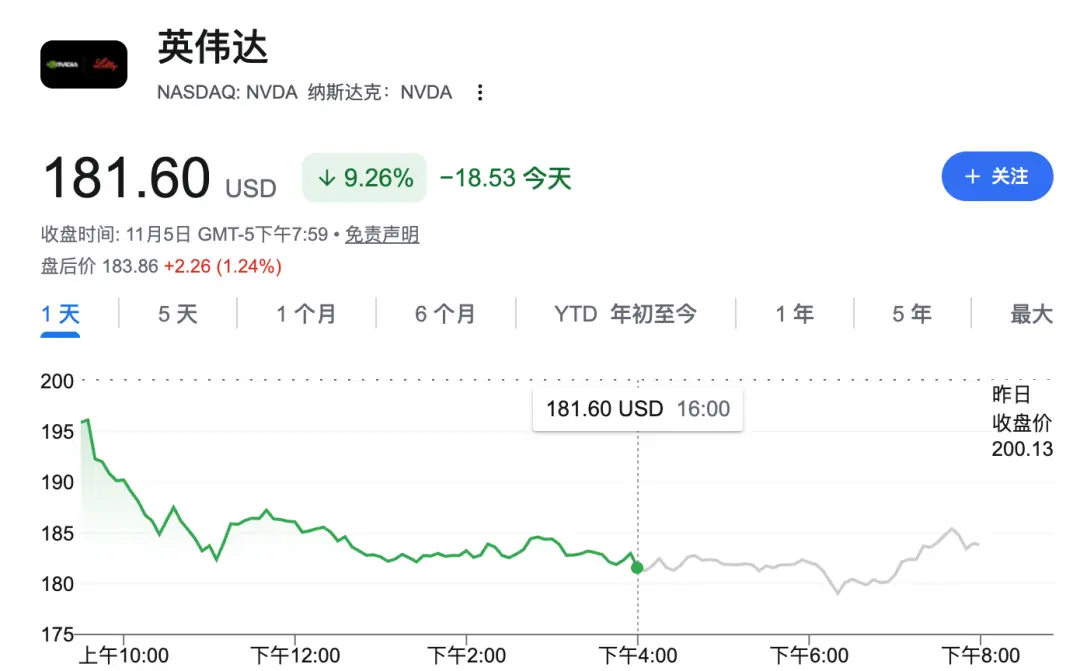
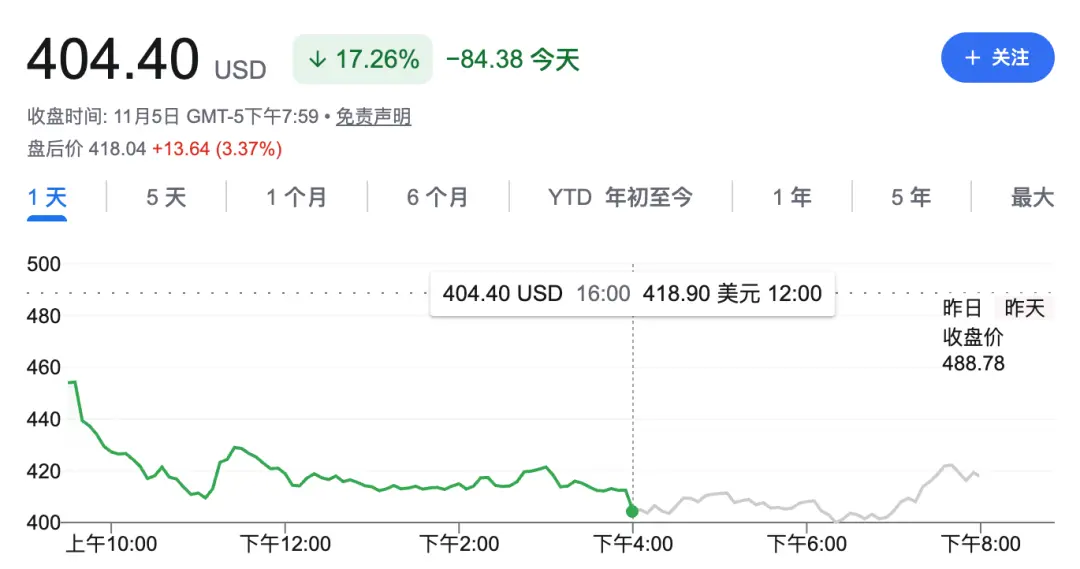
From chips, servers, optical modules to electricity suppliers for data centers, almost no corner of the entire AI infrastructure industry chain was spared.
Media estimates indicate that the U.S. stock market lost about $2.8 trillion in just one day!
Setting aside the electoral effects, a deeper layer is the market’s doubt about whether the massive AI capital expenditures "can really break even," which finally erupted.
But just two days ago, on November 3, Menlo Ventures, a 50-year-old venture capital firm in Silicon Valley and an early investor in Anthropic, released the "2026 Enterprise AI Status Report," which presented numbers that had moved in entirely the opposite direction of the stock market:
Enterprise AI deployment expenditure is projected to soar from $33 billion to $177 billion by 2026, a staggering increase of 5.4 times in just one year. Three years ago, this figure was only $1.7 billion, increasing a hundredfold in three years.
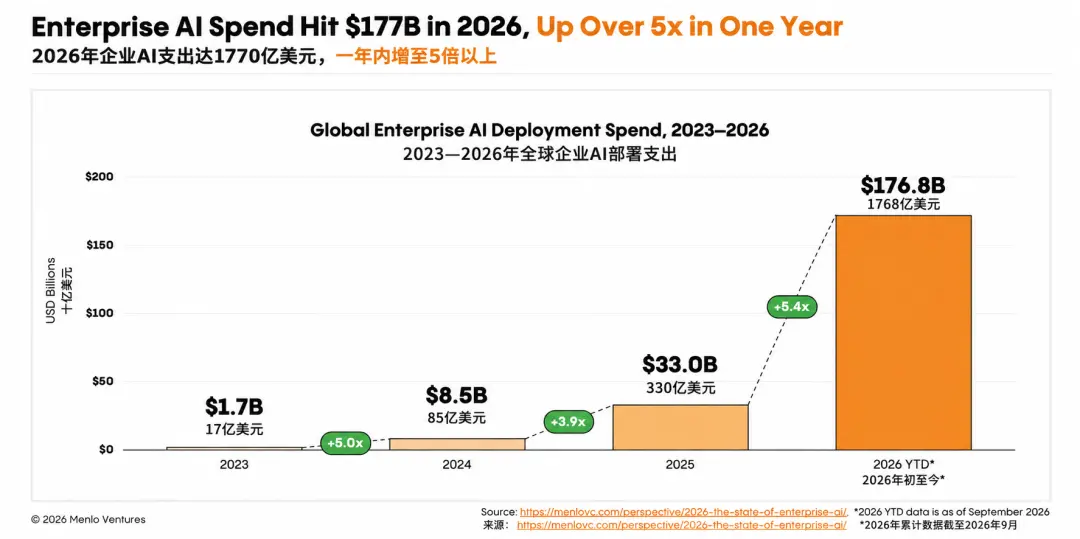
On one side, $2.8 trillion turns to dust; on the other, $177 billion is being poured in.
The contrast is outrageous. Wall Street doubts whether the supply-side capital expenditure can be recouped, while the demand-side CTOs are increasing their orders to the point of losing budget control.
This report also hides two more intriguing clues:
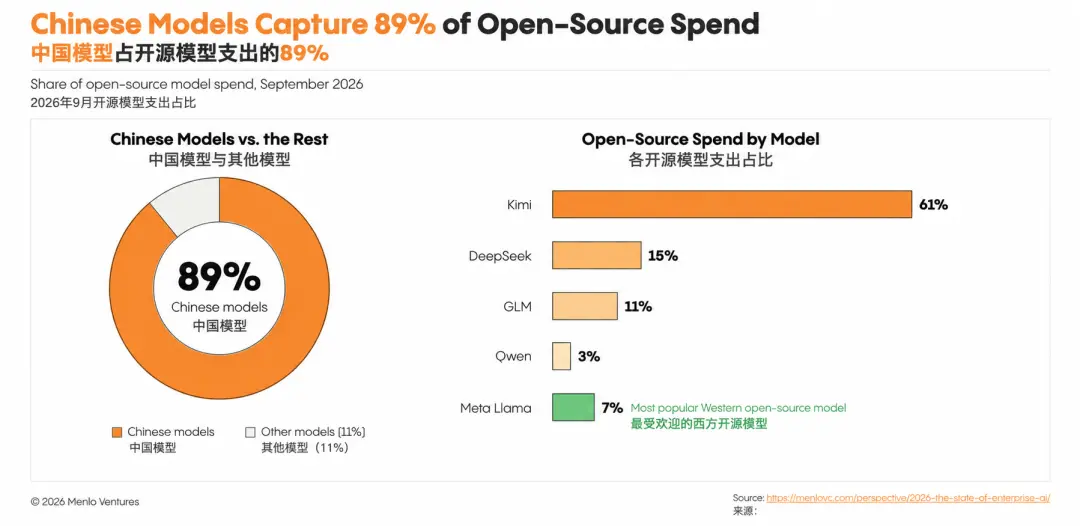
Chinese models captured 89% of enterprise open-source model expenditures, with Kimi accounting for 61%; at the same time, companies are accelerating their spending on more expensive flagship models, with the expenditure share for cutting-edge models increasing from 35% to 63%.
Putting these two events together reveals the real spectacle.
Chinese models are "dominating the charts" on American companies' balance sheets
In enterprise open-source model spending, the Chinese contingent overwhelmingly occupies the top four: Kimi 61%, DeepSeek 15%, GLM 11%, Qwen 3%, totaling 89%. Meta's Llama, the most notable open-source player in the Western world, only accounts for 7%.
In other words, when American companies run open-source models in production environments, nine out of ten times, the underlying technology comes from China.
But even more interesting is that Chinese models are no longer just "cheap alternatives" — they are beginning to be integrated into others' products.
Just yesterday, on November 5, Thinking Machines Lab unveiled their new model Inkling 2 Small. This company needs no introduction: founded by former OpenAI CTO Mira Murati, it raised $2 billion in its seed round, with its most recent valuation hitting $40 billion, making it one of Silicon Valley's most prominent labs.
The model itself is impressive: with 594 billion total parameters, 17 billion active MoE, and a score of 31 on the Artificial Analysis intelligence index.
But that's not the focus. The key lies in an unassuming corner of a technical blog —
In the latter half of pre-training, most of the data fed to the model is not scraped from the internet but generated by running a few earlier models first. The first one mentioned is Kimi K3 from the Dark Side of the Moon.
What is this called? This means Kimi acted as a teacher for Silicon Valley's star laboratory.
The premise of being a teacher is that others are willing to copy the answers you write. A year ago, this role essentially belonged only to GPT and Claude.
Being a teacher is just one application. Kimi K3 is also serving as a foundation for American companies.
In August this year, legal AI unicorn Harvey — valued at over $10 billion, with OpenAI still a shareholder — released its first model, Tenet.
Who is the foundation? Not the shareholder OpenAI's GPT, but Kimi K3.
Harvey used only about 150 Nvidia B300s, spending two months on post-training legal tasks on Kimi K3.
The result was that Tenet nearly doubled the number of tasks completed on its own legal agent benchmark and held its own against flagship models from Anthropic, OpenAI, and Google on several complex legal tasks.
The model-building Thinking Machines are using it as a teacher, while the application-focused Harvey is using it as a foundation. Kimi has made its way from the laboratory to the application layer.
For these companies, open weights mean they have a knife they can sharpen themselves, rather than just a cheap knife.
Thus, Chinese models have entered the production chain of top overseas applications — from being called upon to being treated as teachers and foundations.
Furthermore, this momentum is accelerating.
On October 23, the recently released Kimi K3.1 Pro reported a Terminal-Bench 4.0 score of 65.7%; shortly after on November 5, it entered Microsoft Foundry —
This is the first open-source weight model to adopt a "revenue sharing" model on Microsoft's cloud. Simply put, every time a company calls Kimi on Microsoft Azure, the Dark Side of the Moon receives a payment.
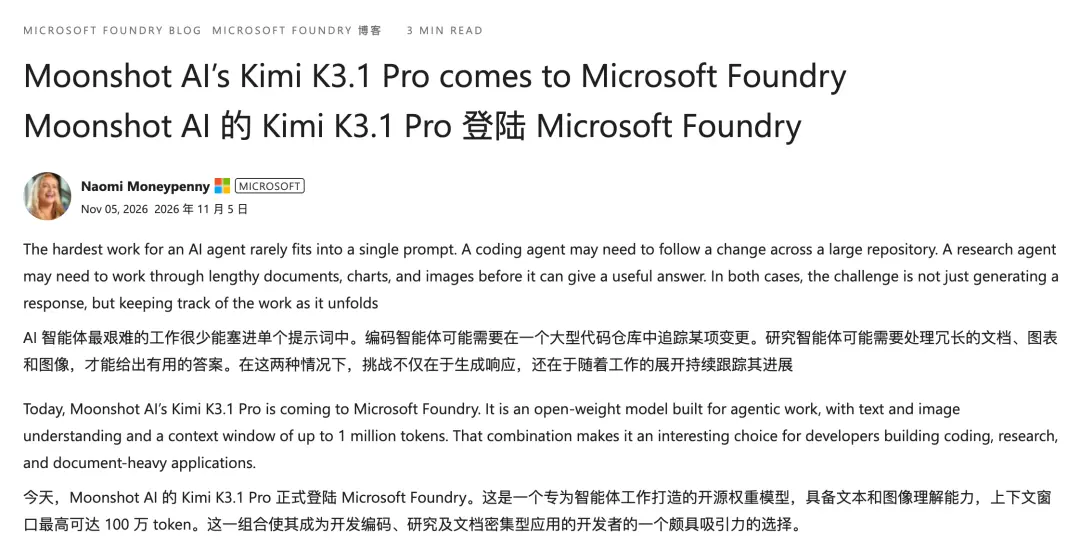
Before Microsoft, Kimi had already entered Amazon AWS. Microsoft and Amazon, the two largest clouds globally, have both issued "entry tickets" to Chinese open-source models.
Another set of accounts: usage doubles, but spending doesn’t increase
With such strong performance, should closed-source models be worried?
The story is far from that simple.
If we only look at usage, the momentum for open source is indeed remarkable: the token share increased from 11% to 19%, and the monthly processing volume skyrocketed 22.5 times to about 29 trillion.
But where's the money? The spending share actually dropped from 6% to 4%.
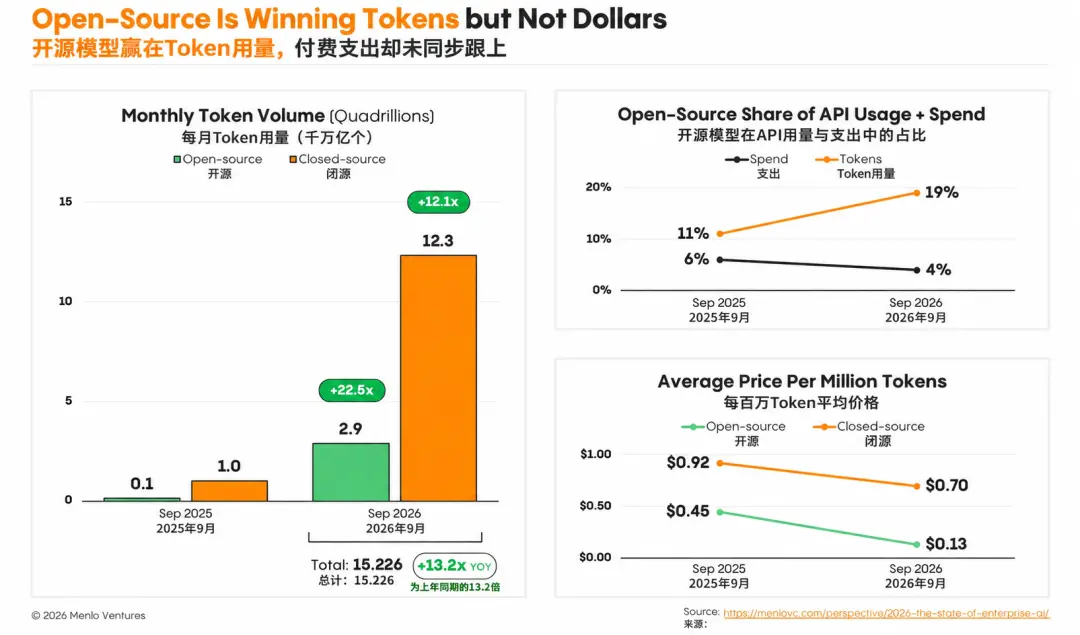
The painful reason: over the past year, the open-source camp has mostly focused on one thing — making smaller, faster, and cheaper "flash" level models and engaging in a fierce price war.
In one year, the average price of open-source tokens dropped by 3.3 times, now costing only $0.13 per million tokens; closed-source models average $0.70, which is over five times more expensive.
The outcome of this price war is that while the amount of work done has doubled, the income has actually decreased — the incremental gains have all been devoured by price cuts.
The open-source Flash models may have won the shouting match, but the flagship models have won the wallets.
Enterprises do not discriminate between open-source and closed-source; they only recognize who can get the job done. However, within the open-source camp, the number of candidates that qualify as flagships is few.
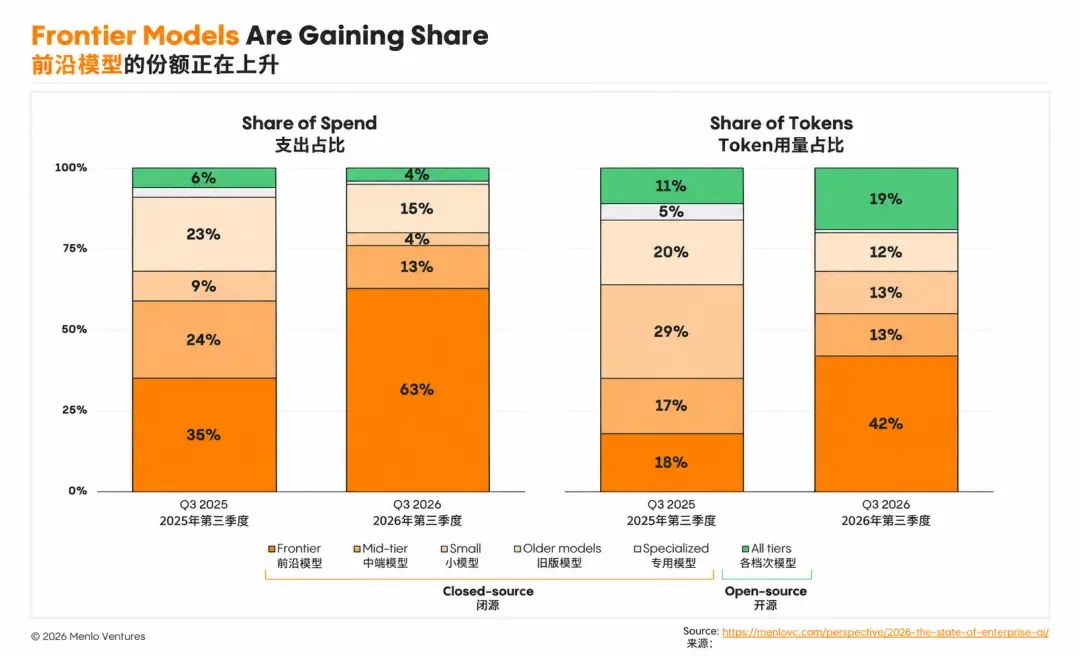
This is the most counterintuitive finding of the entire report: the expenditure share for cutting-edge flagship models surged from 35% to 63%, while the token share doubled from 18% to 42%.
Last year, the mainstream choices for enterprises were Claude Sonnet 4.5 ($3 per million input tokens) and GPT-5 ($1.25); this year, they switched to Claude Opus 5.5 ($4) and GPT-6 Astra ($10). Prices have skyrocketed several times, yet instead of running away, users have flocked in.
Where is the money flowing? Anthropic rose from 40% to 55%, OpenAI from 27% to 31%, together capturing 86% of enterprise LLM API spending. Google dropped from 21% to 9%, falling behind.
Meanwhile, contenders like Kimi K3, DeepSeek V4, and GLM-5.3, whose performances are approaching flagship levels, together account for less than 5%. The capabilities are there, but enterprises have not yet dared to hand over their lifeline.
The most tragic are those caught in the middle: small closed-source models dropping in price by over 80%, yet their token share still fell from 29% to 13%. The flagship models are siphoning off complex tasks, and open-source models are grabbing the simpler ones, squeezing from both ends, feeling like they are not wanted.
So why are enterprises willing to spend more money?
Imagine this: letting AI fix an online issue, reading code, checking logs, locating problems, changing files, running tests. A cheap model missteps every few steps, forcing you to repeatedly explain, check, and redo, ultimately forcing you to handle it yourself. While the token bills are cut down, the engineer's entire afternoon gets invested.
Thus, the calculations that enterprises are making do not revolve around how many dollars are spent on every million tokens, but rather how much it costs to complete the entire process from start to finish. The model invocation fees are just a small part; the real cost lies in monitoring, waiting, and modifying.
Cheap is certainly good, but it must come with a prerequisite — the job must be done properly.
However, does open-source not handle big tasks?
Take Kimi K3.1 Pro as an example, with its 2.8 trillion parameter MoE architecture supporting a context window of one million tokens, achieving a Terminal-Bench 4.0 score of 65.7%, surpassing GPT-6 Astra.
It scored 64.4 on the financial research benchmark OfficeQA Pro v2, ranking first globally. The hallucination error rate dropped from the previous generation's 23.4% to 6.85%.
This is now beyond the "just usable" level; it's at a level of competing arm wrestling with closed-source flagships.
Open source has never lacked intelligence; rather, it has been the level of trust from enterprises towards it — compliance, after-sales service, and long-term strategies, these "off-exam" scores, are the last hurdle.
Ultimately, the crash in the U.S. stock market today and the data from this report tell the two sides of the same story.
Wall Street focuses on the supply side: massive capital expenditures, data center approvals, electricity costs, all of which hang overhead like swords.
Meanwhile, the Menlo Ventures report targets the demand side: for every dollar spent training models, enterprises are spending $1.70 to use them — downstream demand is backing up upstream investments.
Earlier this year, Wall Street even panicked over "AI eating SaaS." The report, however, shows that 55% of new AI expenditures are from entirely new budgets, with only 9% being shifted from traditional software budgets to AI-native providers.
AI is expanding the pie, not fighting over it.
Tim Tully, a partner at Menlo Ventures, who authored this report, stated a hard truth:
Wall Street asks daily whether AI can break even, but what we see is that enterprise buyers have not held back; instead, they are finding ways to make AI do more work.
"We may still be underestimating this market."
Stock prices may drop, but the bills do not lie
Finally, let's look back at the three sets of contrasts hidden in this report:
Flagship vs. Open Source. Flagship models captured 69% of deployment spending, with the first-mover advantage of leading labs amplified in the Agent era.
However, the report also contains a telling line — "the scarcity of capabilities will not last long."
Whenever open-source catches up with a flagship in a certain task, the previous premium will have to be re-evaluated.
Closed-source flagships do not hold permanent premium rights.
Usage vs. Revenue. Chinese open-source with an 89% share demonstrates its capabilities, but there is a commercialization test between the 19% token usage and 4% of spending.
Being widely invoked is one hurdle, but being able to stably handle complex tasks and keep customers paying is the next.
The cases of Harvey and Thinking Machines provide a path — not relying on being cheap, but instead becoming others' teachers and foundations; the revenue-sharing model from Microsoft and AWS offers another — collaborating with cloud giants, earning from each invocation.
Stock Prices vs. Bills. The contrast between Wall Street and enterprises is not as contradictory as it seems.
Stock prices reflect expectations, while bills record reality. The evaporation of $2.8 trillion in a day is an adjustment of expectations, while a fivefold increase over a year reflects accelerating reality. Both can simultaneously be true.
However, looking further ahead, this report may reveal much more than just a business cycle — it highlights a redistribution of industrial power.
Three years ago, AI was still a toy in laboratories; three years later, enterprises are spending $177 billion annually to use AI, an amount equivalent to one-third of total public cloud revenue.
The main contributors have also changed; 80% of tokens are burned by agents themselves.
Who’s model is effective, who trains the model, who helps run the model — the division of labor across the entire chain is being rewritten by the power of Chinese open source.
免责声明:本文章仅代表作者个人观点,不代表本平台的立场和观点。本文章仅供信息分享,不构成对任何人的任何投资建议。用户与作者之间的任何争议,与本平台无关。如网页中刊载的文章或图片涉及侵权,请提供相关的权利证明和身份证明发送邮件到[email protected],本平台相关工作人员将会进行核查。


