AI is still expanding, he first handed over his position.
David, Deep Tide TechFlow
AI stocks plummeted again, and the market once again recalled that young man who became famous by betting on computing power infrastructure after leaving OpenAI.
Leopold Aschenbrenner, referred to as the "Son of the U.S. Stock Version" by the Chinese investment community. In July of this year, his fund's portfolio value dropped 67% in just one month; in September, he began trading options again. Now, that familiar batch of stocks has been sold off again, and news of him "blowing up again" has followed close behind.
The once Son of the Version has nearly turned into a discarded pawn following the Democratic Party's victory in the midterm elections, as the stock market's fortunes changed dramatically.
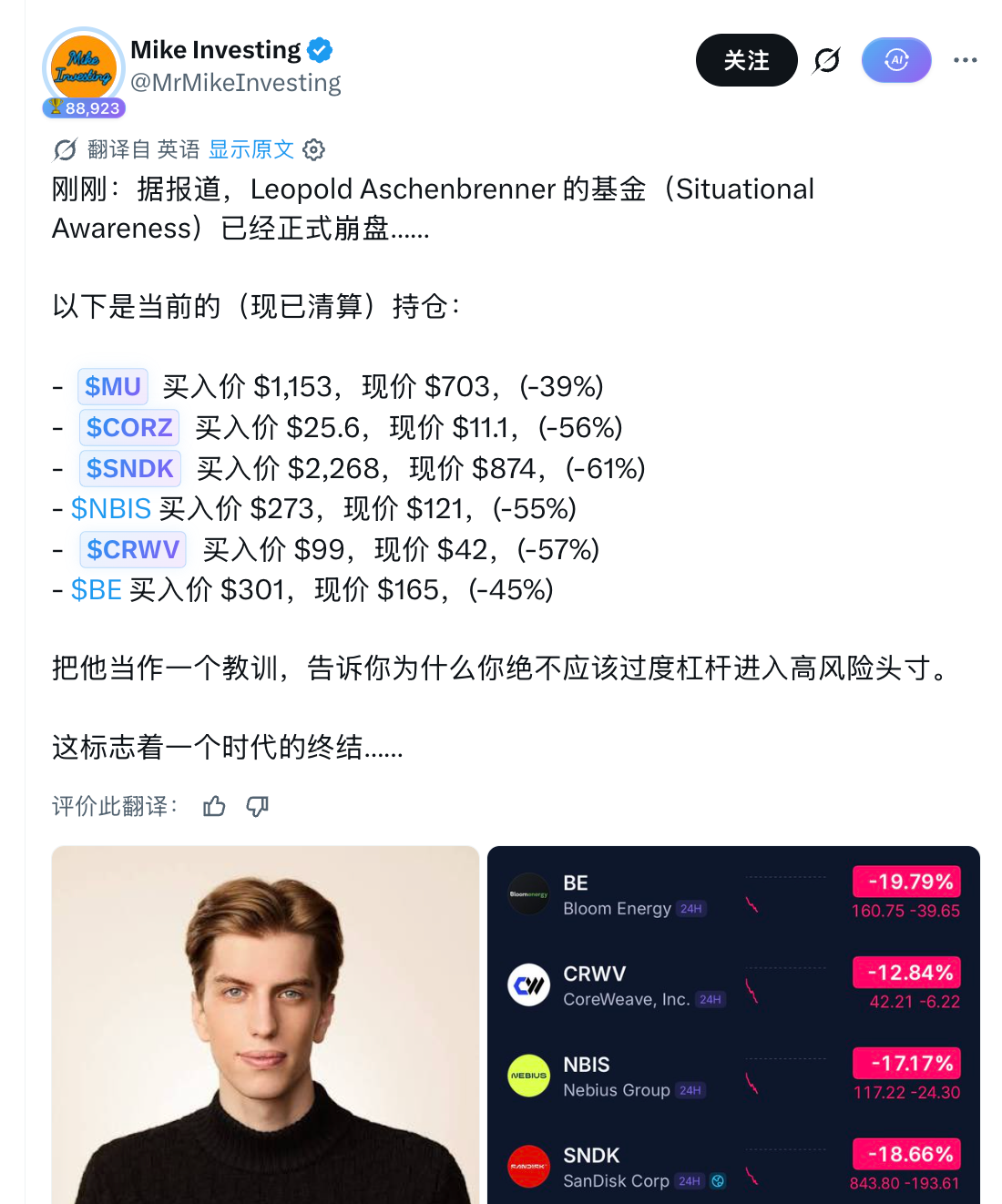
AI needs what, he buys what
Leopold's investment story is easy to believe.
He researched the safety issues of superintelligence at OpenAI, and after leaving, he founded an investment firm, with early supporters including the Collison brothers of Stripe, Nat Friedman, and Daniel Gross. This background placed him between two groups of people: one side researching how far AI can go, and the other side having the money to bet on how far it will go; and he clearly has both.
His stock picks are also very intuitive. AI needs more storage, Micron and SanDisk entered the portfolio; model training and inference require computing power, Nebius and CoreWeave offer cloud services; data centers need electricity and computer rooms, Bloom Energy and Core Scientific also appear in the holdings.
These companies do different things, but their revenues are all related to the same expenditure: building and operating more AI infrastructure. Rather than guessing which model will ultimately win, buying the things they must procure looks like an easier-to-understand and more convincing investment pathway.
And indeed, money has been made. According to the investor letter disclosed at the end of July, the fund's net return reached 439% in the first half of the year. By the end of June, in the publicly declared U.S. stock holdings, SanDisk and Micron together accounted for about 55.6%, with just these two storage companies making up more than half. The other companies in the holdings, although they provided industry distinctions, did not keep the portfolio away from the AI construction boom.
When the market was rising, this concentrated betting amplified profits and pushed everyone's sentiment for early knowledge of the AI narrative, youthfulness, and closeness to the core circle to a peak.
But by July, chip stocks began to be sold off. Due to the fund's use of high leverage, margin calls soon followed. At the end of the month, it sold off most of its listed stock positions to Citadel. The investor letter seen by Reuters showed that his portfolio dropped 67% that month. Leopold began to apologize and wrote in a letter to investors: "We let you down this month."
However, even accounting for this loss, the fund was still up about 80% for the year.
The stocks he sold, the buyers also had no intention to stay long
Citadel took over and quickly began to split and sell off this batch of positions.
This was not a Wall Street giant recharging faith for the stars and seas of AI; rather, it was a cold-hearted liquidation of bad assets. Citadel's head Ken Griffin played the role of an emotionless liquidation machine. In less than three weeks, he quickly offloaded over 80% of the original portfolio's risk through hundreds of large transactions, cashing out over $4 billion.
As this top hedge fund magnate emphasized in his letter to investors: "The ability to diversify and dispose of these risks was the core of this transaction."
The same batch of stocks, retail investors saw the future of AGI, while Wall Street's old money only saw the bloodied spreads. Buyers had the funds to take over and could also swiftly sell off; whereas the seller was able to survive precisely because he was forced to reveal all his cards.
Died from the "policy black swan" after the elections
The explosion in July was survived by cutting losses, but in the financial system, once cracks appear, they spread rapidly.
In September, due to extremely poor risk control records, JPMorgan officially cut off lending to the situational awareness fund. This meant Leopold lost the most core credit engine on Wall Street.
However, this former OpenAI genius researcher did not give up. Losing direct margin financing, he turned to the options market in mid-September and aggressively bought call options on infrastructure stocks such as AMD, Bloom Energy, and CoreWeave.
To pursue extreme leverage, he even bought deep out-of-the-money options (OTM), attempting to use this "succeed or die trying" tool to make a last-ditch effort, betting that stock prices would see a meteoric rise in the short term.
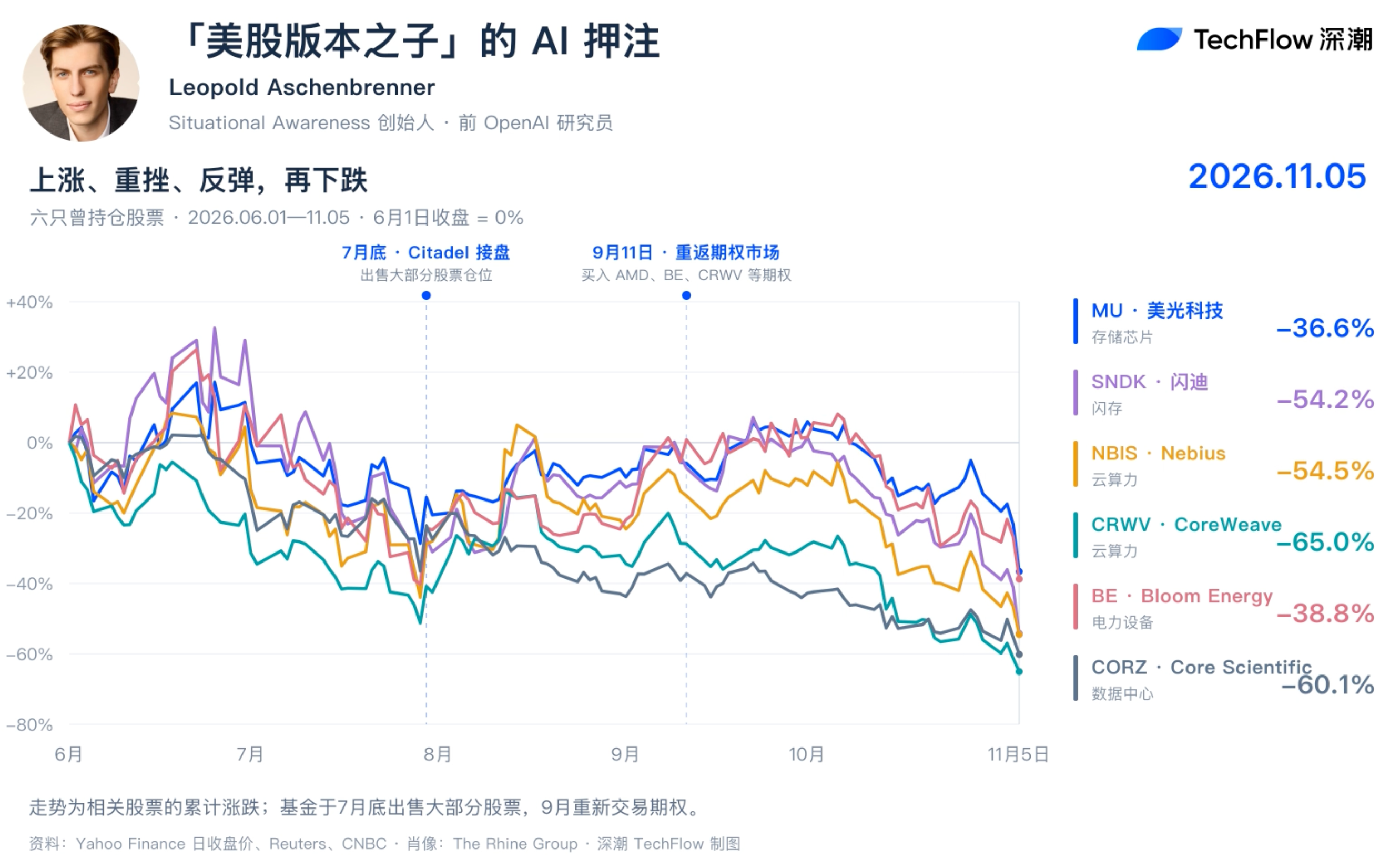
He tried to ride the second half of the AI wave with options, but what he encountered was the iron wall of policy from the midterm elections in November.
With the Democratic Party sweeping both houses, multiple states in the U.S. turned on red lights for data centers, and AI infrastructure stocks faced a brutal revaluation. From the June peak to November 5, CoreWeave plummeted 65%, Core Scientific dropped 60%, and SanDisk and Micron were heavily wiped out as well.
If Leopold had been holding the spot, perhaps he could have stubbornly held on through a 60% drop, using time to trade for AGI's space; but he was holding options with extremely high time decay.
Under the double squeeze of plummeting underlying assets and approaching expiration dates, the residual value of this bet was essentially wiped out mercilessly.
Leopold's exit is one of the most profound metaphors of this fervent era:
He bought everything that AI must spend money on, and his overall direction may have been flawless. But his, or the largest fallacy of investors who dared to bet on AI's future, leverage, or all-in at high levels, lies in trying to leverage high leverage and short-term options that can be forcibly liquidated at any time to understand a grand blueprint that may take a decade to realize.
The stars and seas leading to AGI are still vast; it's just that this most devout evangelist has already succumbed to the leverage before dawn.
免责声明:本文章仅代表作者个人观点,不代表本平台的立场和观点。本文章仅供信息分享,不构成对任何人的任何投资建议。用户与作者之间的任何争议,与本平台无关。如网页中刊载的文章或图片涉及侵权,请提供相关的权利证明和身份证明发送邮件到[email protected],本平台相关工作人员将会进行核查。


