From the $6.34 billion security incident to stablecoins, artificial intelligence, the Chinese market, and life choices
In December 2014, a year before deciding to start a business, I had the fortune of meeting He Yi, now the leading lady.
In the same year, He Yi and Changpeng Zhao met for the first time. At that time, Changpeng Zhao was at Blockchain.info, and He Yi was at OKCoin.
In June 2014: Upon He Yi's invitation, Changpeng Zhao joined OKCoin as CTO.
In 2017: Changpeng Zhao founded Binance and then invited He Yi to join, becoming a co-founder.
Time flew by, and nine years later, on November 3, 2026, I was invited to listen to Changpeng Zhao's live interview at the Oxford Union.
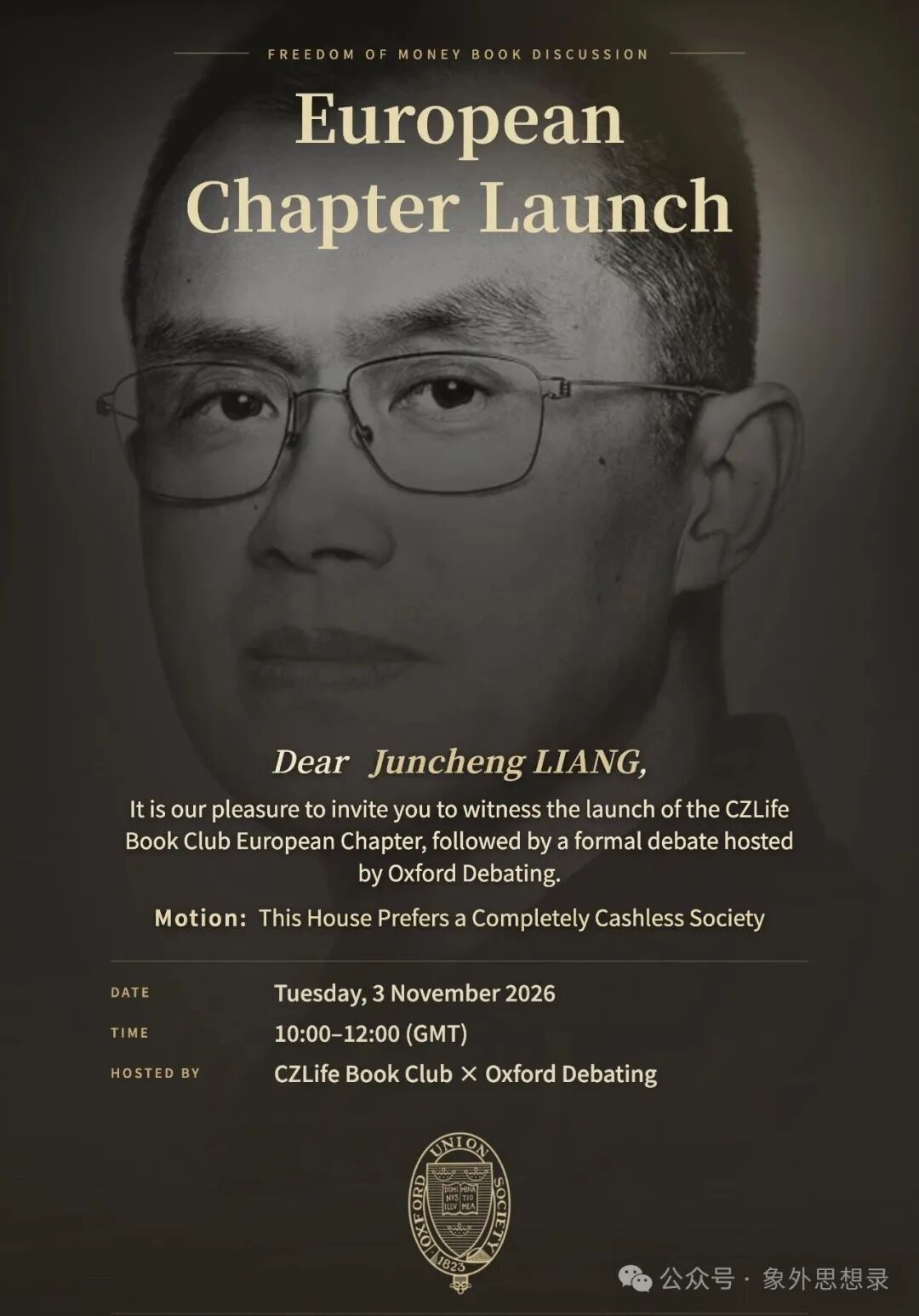
The Oxford Union Society was established in 1823 and is one of the oldest and most influential university debating societies in the world. The Oxford Union has always upheld the tradition of free speech and open discussion. For over 200 years, the Oxford Union has invited numerous heads of state, international dignitaries, Nobel laureates, scientists, entrepreneurs, and cultural figures to give speeches and participate in debates. It has long become an internationally recognized venue for public speaking and exchange of ideas.

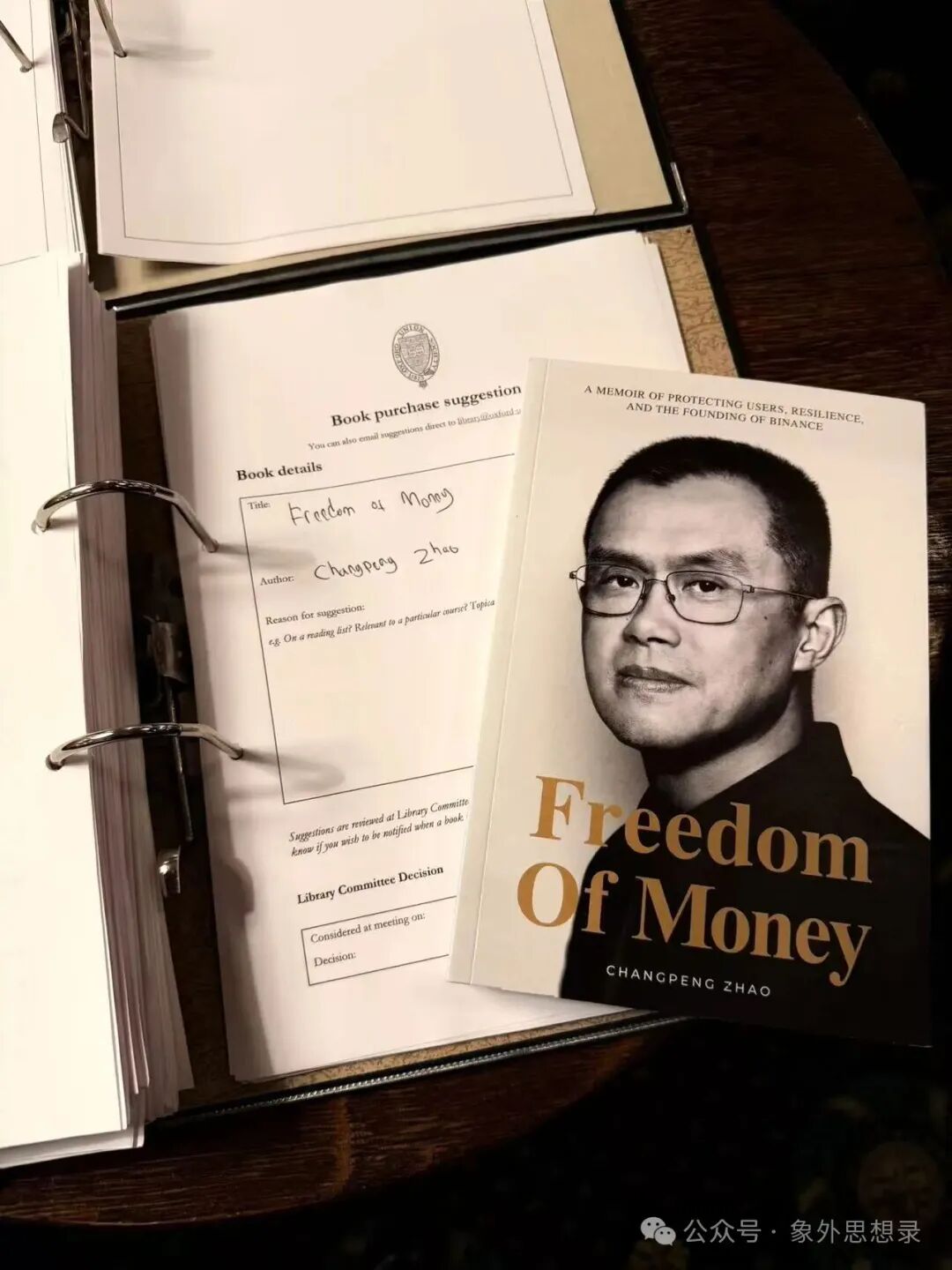
That day, the wind in Oxford was strong and cold. In the morning, I attended a debate at the University of Oxford themed on Changpeng Zhao's new book "Freedom of Money." A big bowl of beef noodles next to St Peter College couldn't shield me from the biting cold wind in the afternoon. By 4 PM, I had already hidden in the debate society bar, sipping whiskey while waiting for Changpeng Zhao's arrival, where a long queue formed around 5 PM.
At 6 PM, Changpeng Zhao entered the Oxford Union on time, and the hall was already filled with hundreds of attendees who had been waiting.

On October 29, Binance had just experienced a major cybersecurity incident. According to the investigation update released by Binance on November 3, the incident involved approximately $6.34 billion in digital assets. As of the time of disclosure, about $2.85 billion of the related assets had been frozen or intercepted. Binance stated that it had allocated enough funds to cover the losses and was gradually topping up the affected assets. Thus, this event became very meaningful: it might be the first time Changpeng Zhao faced such a large audience for open communication following this recent major incident.
Therefore, the entire English interview at the Oxford Union began with a straightforward question: after such a significant mistake, why should users still trust this platform? The ensuing nearly hour-long discussion gradually unfolded, transitioning from cybersecurity to entrepreneurial mission, global finance, artificial intelligence, stablecoins, and the Chinese market; after entering the audience Q&A, issues arose, including quantum computing, the personal credibility of the founder, marriage choices, and the tokenization of traditional assets. The content and depth far exceeded the interview in Hong Kong in August 2026.
Below are 19 questions and Changpeng Zhao's main viewpoints, sorted by the order they were asked in the live session.
01. Why accept the invitation from the Oxford Union?
Changpeng Zhao believes the Oxford Union truly embodies the spirit of freedom of speech. The industry that Binance engages in is also somewhat controversial. Binance is focused on another type of freedom, that is, the freedom of money. This is actually the title of his latest autobiography.
Freedom of speech is very important because it is a necessary foundation for achieving almost all other freedoms. If we look back over the past 200 years of human civilization, we will find that the concept of freedom has been continuously evolving. From the abolition of slavery and the attainment of personal freedom, to freedom of speech, freedom of the press, and freedom of information. Now, we are entering a new stage—freedom of intelligence. This is not only a possibility; Changpeng Zhao believes it is bound to happen.
Therefore, being here to discuss these issues is “an honor for me. This is actually a place where different ideas of freedom converge.
02. After such a severe hacking attack, can Binance still reassure users?
Focus of the question: How does CZ plan to respond to Binance users and the public regarding the significant security breach?
Changpeng Zhao first admits that the attack exposed significant deficiencies in Binance's security and operational processes. In his view, regardless of how advanced the technology used by hackers may be, there are typically various blocking methods that can be employed prior to an attack. Therefore, one cannot simply excuse the platform's responsibility by claiming “the attack was too advanced.”
However, he also emphasized that Binance's response afterward has at least two commendable points: first, it communicated progress to the outside quickly following the incident; second, the platform promised to bear the users' asset losses itself. He linked the latter to the user protection principle established when he founded Binance, believing that a centralized exchange must take responsibility during a crisis and should not pass the costs of internal vulnerabilities onto users.
He also compared the public transparency of blockchain with the information disclosure of traditional financial institutions: on-chain fund flows can be tracked in real-time by external analysis firms, and sometimes third parties even identify anomalies faster than the platform itself. His assessment is that this transparency, while amplifying the immediate impact of a crisis, is also the reason why the system can accept public oversight.
The core of this question is not “Binance is absolutely secure,” but rather that CZ acknowledges mistakes while emphasizing emergency transparency and the mechanism for bearing user losses. Additionally, “In the short term, AI has a double-edged effect. But in the long run, I firmly believe that artificial intelligence will make the entire financial and cryptocurrency system more secure. This is merely a transitional phase.”
03. Can you ensure that such attacks will never happen again?
Focus of the question: Since you believe attacks can be prevented, what specific guarantees can the platform make?
CZ did not offer a 100% safety promise. He believes similar attack paths should be thoroughly investigated and blocked. However, anyone claiming that a complex information system can remain immune to attacks forever is not being realistic.
According to his introduction on site, attackers may have spent about five to six months preparing, first trying to approach the internal company through traditional methods like fake recruitment and social engineering, before utilizing AI to accelerate their understanding of the system. He particularly pointed out that certain basic operational security protocols were not strictly enforced, which is a problem that should not occur on a large trading platform.
“There exists a fundamental asymmetry problem in cybersecurity”: the difficulty of security lies in that attackers only need to find one entry point, while defenders must investigate as many entry points as possible. As AI rapidly increases the efficiency of attacks, the defensive side must also strengthen equipment, permissions, internal processes, and anomaly monitoring, and cooperate with AI companies, cybersecurity experts, regulators, and law enforcement agencies.
Therefore, his attitude toward the future is not to guarantee “no further incidents,” but rather to promote the industry from passive remediation to stronger proactive defense. Regarding the cross-institutional collaboration triggered by this attack, he sees positive changes but acknowledges that relevant asset recovery work is still ongoing.
04. Why did it take until nearly 40 to view blockchain as an entrepreneurial mission?
Focus of the question: Why does CZ view Binance as a long-term investment worthy of commitment?
CZ believes sustained entrepreneurship over many years cannot rely solely on the motive to make money. When a person first enters the workforce, they usually consider livelihood first, then family; finding a true mission that one is willing to invest in for the long term may take longer. For him personally, this process was not instantaneous either.
He reflected on his experiences born in China, raised in Canada, and later working in different countries, believing these experiences reinforced his emphasis on personal freedom. The internet has made information dissemination more open, but he missed the early opportunities for internet entrepreneurship. After being exposed to blockchain, he gradually began to believe that this technology might bring similar changes to the flow of funds and modes of economic participation.
He also noted that many historically impactful technologies were accompanied by strong controversy when they first emerged. “For instance, when printing technology first appeared, it was restricted or even banned in many places. Later, freedom of the press also became a highly controversial topic, sparking extensive discussion. Technologies that have the potential to profoundly change society often undergo similar processes.” The volatility and skepticism surrounding the blockchain industry do not inherently negate its long-term value in his view.
Thus, his narrative of entrepreneurship revolves around one word: mission—believing that technology can improve a certain limitation in reality.
05. With banks and fiat currencies, why do we still need cryptocurrencies?
Focus of the question: If the existing financial system can complete transactions, what new problems does blockchain solve?
This is one of the most content-rich questions in the entire interview. CZ first emphasized the accessibility of financial services: in a mature financial system like the UK, it may be hard for people to appreciate the difficulties some regions face in opening accounts, transferring money, and cross-border payments. For groups with insufficient bank coverage or high cross-border payment costs, mobile wallets and blockchain payments may offer an alternative.
He then discussed the purchasing power of wealth. In a high-inflation environment, people want tools to protect their assets, but he also admits that not all cryptocurrencies are suitable for this function. “Those who early invested in successful large tech companies often received disproportionately high returns. However, they also undertook significant risks initially. So, some individuals getting rich through cryptocurrencies is not an inexplicable phenomenon.”
The third value arises from cross-border payments, and the fourth is the trading hours and global accessibility of financial markets. He believes that friction still exists between different countries' financial systems, while on-chain payments and transactions have the potential to run 24/7. Finally, he extends this convenience to global asset allocation: investors from different countries should have the opportunity to access quality financial assets in different markets more conveniently.However, this is a claim about technological potential, rather than a conclusion that all crypto-financial services are superior to banks. Practical applications still need to address issues such as fees, compliance, custody of assets, and consumer protection.
06. How long until the global financial system fully adopts blockchain?
Focus of the question: What kind of time cycle does a technology transitioning from the fringe to the mainstream go through? Where are the resistances?
CZ described the possible path of technological proliferation using the “S-curve”: growth starts slowly in the initial stage, accelerates past a certain adoption rate, and then slows down again in the maturity phase. He provided a very rough personal estimate on-site: it may take five to ten years to reach an initial level of popularity, with an intermediate phase possibly lasting ten to fifteen years, while the final conversion of users or institutions may take a very long time. These figures are not industry predictions validated by models.
He believes that changes in the U.S. attitude toward digital assets will influence regulatory discussions in other countries. However, what is more challenging to change than policy positions may be the massive existing financial infrastructure: the current banking systems, internal processes, compliance requirements, and technical interfaces are not easily changeable. Even if new platforms grow rapidly, they may still face access difficulties to traditional banking services in different regions.
Another layer of resistance comes from the government's control of monetary policy and capital flows. “Governments are not always the most efficient institutions for resolving economic issues. In many cases, excessive government intervention may also create new problems.” CZ tends toward a more liberal global economic system but also admits that the crypto industry itself still has security, fraud, and governance issues, making it unreasonable to expect countries to fully loosen regulations overnight.
What he presented was not a precise year, but the judgment of “long-term, nonlinear, with institutional and technological progress advancing in synchrony.”
07. How will artificial intelligence reshape the cryptocurrency industry?
Focus of the question: Are AI and cryptocurrency two parallel hotspots, or will they form actual business connections?
CZ first spoke about software development. He mentioned that he has also used AI programming tools driven by natural language(Vibe Coding), feeling that the technical capability has significantly improved lately. In the past, startup teams had to spend a lot of effort coding and building systems; now, this part of the work is gradually becoming easier; competitive advantages may shift from pure coding capabilities to product design, market understanding, and problem-solving skills.
For the cryptocurrency industry, AI can accelerate product development, system improvements, and security analysis, while it might also drive updates in cryptographic algorithms. However, he believes the more noteworthy aspect is the future possibility of massive micropayments occurring between AI agents (Micropayments), where agents represent users seeking services, completing tasks, and automatically settling payments, creating frequent payment demands between machines.
For instance, a very small software development task in the future might be automatically matched with an executor by the system, results verified, and payments made. If such transactions happen thousands of times a day, there will be a need for low-cost, digitally native, and automatically callable payment infrastructure.
CZ did not assert that any existing public chain would definitely come out on top. His view is that AI may create new payment demands, and that blockchain and stablecoins have the opportunity to participate in meeting that demand.
08. Can computing power, data centers, and energy keep up with the expansion of AI?
Focus of the question: As software and model demands continue to rise, can the physical world provide sufficient electricity, equipment, and infrastructure?
CZ generally holds an optimistic attitude. One reason is the capital investment: global tech companies and investment institutions are investing huge resources into AI and computing power infrastructure, which he believes will accelerate the iteration of hardware, data centers, and energy technologies.
He envisions that in the future, solar facilities and data centers may occupy more land; with the growth in computing power demand, the scale and form of energy systems may undergo significant changes. However, he did not deny resource bottlenecks, like the supply of certain materials potentially being unable to keep pace with the speed of expansion in the short term.
More importantly, he disagrees with constructing predictions for decades into the future solely based on current equipment structures. “If AI can create new algorithms for our industry, it can also help develop new solutions in energy, materials, and computing.”
This represents an optimistic assessment of technological progress, rather than an assurance that future power grids, chips, or material supplies will be secure.
09. When AI enables everyone to start a business, will there be a proliferation of useless products?
Focus of the question: If trial and error and programming are completed by AI, will young entrepreneurs learn real skills?
The host shifted the topic from technology to education, mentioning some products lacking actual value during past entrepreneurial fads, expressing concern that after AI reduces development barriers, the market will simply be flooded with more similar projects.
CZ's response is that learning fundamental principles remains important. AI can write programs, but it cannot allow entrepreneurs to completely abandon judgment, validation, and systematic understanding. For critical systems, blindly trusting AI-generated code is particularly dangerous.
He gave an example where, in the future, one model could write code, another model could cross-reference, and multiple agents could check results repeatedly. He also proposed a more distant vision: machines might not always generate source code that is easy for humans to read, but may directly produce code that is closer to low-level execution forms.
In other words, he does not believe that "being able to write every line of code" is necessarily the most crucial skill for future entrepreneurs but insists that understanding product objectives, mastering basic logic, and establishing reliable verification mechanisms remain indispensable. “I believe the truly important thing in the future is to understand basic principles, rather than to require everyone to master all specific technical details.”
10. Why has the popularity of cryptocurrency declined? Why are governments cautious?
Focus of the question: Why is public opinion no longer as fervent as it was from 2020 to 2022? Why has there been a delay in comprehensive acceptance by various countries?
CZ offered an unconventional explanation: “When a technology matures and becomes part of social infrastructure, people often stop discussing it in particular.” Internet protocols, mobile networks, or roads are part of daily life but do not always capture headlines. Therefore, a decline in media interest does not necessarily equate to a loss of value in technology; it may simply reflect the gradual normalization of certain applications. He also believes that AI has drawn a significant amount of capital and media attention, which has objectively shifted the focal point of the tech industry.
As for government attitudes, he emphasized that different countries have different interests. For example, some reserves of USD stablecoins may be allocated to U.S. Treasury bonds, which could increase the demand for U.S. Treasury bonds; the use of dollar-denominated stablecoins globally may also extend the influence of the dollar. This could explain why the U.S. might see the strategic and financial value of stablecoins.
However, for countries that implement stricter capital management, the cross-border freedom brought by crypto assets may not align with current policy objectives. CZ did not provide a unified answer applicable to all countries nor completely address the host's concerns regarding illegal transactions.
11. How do you view China's capital controls, the internationalization of the yuan, and the role of Hong Kong?
Focus of the question: How should the desire to promote the international use of the yuan be balanced with the management of cross-border capital flows?
When discussing the financial systems of different countries, CZ specifically talked about China. He believes one of the purposes of capital controls is to manage the outflow of funds, but investors also consider whether future profits can be smoothly remitted back. Even if possible, the processes and time costs may still affect cross-border investment decisions.
He pointed out that there is a need for long-term coordination between the internationalization of the yuan and the management of capital flows. However, he did not claim to have the best policy answers, emphasizing that economic scale, institutional objectives, and risk tolerance differ in each country.
Regarding Hong Kong, CZ described it as a “sandbox” for observing innovations in digital assets. This should be understood as his judgment of Hong Kong's role, rather than a policy signal indicating the mainland of China is about to fully open up cryptocurrency trading. He specifically warned markets against becoming overly excited due to certain supportive statements about financial innovation: “If China fully opens up a particular area, millions or even tens of millions of new projects might emerge in a very short time. Among them, there could be legitimate and excellent innovative projects. But there may also be fraudulent projects, malicious actors, and various unmanageable issues. When the number of projects becomes so vast, regulation becomes incredibly complex. Therefore, China must carefully consider how to implement its opening policies.” The emphasis is on that different economies can have different choices regarding the speed of openness and risk management, rather than a simple “support” or “oppose” stance on cryptocurrency.

12. Will the next wave of widespread cryptocurrency adoption rely on institutions or ordinary consumers?
Focus of the question: After the waves of ICOs, NFTs, and others have passed, what will be the next application that brings real mass users?
An Oxford MBA student in the audience raised the point that past industry growth often stemmed from new concepts, whereas now attention is increasingly shifting toward institutional finance and asset tokenization. Will the next wave be sparked by 24/7 trading, payments, or some new consumer-level application?
CZ did not provide a definite “next killer application.” He reviewed the market narratives from different periods, including Bitcoin, altcoins, ICO, and NFT, stating that there have been phases indeed lacking sufficiently attractive consumer innovations.
Currently, he views increased institutional participation and the exploration of tokenization of traditional assets like U.S. stocks as noteworthy directions; however, breakthroughs specifically targeted toward ordinary people, especially in daily payments, may still take years to mature. He acknowledged that he cannot accurately predict which product will trigger the next growth.
This is a rare question where CZ explicitly stated, “I still do not know the exact answer.”“But I believe this industry will continue to produce new innovations.”
13. What are the differences between central bank digital currencies, stablecoins, and bitcoin?
Focus of the question: With the continuous development of CBDCs, will they replace stablecoins or native crypto assets?
CZ distinguishes these three asset types based on their different uses. Central bank digital currencies (CBDCs) are issued by central banks and have a sovereign credit background; under specific designs, they may also have clearer permissions management, funds usage restrictions, and issuance arrangements. It does not equate to decentralized cryptocurrencies by nature.
Stablecoins are typically issued by companies or other entities, many of which are pegged to fiat currencies like the USD. They can circulate on blockchain, suitable for transactions and cross-border payments, but holders must still consider risks related to the issuer, reserve assets, redemption, and regulation. CZ recalled that traditional banks were often unwilling to provide services to many crypto platforms, which promoted the popularity of USD stablecoins in the industry.
Native crypto assets like Bitcoin, Ethereum, and BNB each have their own networks, economic mechanisms, and price volatility characteristics, becoming closer to participating in the corresponding ecosystem or risk exposure, rather than simply pursuing price stability against fiat currencies.
His conclusion is not that one will replace another, but rather that different tools meet different needs: “Different types of digital assets satisfy different needs. If you just want to use cryptocurrencies for cross-border payments, today you are likely to choosestablecoins. But if you hope to invest in the long-term development of the cryptocurrency industry, you might considerBitcoin, Ethereum, BNB, or other projects with long-term development potential.” Payment, digitalization of fiat currencies, and participation in blockchain ecosystems are not mutually exclusive choices.
14. Will quantum computing one day break Bitcoin?
Focus of the question: If quantum computing capabilities leap significantly, how long can the existing cryptographic security system hold up?
CZ first stated that he is not a quantum computing expert and does not wish to make absolute judgments on technology details that he is not familiar with. He acknowledges that quantum computing may pose challenges to some existing cryptographic algorithms and has noted that tech companies are continuously announcing relevant research advancements.
However, he cautioned that new technology can often be both used for attacks and to aid defenses. As quantum computing gradually develops, research into quantum-resistant cryptography and system migration might also progress in sync. What truly needs to be addressed is the extent of future quantum capabilities, when existing technology requires upgrading, and how to implement such upgrades.
Therefore, his stance is to emphasize risk and be continuously prepared without deeming Bitcoin or the entire industry as destined to lose its future due to this potential risk. “I would not be overly pessimistic about Bitcoin or the future of the entire cryptocurrency industry because of the development of quantum computing.”
15. Do Binance users trust the platform, or CZ himself?
Focus of the question: After CZ leaves the CEO position, can personal reputation and institutional credibility be separated?
This question at the scene touches on the essence of centralized exchanges. CZ believes trust must be built over time but can be quickly damaged; a trading platform that accepts users' assets also takes on the responsibility to continuously prove its reliability as a counterparty.
He emphasized that although he no longer directly manages Binance, the principle of protecting user assets should not rely solely on whether a specific founder is in office but must become the platform's own system and behavior. He also mentioned that when withdrawals were restored after the incident, he observed that the scale of net outflows was lower than he initially feared, and stated that subsequent capital flows have already improved. However, the related withdrawal ratios and net inflow data were his on-site statements and not independently audited conclusions.
He believes that openly disclosing the issues exposed by the incident, although potentially embarrassing, can help Binance and other platforms learn lessons. For a centralized financial institution, true credibility cannot rely solely on the personal charm of the founder but must depend on the ability to continuously fulfill promises.
“To me, the real importance lies not just in whether an institution can avoid making mistakes forever, but in how it resolves problems, takes responsibility, learns from them, and continues to move forward after issues arise.”16. How does CZ suggest young people choose partners?
Focus of the question: People often discuss how to choose business partners; what about life partners?
After a series of serious questions involving technology, finance, and security, one audience member suddenly turned the topic towards personal life. He asked CZ how young individuals should choose life partners and what role partners play in personal careers.
CZ did not respond with the typical entrepreneurial success formulas. He indicated that finding a business partner is already challenging; choosing a life partner may be even more complex; he too does not have a one-size-fits-all standard answer. He mentioned his own experiences of marriage and divorce, acknowledging that people change over time and relationships may also evolve.
“This is indeed a very difficult question. I don’t have a simple standard answer to provide everyone. I can only wish you all good luck.”The host then took the topic lightly, mentioning an upcoming event related to interpersonal relationships at the debating society. This moment became one of the rare shifts from financial topics to personal life during the night, making the on-site exchange feel more natural.
17. Who will bear the $6.34 billion loss? Did CZ use personal wealth?
Focus of the question: Where does the money come from to make up for Binance users' assets?
An audience member from Indonesia mentioned theories circulating online that apart from Binance's protection funds, CZ might have used personal funds to help compensate users and sought clarification.
CZ introduced three sources of funds according to his understanding: SAFU user asset security fund, futures insurance fund, and funds on Binance's own balance sheet. He mentioned that the SAFU fund is approximately at the billion-dollar level and that a portion of those funds has been accessed. He also provided rough scales and the usage status of the futures insurance fund. But these details belonged to his on-site estimates and should not be taken as precisely audited balances.
He also distinctly separated “frozen or restricted stolen assets” from “assets that have been recovered and can be reused.” Even if assets are tracked down, they may need judicial and enforcement proceedings to be practically returned.
18. Cryptocurrencies claim to be decentralized; how can governments freeze or confiscate them?
Focus of the question: Is government enforcement against digital assets contradictory to the principle of decentralization?
An audience member mentioned the U.S. government's actions regarding specific countries or entities related to crypto assets, wanting to know how governments manage to freeze or seize assets.
CZ emphasized that he does not understand all the details of the specific case mentioned by the questioner and could only explain a common mechanism: when digital assets enter regulated intermediaries like centralized exchanges, the exchanges may receive court orders, lawful enforcement requests, or other legal documents, thus needing to take restrictive measures on related accounts and assets.
Thus, the operational mode of decentralized networks themselves and the question of whether funds have been passed through centralized custodians and trading platforms are two issues that need to be discussed separately. Having the ability to transfer on the chain does not imply that all real-world transaction paths are free from judicial jurisdiction.
19. Will the tokenization of U.S. stocks and commodities siphon off funding from cryptocurrencies?
Focus of the question: As traditional assets enter digital asset platforms, will native cryptocurrencies like Bitcoin lose liquidity?
The last live question came from a participant in China. He expressed concern that the entry of traditional financial assets like U.S. stocks and commodities into crypto platforms would absorb investment funds originally allocated to crypto assets.
“My answer is: it will both happen and not happen.” CZ provided an analysis split into two time dimensions. In the short term, if the native crypto industry lacks sufficient new applications, investors may indeed shift some funds from crypto assets to stocks and other categories; however, in the long term, an increase in asset types may also attract a group of traditional investors who have never used digital wallets, stablecoins, and crypto trading services.For example, an Asian investor who was only interested in U.S. stocks might enter a digital asset platform due to more convenient trading channels. After becoming familiar with stablecoin payments and platform operations, they might start looking at Bitcoin or other on-chain assets. According to this logic, the tokenization of traditional assets is unlikely to merely be a competition for the existing market funds, but could also broaden the potential user base of the entire ecosystem.
CZ thus emphasized that making it easier for more people to access more quality assets is more meaningful than limiting users to a particular type of cryptocurrency. Of course, whether tokenized securities can be opened to different country investors still relies on securities laws, issuance structures, custody, and investor protection arrangements, and just because it can be traded technically does not mean it can be circulated without legal restrictions.
Summary: What does CZ most want to emphasize from the 19 answers?
This discussion began with the Binance security incident but did not remain solely on “incident response.” The 19 questions presented four interwoven main themes.
First, safety and credibility are the bottom lines for financial platforms. CZ acknowledges that the system has weaknesses and admits that no one can guarantee absolute safety; however, he insists that when problems arise, the platform must assume responsibility, disclose promptly, and repair institutional flaws, which are critical conditions for a centralized exchange to maintain trust.
Second, the value of cryptocurrencies needs to return to real uses. Coverage of financial services, cross-border payments, global asset accessibility, and 24/7 trading are closer to what he understands as long-term technological directions than short-term market speculation.
Thirdly, AI may simultaneously alter the supply side and demand side. It makes software easier to develop while also complicating network attacks; future AI agents may create significant demands for automatic trading and micropayments between machines.
Finally, technological evolution will not bypass institutional realities. From U.S. stablecoins, Hong Kong’s digital asset explorations to China’s capital management and the freezing of assets by centralized exchanges in cooperation with law enforcement, the entire industry’s development still has to interact with national laws, financial regulations, and institutional governance.
The dialogue at the Oxford Union did not provide a definitive timeline for when cryptocurrencies would fully enter the mainstream, nor did it find an answer that eliminates all technological and security risks. Rather, it felt more like a re-discussion on what this industry must rely on to earn long-term trust after a significant security crisis.

Highlights
After the event, when I mentioned to my son that Changpeng Zhao has a net worth of $114.6 billion, about 810 billion yuan, and ranks 18th on the global billionaire list, my son, who is into music, expressed: “So rich!”I said: “Do you know? He moved to Canada at 12, started working at McDonald's at 14, and the last time he took money from home was for his first year of college tuition...”
免责声明:本文章仅代表作者个人观点,不代表本平台的立场和观点。本文章仅供信息分享,不构成对任何人的任何投资建议。用户与作者之间的任何争议,与本平台无关。如网页中刊载的文章或图片涉及侵权,请提供相关的权利证明和身份证明发送邮件到[email protected],本平台相关工作人员将会进行核查。


