Author: Digital Life Kazik
Last night was truly a magical day; really, it's been a long time since I've seen the US stock market crash like this...
As of 2:49 AM, the trend looked like this.
The Nasdaq plummeted more than 5% during the day, the Philadelphia Semiconductor Index fell nearly 11%, Nvidia dropped close to 9%, and a bunch of AI-related companies, such as AMD and SpaceX, simply couldn’t hold their stock prices anymore.
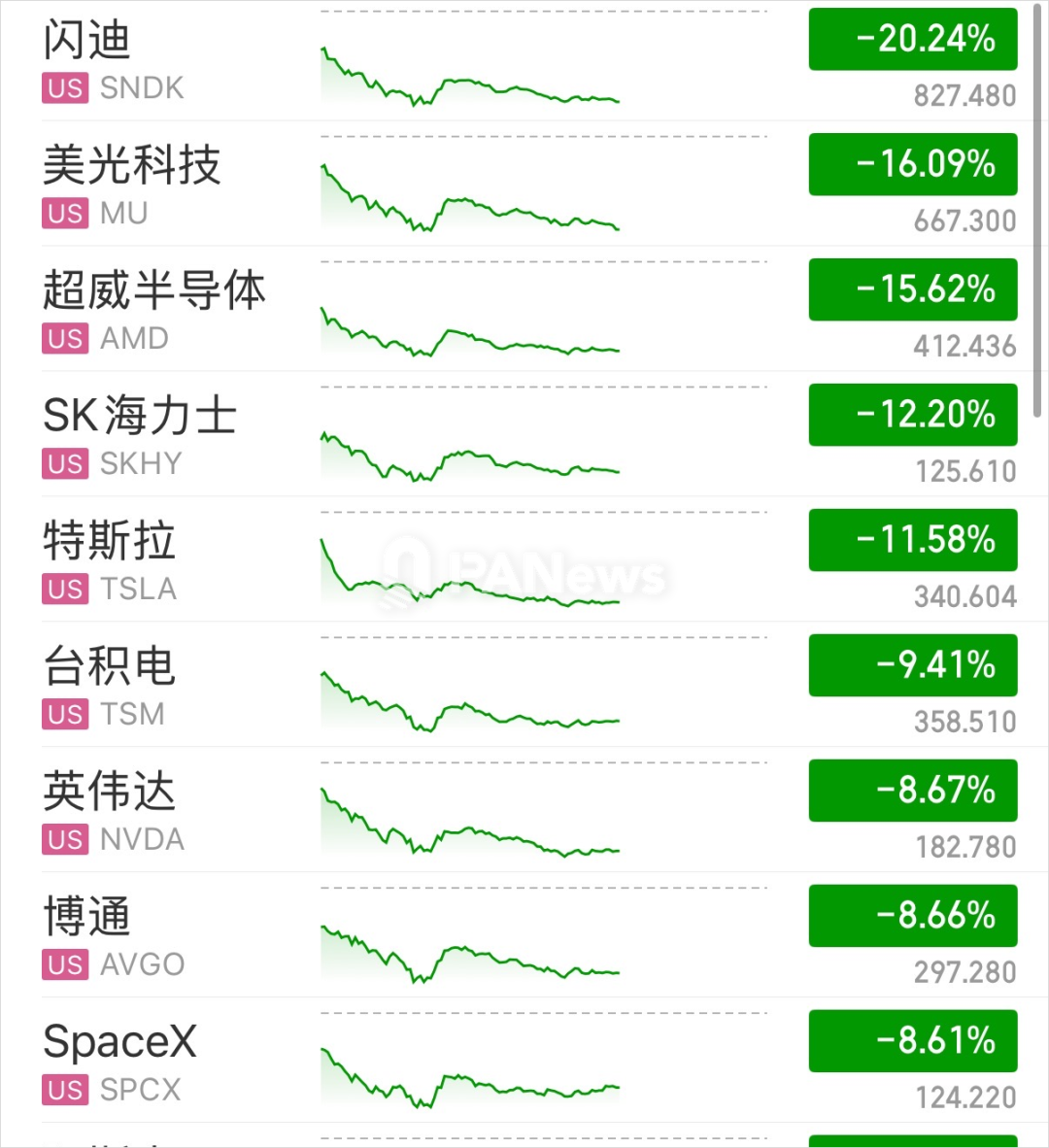
Just today alone, the Nasdaq lost nearly 1.8 trillion dollars in market value.
Chips, computing power, data centers, all fell together.
And behind this, there is a very magical thing happening: residents in the US are now increasingly opposed to building AI...
It's quite magical.
The origin of all this traces back to the recently concluded midterm elections in the US.
Trump suffered a devastating defeat, essentially being crushed unilaterally, and the Democrats won incredibly, taking control of both the House and the Senate. This means that starting in January 2027, Trump will face a Congress controlled by the Democrats.
The most outrageous thing is that Trump’s base state of Texas surprisingly turned blue, directly taken by the Democrats...
I don't even know how to describe the absurdity of this situation, seriously.
Remember this Texas, as the upcoming stories about data centers are closely related to it.
On the day after Trump's loss, on the evening of November 5, Arizona Democratic Representative Yasmin Ansari suddenly posted a message on X.

"The number one agenda for Day One of the Democratic administration should be to pause the development of advanced AI, regulate this out-of-control industry, and ban artificial superintelligence."
This line from her left me stunned; isn’t it that American AI has finally welcomed its “zhizi”... but this “zhizi” is not released by the Trisolarans, but chosen by the American people themselves...
People below also didn’t hold back in their criticism.


Even this magical translation is a bit dirty...

Musk also reposted this message, adding a sentence.

Translating it means "Brave New World"; this is actually quite profound.
However, if it were just an ordinary statement, I don't think it would elicit such a reaction. The main issue is that this lady is serious; they have actually proposed a set of legislation.
On September 23 of this year, Sanders introduced the "Artificial Superintelligence Prohibition Act of 2026" in the Senate, and the next day, Representative Casar introduced a version in the House with the same name, with this lady being one of the earliest co-sponsors.
The contents of the legislation can be summarized roughly as follows:
1. A comprehensive ban on the development of artificial superintelligence. The law defines it as AI that surpasses human cognitive ability in most areas, or has the ability to destroy humanity or cause humanity to lose control.
2. Establishment of a cabinet-level Artificial Intelligence Department, specifically monitoring leading AI systems, overseeing the removal of dangerous capabilities, such as ignoring shutdown commands or initiating cyberattacks on their own.
3. All development of advanced AI must be paused until this department is established and safety rules are determined. During the pause, relevant models cannot be trained, modified, or fine-tuned, and unreleased ones cannot be released.
4. If violated, individuals can face up to 20 years in prison, and companies can be forcibly dissolved; the press release for the law refers to this as corporate death penalty.

The advanced AI in the legislation is defined by computational power.
The line given in the House version is a training computational power reaching 10 to the power of 25 operations.
The EU's "Artificial Intelligence Act" also uses the same line to assess whether a general large model has systemic risk.
How ridiculous is this data? According to previous statistics, the first model to cross this line was GPT-4, released in March 2023...
In other words, from GPT-4 onwards, all cutting-edge models surpass this line; don’t mention GPT-6 Astra, Claude Opus 5.5; even the Llama 3.1 405B, which you wouldn’t even look at, has surpassed the line by 3.8 times, and Grok 3 from 2025 has exceeded it by 46 times.
So what cutting-edge AI? None can escape.
If this law is truly implemented, leading labs such as OpenAI, Anthropic, Google, xAI, and Meta will essentially have to halt all model training according to this standard, because who knows what kind of tricks that so-called cabinet-level Artificial Intelligence Department will come up with.
After all, if you violate it, individuals face a 20-year sentence, and companies can be forcibly dissolved; I can only say one thing, that is really high-level.
However, this law is unlikely to pass because the one in the White House is still Trump; for the law to pass, Trump must sign it. Given that Trump is such a supporter of AI, there’s no way he would sign it, right?
If the president doesn’t sign, it can be directly vetoed.
For Congress to override the president's veto, both chambers must obtain two-thirds of the votes, so out of 435 seats in the House, two-thirds is 290 seats, and out of 100 seats in the Senate, two-thirds is 67 seats.
Even with the Democrats winning overwhelmingly this time, the House is only about 250 to 260 seats, and the Senate is around 54 seats, still far from the two-thirds, so it’s essentially improbable to override Trump’s veto.
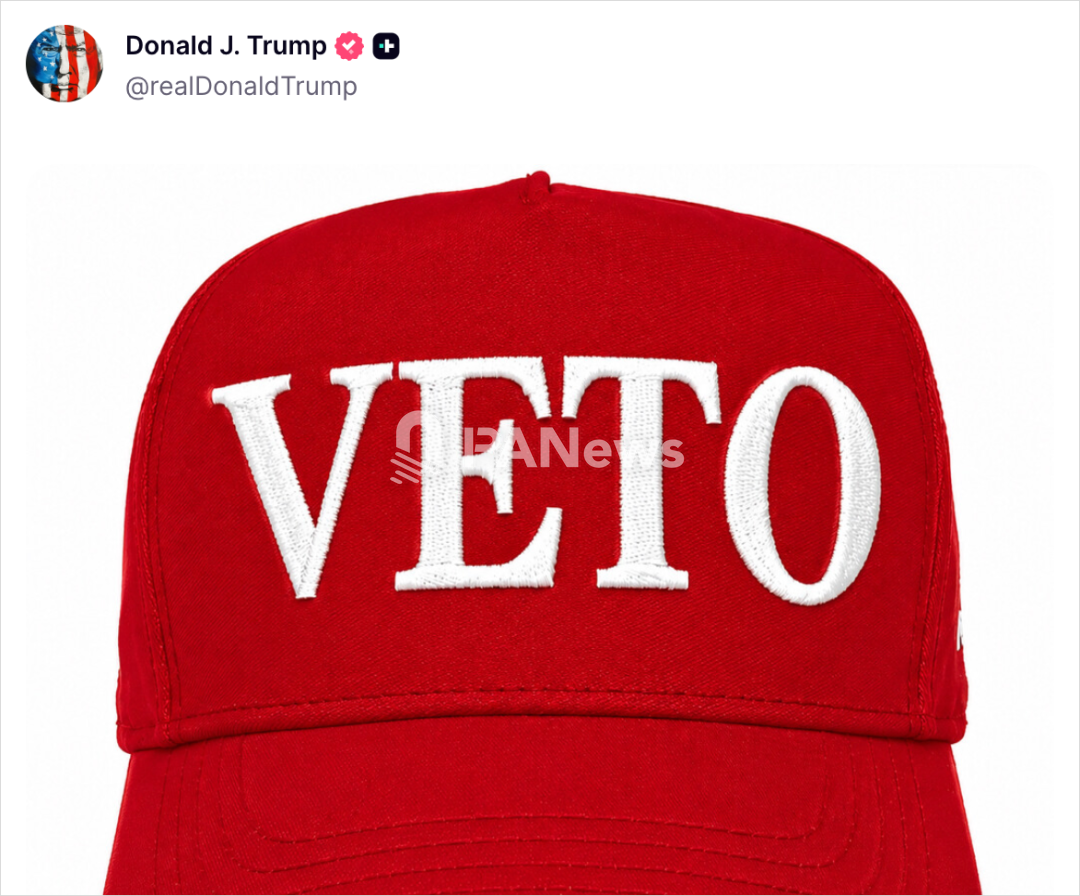
So after the election, Trump posted an image of a red hat with just one word on it.
VETO.
Veto.
Clearly, the bill won't pass. So why did the whole story collapse, leading to panic selling? The issue lies with the collapse of the data center story.
AI is now a fundamental livelihood issue for the people in America because their infrastructure is too poor... they lack electricity.
People can easily feel that the big model competition is just between OpenAI and Anthropic comparing benchmarks, who is smarter; that's one dimension.
But the core dimensions are actually four things:
Money, chips, land, electricity.
If you have money, you can buy GPUs.
If you buy GPUs, you need a place to put them, right?
Then after it’s placed, it needs power supplied.
After power supply, you also need to manage cooling.
Once all that is sorted, you can continue to build the next one.
In recent years, one of the fundamental assumptions of the AI bull market in the US is that this cycle can expand endlessly, thus capital expenditures skyrocketed, Nvidia's cards are selling higher and higher, and even power companies and transformers are rising.
However, during the midterm elections, the American people were unhappy; they looked at the ballots and said: hold on, why are you building it like this? We won’t allow you to build it!
The reason is quite simple:
Electricity costs.
According to data from the US Energy Information Administration, residential electricity prices in the US have risen by more than 10% from 2024 to now. Residents' electricity costs in Ohio have increased by over 20% in two years. Research from the Dallas Fed also stated that the demand for electricity from data centers has pushed up the overall wholesale electricity prices in the US by 6.9%, with some areas where data centers cluster pushing it up by 15%.
At this moment, we can put ourselves in the shoes of the American people; now, a data center costing hundreds of billions of dollars is being built next to your home.
The GPU profits go to Nvidia, the model profits go to OpenAI, and the rising stock prices benefit the shareholders in Silicon Valley.
Then you find: "Damn, my electricity bill went up, why is water resource also getting tight, and why is it getting more expensive for me to buy a gaming computer? What did we gamers do to deserve this???"
This is the crucial point; AI has truly faced what is called the “political economy problem” for the first time.
The benefits brought by technology are nationwide, but the costs are highly localized and dispersed.
Silicon Valley takes the model profits, Wall Street takes the asset appreciation.
But that person living in a small town, paying electricity bills every month, is the one who first sees the bill skyrocketing, and their cost of living soaring.
As a result, public opinion couldn’t be contained...
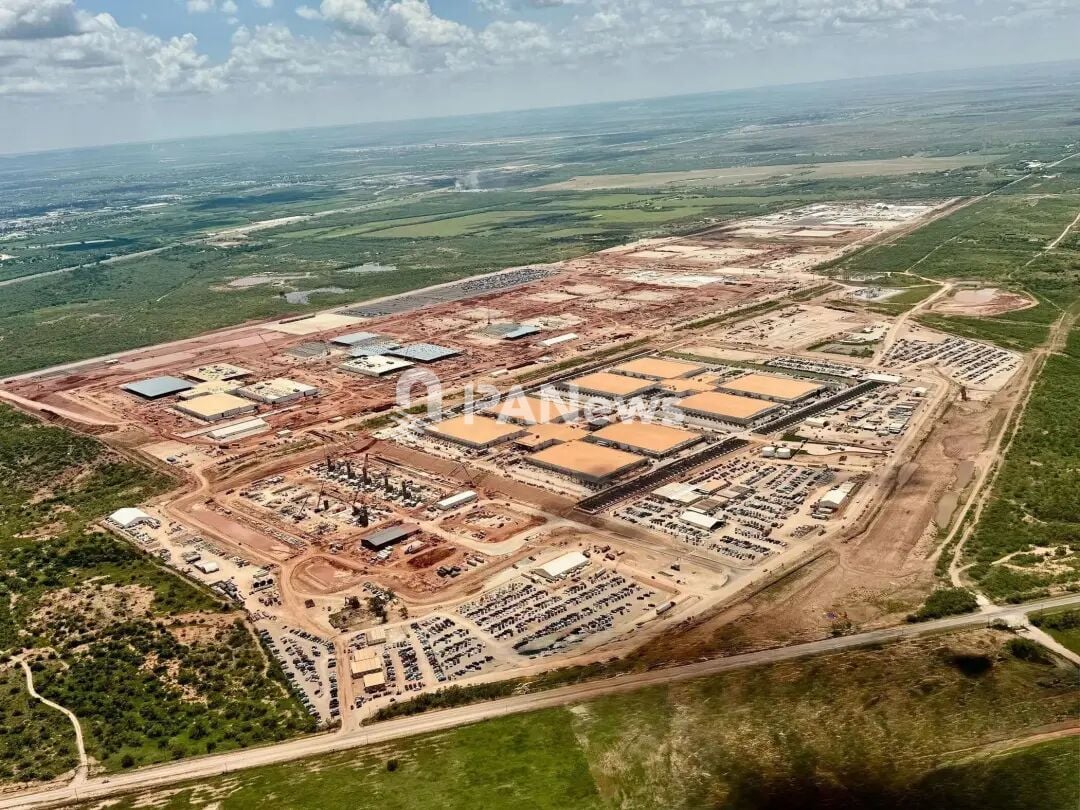
The newly elected Texas Governor Inohosa promised during the campaign to suspend the construction of new data centers and cancel subsidies and tax breaks for large developers.
About a quarter of the planned data center capacity in the US is in Texas because Texas is Trump's base; who would have thought that the base would be overturned?
Now, OpenAI is building Stargate there, Google is investing hundreds of billions to expand AI infrastructure, and Meta and Microsoft are also constructing large computing power parks.
Musk has even moved a significant portion of his autonomous driving computing power, robot production, advanced chip factories, Starlink manufacturing, and Starship production systems here, and now everyone is in a stare-off.
On the same day, Georgia's Governor Bostons, who also won, promised to temporarily halt the construction of new data centers across the state to first assess the impact on electricity costs, the community, and the environment. In Ohio, Acton proposed that data centers pause unless they bear all electricity costs, employ union workers, and meet environmental standards.
And the policies of these states do not require Trump's signature; governors have their decision-making power.
And this is just regarding governors.
In this midterm election, many places in the US had ballots directly printed with votes related to data centers; before the election, Forbes counted over 50 items across 13 states.
According to CNBC's statistics, with one exception, nearly all voters stood against data centers.
A small town in Ohio called Asheville has a data center already under construction, and over 80% of voters opposed it, while in Alhambra, California, over 80% of people voted to support a ban on data center construction.
Therefore, confidence wavered. In this era, everyone understands that in the financial industry, confidence is often more valuable than any metric.
But if we think about the issue from the ground level, I believe there exists a very concrete reality.
That is, the current speed of progress in AI technology far exceeds the speed at which technological dividends are transmitted to ordinary people.
This is a very severe imbalance.
You will find something strange.
AI has changed the world at a technical level, but the incremental benefits it brings to ordinary people may be far less than we imagined.
A typical office worker can indeed use AI to write emails, make PPTs, and organize tables, greatly improving efficiency.
But, has his salary increased?
Has his working hours been reduced?
Has he gained an opportunity that was previously completely unattainable because of AI?
If we look back at those true technological revolutions in history that changed the world, we will find a very important commonality: they eventually created a large number of new demands, new markets, and new opportunities for ordinary people.
But in this round of AI, we certainly believe that there will be stars and oceans in the future, but now, at the eve of a technological curve explosion, it's indeed hard to see the increments ahead.
So, if most of the value created by AI becomes the profits of a few tech companies, the market capital of the capital markets, and the wealth of a handful of those mastering computing power and technology...
Meanwhile, a large number of ordinary people face more expensive living costs, more intense job competition, and the anxiety of being replaced at any time.
Then... for the American people, the ballot may be their only recourse.
You can tell them that AI will change human civilization.
You can also tell them that AGI may be coming next year.
But in the end, it will certainly ask you one question:
“So what does it have to do with me?”
I always believe that the essence of AI must be human-centered.
How great the technology of an era is ultimately depends on how many ordinary people's lives it can make better.
Allow those who were originally excluded from opportunities due to education, resources, geography, and wealth to gain the qualification to participate in competition for the first time with the help of AI.
Allow those once difficult problems to be cured.
Transform the efficiency created by AI into cheaper goods, better services, higher incomes, and more free time for humanity.
So, I certainly hope that this time, the unrest in America can really provide us with a rare window.
I also hope we can seize it.
But I hope that when we look back on this history in the future, when we discuss success in the AI era, beyond how powerful the models are, how advanced the chips are, and how many data centers have been built, we can also have another answer.
That is, because of the emergence of AI, the destinies of countless ordinary people have truly changed.
After all, the true national fortune.
It will definitely.
Appear in the lives of every ordinary person.
免责声明:本文章仅代表作者个人观点,不代表本平台的立场和观点。本文章仅供信息分享,不构成对任何人的任何投资建议。用户与作者之间的任何争议,与本平台无关。如网页中刊载的文章或图片涉及侵权,请提供相关的权利证明和身份证明发送邮件到[email protected],本平台相关工作人员将会进行核查。


