
Author: FX168 Financial
The US stock market encountered the most severe technology stock sell-off in 19 months on Thursday. The Nasdaq Composite Index closed down 5.52%, marking the largest single-day drop since the announcement of tariffs on April 2025 by Trump on "Liberation Day", and officially confirming its entry into a technical correction zone. The S&P 500 index plummeted 4.36%, while the Dow Jones Industrial Average fell 3.44%. This sell-off led to approximately $3 trillion in market value being wiped out from S&P 500 components in a single day, indicating that political and regulatory expectations are rapidly reshaping the market’s judgment on artificial intelligence trading following the midterm elections.
The core pressure of this decline came from AI, semiconductor, and data center-related stocks. The Democrats won control of Congress in the midterm elections and achieved significant victories in several states where there were clear objections to data center construction, raising market concerns that future regulations and local resistance to the expansion of AI infrastructure may increase further. The logic of AI capital expenditure, which has propelled US stocks to new highs over the past year, is now facing an unprecedented pressure test.
Nasdaq officially enters correction zone
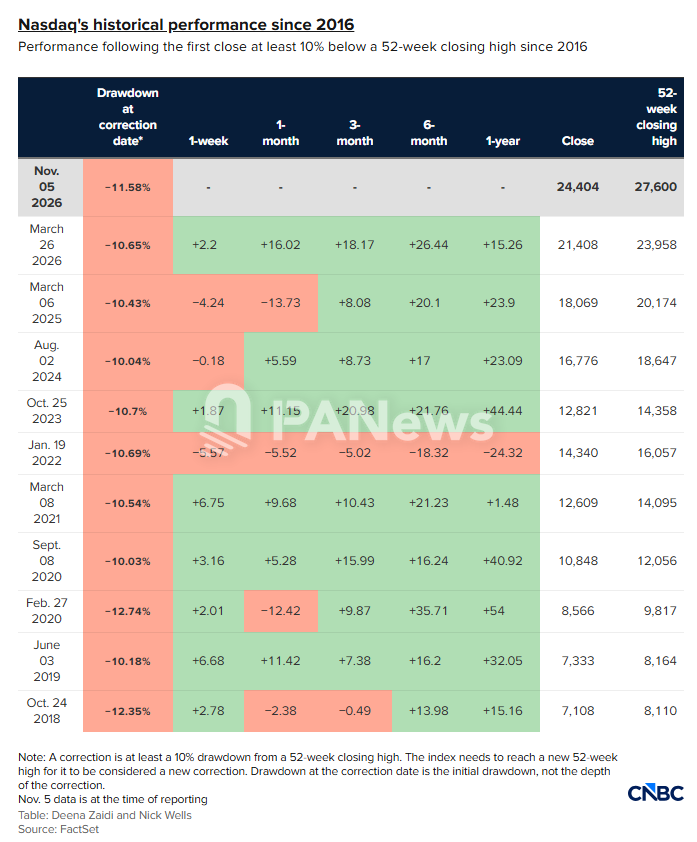
The Nasdaq Composite Index closed at 24315 points on Thursday, falling more than 10% from the historical closing high set on October 6, officially entering a technical correction zone. Generally speaking, a drop of more than 10% from recent highs signifies that the index is in correction territory.
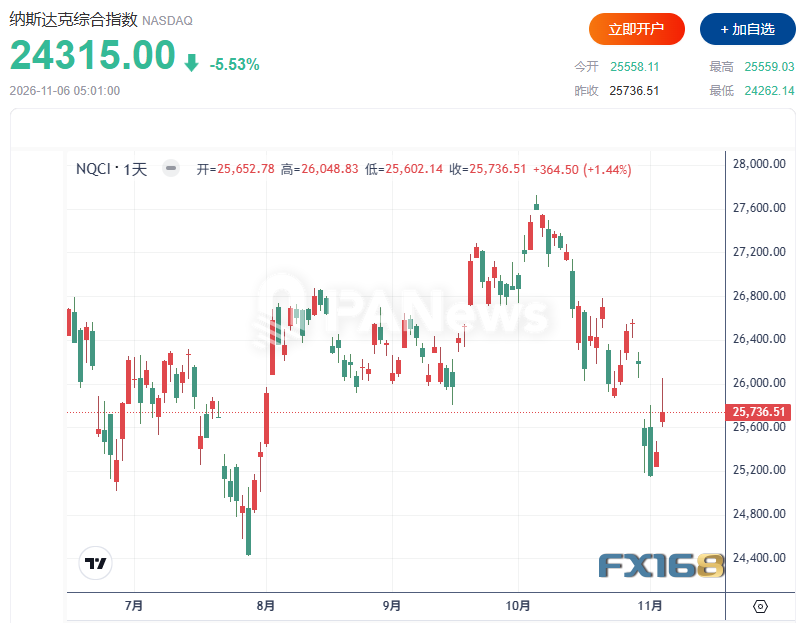
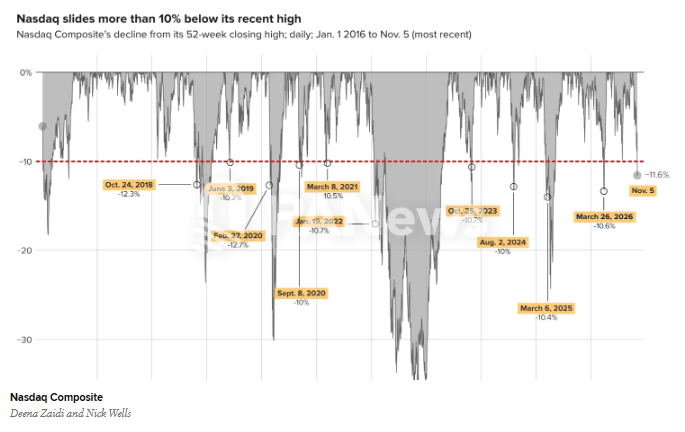
This is also the worst single-day performance for the Nasdaq since April 2025. In just one trading day, the sharp decline in technology stocks completely reversed the optimism brought by the midterm elections the previous trading day.
The S&P 500 index closed at 7353.73 points on Thursday, with a decline of 4.36%; the Dow fell to 51523.06 points, down 3.44%. Despite facing severe adjustments, the S&P 500 has still accumulated an increase of about 7.4% this year, while the Nasdaq has increased by about 4.6% year-to-date.
Trading volume also noticeably expanded. On Thursday, trading volume on US exchanges reached 26.9 billion shares, far exceeding the average of 17.7 billion shares over the past 20 trading days, indicating that investors are adjusting positions rather than experiencing ordinary low-volume pullbacks.
$3 trillion in market value evaporated in one day
One of the most shocking numbers in the market on Thursday was that S&P 500 components collectively lost approximately $3 trillion in market value.
This indicates that the market has shifted from merely adjusting based on individual highly valued technology companies to a broader sell-off of risk assets.
Just a day prior, the US stock market had surged significantly due to reduced political uncertainty. On Wednesday, the S&P 500 recorded its largest single-day increase in three months, while the Dow soared more than 1500 points at one point.
At that time, the market believed that Democratic control of Congress could create stronger political checks that would limit the Trump administration's ability to further increase fiscal spending, raise tariffs, or introduce other inflationary policies.
However, by Thursday, investors quickly shifted their focus to an entirely different issue: whether the Democratic control of Congress would impose stricter restrictions on artificial intelligence, data centers, power consumption, and large technology companies.
This change in expectations became a significant catalyst for the slump in technology stocks.
Nvidia drops over 9%, semiconductor index plummets 12%
The semiconductor sector became the epicenter of this market storm. The Philadelphia Semiconductor Index plummeted over 12%, setting an extreme single-day drop and falling to its lowest level in over six months. Nvidia's stock price fell over 9%, while other chip and AI infrastructure-related companies also faced heavy sell-offs.
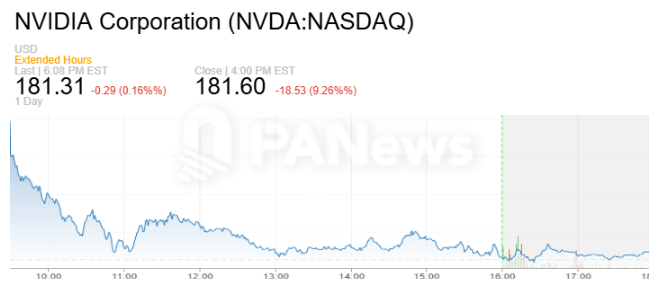
The reason semiconductor companies were particularly impacted is that the current AI growth story heavily relies on rapid data center expansion. Any slowdown in construction, delays in approvals, or cuts in capital expenditures could directly affect future chip demand.
Market concerns extend beyond regulation. Against the backdrop of AI investment reaching historical highs, investors are also increasingly questioning whether substantial capital expenditures can generate sufficient returns. Once the pace of data center expansion slows, those companies that previously obtained high valuations based on rapid growth expectations must re-accept a more stringent profitability test.
Data center stocks experience comprehensive collapse
Data center and Neocloud companies also suffered severe blows. IREN and Applied Digital both fell over 14%, while CoreWeave dropped nearly 10%. These companies have benefited from the explosive demand for AI computing power in recent years, rapidly expanding servers, data centers, and cloud computing infrastructures, but they also rely heavily on external financing.
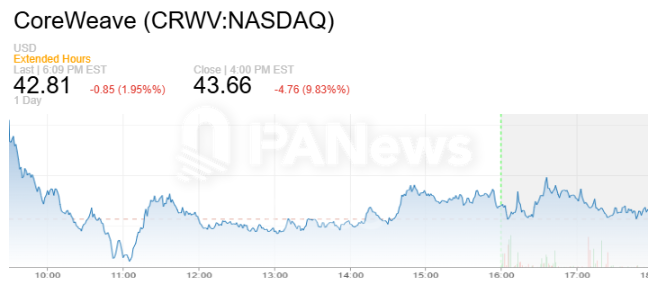
Rising interest rates have already increased financing costs, and if data center construction comes under stricter regulation, the logic for corporate expansion will face dual pressure.
The market is currently concerned that some states and local governments may adopt a more cautious attitude toward the approval of new data centers, especially in regions where issues related to electricity, water resources, and land use have already triggered community backlash.
Melissa Brown, head of global investment decision research at SimCorp, stated that investors seem to be realizing that some newly elected members of Congress and governors may wish to slow down the pace of AI infrastructure construction. Even if they cannot completely stop this trend, any slowdown will raise concerns, as the AI growth story over the past few years has heavily relied on the rapid expansion of supportive infrastructure.
Large tech stocks are not spared
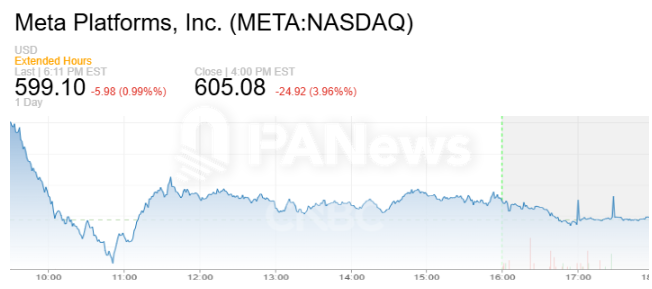
The sell-off was not limited to chip and data center companies. Meta fell 4%, while Amazon and Alphabet both dropped around 2.2%. These companies had previously been favored by the market due to AI investments and advertising and cloud computing business growth, but as overall risk appetite rapidly deteriorated, they found it difficult to remain insulated.
AI-related power and equipment suppliers also faced pressure. GE Vernova fell 7.5%, and Constellation Energy dropped 2.5%. This indicates that the market is reassessing the entire AI infrastructure supply chain, not just the upstream chip manufacturers.
Tesla and SpaceX, under Elon Musk, also experienced declines. Musk had previously invested nearly $500 million to support Republican candidates in the midterm elections, and as the Democrats took control of Congress, the market began to worry that his companies might face more policy and regulatory scrutiny.
Qualcomm's earnings report failed to save the stock price
Qualcomm fell 9.5% on Thursday, although some of its performance indicators were not poor, but the fourth-quarter smartphone chip sales did not meet Wall Street expectations, further intensifying investor concerns about semiconductor demand prospects.
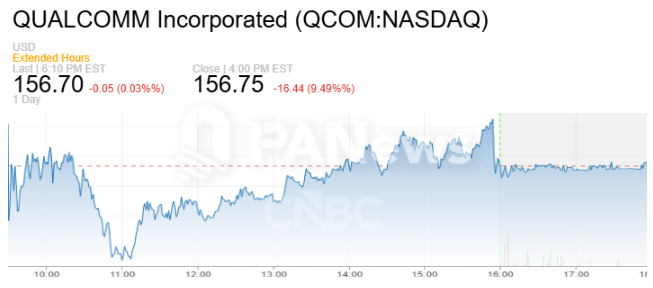
In normal market conditions, such a drop in earnings would not necessarily trigger a nearly 10% decline, but in Thursday's highly tense risk environment, any negative signals are amplified quickly.
Jed Ellerbroek, portfolio manager at Argent Capital Management, believes that the current trend resembles a "surrender phase" for data center capital expenditure beneficiary stocks, especially in the semiconductor sector. However, he also thinks that some stocks' declines on Thursday may have been excessive.
This assessment suggests that a certain degree of panic selling may have already emerged in the market in the short term, but whether it can stabilize quickly still depends on investors' reassessment of AI policies and capital expenditure prospects.
Shifting focus from "What can AI change?" to "How much is AI worth?"
The core of this adjustment is not that investors suddenly deny the long-term value of artificial intelligence.
The real change in the market is the valuation logic. In the past few years, investors have focused more on how large a market AI can create, how much productivity it can drive, and which companies can become long-term winners. However, with capital expenditures continuously expanding, financing costs rising, and data center regulatory risks increasing, the market is beginning to demand companies to prove that these investments can truly generate returns. In other words, Wall Street is shifting from focusing on "What can AI change?" to questioning "How much is AI worth?" This is also why the biggest declines now are not only among tech giants, but also among companies that heavily rely on AI capital expenditure, high valuations, and external financing.
Federal Reserve interest rate hike expectations remain a layer of pressure
Besides AI regulatory risks, Federal Reserve policy remains another variable that the market cannot ignore.
Cleveland Fed President Harker and Richmond Fed President Barkin both hinted on Thursday that the possibility of further interest rate hikes still exists. The market currently still expects the Federal Reserve may raise interest rates again at the December meeting.
Higher interest rates are particularly disadvantageous for tech stocks, as the valuations of growth companies highly depend on discounted future cash flows. When interest rates rise, the present value of these future earnings decreases, and high-valuation companies often bear the brunt.
At the same time, maintaining high interest rates will also increase the financing costs for AI infrastructure companies, further weakening market tolerance for high capital expenditure models.
Friday's non-farm payrolls become the next test
The market will next turn its attention to the US October non-farm payroll report to be released on Friday.
If job growth significantly exceeds expectations and wage pressures remain high, Federal Reserve rate hike expectations may heat up further, and tech stocks and other high-valuation assets may continue to face pressure.
If employment data shows a clear cooling in the labor market, it may reduce the urgency for further rate hikes and provide some buffer for bond yields and tech stocks.
However, after experiencing the evaporation of $3 trillion from the market on Thursday, whether a single economic data point can quickly reverse risk sentiment remains highly questionable.
Investors are currently more concerned about whether the policy environment for AI infrastructure has undergone structural changes following the midterm elections.
AI bull market enters a real watershed
Thursday's "Black Thursday" may become an important watershed for the current AI market.
But it may signify that the previous market phase of "any connection with AI will rise" is coming to an end, as investors begin to more strictly differentiate between companies that truly have profitability and cash flow and those that maintain high valuations relying on financing and forward growth stories.
The Nasdaq plummeted 5.52%, the semiconductor index fell over 12%, and the S&P 500 lost approximately $3 trillion in a single day, indicating that this market storm has sent a very clear signal: Wall Street's faith in AI has not disappeared, but its tolerance for AI pricing is rapidly decreasing.
The real pressure test may have only just begun.
免责声明:本文章仅代表作者个人观点,不代表本平台的立场和观点。本文章仅供信息分享,不构成对任何人的任何投资建议。用户与作者之间的任何争议,与本平台无关。如网页中刊载的文章或图片涉及侵权,请提供相关的权利证明和身份证明发送邮件到[email protected],本平台相关工作人员将会进行核查。


