From paper certificates to on-chain tokens, six ways to hold, six boundaries of rights.
Written by: @steinRWA
Translated by: AididiaoJP, Foresight News
Everyone knows how to buy stocks, and some know what rights come with them. But most investors have never asked: whose name is written on the company's shareholder register?
Public companies have an official shareholder list, called the register, maintained by a transfer agent. Who is recognized as a shareholder by the company, who receives dividends, who votes, and who gets money when the company has problems all depend on this list.
There are six common ways to hold shares, from paper certificates to stock tokens in a crypto wallet. They look different, but fundamentally boil down to one thing: how far your name is from the transfer agent's register.
A list determining how many people stand between you and the company
Paper certificates are closest to being "on the list with your name". The company sends dividends and reports directly to you, with no one in between, and brokers cannot lend your shares out.
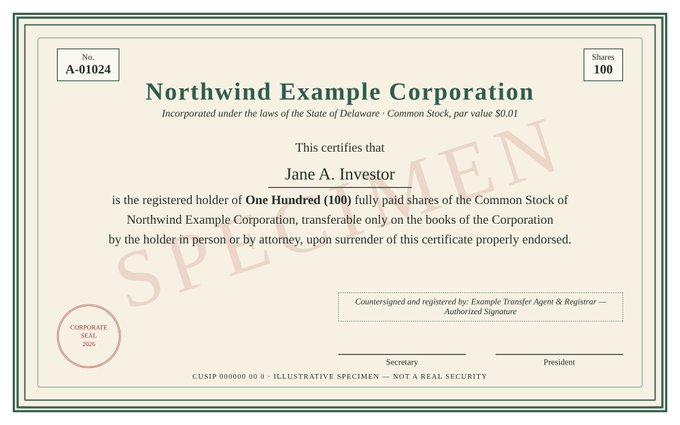
The problem is slowness and cost. Selling requires sending the certificate back; if it’s lost, replacement requires an affidavit and indemnity guarantee, usually costing 2%-3% of the stock’s market value. Continental Stock Transfer charges 3% for U.S. holders and 5% for other regions. A $50,000 certificate could cost $1,500 to $2,500 to replace.
DRS: The paper is gone, but the name remains
DRS replaces paper with electronic entries, and the name remains on the transfer agent’s register. There are no certificates to lose, it’s typically free, and dividends and voting materials are sent directly to you by the company’s agent.
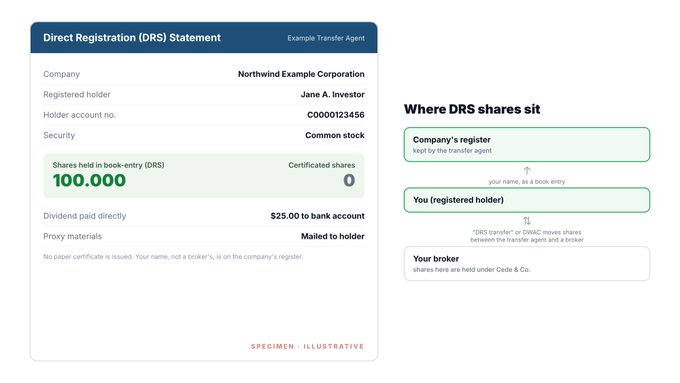
It is not a broker account: you cannot place limit orders, cannot pledge shares, and selling often requires bulk selling or transferring to a broker first.
Computershare maintains the registers for 58% of S&P 500 companies, with about 35 million shareholder accounts; Equiniti has about 20 million. The GameStop retail investors made it famous: in March 2023, about 76 million shares, accounting for a quarter of the company’s equity, were held in this way.
DSPP: Bypassing brokers but often not bypassing registered holders
DSPP allows you to bypass brokers and buy shares directly from the company plan. IBM, Union Pacific, and Texas Instruments all offer them through Computershare.
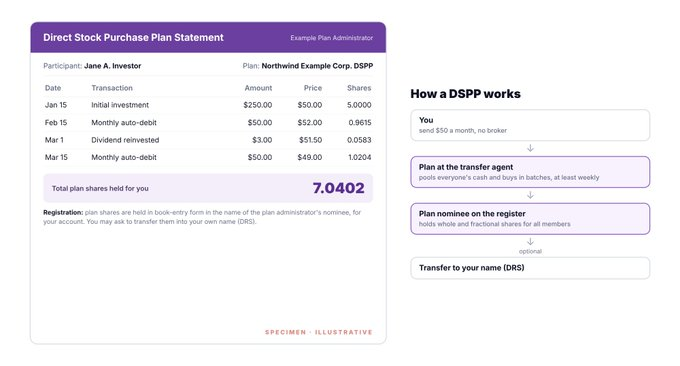
The thresholds are not high: Union Pacific starts at $250, IBM at $500, and after that you can add $50 each time; dividends can even be automatically reinvested, and you can even buy fractional shares.
However, many DSPP stocks do not have your name on them. Union Pacific’s plan specifies that Computershare will hold all the shares purchased or deposited by participants in the name of the registered holder. The plan knows who you are, but the register lists the registered holder.
You can transfer the plan shares to your own name, then it becomes DRS. Otherwise, you bypassed the broker but not the intermediary.
Fees also vary. Union Pacific’s purchase fees are borne by the company, and selling incurs a $15 fee plus $0.12 per share; cash must be invested in batches at least weekly, where you cannot control the transaction price. IBM charges $5 for each check investment and $1 for automatic deductions.
The on-chain version aims to preserve the benefits of "buying directly from the company" while removing the worst parts. Superstate’s Direct Issuance Programs will be announced on December 10, 2025, allowing public companies to sell new tokenized shares directly to verified investors. Investors pay with stablecoins, and shares are instantly transferred to their wallets; there are no underwriters, and companies follow the standard S-3 shelf registration. It operates on Ethereum and Solana, with the first issuance expected in 2026.
Securitize conducted an early version in 2021: wallet provider Exodus raised about $75 million through Regulation A directly from individual investors, with Securitize acting as the blockchain transfer agent. Equiniti provides the Shareholder Central portal for Bullish, allowing registered holders to switch between ordinary book shares and tokens.
Unlike traditional DSPPs, these on-chain versions place shares in your name rather than in the name of the plan's registered holder. Most investors endure intermediary issues daily but may not even know it.
Brokerage-held shares: Most convenient to buy and sell, but your name isn’t on the register
When you buy shares on Robinhood, Fidelity, Schwab, or almost any broker, your name is not on the register; it is Cede & Co.—the registered holder for DTC. DTC holds shares for virtually all U.S. brokers. As of 2023, about 75% of GameStop’s shares were under Cede & Co.
Brokers maintain a separate account noting which shares belong to you. Legally, you hold a "security interest" against the broker, not a direct position on the company's shareholder register. This is what brokerage-held holdings mean.
It’s popular for a reason: transactions complete in seconds, you can place limit orders, you can finance, and sales settle the next day; in case of broker failure, SIPC covers up to $500,000.
Convenience comes at a price. Shares bought on margin can be lent by the broker to shorts; during the borrowing period, you may lose voting rights, and dividends may become cash in lieu, with different tax implications. Only shares fully paid off will be lent if you join a lending program.
Plans like Fidelity’s fully paid lending charge daily, but during the borrowing period you don’t have voting rights, and what you receive is cash in lieu instead of dividends, and borrowed shares are not protected by SIPC; protection comes from collateral placed with a custodian bank by the borrower.
Wrapped tokens: Prices like stocks, legally a promise
Most tokenized stocks are not stocks but synthetic tokens. A third party buys real shares and hands them to a custodian, then issues a matching token. The token feels like a share, but legally it is a commitment from the issuer to you.
xStocks trade on Kraken and Solana and are issued by Backed Assets (JE) Limited from Jersey, legally categorized as "tracking certificates," which are nameless debt instruments. Each is supported one-to-one by real shares; in the case of the issuer's failure, the independent agent can seize the stock, but there are no voting rights, and the tracked company will not know of your existence.
Robinhood's Stock Tokens are similar, being tokenized debt securities issued from Jersey. Ondo adds stock prices and dividends reinvested but does not provide ownership.
Counting the layers of intermediaries makes it clear: the register lists Cede & Co., followed by the custodian or broker, next the synthetic token issuer, and finally you, holding a receivable from the issuer.
Debt notes and tracking certificates are commitments, not shares; your safety depends on the collateral and legal structure behind them.
SEC staff calls this type “synthetic tokenized securities,” distinguishing between those linked to securities and those based on securities swaps; the latter do not confer rights such as ownership, voting, or information, and regular U.S. investors face restrictions. The Ondo structure has been described as bankruptcy isolation, with some stocks able to transmit voting preferences via Broadridge, but defaults typically provide no voting rights.
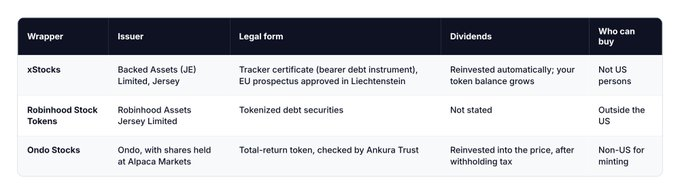
Synthetic tokens are popular because they allow trading in any stock without needing a company’s permission, 24/7 trading is available, and they can also be directly used as DeFi collateral. The tokenized stock market, worth $4.64 billion, is largely made up of such products.
IST: Moving the register on-chain
IST is an alternative approach: the company allows the transfer agent to place part of the register on-chain. Tokens move from one wallet to another and the shareholdings on the register move along with them.
SEC staff state that the form does not affect the application of federal securities laws – shares are still shares. This is the only designed tokenized form that allows you to become a registered shareholder. Computershare describes IST holders as "registered shareholders with the same rights as other registered holders," equivalent to DRS plus superpowers.
These superpowers are real. Approved wallets can be transferred 24/7; Galaxy Digital's shareholder list is updated in real-time when tokens change hands; Forward Industries' tokenized stocks can be collateralized for stablecoins on Kamino; Galaxy is also putting the 2026 shareholder voting record on-chain.
Not many companies are doing this: Galaxy, SharpLink, and Forward Industries via Superstate; Bullish through Equiniti; Exodus and Securitize via Securitize themselves; now Canton Strategic Holdings through Fairmint.
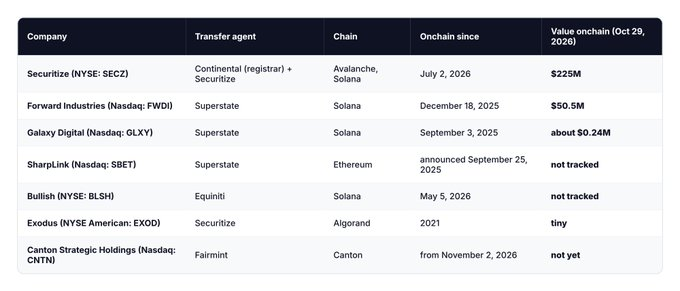
Fairmint's subsidiary, Fairmint TA LLC, is an SEC-registered transfer agent (file number 084-06901). On October 28, 2026, it launched services to move the main shareholder register of companies onto the Canton Network, recording issuance, transfers, and cancellations through the Open Cap Table Protocol. The first disclosed company is Nasdaq-listed Canton Strategic Holdings (CNTN), with its tokenized shares expected to start trading on TSV as early as November 2, 2026, with rights equivalent to those of shares purchased on Nasdaq.
The benefits of an on-chain register go beyond instant updates and no downtime. Shares can be self-staked, company actions can be automated, transfer rules can be written into smart contracts, and issuer fundraising can be faster.
Classic registers update in batches; Galaxy's tokenized shares are recorded by Superstate on Solana, with the shareholder list updated in real-time whenever tokens move. Only the tokenized portion is on-chain; shares held by brokers remain in the regular electronic register.
You can borrow against your own shares or choose to stake them yourself. Forward Industries' tokenized shares can be stored on Kamino for stablecoin loans, something regular DRS holders find difficult to do due to the lack of brokers or margin accounts. The downside is that while deposited, tokens are in the lending agreement, and if the loan goes bad, they may be liquidated.
The most important point is: you must keep your wallet's private key secure, as the transfer agent still retains off-chain documentation to link the wallet to your real name.
Superstate and Securitize: Two strategies for IST
Superstate was founded by Robert Leshner, also founder of Compound; its Opening Bell platform puts SEC-registered shares directly on-chain, not synthetic or wrapped versions. Existing shareholders open Superstate accounts and transfer shares from brokers to approved wallets.
The largest case is Forward Industries: on-chain shares grew from $9.8 million at the end of December 2025 to $56.8 million at the end of September 2026, nearly sixfold; non-U.S. holders could use it for loans on Kamino from the start, priced by Pyth. Galaxy has only a small portion of shares on-chain.
Securitize has been in this business the longest. In 2021, it was the blockchain transfer agent for Exodus's $75 million direct issuance. In April 2026, the largest transfer agent, Computershare, chose it to allow Computershare's clients to issue IST. In June, Continental Stock Transfer named it a preferred tokenization partner. On July 2, Securitize went public on the NYSE, tokenizing its own stock on the first day.
Its business primarily involves funds: as of the end of June 2026, about $4.3 billion in tokenized assets, $5 billion by July, managed by firms like BlackRock, Apollo, and KKR. Trading volume grew 147% in the second quarter to $5.3 billion, with revenue of $14.4 million and a net loss of $21.7 million.
Exodus's 2021 issuance was also managed by Securitize as the transfer agent, with only tokenized shares holders appearing in its records. Through collaboration with Computershare, other companies can also add this option while the register is maintained by Computershare.
CET: The on-chain version of brokerage-held shares with a conversion option
IST requires approval from each company, which is slow. Securitize therefore built a bridge. In October 2026, it launched Securitize Stocks, tokenizing 12 U.S. stocks, including Apple, Microsoft, Nvidia, Alphabet, Tesla, Meta, Amazon, Netflix, Circle, MicroStrategy, and Palantir. These are called Convertible Equity Tokens (CET).
CET is "an on-chain version of brokerage-held shares": you hold a security interest through Securitize's broker, with real shares behind it one-to-one, and Securitize promises not to lend them out. But you are not a shareholder on the company’s register. "Unless converted, the holder is not a registered shareholder of the underlying issuer."
They trade on Solana, settled in USDC, with Jump Trading as the market maker, initially starting from extended trading hours and planning for 24/7; Securitize Markets sells in the U.S., and Securitize Europe sells in the EU; holders retain dividends and voting rights categories; they can later use it as collateral in lending markets like Aave.
The "conversion" is the bridge: if the company later adopts IST, CET holders can switch to real registered shares without selling. Securitize can add any stock today and upgrade shareholders one by one.
SECZ: Buying stocks the same way, but different methods, different names on the register
On July 2, Securitize went public on the NYSE, and on the same day put its own stock on-chain. If you buy tokenized SECZ through KYC, whose name is on the register? The answer depends on the method of purchase.
If you buy through a regular broker on the NYSE, the name on the register is the broker’s holding, and you are the beneficial owner. If you buy tokenized SECZ on the Securitize platform, the evidence points to direct ownership: Securitize's own S-1 states that it maintains "appropriate ownership records" as a transfer agent, reconciling tokenized shares with other shares "through the same control book and primary securities holder documentation."
Most SECZ trade on the NYSE through regular brokers, still under Cede & Co. brokerage holding, and Securitize can only see these holders through the broker list as any other company would; what it knows directly are only the investors holding tokenized SECZ on the platform.
Dividends: The closer to the register, the more direct the money
Among the six methods, the transfer agent always remains the custodian of the list. Only two things truly change: it records whose name is on it and what it does for you.
First, let’s look at dividends. Holders of certificates, DRS, and IST receive money directly. DSPP members can automatically reinvest dividends. Holders under brokerage holding must receive through their brokers, with arrival sometimes delayed; if the stock has been lent out, what they receive may not be dividends, but cash in lieu.
Fidelity applies an additional 26.98% credit for qualified dividends in taxable accounts to offset tax differences caused by cash in lieu. Holders of wrapped tokens receive reinvested dividends: xStocks adjust balances directly, while Ondo deducts taxes before investing.
Fees and lending: Convenience comes at a price
- Fees: If certificates are lost, replacement costs 2%-5% of the stock's market value; DRS is usually free; DSPPs charge a bit for buying or selling; the costs for minting and trading wrapped tokens vary by platform and are not disclosed in legal documents.
- Lending income: Only holders under brokerage holding can earn this money, provided they join a fully paid lending program. Stocks bought on margin may be lent out by the broker, and you may not receive funds; once the stock is lent out, it is no longer covered by SIPC.
- Borrowing ability: Stocks under brokerage holding can be used for margin loans; IST holders can borrow against their tokens in DeFi, such as Forward's shareholders doing on Kamino; wrapped tokens are the most commonly used in this regard, being mainstream collateral in DeFi, but all you are collateralizing is a mere promise.
Before buying, first ask these five questions
No matter what method you use to hold shares, five questions can reveal what you truly own:
- Whose name is on the register? Yours, the registered holder, or Cede & Co.?
- Legally, what do you own? The shares themselves, a security interest against a broker, or a promise from the synthetic token issuer?
- Can others lend your shares? Only brokers can, and usually only for margin purchases or if you proactively join a lending program.
- Do dividends and voting rights belong to you? Registered holders usually have them; holders of synthetic tokens usually do not have voting rights.
- If the intermediary fails, what protects you? SIPC, segregated collateral, or nothing at all?
Conclusion: Back to the oldest question
From paper certificates to on-chain tokens, we’ve come full circle, returning to the same question. Paper certificates put your name on the register at the cost of slowness; brokers speed up transactions at the cost of your name disappearing from the register; wrapped tokens allow global trading at any time at the cost of only holding a piece of paper that is a promise. IST aims to provide a solution that gives everything at once: your name on the register while having the speed of internet trading.
These products are still small in scale. But the next time you buy stocks, whether on-chain or off-chain, it’s worth asking the oldest question in the investment world: whose name is written on the register?
免责声明:本文章仅代表作者个人观点,不代表本平台的立场和观点。本文章仅供信息分享,不构成对任何人的任何投资建议。用户与作者之间的任何争议,与本平台无关。如网页中刊载的文章或图片涉及侵权,请提供相关的权利证明和身份证明发送邮件到[email protected],本平台相关工作人员将会进行核查。


