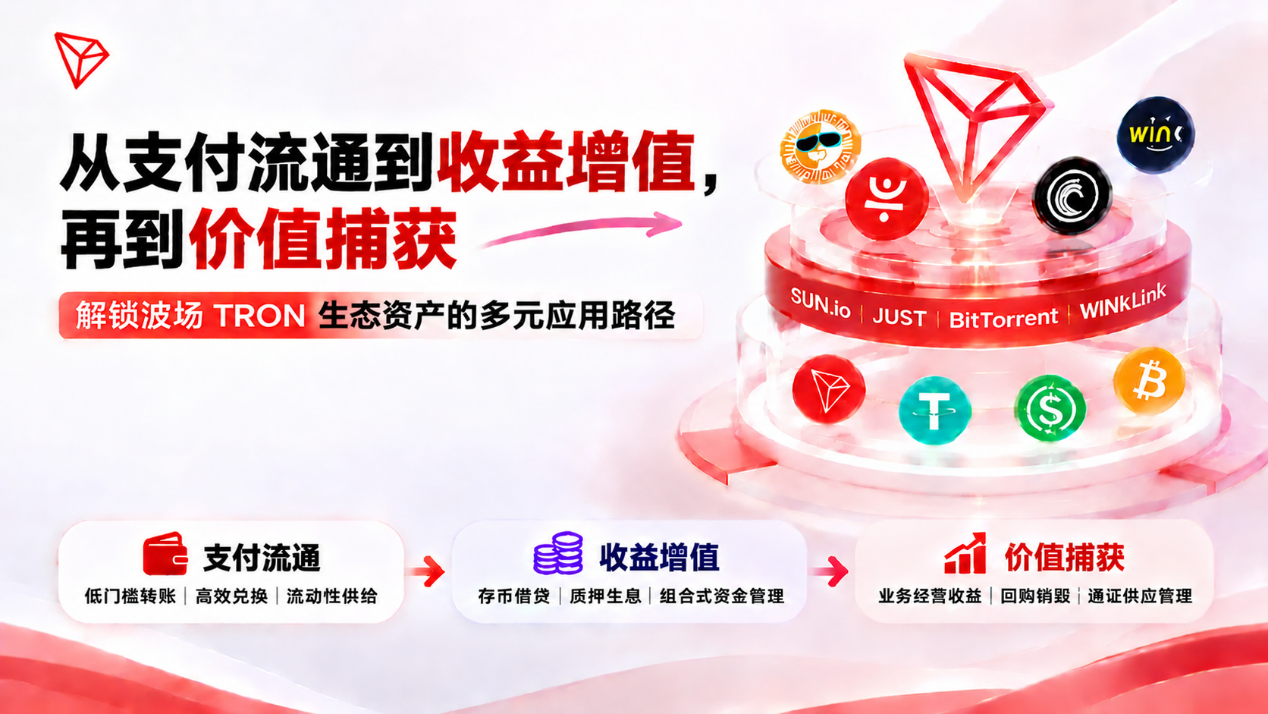
 As the cryptocurrency industry evolves, Web3 has moved from the early rough stage of narrative hype, performance parameter comparisons, and a pile of application numbers into a value return phase centered around "real application landing" and "intrinsic value capture." In this round of industry paradigm transformation, TRON has become a benchmark for public chain development with both user base and practical value, thanks to its absolute advantage in the stablecoin payment field, a large real user base, continuous leading on-chain activity, sustainable ecological value-capturing mechanisms, and efficient asset circulation capabilities.
In the stablecoin payment field, according to CoinDesk's third-quarter report, TRON has accounted for nearly 73% of global stablecoin on-chain transfer activities. In terms of on-chain activity, DeFiLlama data shows it has long maintained the number one spot for daily active users among global public chains, continually leading over top public chains like Solana. On the ecological front, the four core projects JUST, SUN.io, BitTorrent, and WINkLink have implemented a native governance token buyback and burn mechanism, using real business income to benefit tokens, solidifying the protocol’s operating results into long-term value and further deepening the ecosystem's ability for intrinsic value capture.
For users, the core focal point of attention always lies in the applicability of TRON ecosystem assets, the sustainability of income mechanisms, and how to participate in ecological construction with low barriers to truly enjoy the dividends of the ecological positive development. In relation to the TRON ecosystem, this demand is jointly undertaken by the asset layer and the application layer: the asset layer provides the basis for circulation and income, while the application layer undertakes specific scenarios such as transfer payments, transaction exchanges, lending for income, and liquidity supply.
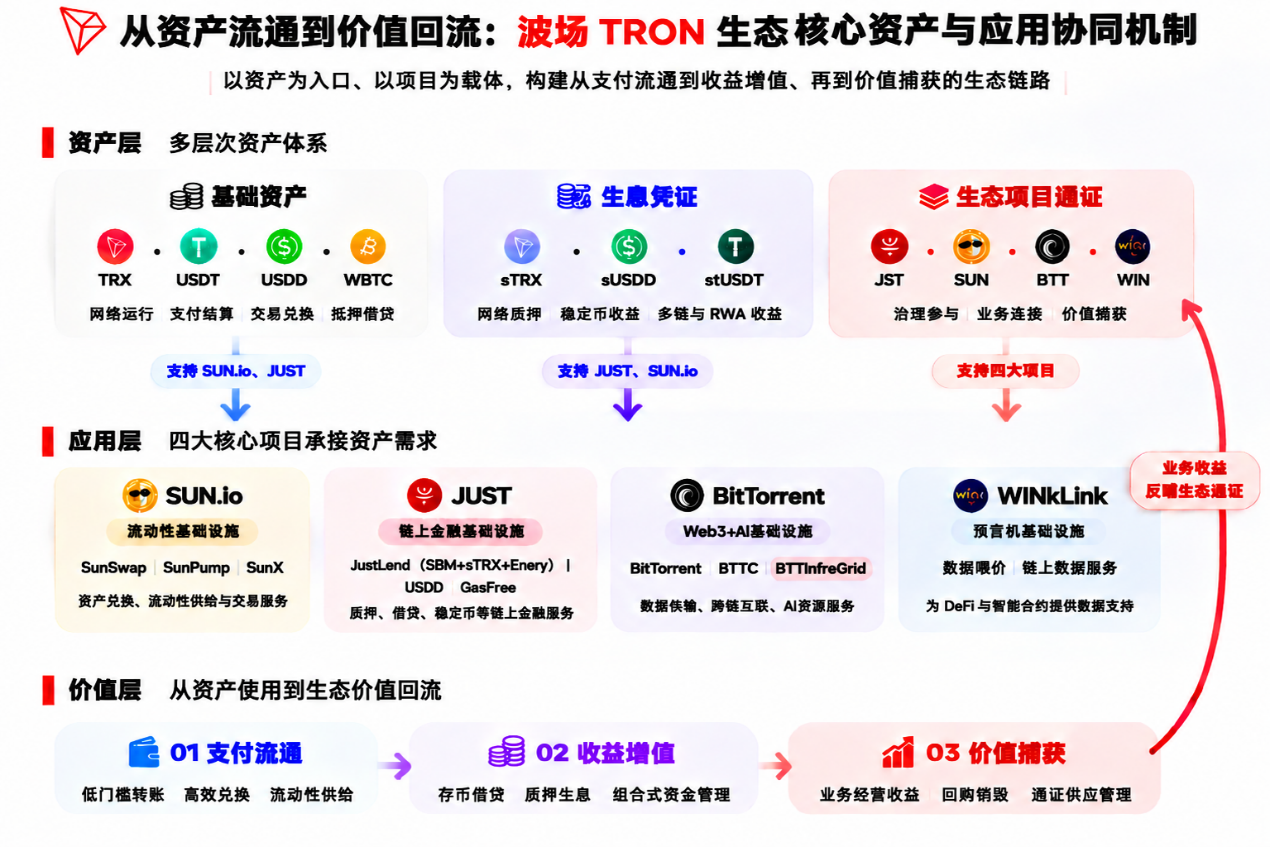
On the asset layer, TRON has formed a multi-tiered asset system consisting of foundational assets like TRX, USDT, USDD, and WBTC, interest-bearing certificate assets like sTRX, sUSDD, stUSDT, and ecological project governance tokens such as JST, SUN, BTT, WIN; on the application layer, SUN.io, JUST, BitTorrent, and WINkLink each provide liquidity services, on-chain finance, decentralized infrastructure, and oracle data services, respectively. The continuous combination of assets and application scenarios together drives the transition of assets from payment circulation to income appreciation and value capture.
Assets carry value, applications open channels: TRON solidifies an efficient foundation for payment settlement and asset circulation
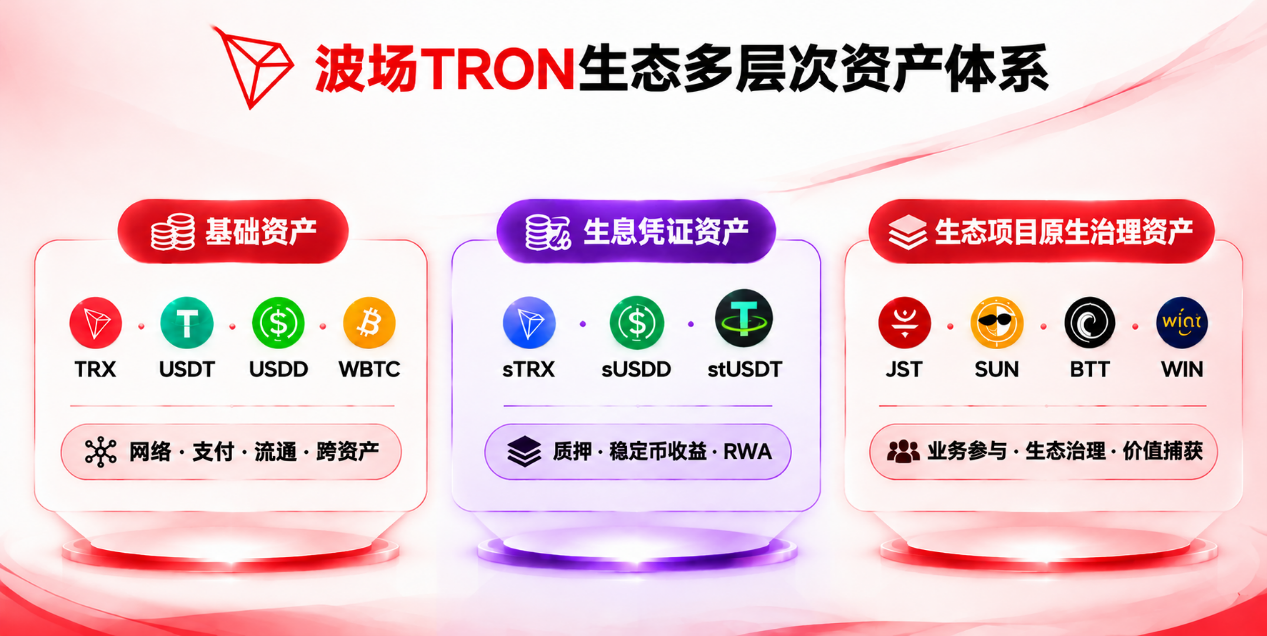
Assets not only serve as the value carrier for user participation in the TRON ecosystem, but are also an important link connecting the foundational network infrastructure and upper-layer on-chain applications. Currently, TRON has formed a multi-tiered asset system comprised of foundational assets, interest-bearing certificate assets, and native governance assets from ecological projects. Among them, foundational assets such as TRX, USDT, USDD, and WBTC serve network operation, payment settlement, value circulation, and cross-asset applications; interest-bearing certificate assets such as sTRX, sUSDD, and stUSDT further connect network staking, stablecoin yields, and RWA yield scenarios; JST, SUN, BTT, and WIN governance assets serve functions such as business participation, ecological governance, and value capture. Different types of assets perform their respective roles, jointly forming the value circulation foundation of the TRON ecosystem, which is further expanded by ecological applications like JUST and SUN.io.
From a functional perspective, TRX, as the native token of the TRON network, mainly bears the functions of network operation, resource acquisition, gas payment, and ecological participation. As the ecological system continues to improve, the application boundary of TRX has further extended to asset allocation, transaction exchange, and ecological financial services and has gradually grown into a configuration-type cryptocurrency that connects traditional financial markets and the Web3 ecosystem, becoming the core hub linking TRON's underlying infrastructure and full-scenario on-chain applications. In September 2026, Canary Capital launched a TRX spot staking ETF (code: TRXS), providing traditional institutional investors with a compliant channel for participating in TRX asset allocation and on-chain staking income; meanwhile, TRON Inc., the listed company in the U.S. stock market, has continuously increased its holdings of TRX in the open market, and as of November 5, its treasury holds over 720 million TRX, demonstrating institutional attention to the long-term allocation value of TRX.
Stablecoin assets like USDT and USDD form the core pillars of value transfer and payment settlement in the TRON ecosystem. While fulfilling the circulation function of foundational stablecoins, they can also serve as underlying assets that connect to lending, income management, and other ecological financial products, supporting various on-chain financial applications. As of November 5, the circulating scale of USDT on the TRON chain has exceeded $94.1 billion, far surpassing Ethereum during the same period, solidifying its position as the dominant global circulating USDT. USDD, on the other hand, is TRON's native decentralized over-collateralized stablecoin, supporting the minting of new coins by collateralizing assets like TRX, USDT, WBTC, and sTRX, and its current circulating scale is nearly $1.5 billion, making it the second-largest stablecoin on the TRON network and ranking among the top ten stablecoins globally.
WBTC further expands the boundaries of heavyweight blue-chip assets in the TRON ecosystem. As a 1:1 fully collateralized mapped asset of Bitcoin, WBTC provides a standardized path for efficiently accessing Bitcoin assets on blockchain and DeFi applications, executing a 1:1 full reserve mechanism throughout the entire link, with a current total circulation of approximately 116,500 BTC. In November 2025, JustLend officially launched a WBTC fund pool, supporting users to supply and borrow this asset; in April 2026, USDD launched the WBTC Vault feature, allowing WBTC to be used as collateral for minting USDD, further facilitating the full-scenario application chain of Bitcoin assets within the TRON ecosystem.
Hence, TRX, USDT, USDD, and WBTC together form an important foundational asset for the circulation of assets and financial applications, which can be directly used for transfer payments and transaction exchanges, and can also participate in staking income, collateralized lending, and liquidity management under the support of the corresponding protocols. However, to enable these assets to truly land on a large scale in daily payment settlements and high-frequency trading scenarios, the support and infrastructure of TRON's application layer are indispensable. Applications like JUST's GasFree, JustLend's energy services, and SUN.io's SunSwap offer solutions targeting transfer thresholds, on-chain interaction costs, and asset exchange efficiencies.
In transfer payment scenarios, the TRON ecosystem not only offers an efficient native foundational transfer function but also continuously optimizes the experience around users' genuine usage pain points. The GasFree service under the JUST ecosystem supports draining the corresponding network gas fee directly from the target token for the transfer, eliminating the need to hold native TRX to pay transaction fees, breaking the traditional limitation that transfers must hold native tokens. Currently, GasFree has supported "gasless" transfers for the two major stablecoins, USDT and USDD, significantly lowering the usage threshold for users accessing the TRON network for the first time.
Regarding on-chain interaction costs, JustLend's energy services allow users to rent or purchase network energy resources based on operation frequency as needed, thereby lowering the comprehensive usage costs arising from direct on-chain interactions.
In the asset exchange and trading flow phase, SunSwap supports decentralized exchanges of core assets like TRX and USDT against other supporting assets within the ecosystem; its built-in PSM stablecoin exchange tool enables 1:1 zero slippage trades between USDD and USDT, further reducing slippage losses in stablecoin trading.
Thus, the underlying asset system and upper-layer application matrix form bidirectional support, as GasFree and JustLend's energy services continuously optimize payment settlement efficiency, and SunSwap ensures smooth asset trading and flow, together enhancing the payment settlement and asset transfer experience, providing foundational support for ecological value circulation and scenario landing.
From DeFi participation to holding assets for income: Exploring diverse paths for income appreciation of TRON ecosystem assets
Once assets smoothly complete payment settlements and trading transfers, how to further enhance the efficiency of idle funds and continue participating in income appreciation management becomes the next core demand for ecological financial applications. Around this demand, the TRON ECO has formed multi-tiered paths from direct DeFi participation to holding interest-bearing certificates, and then to cross-protocol portfolio management: users can directly invest foundational assets like TRX, USDT, USDD, and WBTC into protocols such as SunSwap and JustLend to participate in liquidity provision, coin storage for income, and collateralized lending; they can also further connect network staking, stablecoin yield, and real-world asset yields through interest products like sTRX, sUSDD, and stUSDT.
At the foundational DeFi participation level, SunSwap and JustLend together constitute important entry points. SunSwap allows users to assemble trading pairs with TRX, USDT, USDD, etc., per the liquidity pool rules and provide LP liquidity, thus participating in transaction fee distribution and related incentives. JustLend provides asset deposit and collateralized lending services through the SBM lending market, supporting various assets including TRX, USDT, USDD, WBTC, sTRX, wstUSDT, and JST, SUN, BTT, WIN, enabling users to earn deposit interest based on market supply and demand and protocol rules or to borrow other tokens by collateralizing their assets to meet different funding management needs for various terms and liquidity.
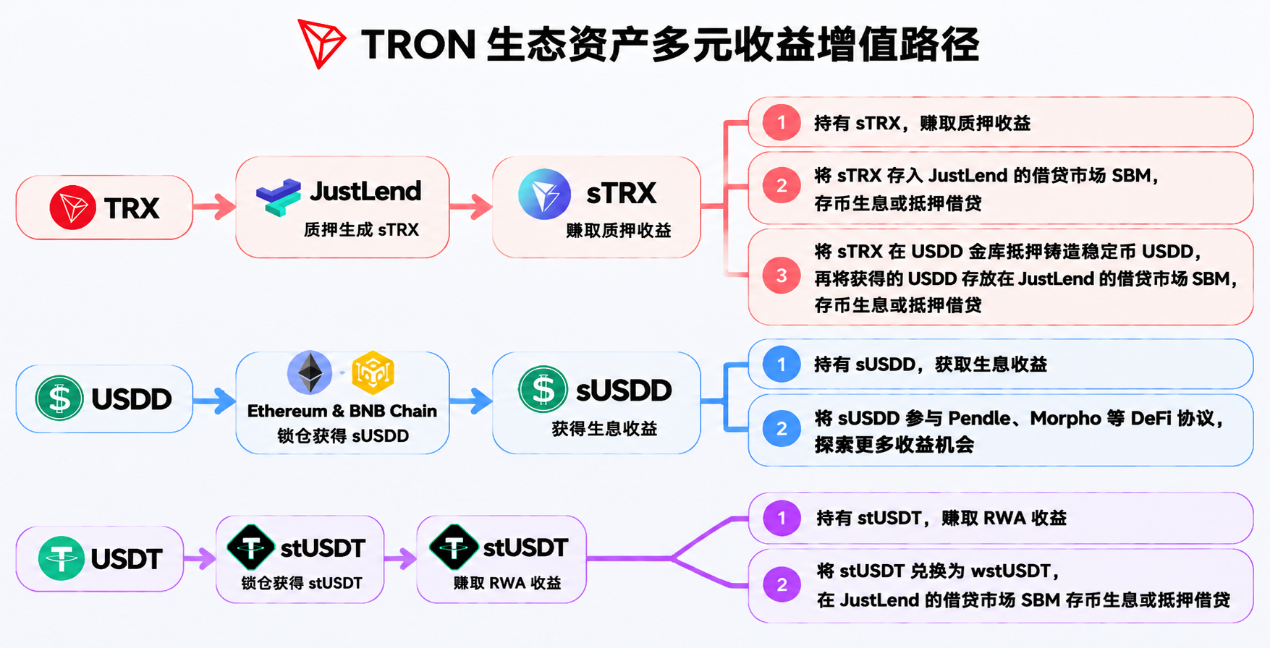
Building upon foundational DeFi participation, interest-bearing certificate assets extend the income paths from active operations to certified asset management. sTRX, sUSDD, and stUSDT are constructed around TRX network staking, USDD yield mechanism, and RWA asset yield respectively. Users only need to stake, deposit, or lock corresponding assets per product rules to earn the relevant certificates and associated income. More importantly, these certificates are not limited to the underlying income itself and can further participate in DeFi activities, allowing the same asset to continuously release value across different scenarios.
sTRX connects to TRX network staking income. As a TRX liquidity staking product launched by JUST under JustLend, it supports acquiring sTRX by staking TRX to earn TRON network staking income, of which the corresponding staked TRX has exceeded 9.8 billion. On this basis, the application boundaries of sTRX can further extend to multiple financial scenarios, where sTRX can also be used within JustLend’s SBM-supported market for coin storage or collateralized lending; in USDD pools that support sTRX collateral, it can be used as collateral for minting USDD, and then the obtained USDD can be deposited into the respective market; when supported by SunSwap, it can also make trading pairs with TRX and other assets providing LP liquidity. Thus, the staking rights of TRX can connect to richer on-chain financial scenarios, bridging lending, stablecoins, and liquidity management, unlocking a multi-tiered return on the asset.
If sTRX mainly opens up the “staking - income - lending” path on-chain, then sUSDD extends income management to cross-chain scenarios. As a yield-bearing asset certificate built around USDD, users can lock USDD on supported networks such as Ethereum and BNB Chain and obtain sUSDD while participating in the relevant underlying income mechanisms. Additionally, sUSDD can also connect to multi-chain DeFi applications like Pendle and Morpho, further expanding income management methods.
stUSDT extends the income path of USDT stablecoin assets to real-world assets (RWA). As a yield-bearing asset related to USDT, stUSDT provides a channel for users to participate in traditional financial market-related asset returns through underlying asset allocation mechanisms, with the value of locked assets exceeding $56 million. After depositing USDT as per product rules and obtaining stUSDT, users can participate in the underlying income mechanisms and, using the platform’s official tool, Wrapper, convert it into the TRC-20 format wstUSDT, further integrating RWA yielding assets into the on-chain financial system, such as participating in coin storage for income or collateralized lending in JustLend’s supported markets.
From earning sTRX by staking TRX to expanding USDD cross-chain earnings through sUSDD, and then connecting to RWA income via stUSDT, the TRON ecosystem has formed an interconnected diverse income path, where network staking, stablecoin yield, RWA yield, and cross-chain income management develop in parallel. Meanwhile, through DeFi applications like JustLend and SunSwap, all kinds of income certificates can be freely combined across different protocols, allowing the same asset to continuously circulate and release value among staking, lending, and stablecoin scenarios.
Ecological governance asset value capture continues to upgrade, buybacks and burns connect ecological growth dividends
As the circulation of foundational assets gradually smoothens and the channels for income appreciation become increasingly rich, the value capture mechanisms of the core projects within the TRON ecosystem are also continually upgrading, further linking business development with ecological asset value. Currently, the core ecological projects JUST, SUN.io, BitTorrent, and WINkLink have all implemented the buyback and burn mechanism for their native tokens JST, SUN, BTT, and WIN, bridging the real business revenue of the projects with the token economic system, allowing users to share in the development results of the ecosystem while also benefitting from the deflationary effects of buybacks and burns.
From a mechanism perspective, buybacks and burns establish a link between ecological tokens and the actual business development of projects: on one hand, projects use business operating income for buybacks in the open market, creating genuine buying demand for tokens from an operational perspective; on the other hand, by burning, the circulation supply in the market is directly reduced, creating a sustained deflationary effect on the supply side. This means that the better the business grows, the larger the scale of tokens that can be used for buybacks and burns, leading to a more apparent contraction in circulation, and the deflationary effect will continue to amplify. In the case where demand remains relatively stable, the reduction in supply may provide support for token value.
Currently, the buyback and burn mechanisms for JST, SUN, BTT, and WIN have achieved phased results. Notably, the buyback and burn scale of JST in the JUST ecosystem stands out: as of now, JST has completed five phases of buybacks and burns with a total of over 1.881 billion tokens being bought back and burned, achieving a total deflation rate exceeding 19%, with over $118 million invested in real buyback funds, primarily sourced from JustLend’s business earnings. SUN.io has continuously executed 52 rounds of buybacks and burns for SUN, cumulatively burning over 685 million tokens, accounting for 3.44% of the total supply, with buyback funds sourced from the protocol revenues of products like SunSwap, SunX, and SunPump. BTT and WIN have also completed their first round of buybacks: BTT's first round reached a size of 21.62 trillion tokens valued at approximately $7.6 million, accounting for approximately 2.18% of the total supply; the first round of WIN reached a burn quantity of 67.357 billion tokens valued at approximately $3.59 million, accounting for about 6.74% of the total supply.
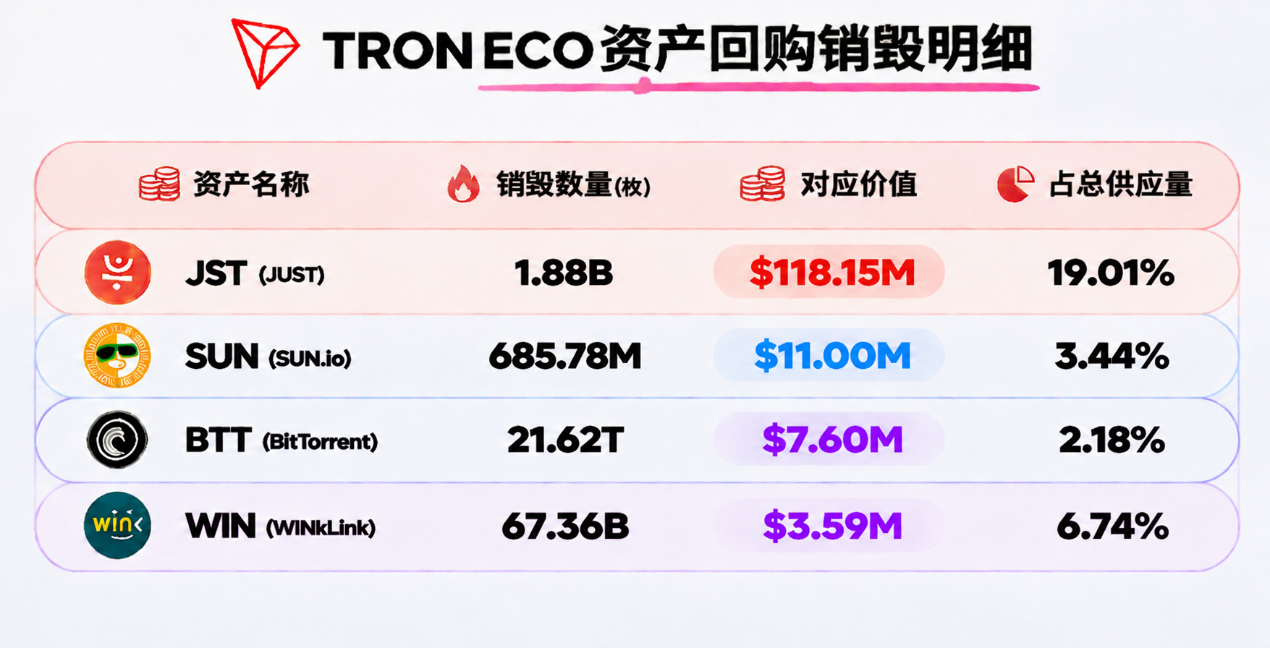
From JST, SUN's ongoing regular buybacks to BTT, WIN's initial buyback and burn plans' concentrated implementation, all four core governance tokens in the TRON ecosystem have completed the closed-loop of deflationary mechanisms, with real business revenue becoming the core support for token value capture, directly driving the re-evaluation of the ecological core asset value. According to feedback from the secondary market, the continued implementation of buyback and burn mechanisms has significantly enhanced asset price resilience: since the buyback plan started in October 2025, JST has seen an annual cumulative increase of over 300%; within three months after the buyback plan was initiated in July 2026, BTT and WIN rose over 23% and 100%, respectively; the deflationary value effect is continuously being released.
For users, governance assets like JST, SUN, BTT, and WIN serve dual value: they are not only certificates of rights to participate in the governance of core projects like JUST, SUN.io, BitTorrent, and WINkLink, but also important carriers connecting to ecological development outcomes. Relying on the normalized buyback and burn mechanisms driven by the project's real business revenue, the deflationary value will continue to enhance with the growth of ecological revenue, allowing users to automatically share in the growth dividends of ecological business without additional operations; meanwhile, these governance assets can also connect to various DeFi applications within the ecosystem, further activating assets and enhancing usage efficiency.
From asset utilization to value return, TRON ecosystem assets ignite a new growth flywheel
From the efficient payment circulation of foundational assets to the expansion of on-chain income management and asset allocation scenarios through interest-bearing certificate assets, and finally to the landing of token value capture through ecological projects relying on real business operations and normalized buyback and burn mechanisms, TRON is completing a value cycle of synergizing assets, applications, and token economics. This allows the overall growth of the ecosystem to no longer rely on short-term external traffic stimulation but instead depend on the internal business circulation of the ecosystem to continuously create value, gradually driving the growth flywheel into operation.
In this flywheel system, the asset layer first provides foundational power. Mainstream assets like TRX, USDT, USDD, and WBTC firmly build the liquidity foundation for network operation, payment settlement, and on-chain financial applications, while sTRX, sUSDD, and stUSDT further open up the flow channels for network staking, stablecoin appreciation, multi-chain asset interactions, and RWA yields; each circulation of foundational assets provides initial power for the flywheel’s rotation.
If the asset layer determines the starting point of the flywheel, then the application layer determines the efficiency and radius of the flywheel's rotation. SUN.io, JUST, and other core DeFi projects continuously expand the depth of asset utilization and coverage of scenarios through trading, staking, lending, and income management products, improving asset utilization efficiency and further accelerating the rotation of the flywheel; BitTorrent and WINkLink enrich the ecological business layout through decentralized storage infrastructure, AI computing power scheduling, and oracle data services, bringing a continuous stream of new business needs to the flywheel.
As business demands and operational revenues gradually settle, the governance asset layer undertakes value return. The four ecological governance assets JST, SUN, BTT, and WIN bind project operating cash flow with token supply management through the buyback and burn mechanisms, providing a feasible long-term path for the value capture of the entire ecosystem.
Therefore, asset circulation creates real demand for on-chain applications, application collaboration continuously enhances capital efficiency across the entire link, business development accumulates stable operational income, and the deflationary value mechanism returns income to ecosystem participants. Each segment mutually supports one another, forming a positive cycle from asset use, business growth to value return, where each link adds new power to the flywheel.
For users, TRON ecosystem assets are no longer just tools for holding and trading but versatile rights carriers that allow participation in payment settlements, asset exchanges, staking, lending, income management, and community ecosystem building through various on-chain applications, directly sharing the full-link value dividends brought by the rotation of the flywheel. For ecological projects, continuous product iteration and business expansion constantly create new demands for asset applications, further promoting the collaboration between project operations and the token economic system, accelerating the flywheel's ongoing speed.
免责声明:本文章仅代表作者个人观点,不代表本平台的立场和观点。本文章仅供信息分享,不构成对任何人的任何投资建议。用户与作者之间的任何争议,与本平台无关。如网页中刊载的文章或图片涉及侵权,请提供相关的权利证明和身份证明发送邮件到[email protected],本平台相关工作人员将会进行核查。


