
Author: 0xFacai, Blockbeats
We previously mentioned that in September, the nominal trading volume of on-chain options reached $4.829 billion, a month-on-month increase of 121.7%; the monthly premium trading volume also grew from over $20 million at the beginning of the year to over $80 million. Hyperliquid founder Jeff publicly discussed the development opportunities in options.
However, many crypto-native traders are already accustomed to trading perpetual contracts. They go long when bullish, go short when bearish, place margin, and open or close positions at any time. When they switch to the options interface, facing a row of strike prices, expiration dates, and Greek letters, their impulse to trade is first consumed by the complexity of operations.
The recently announced Power Perps on the HIP-3 trading platform Paragon offers another entry point. It starts from HYPE², allowing traders to gain option-like profit curves using a "contract opening" method.
There are no strike prices and no expiration dates. You are still trading a perpetual contract, but the price it tracks has become the square of HYPE.
Convexity
The profit of a standard perpetual contract is a straight line. Holding a fixed number of long positions, you earn the same amount for every $1 increase in the underlying; similarly, you lose the same amount for every $1 decrease. Leveraging makes this line steeper, without changing its shape.
"Nth power contracts" change this.
For convenience, let's assume an asset starts at a price of $100, and the price of the second power contract also starts at $100.
If the underlying rises to $110, the index reaches 121, an increase of 21%; if the underlying falls to $90, the index drops to 81, a decrease of 19%. For the same 10% price change, the bulls earn a bit more on the way up and lose a bit less on the way down.
When the market expands, the difference becomes more obvious. If the underlying increases by 50%, the second power index rises by 125%; if the underlying decreases by 50%, the index drops by 75%. If the underlying doubles, the index becomes four times its original value. The cubic contract goes further; if the underlying doubles, the index becomes eight times its original value.
Assuming the price change of the underlying is r:
Second power contract's price change = 2r + r²
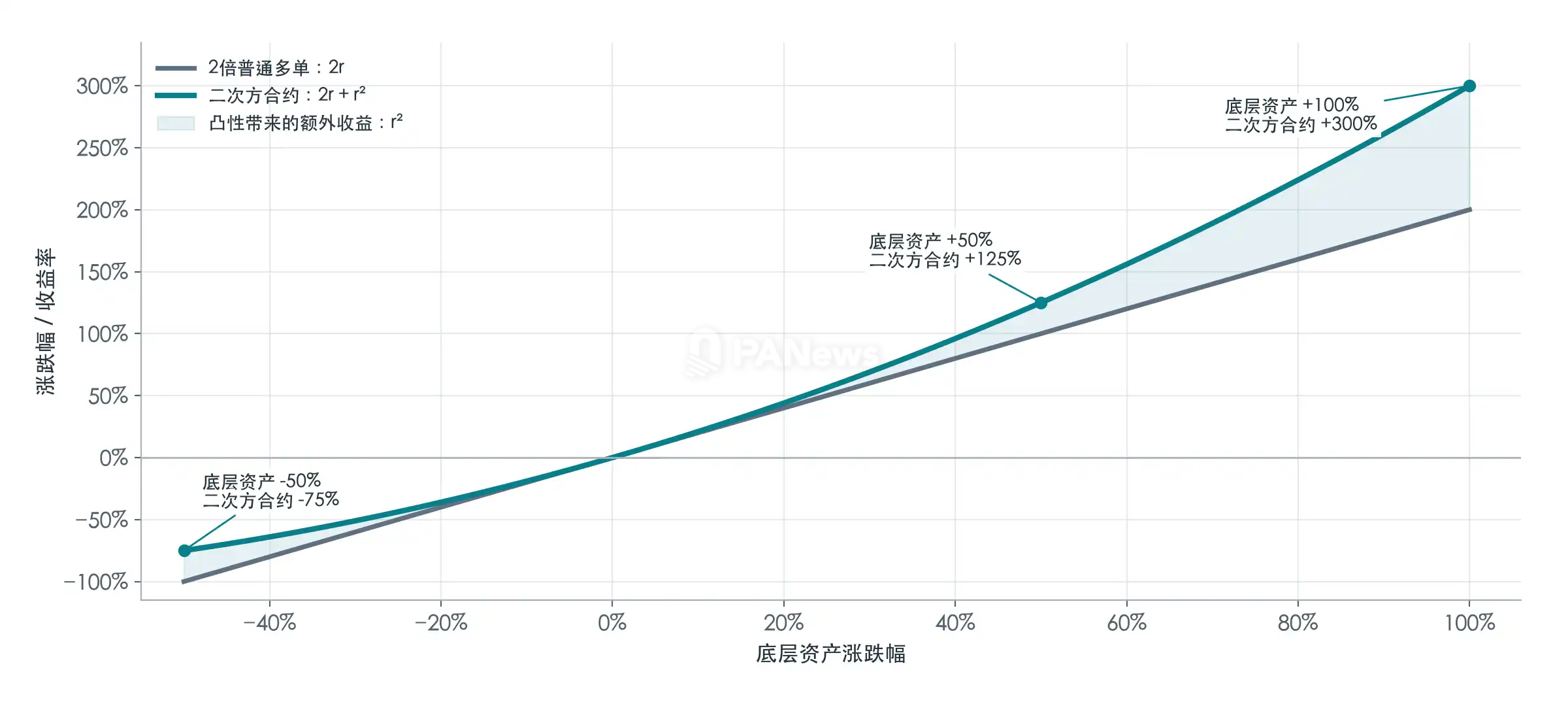
The preceding 2r provides the 2x leveraged profit margin for going long; the subsequent r² is always non-negative, thus relative to 2x long, it increases profit during upward movements and reduces losses during downturns. The larger the market swing, the greater this gap becomes.
This is "convexity." Moving up along the second power curve, for every additional $1 increase, the bulls earn more than they did on the previous $1; moving down, for every additional $1 decrease, the losses are less than on the previous $1. The sensitivity of the second power contract changes automatically with the price, which standard contracts cannot achieve.
What option traders are willing to purchase includes this "convexity."
This concept had a theoretical foundation as early as 2021. Paradigm's Everlasting Options discussed how to maintain an "everlasting" options exposure through continuous funding rates, and the subsequent Power Perpetuals article considered the power of price as the tracking target. Afterward, Opyn practiced this with Squeeth, which tracks ETH², while Paragon aimed to bring such products to Hyperliquid's order book.
Moreover, the demand for traditional options trading is fragmented across many contracts with different strike prices and expiration dates, leading to very fragmented liquidity. "Nth power contracts" allow traders of the same underlying and the same power to share the same order book.
Fees
At this point, a thought may easily arise. The second power contracts rise faster and fall slower, but what is the cost of this advantage?
Let’s conduct a long-short dual opening experiment. Suppose a trader opens a second power long position when the price is $100 and hedges it with two units of the underlying asset's standard short position. If the underlying price rises from 100 to 110, the second power long earns 21, while the linear short loses 20, yielding a total profit of 1. If the underlying drops from 100 to 90, the second power long loses 19, and the linear short earns 20, still yielding a profit of 1. Rising to 120 or dropping to 80, both scenarios yield a profit of 4.
Expressed in formula, the profit and loss of this long-short combination is:
Long-short combination price profit and loss = (Price of underlying asset - 100)² ÷ 100
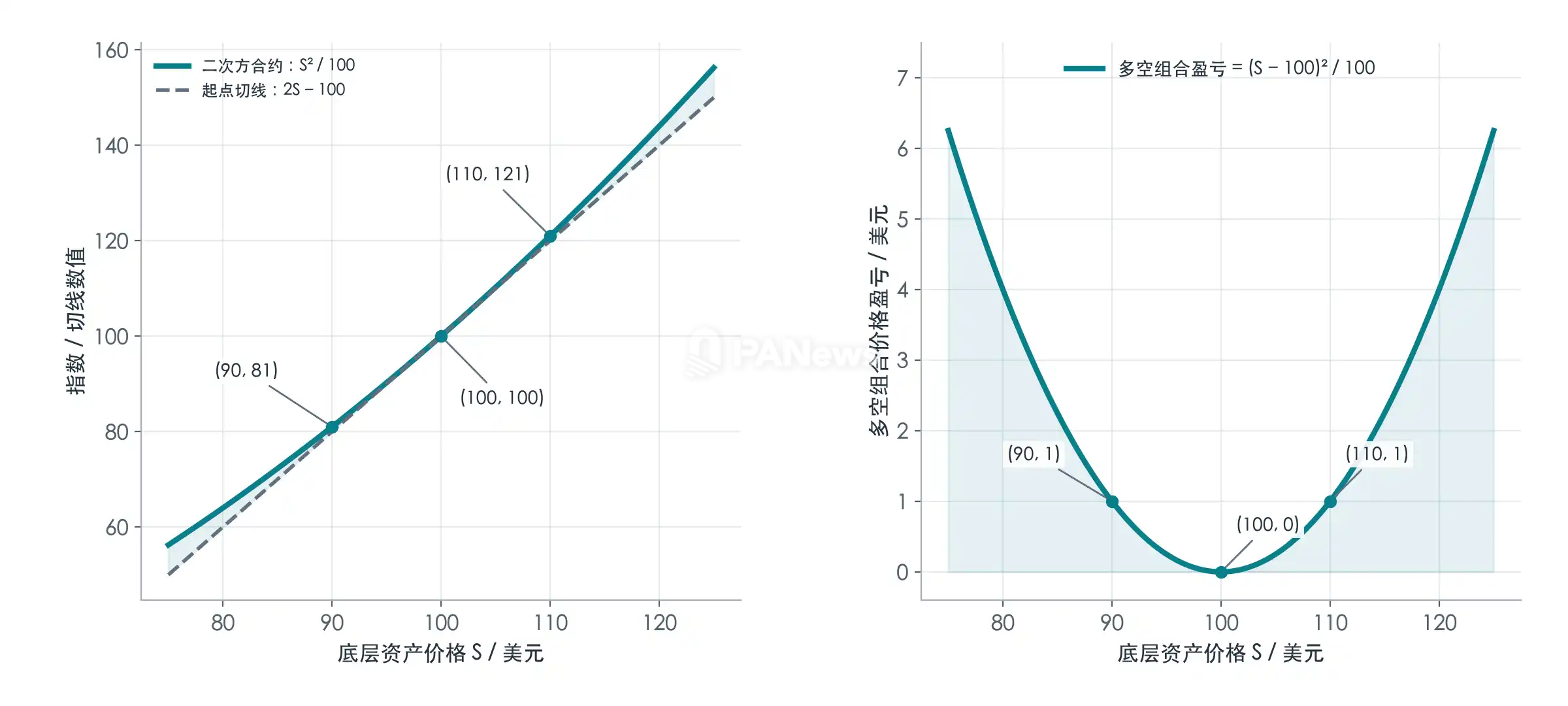
If there were no funding rates, traders could arbitrage freely using the above method.
However, the "no-arbitrage principle" requires that such benefits must come at a price, i.e., funding rates.
From the market maker's perspective, this is easier to understand. A market maker sells a second power contract while simultaneously buying two units of the underlying asset to hedge. If the underlying rises by $10, the market maker's short incurs a loss of 21, while the hedged spot only gains 20, resulting in a net loss of 1; if the underlying falls by $10, the short earns 19, while the hedged spot loses 20, also resulting in a net loss of 1. This is the "arbitrage" profit from the other side.
Market makers must also continually adjust the hedged quantity as prices change. After each adjustment, the next price movement will again generate profits and losses related to the square of the change. Accumulating these squares forms the "variance" in this context. The more volatile the price changes are, the higher the hedge costs incurred by market makers in providing convexity.
Therefore, aside from the holding costs of standard contracts, long positions on Nth power contracts must continuously pay for convexity. This cost, which is related to variance (the square of volatility), is usually paid from longs to shorts. The premium and discounts at the order book will also affect the final funding rate.
Liquidation
Starting again from $100, let’s take out $100 in principal and compare a 2x long position with a fully collateralized second power long position worth $100.
If the underlying drops from 100 to 50, the loss for the 2x long position is $100, and the principal has been fully lost, with actual liquidation occurring even earlier. Ignoring funding rates and losses from other full positions, the second power long at this point drops from 100 to 25 and still retains $25 in equity, meaning it will not be liquidated due to a simple price drop.
The fully collateralized second power long position allows traders to gain about double the initial price sensitivity while avoiding liquidation triggered solely by a price drop.
However, if leverage is applied again to the second power contract, the liquidation will approach quickly. According to Paragon’s risk documentation, without considering accumulated funding costs and other account assets, a 2x HYPE² long position will be liquidated when HYPE decreases by approximately 22.5%, while a 3x HYPE² long position will be liquidated with just a 10.6% drop.
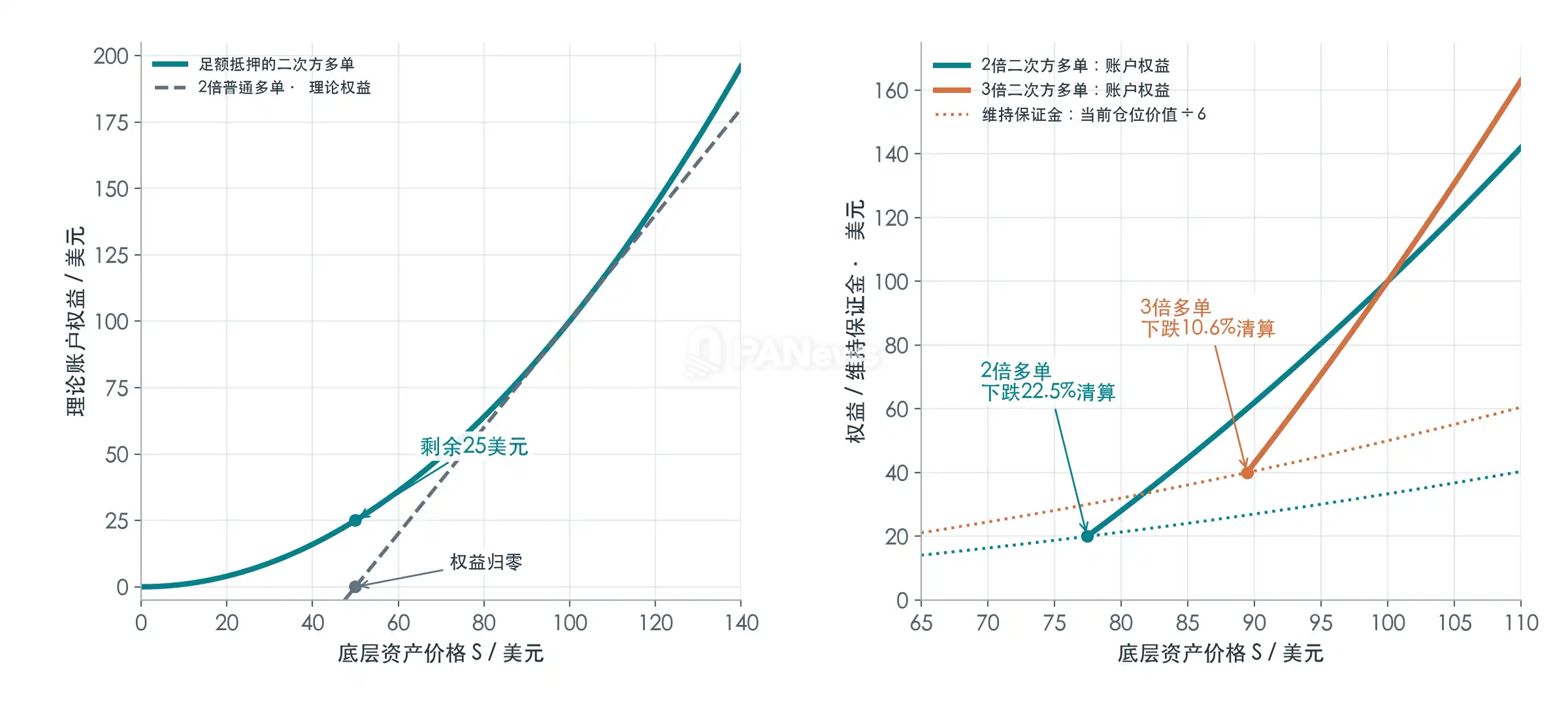
The short side must also be more cautious. The higher the price rises, the faster the losses for the second power short, and a 1x second power short will also be liquidated.
Volatility Trading
The combination of the second power long position with a linear short position can also turn into a trading strategy. You don’t need to determine whether the next move will be up or down; you just need to assess whether the price will move sufficiently away from its current position.
In traditional options, buying both a call and a put option at the same strike price and expiration creates a "straddle." Profit can be obtained in either direction during significant increases or decreases. Power Perps uses a second power long position along with a linear short position to generate a profit curve that rises on both sides.
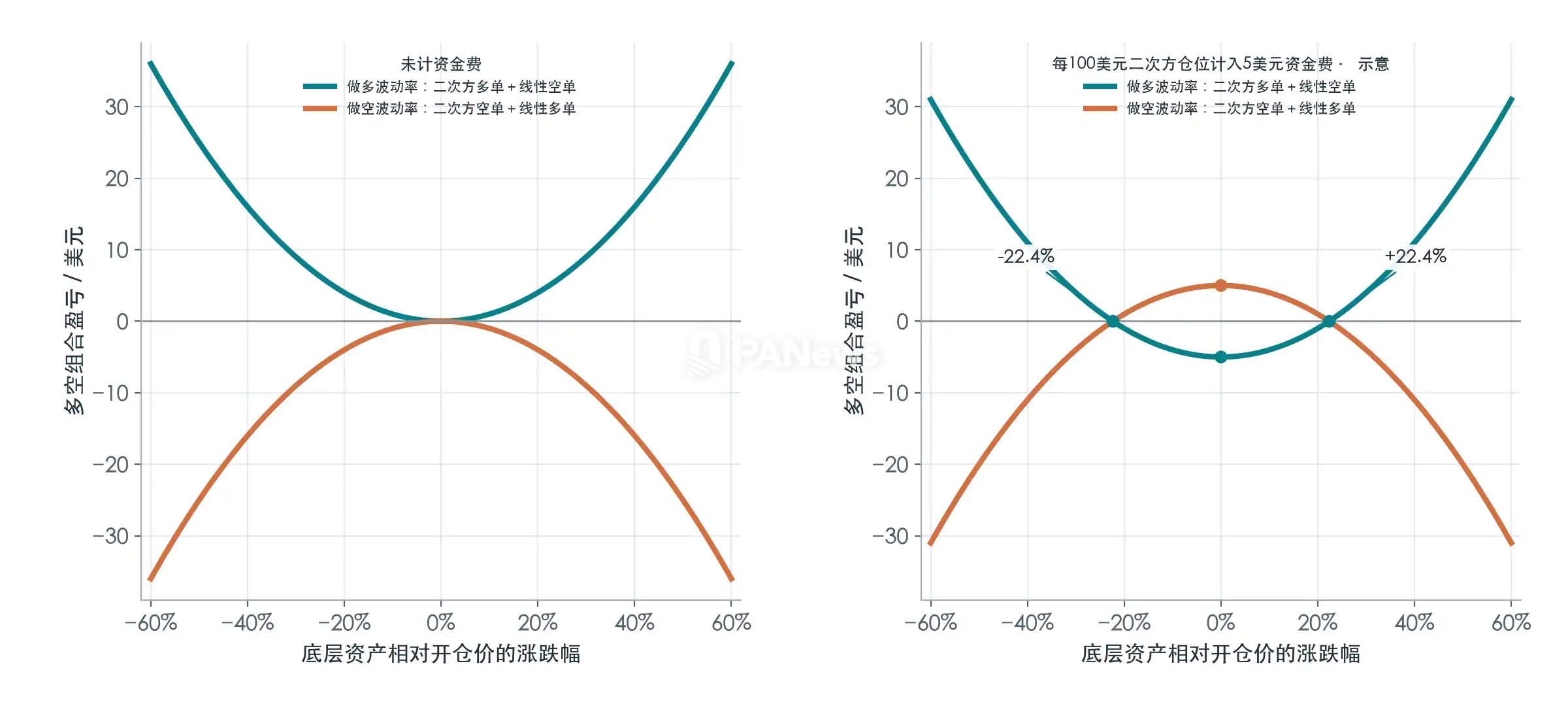
This is an intuitive entry point for going long on volatility. Significant increases and decreases can bring opportunities, but the price needs to have sufficient volatility to offset the funding fee costs.
Conversely, by shorting the second power contract and buying the corresponding quantity of the underlying asset or linear long position for hedging, one can go short on volatility. If the price remains close to the opening position, the funding fees collected by the second power short contract may become profit; however, once there is a significant increase or decrease, the losses from the hedge will increase with the square of the price movement.
But the feature of second power contracts "without an expiration date" also means that the cost of holding due to funding fees can accumulate indefinitely.
Power Perps cannot replicate all traditional options strategies exactly. Exotic combinations require two different strike prices; spread strategies can set profit ceilings and loss floors through different strike prices; covered calls and puts require selling options at specific strike prices to give up some profit space in exchange for premiums.
These strategies have profit inflection points defined by strike prices, usually also having specified expiration times. The combination of second power contracts and linear positions provides a smooth curve. Adjusting the proportion of positions can approximate certain options strategies within a specific price range; however, if one wants to precisely agree on "capping at a certain price" or "constant profit within a certain range," they still rely on options.
The cost of simplified operations and concentrated liquidity is a reduction in the freedom to choose profit structures.
Evolution of "Coin Listing" Strategy
Hyperliquid provides the order book, underlying market, and margin system, while Paragon designs new profit curves based on these foundations. Market makers can hedge more conveniently, and developers can continue to package combinations into strategies, reducing the operations required for traders to build and adjust positions.
Traditional options have proven that there is a long-term demand for different profit structures in the market. The value of Paragon's current attempt lies in expressing part of this demand in a way familiar to crypto-native traders, while allowing existing perpetual liquidity to hedge the new products.
More noteworthy is the trend that the "coin listing" of the HIP-3 exchange has evolved from selecting popular traditional financial assets to creating new forms of derivatives. Looking forward to seeing more of such financial experiments on Hyperliquid.
免责声明:本文章仅代表作者个人观点,不代表本平台的立场和观点。本文章仅供信息分享,不构成对任何人的任何投资建议。用户与作者之间的任何争议,与本平台无关。如网页中刊载的文章或图片涉及侵权,请提供相关的权利证明和身份证明发送邮件到[email protected],本平台相关工作人员将会进行核查。


