Author: Alea Research
Translation: Deepwave TechFlow
Deepwave Introduction: In the public chain ecosystem, the complete transparency of all transfers and capital deposits on Ethereum is becoming a core pain point for companies paying salaries, institutions managing financial resources, and whale traders protecting positions. This in-depth research report from Alea Research tracks the micro fund changes of Railgun: stablecoins have replaced Ethereum as the absolute main force, with monthly inflows and outflows exceeding $117 million, setting a historical record.
By upgrading the underlying to EIP-7702, the protocol has expanded anonymous interactions to complex DeFi scenarios such as Aave lending and Morpho vaults within just seven days, and has rigorously calculated the true risk-free cash flow distribution for stakers using mathematical models.
On the Ethereum network, any stablecoin payment reveals the sender, receiver, and specific amount in the blockchain explorer. For companies needing to distribute employee salaries, institutions coordinating capital allocation, or traders who urgently need to hide positions to prevent being targeted by counterparties, this constitutes a fatal pain point.
In September of this year, a total of $117 million in stablecoins chose to flow into and out of Railgun's privacy fund pool, setting a record for the highest single month in the history of this protocol. Currently, stablecoins occupy 77.2% of the total assets flowing through this fund pool, significantly higher than 33.7% a year ago.
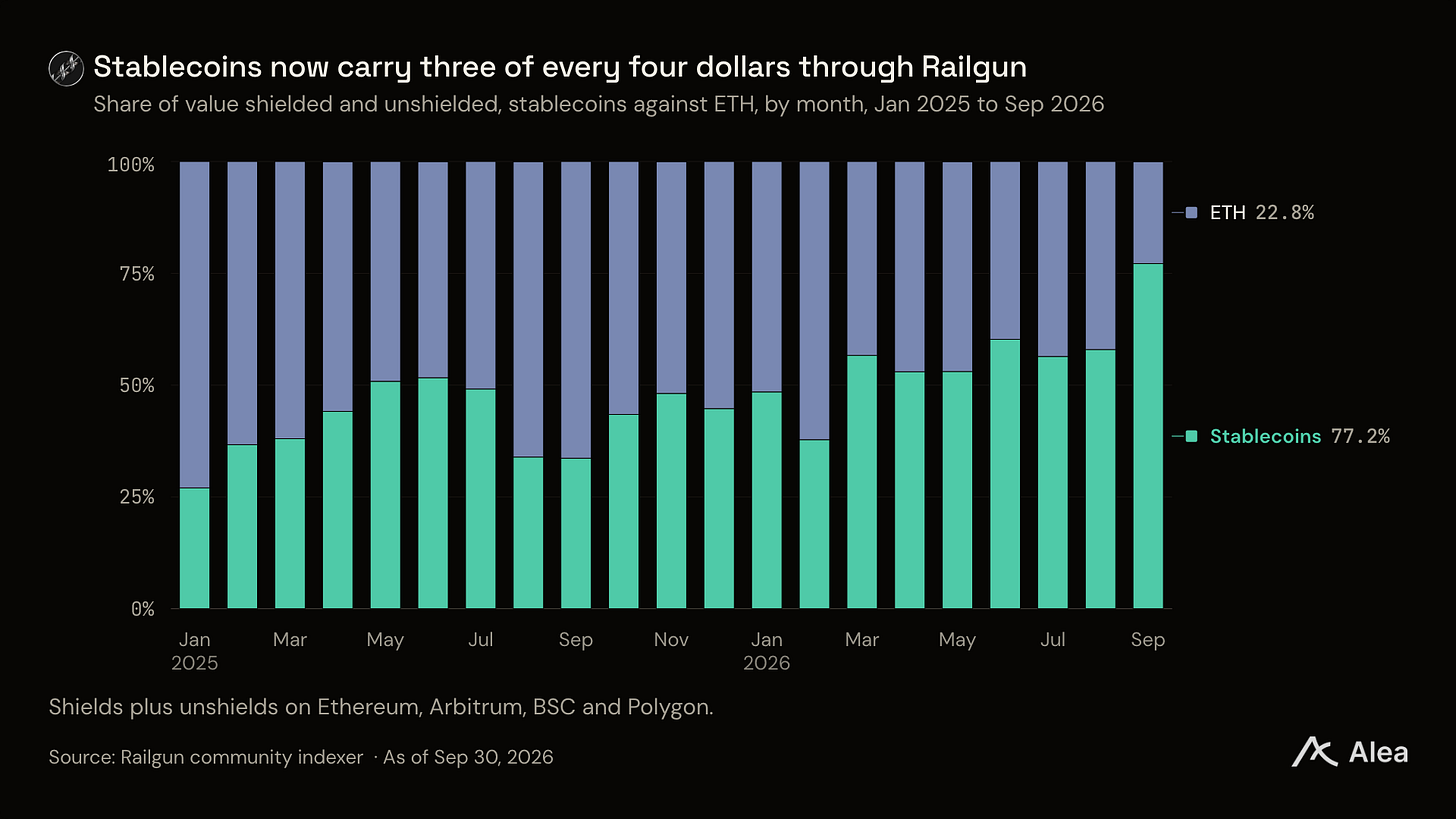
Figure: Trends in stablecoin and ETH fund pool changes on Ethereum, Arbitrum, BSC, and Polygon
Key Points
Stablecoins have officially evolved into the core business pillar of Railgun. The trading volume of stablecoin transactions flowing through this privacy pool has surged by 93.6% within a year, jumping from $60.7 million in September 2025 to the current peak. USDC, USDT, DAI, and fxUSD can seamlessly flow between Railgun addresses, with both parties fully concealed in identity and transaction amount.
Mainstream wallet ecosystems fully promoted the migration of Railgun's DeFi interaction traffic to one-time accounts within just seven days. After the new version was released on September 30, the weekly operation count for unblocking to the old shared contracts plummeted from 612 to 21, while the call volume to unblock to one-time accounts surged from zero to 559.
Privacy users can now safely hold on-chain lending positions and vault shares. DeFi positions initiated from one-time independent accounts will permanently reside in that account, and that account will have no traceable connection to the owner's public wallet address on-chain.
The governance token RAIL has surged 35.3% this year, while ETH has dropped 21.7%. In September, the monthly privacy trading volume across Ethereum, Arbitrum, BSC, and Polygon reached a record 13,918 transactions, a substantial increase of 65.2% year-on-year.
Token stakers have cumulatively received 524 ETH this year, with half of that amount coming after July. A community proposal passed on July 22 raised the stakers' bi-weekly distribution ratio to 4.2% of the vault's funds. The browser wallet Ambire is set to officially integrate with Railgun through the Ethereum Foundation's Kohaku development kit.
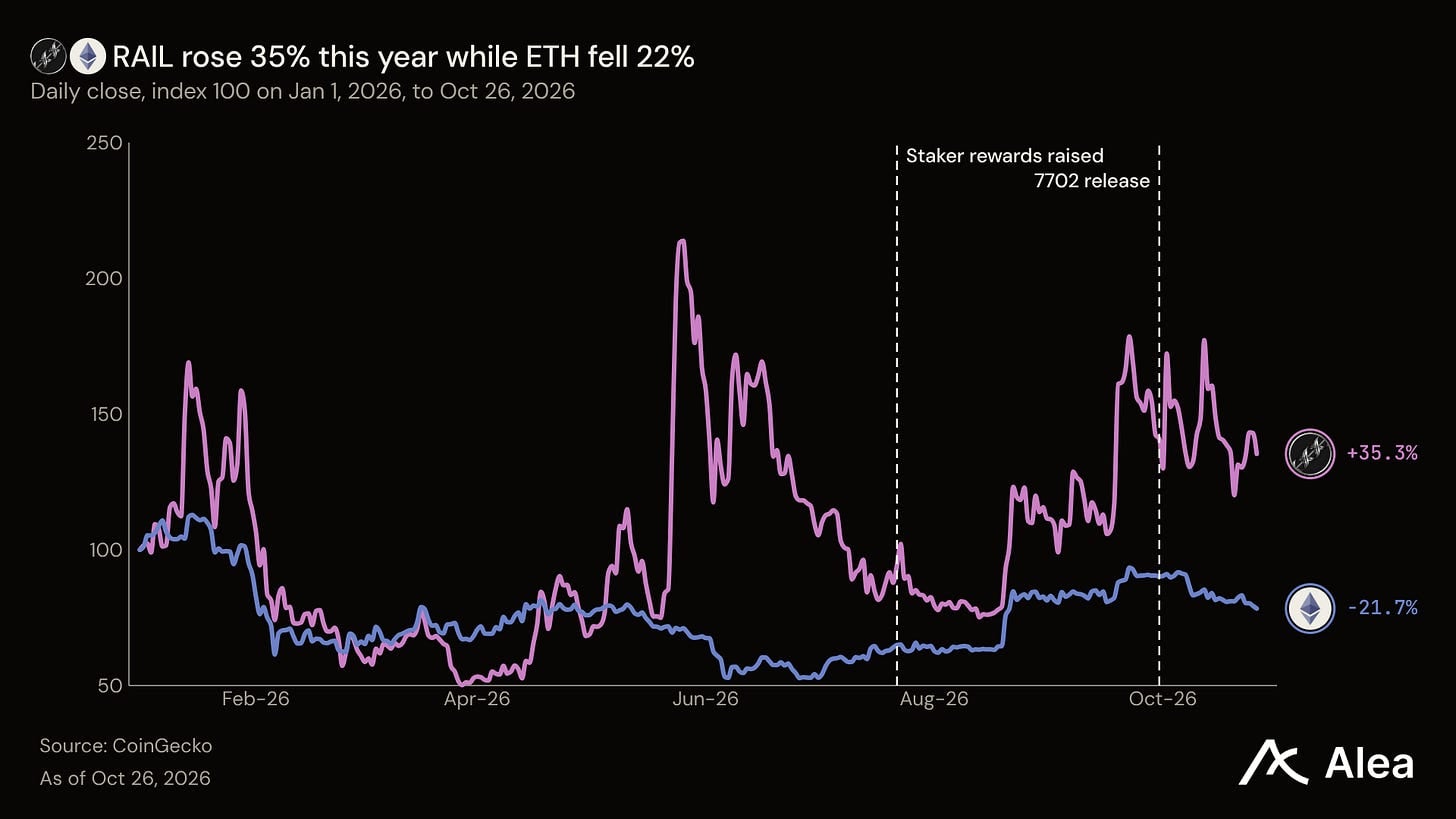
Figure: RAIL and ETH trend comparison based on January 1 closing price
Shift in Business Focus to Stablecoins
In September, the trading volume of stablecoins at the edges of the fund pool exceeded three times that of ETH, with volumes of $117 million compared to $34.8 million.
Railgun uniformly stores all tokens under shield protection in a smart contract fund pool. Users manage assets from that pool through zero-knowledge proofs (ZK Proofs), which verify the validity of funds on-chain without exposing the asset owner, account balance, or type of token. In September, f(x) protocol officially supported users minting their synthetic stablecoin fxUSD directly into the shielded balance.
Point-to-point transfers between two Railgun addresses incur no protocol fees at all. In addition, wallet endpoints can also choose to run "Private Proofs of Innocence," an optional on-chain screening mechanism that can verify the compliance of each new deposit against sanctions or fraud tracking blacklists without exposing user identities.
Key Seven Days in October
Before October of this year, all of Railgun's DeFi contract interactions were executed through Adapt Relay, a single shared relay contract. The fund pool would transfer tokens to the relay, which was responsible for calling external DApps and re-shielding the execution results back, completing the entire process in a single transaction.
This model is very suitable for instant token swaps but completely fails for any operations tightly bound to deposit addresses (such as Aave lending collateral), as public shared contracts cannot deliver specific positions to the underlying users who provide initial funds.
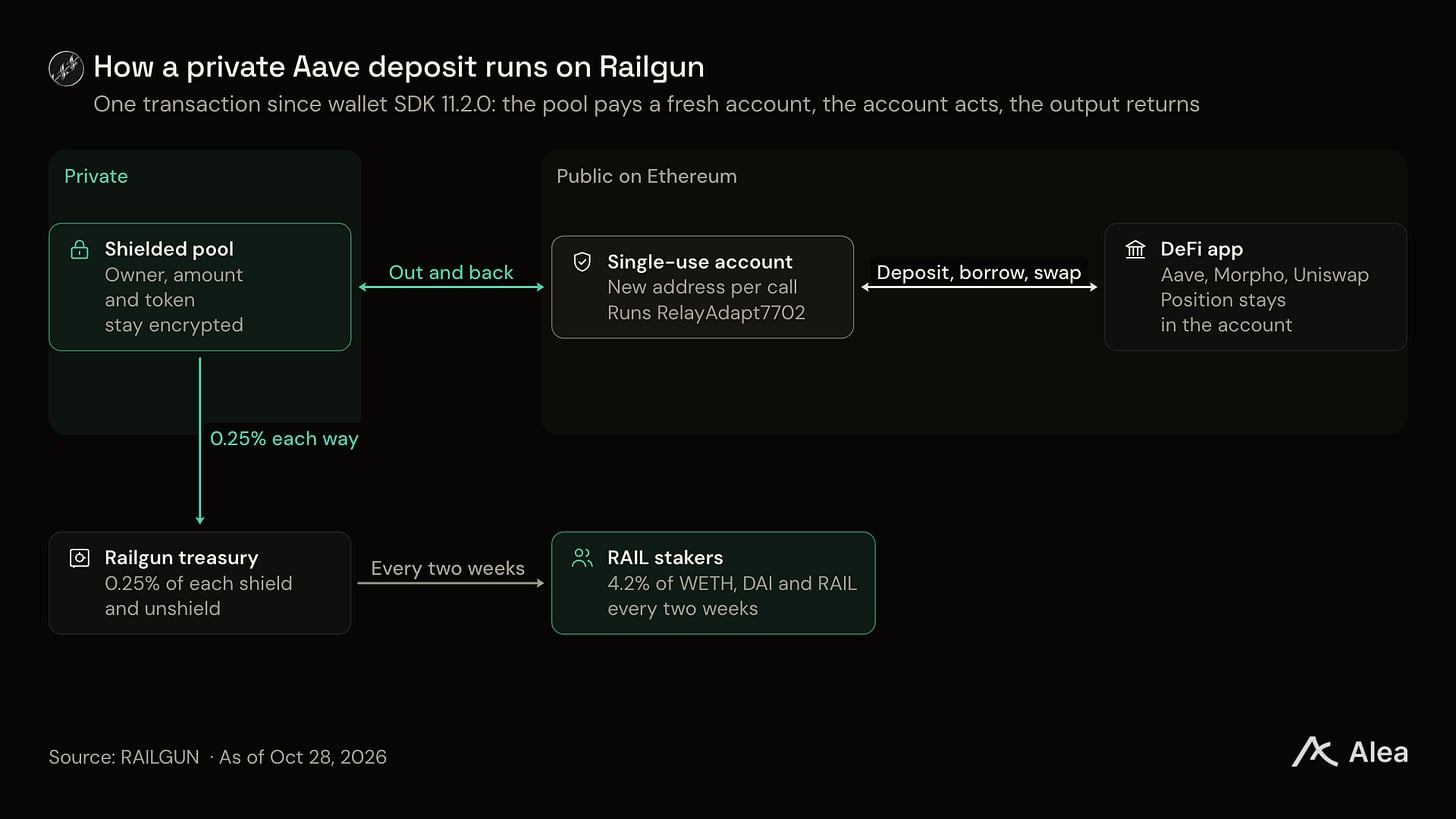
Figure: Single Railgun DeFi call process architecture in Wallet SDK version 11.2.0
The Railgun wallet toolkit version 11.2.0 released on September 30 has completely overturned the old model. The new version replaces the traditional relay with an Ethereum EIP-7702 protocol upgrade, enabling ordinary external accounts (EOAs) to directly run smart contract code.
Now, every DeFi call is initiated by a new one-time account dynamically derived from the user's private key. All wallet endpoints direct these accounts to the same delegated contract RelayAdapt7702. Because all users across the network share the same delegation agent, the on-chain path completely obscures which wallet application the initiator is using.
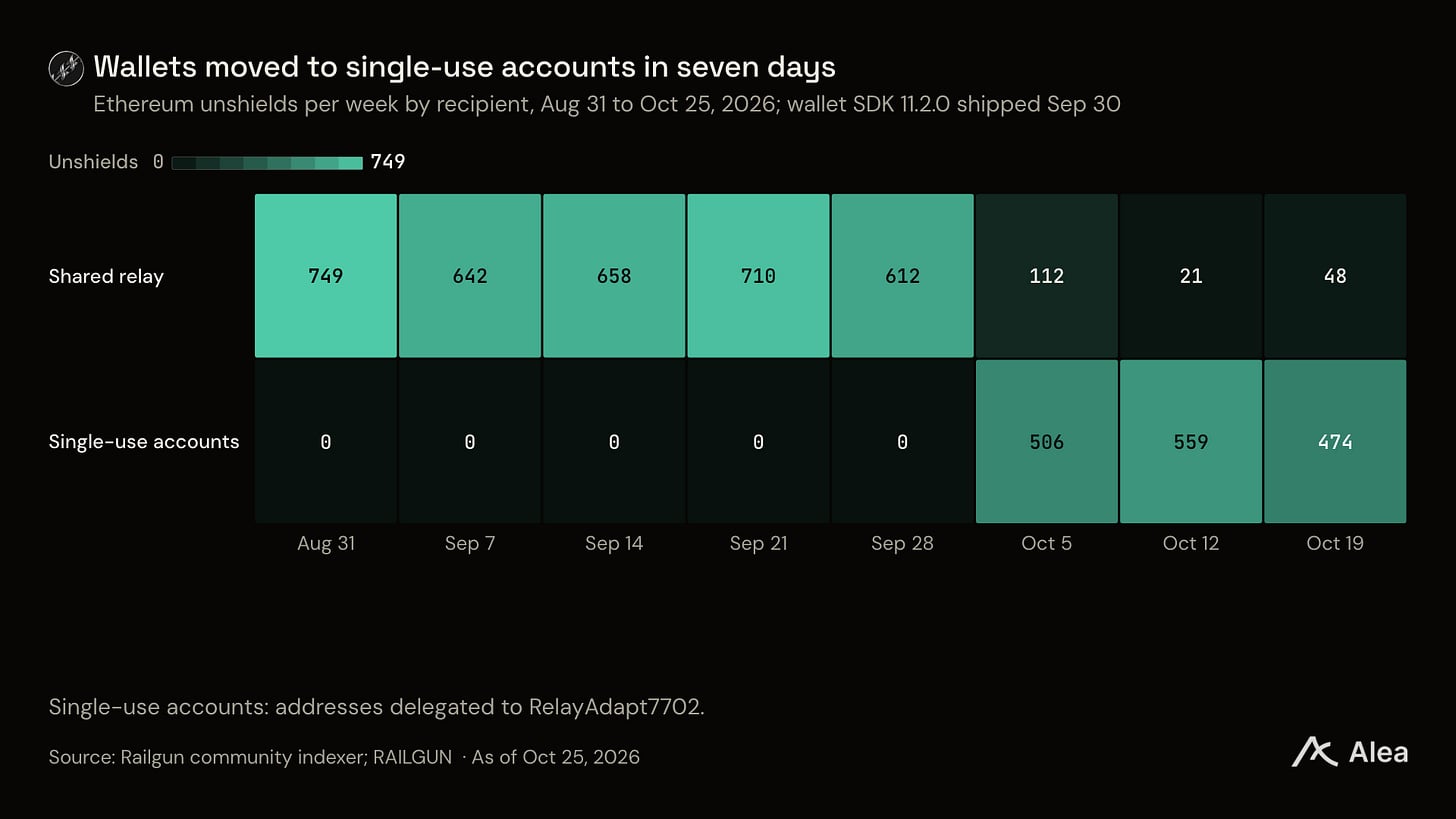
Figure: Comparison of weekly unblocking to shared relay and delegated relay by on-chain code classification
The weekly unblocking calls directed to traditional shared relay plummeted from 612 to 112 on the week of September 28, and then further contracted to 21. Meanwhile, the overall interaction volume across the network remained firmly at around 600 transactions per week: with weekly counts of 612, 618, 580, and 522 respectively.
During the period from October 5 to October 25, as much as 89.5% of the unblocking calls were directed to one-time independent accounts, with 1,539 operations precisely distributed across 1,368 completely different addresses. Almost every interaction has its own completely new independent account.
The third-party wallet ecosystem is the biggest contributor to the successful implementation of this technological upgrade, with the code of Terminal Wallet serving as the reference standard for the new interaction process. On September 23, version 3.0.2 of Railgun’s official manual added routing plans for making private deposits to any Morpho lending vault. The mobile wallet Anon integrated Railgun into mobile in September, and community stakers have officially voted to approve protocol deployment on Base network.
Record On-chain Traffic Across Four Public Chains
In September, Railgun processed a total of 13,918 privacy transactions, marking its busiest month in history. Among them, the Ethereum mainnet handled 8,089 transactions, while Arbitrum handled 3,348 transactions. From January to September this year, the total number of privacy transactions across the network reached 94,685, a significant increase of 57.6% compared to the same period in 2025.
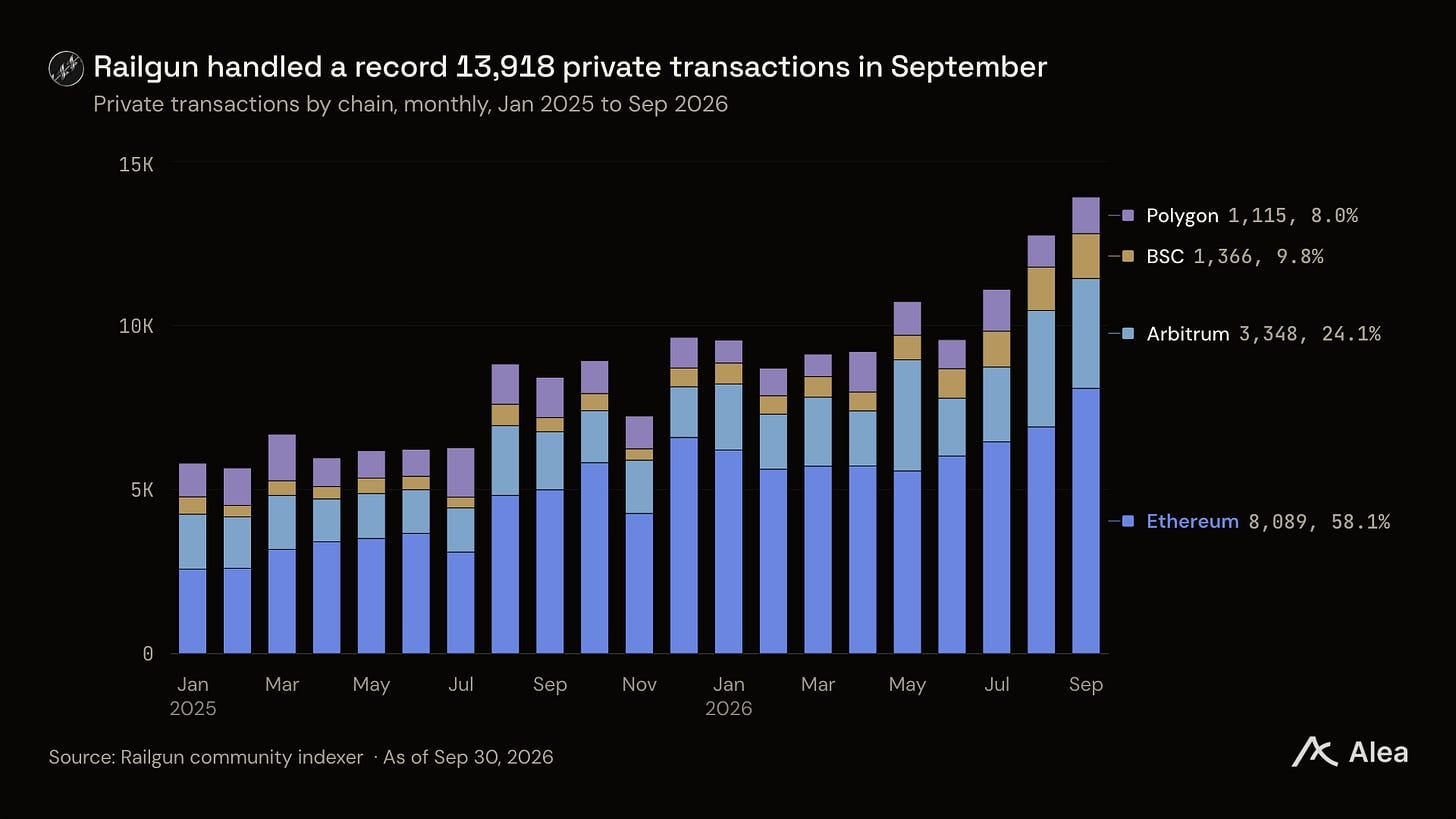
Figure: Monthly privacy transaction volume statistics on Ethereum, Arbitrum, BSC, and Polygon
What Do Stakers Really Get
Every two weeks, Railgun's on-chain vault will direct a portion of WETH, DAI, and RAIL reserves into the staking rewards distribution contract. Before July, the total dividends per period maintained around 14 to 21 ETH.
However, after the stakers voted to raise the distribution ratio from 2.0% to 4.2% on July 22, each bi-weekly dividend amount surged to 35 to 40 ETH. As of October 21, the cumulative total of dividends for the entire fiscal year has reached 524.4 ETH, of which as much as 262.9 ETH originated from the passage of that governance proposal.
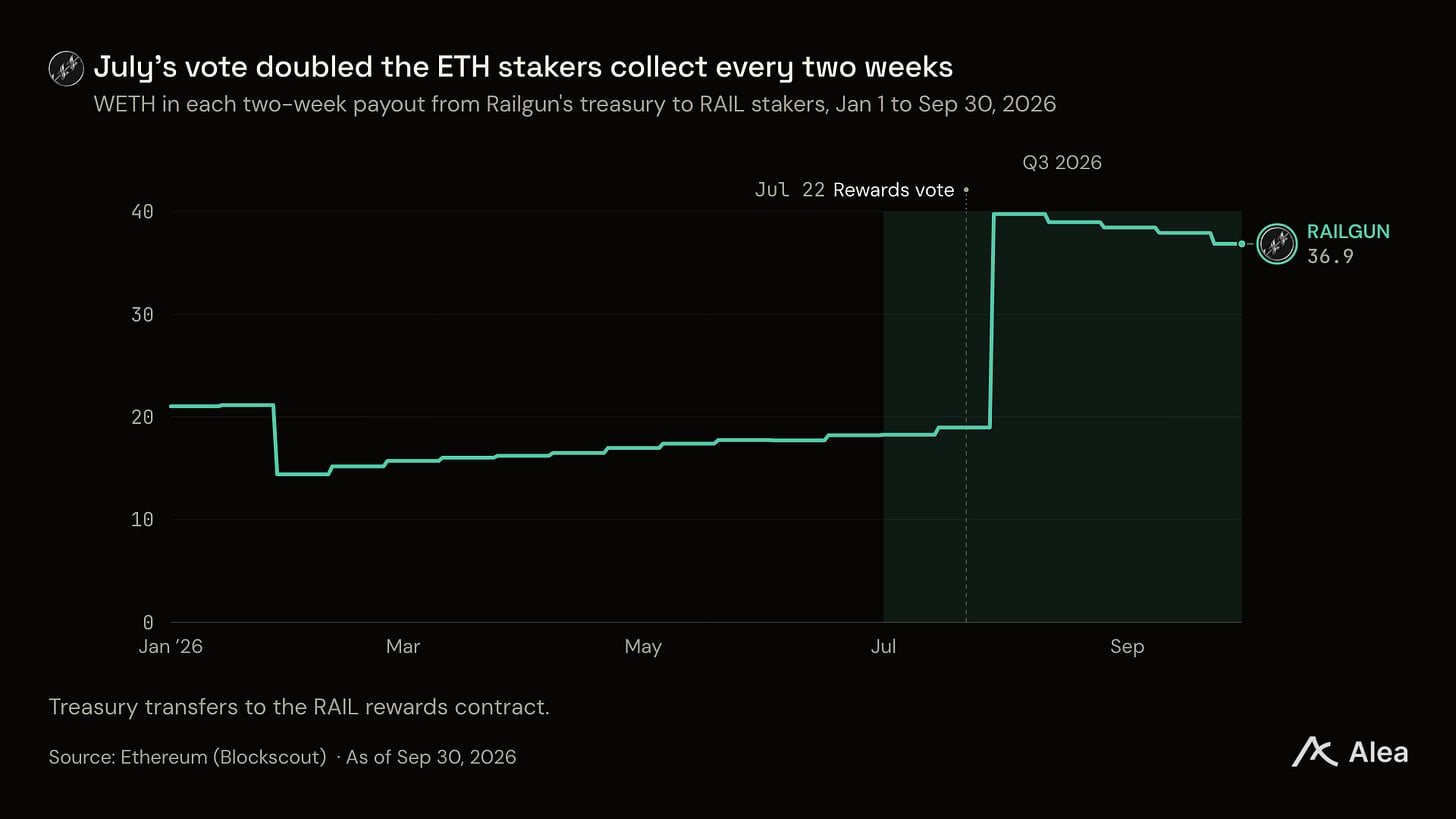
Figure: Single dividend records of WETH transferred to RAIL reward contract
Railgun levies a fixed fee of 0.25% on each shielded and unshielded operation and directly injects it into the on-chain treasury. The relay nodes responsible for submitting on-chain transactions for users will also charge additional Gas premiums, but this revenue belongs to the broadcasting nodes and does not enter the protocol treasury.
Every two weeks, 4.2% of WETH, DAI, and RAIL in the treasury will be opened for claiming based on the weights of RAIL locked by users. The entire revenue chain is autonomously executed by smart contracts, with no intervention from any multi-signatures or core team signers, and any mechanism change must go through on-chain governance proposals. The RAIL token itself does not set up buyback or burn mechanisms. In the dividend period of October 21, the treasury issued 35.0 WETH, 15,730 DAI, and 88,849 RAIL. The USDC and USDT reserves deposited in the treasury have not yet been included in this dividend cycle.
Scenario Simulation: Protocol Fees and Staker Dividends
Currently, the total amount of RAIL locked across the network by stakers is 42.53 million RAIL, accounting for 70.9% of the current total circulating supply of 60 million RAIL. Based on a price of about $2.41 per RAIL on October 27, its circulating market value is $144.5 million, and if calculated against the token contract maximum limit of 100 million, the fully diluted valuation corresponds to $241 million. The protocol captured fees in September reached $385,507, refreshing the highest record since 2026.
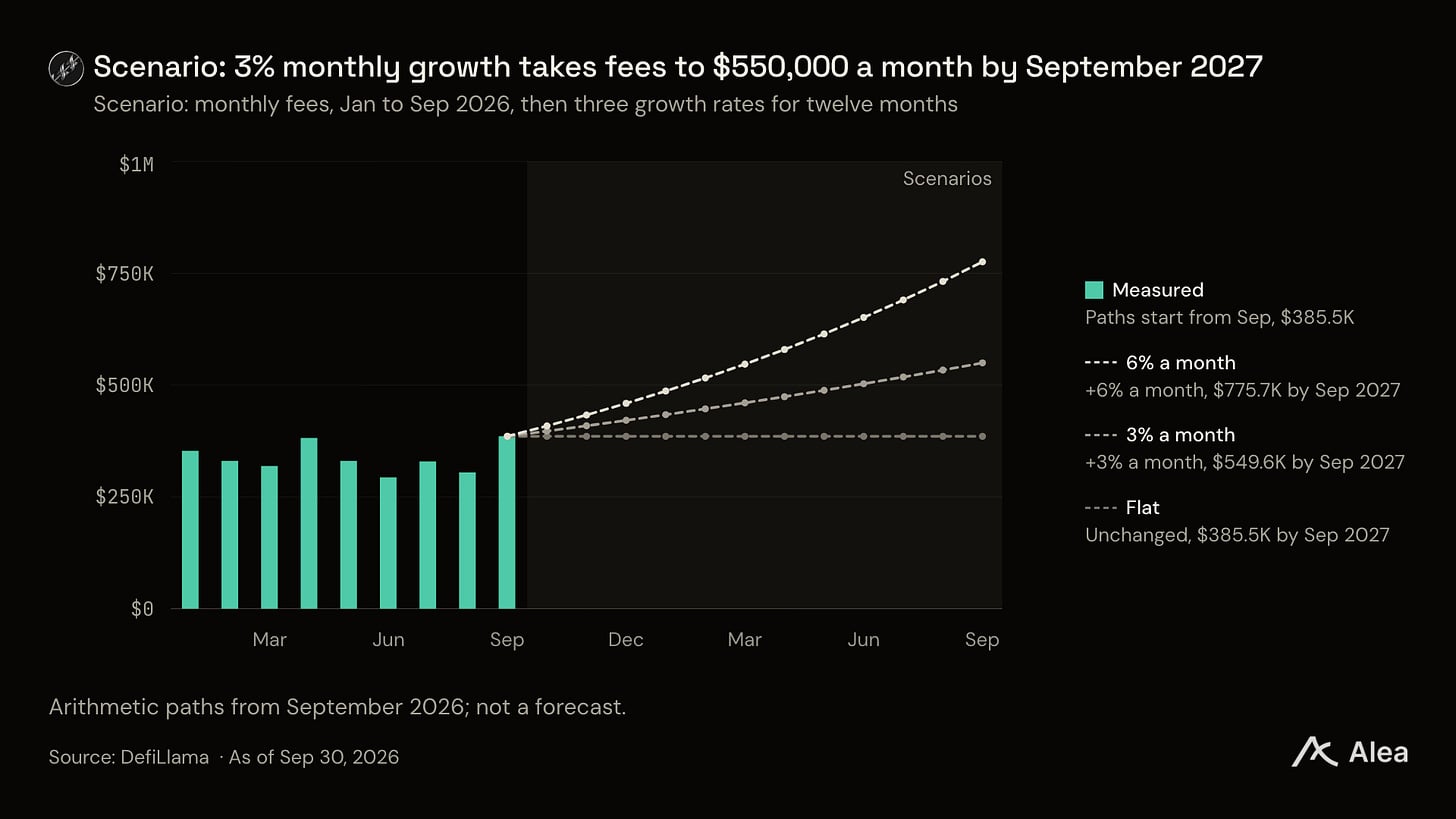
Figure: Monthly fees and scenario simulations based on different growth rates as of September 2026
If the measurement base maintains stability at September levels, the protocol's annual captured fees amount to 4.5% of the total value of staked RAIL (calculated at a RAIL price of $2.41). If the protocol’s average monthly fees grow steadily at a rate of 3%, by September 2027, the monthly fees will reach $549,641, with the annualized return rate rising to 6.4%; if the average monthly fees growth rate reaches 6%, the monthly fees will exceed $775,716, with the annual dividend yield rising to 9.1%.
Additionally, the treasury continues to release the RAIL tokens it holds for dividends. Based on the asset deposits on October 27, the comprehensive annualized dividend return rate for current stakers is around 7.6% of the total locked value.
Railgun solidifies core liquidity in the Ethereum mainnet while relying on cryptographic algorithms to conceal asset ownership and flow. This year, stablecoin funds have captured three-quarters of its total trading value. The integration of EIP-7702 smoothly extends the previously token-swap-limited privacy protection into complex lending and vault scenarios, completing a full switch of the entire wallet ecosystem within seven days.
Every protocol fee is timely returned to token stakers according to established rules, with July's proposal doubling the single-period ETH dividends. With the full launch of the Ambire wallet and the establishment of the RailOxide cross-chain privacy trading protocol announced on October 24, a new batch of wallet ecosystems is accelerating the integration of this new privacy infrastructure.
免责声明:本文章仅代表作者个人观点,不代表本平台的立场和观点。本文章仅供信息分享,不构成对任何人的任何投资建议。用户与作者之间的任何争议,与本平台无关。如网页中刊载的文章或图片涉及侵权,请提供相关的权利证明和身份证明发送邮件到[email protected],本平台相关工作人员将会进行核查。