Author: Jia Liu, Zhang Sheng Beatz
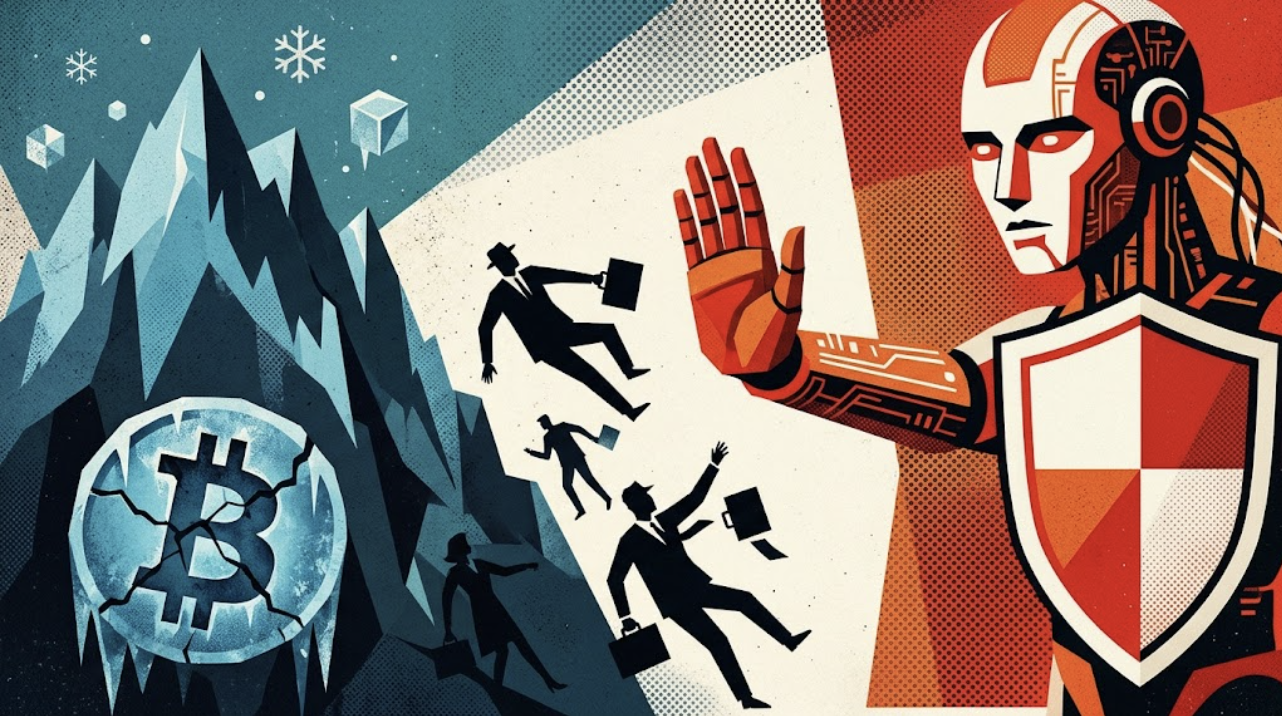
“AI is the main reason for our layoffs.” This has become the main statement of all companies announcing layoffs today.
In the first half of 2026, nearly 140,000 people were laid off in the American tech industry. Amazon cut 9% of its workforce, and Meta laid off 10%. Their reasons for layoffs are almost the same: AI is changing everything, and companies must streamline.
In fact, over 56% of layoffs in 2026 have explicitly listed AI, automation, or machine learning as the reason. AI has been the top reason for layoffs in American businesses for four consecutive months. Ironically, nearly 60% of companies admit they are packaging layoffs or hiring slowdowns as “AI-driven,” while the real reason is financial pressure.
The shockwaves of AI are not confined to Silicon Valley; it is reshaping the employment structure in almost every industry. The Web3 sector, as an intersection of technology and finance, has been particularly affected. The large-scale layoffs in the Web3 industry have been ongoing for over half a year and are exceptionally severe and rapid.
Since the beginning of this year, especially in recent months, news about layoffs, team restructuring, and personnel shifts at leading trading platforms has been intensively appearing on X, Reddit (the foreign equivalent of Zhihu), Xiaohongshu, Maimai, and among professionals in coffee chats. The once-dominant BitMEX has almost faded from mainstream view, and smaller platforms are exiting or shrinking their business lines. With talent and attention being drained by the AI industry, layoffs in the Web3 sector seem like a necessity.
The Sword of Damocles Has Fallen
Kevin received his layoff notice just three days before his last day.
Kevin had worked at an internet giant for several years before being attracted by high salaries and narratives in the Web3 sector, making a switch to a leading trading platform. He later learned that his layoff had actually been decided over a month earlier.
During that time, he felt no signals indicating he would be laid off. All work was proceeding normally; meetings were held, and messages were responded to. Until HR approached him, there was no reasonable explanation, no so-called poor performance, but the Sword of Damocles of layoffs still fell on Kevin.
In hindsight, the only signal he could consider was that two of his original team of ten had already left before him. At that time, everyone’s reasoning was that they were “not a good fit” or “looking for other easier jobs.” “Looking back now, maybe that was when they were already being pushed out,” Kevin told Zhang Sheng Beatz.
Richard’s smaller trading platform employed a more extreme method for layoffs. After being a stay-at-home dad for nine years, he returned to the workplace and found a job at a relatively small cryptocurrency trading platform. However, he and many colleagues were soon laid off.
According to him, one morning, he opened his computer as usual to prepare for work, only to find that his system access had been shut down. He thought it was a technical glitch until he opened the work group chat and saw about forty colleagues asking the same question: “Why can’t I log in?” No one knew what had happened. Panic spread like water in the group chat. A few hours later, they received a cold layoff notice in their private emails, effective immediately.
What chilled Richard even more was something else. Shortly before being laid off, a leader had hinted to him that one of his developer colleagues “might need to be adjusted.” At that time, Richard was still trying to help that colleague stay, even rearranging the work responsibilities to prove that this person was irreplaceable. However, before he could submit his proposal, both of them ended up facing the layoff outcome.
Another former employee from a cryptocurrency trading platform, Xiao Yu, described a similar layoff scenario to Zhang Sheng Beatz. In her previous company, the first step of laying off employees was to disable their Slack accounts and cut off email access in bulk. “Whenever we saw someone suddenly disappear from Slack, we would immediately rush into private chat channels, eager to send our phone numbers and LinkedIn links,” Xiao Yu said, “because we didn’t know who would be next, and everyone wanted to make sure to stay in touch while there was still time.”
“When the layoff finally came for me, my manager sent me a message via Slack asking if I was free for a call,” Xiao Yu said, “Before I could respond, all my access was revoked.”
Layoffs Are Like a Tornado
Kevin revealed that in the months following his departure, the group continued to have layoffs, leaving only two people remaining. The trading platform he worked at cuts about 10% of its staff every quarter, totaling 40% over the year.
Coinbase announced global layoffs of around 700 people in May, officially termed as “AI-driven restructuring,” a reduction of approximately 14%. However, according to insiders speaking to Zhang Sheng Beatz, the impact on Coinbase's India office far exceeded this number. Former employees reported that about 90% of staff in the India office had left, affecting all business sectors, not just sales. Only a few top engineers were invited to relocate to Canada to continue working.
The primary reason cited for the mass layoffs at the India office was high costs and significant time zone differences with the US. Coinbase pays about 7.5 million rupees (approximately 110,000 CAD) to an Indian SDE2 (mid-level engineer), comparable to local mid-level engineer salaries in Canada. In many high-paying product companies, the salaries of Indian architects are even higher than those of their EU counterparts.
Many trading platforms have been reported where employees and HR failed to negotiate compensation agreements, resulting in their final workday being confirmed that same day with access revoked. Additionally, the recently closed trading platform BitMart has seen entire departments laid off since May.
Moreover, many trading platforms choose to lay off employees at specific times, which is not a coincidence. According to Zhang Sheng Beatz, around June 30 is a peak time for layoffs in the industry. The reason is simple: they have new financial reports to release in July, and this data is to be presented to investors. By laying off a group of people and reducing costs, the profit and loss statement immediately looks better. For the management of trading platforms, layoffs are not just about cutting costs; they are also a form of financial narrative management. A streamlined report presented to investors is more convincing than any explanation.
Not just the trading platform represented by Kevin and Richard, almost all of the Web3 industry is undergoing large-scale layoffs, yet only a few layoff compensations are reasonable and satisfactory.
The interviewees mentioned earlier encountered similar situations, with trading platforms disconnecting contact and access very quickly during layoffs: “Everyone's contact information is on there; without access, we can't even advocate for our rights.”
Zhang Sheng Beatz learned from insiders that operational and product positions working offline or in overseas offices still receive reasonable handover time and compensation during layoffs, “but many tech roles are remote, so they just fire you directly and quickly, having no impact on them.”
Many IT employees are based domestically, while trading platforms are registered overseas. “You’re not there, so the cost of execution is high. That little money doesn’t affect their livelihood, so most people don’t want to, or can’t, fuss about it.”
Even with a few days of buffer time, the situation faced by employees is not good. HR, when discussing resignation procedures, asked Kevin to fill out the reason for leaving in the system and urged him not to select “company termination.”
“They would say if you select company termination, your background check will not pass, and they will speak ill of you. So they force you to select personal reasons.” If one chooses personal reasons, the company is not required to pay any additional compensation.
In the end, Kevin did not receive layoff compensation; the company just settled his wages and overtime pay up to his last workday. Later, Kevin reflected that during the preceding period before his layoff, there were indeed some signals that he did not understand at the time. For example, the harmony in working with his direct supervisor began to falter, and he could sense that the other person was not fond of him anymore. But in an organization that operates at high speed every day, these subtle changes are easy to overlook until the moment the shoe drops.
During a period of large-scale layoffs, various trading platforms are thinking of ways to package layoffs to look like anything but layoffs.
For instance, Zhang Sheng Beatz also learned from many interviewees that before employees join the company, leading trading platforms send out equipped computers. These computers are internally equipped with strict monitoring systems that track employees' keyboard input frequency and mouse click behavior, with this data included in performance assessments.
Reportedly, there was an employee at an exchange who was fired the next day for watching a series on iQIYI using the company-issued computer for a while.
Many common practices include first setting employees nearly impossible KPIs and, after assessments, terminating employees on the grounds of “poor performance” or “not meeting company standards.” In this way, layoffs are packaged as compliant performance eliminations, and the company does not have to pay additional compensation.
A former employee at a trading platform revealed on X that, during a layoff period, the trading platform held regular tests on “Web3 industry knowledge” and forced it into KPI assessments. If employees failed the exam, they also faced the risk of immediate dismissal.
This massive wave of layoffs has come swiftly and violently like a tornado, but due to being under long-term high-pressure surveillance, everyone tacitly avoids talking about the elephant in the room.
Under the Sound of the Wind, All is Silent
Compared to those who were simply laid off, those who remain are not necessarily more fortunate.
Xiao Yu mentioned that after each round of layoffs, the survivors tend to envy the colleagues who have already left because, at least, their shoes have dropped. Those who remain live in constant fear, with no one knowing if they will be next. Since the layoffs began, she has felt that workplace morale has become extremely negative, permeated by an unspeakable sense of despair, making it hard to muster enthusiasm for anything.
Richard also noted the subtle changes in the work atmosphere during the layoff period. Although the work pace was tight and demanding beforehand, with rapid product iterations, most of the time, everyone was busy with genuine work—product updates and functional iterations. However, the busy work now is entirely different, more aimed at satisfying management's cleverly devised requirements. The company has increased assessment mechanisms, requiring clocking in at specific times, and the frequency of meetings has become even higher than before.
The “stand-up meeting” culture at trading platforms has reached extremes during the layoff period. The initial intention of stand-up meetings was for everyone to finish meetings quickly; standing for meetings is uncomfortable, so people would keep it concise. However, as Richard described, in the trading platform where he worked, this originally efficiency-enhancing tool became a drain: they had to hold two stand-up meetings a day, but even so, no one knew which direction the product was headed.
In six months, they changed project managers three times, and the product management team was left nearly empty. Many people had ongoing projects, but key personnel were suddenly dismissed sometimes just minutes before meetings, causing all that work to come to an abrupt halt.
Richard described that there were even outsourced teams within the trading platform, and these contractors were actually being paid significantly more than regular employees. It was only later when Richard communicated face-to-face with two colleagues that he found out it was because executives had held back employees' raises for two years.
Richard believes that the management doesn’t care about unchecked costs because what they truly care about is not technology or products, but power and control.
Kevin felt the same way. He increasingly felt that the trading platform he worked for resembled a sluggish state-owned enterprise. In the context of the entire cryptocurrency exchange industry frequently encountering security incidents, the technology team of the trading platform not only failed to gain more resources but instead became a state of apprehension: seeking to avoid mistakes rather than achieving success.
“Everyone has stopped taking risks; they just want to ensure their job doesn’t go wrong; the whole thing feels like a state-owned enterprise,” Kevin said.
Before being laid off, John, who grew up abroad, had also lost patience with such a work environment.
From the moment he joined, he had clearly sensed that the “Chinese culture” within the company was particularly strong. Chat logs, JIRA, meeting minutes, and nearly everything else were in Chinese; foreign employees with poor Chinese often felt excluded. The work atmosphere was extremely harsh, with a fast pace, and there was a performance review each quarter.
Since everyone was distributed across different time zones, being online at odd hours became common. John mentioned that his team's stand-up meeting was scheduled for Sunday night, “My weekend plans always ended early.” His QA testing colleague, who was in the US time zone, often sent messages late at night around eleven.
“We are always on call 24/7,” John said, frequently witnessing colleagues submitting code at two in the morning on Saturdays. “There is no work-life balance at all; the life rhythm here feels more like work, living, then working again.”
The Intrigues of the Palace, Genuine and Abandoned
Richard joined during the company's most prosperous period and witnessed the entire process of its rise and fall, with the most lamentable part being the “power struggles” among the trading platform's management, which are more naked and chaotic than typical office politics.
There was a severe trust crisis among the partners in his company due to government investigations and potential litigation issues. One side’s CTO/CFO felt deceived by the other partner or believed they had not received proper support during governmental issues. Eventually, the partners went their separate ways, declaring a split.
Thus, one side, along with the core team and a senior employee, formed a “board of directors,” establishing a new company to become the actual developer of the old product. Those who were once called friends became customers within just a month. By February, the new company was advancing its business at a rate of two new products per week. All of this happened just before and after Richard’s resignation.
Bottom-level employees were neither informed nor afforded a choice in this high-level power struggle. They were victims of internal conflicts and turmoil within the company.
In the Web3 industry, many project founders and even CEOs of trading platforms are essentially just front figures. This is an open secret in the industry, and almost all practitioners tacitly acknowledge it. The real decision-makers are often hidden behind the scenes, and those present must primarily possess loyalty, rather than innovation or technology.
“The toxic culture is transmitted from the top down; those who survive in this system are probably such roles. If you can climb up, you will definitely be alienated by this environment. If you are not such a person, you won't advance.” Kevin analyzed, “Those who get promoted are almost all skilled in power manipulation, adept at upward management, and dominant over subordinates.”
Conversely, those who are deemed not aligned with the core will be purged by higher-ups through various means. Initially, they stop inviting them to meetings, then key decisions are made without them; next, they are reassigned to marginal positions far from core business areas; and then, they no longer need to submit weekly reports, and new tasks are no longer assigned. By the time the replacements are already arranged, they finally realize they have been sidelined.
“So the entire system is very toxic,” Kevin said, “You can look at Glassdoor; everyone generally thinks colleagues are nice and willing to support each other, with good personalities. But the entire system feels like a palace intrigue. You cannot say the wrong thing in front of superiors and must be careful with your rhetoric.”
Within the Fallen Nest, How Can there Be Whole Eggs?
“I feel the entire crypto business model has collapsed,” Kevin said.
The core revenues of trading platforms relied on two things: trading fees and listing fees. When the market was hot, new projects flooded in, retail investors rushed to trade, and trading and listing fees skyrocketed, leading to team expansions. “But now all listing projects have been proven to merely seek profit; once they have made their money, they leave.”
The issue of listing fees is equally severe. According to Kevin, the fees charged by trading platforms to project teams are steep; a small project could pay hundreds of thousands of dollars just for listing fees, while the market value after going live might only be in the tens of millions of dollars. “Trading platforms have destroyed the entire ecosystem. On one hand, the cost of starting a business in the crypto space is too high; on the other hand, retail investors are not buying in anymore.” He sees this as a downward spiral: project quality declines, more tokens are released below their initial values, retail investors exit, trading volumes shrink, fees drop, and listing costs are forced high.
The rise of on-chain derivatives platforms like Hyperliquid has made the predicament of centralized trading platforms even worse. The most profitable derivatives trading segment for centralized platforms can no longer only occur within their systems.
The market-level impact is accelerating this downward spiral.
Many respondents mentioned the massive liquidation event on October 10 last year, which had a deeply negative impact on the industry and severely undermined the confidence of all practitioners. All open positions with leverages over two were forcefully liquidated that day, resulting in a bloodbath for retail investors, who have yet to recover.
Within the fallen nest, there can be no whole eggs; no one can remain unscathed. The plight of trading platforms sends ripples throughout the entire industry.
John informed Zhang Sheng Beatz that many medium-sized Web3 firms managing between $100 million and $500 million are shutting down, as old financing strategies and DeFi yield strategies become increasingly difficult to maintain. Since last summer, the liquidity in cryptocurrencies has become “very severe.” Essentially, all altcoins launched in early 2025 are nearing a value of zero, with negligible market values. Over-the-counter trading volumes are dismal, with hardly anything worth doing outside of RWA-related businesses. A friend of John’s working at a market maker involved in neutral crypto strategies once told him that even as they improved strategies to increase market share and profit per hand, the company's total profits still significantly declined, with earnings generally shrinking to about 30% of their original levels. John's friend ultimately faced layoffs due to company cost-cutting.
It’s not just market makers and quant firms—Kevin mentioned in interviews that currently, Web3 industry VCs are extremely cautious about both investment amounts and numbers, effectively in a state of not investing at all. Even if they do invest, amounts are significantly reduced compared to before. “This cycle has seen VC investment amounts shrink by 80%. No one is investing in crypto. Then during the next bull market, there won’t be many good projects around for retail investors to look at for listings.”
The situation for project teams is similarly tough. Kevin's assessment is: “Aside from a few projects that have Web2 revenues on the B-side, the overwhelming majority of projects have no B-side or C-side revenues.”
Crypto is Like a Cockroach Hotel
Good birds choose the right trees to rest, but for those laid off from cryptocurrency trading platforms, the problem is not about choosing trees but whether there are any trees left to choose from.
After leaving the trading platform, Kevin joined a startup related to AI. He is not alone. According to Zhang Sheng Beatz, the vast majority of professionals leaving the Web3 industry have flocked to the AI sector. This is understandable: AI is currently the hottest track, with active financing, abundant job openings, and many similarities in channels and attributes between the crypto and AI industries, both emphasizing growth, user acquisition, and global operations, with many skills transferable.
Richard's disappointment in the Web3 industry is even more thorough. In his view, the trading platform he worked for was filled with incompetent people from top to bottom, from partner infighting to the dereliction of grassroots employees, “Even today, the people in the crypto world are still a bunch of self-righteous, arrogant individuals.” He too later turned to the AI industry, completely leaving the crypto world behind.
In contrast, only a few people were able to transition into traditional industries. A small number of technically proficient trading system and risk control talents have entered traditional market makers and quant firms. Some operational, BD, and compliance personnel have utilized the active Hong Kong and US stock markets to transfer into traditional brokerage systems, but these are the minority. The more common outcome of being laid off from exchanges has been to flow into the next tier of smaller exchanges.
This is because traditional industries harbor a deeper bias against the Web3 sector than many anticipate.
Zhang Sheng Beatz learned from HR departments in traditional finance that candidates still working at Web3 companies would be directly eliminated from consideration during the recruitment process. In the sterotypical views of many traditional finance professionals, the crypto industry resembles a vast “cockroach hotel,” implying a regulatory gray area, speculative culture, and unverifiable performance. Those who emerge from it carry an original sin in their eyes.
Even within the AI industry, similar biases exist. Several reputable AI companies focusing on large models and infrastructure show reluctance towards candidates with backgrounds in the Web3 sector. From their perspective, the “growth” in the Web3 industry is more based on speculation and narratives rather than real technological barriers. An operations person from a trading platform and one from ByteDance carry vastly different weights in the eyes of HR at AI companies.
This may represent the most profound cost experienced by Web3 professionals who have undergone layoffs.
This Winter is Colder than Ever
Every industry has its cycles. However, this round of winter for the Web3 industry may be different from past ones.
Compared to before, the competitive landscape in the cryptocurrency space has completely changed. Prediction markets like Prediction Market, Polymarket, and Kalshi, as well as retail brokerage trading, are all vying for the same pool of retail investors’ funds. Money from American retail investors is flowing into AI stocks and prediction markets, rather than back into the crypto market.
Some practitioners even believe the current situation is worse than the crypto winter of 2022. At least in 2022, there were still retail investors in the game, but now, the massive liquidation on October 10 swept away the last of the leveraged retail investors.
To gauge whether an industry is young or old, one must not only look at its revenues but also at what it fights for.
Even in such a “contraction” market, the ongoing struggles and underhanded tricks between various trading platforms have not ceased. According to insiders speaking to Zhang Sheng Beatz, some trading platform HR departments have even listed “poaching high-paid employees from competitors” as a KPI, bringing them in and dismissing them a few months later for various reasons in an effort to disrupt competitors’ team rhythms and gather intelligence and customer resources; the poached individuals become disposable tools.
This reminds the author of the fierce delivery wars in the internet sector a few years ago, where the smartest crowd spent hundreds of billions of profits on mutual attrition. Alibaba, Meituan, and JD, China’s internet giants, spent over 220 billion RMB (approximately 31 billion USD) in subsidies on delivery services over two quarters, close to the total spent by all companies globally on generative AI in a year.
Today’s crypto trading platforms are reenacting the same script. The entire industry’s pie is shrinking, retail investors are slipping away, trading volumes are decreasing, yet each platform is still engaging in mutual poaching, throwing mud at one another publicly, and waging zero-sum battles over existing resources.
In the past, we often attributed the large-scale layoffs of trading platforms to the cyclical nature of the Web3 industry or the impact of the AI industry. As mentioned at the beginning of this article, over half of tech layoffs in 2026 cited AI as a reason, but nearly 60% of companies admitted the true reason is financial pressure.
The Web3 industry is no exception.
Charging project teams hundreds of thousands of dollars in listing fees; launching numerous low-quality tokens, resulting in repeated losses for retail investors; consuming employee trust and creativity with opaque performance assessments and monitoring systems; failing to explore new business models in the winter while instead spending resources on undermining opponents.
If today’s Web3 industry winter is not just the fate of a cycle, then who is to blame for the decline of the Web3 sector?
免责声明:本文章仅代表作者个人观点,不代表本平台的立场和观点。本文章仅供信息分享,不构成对任何人的任何投资建议。用户与作者之间的任何争议,与本平台无关。如网页中刊载的文章或图片涉及侵权,请提供相关的权利证明和身份证明发送邮件到[email protected],本平台相关工作人员将会进行核查。


