Author: Zhongjin Insight
Overseas Macro: After the Sweep: Threefold Impact of the U.S. Midterm Elections
The U.S. midterm elections have concluded, the Democratic Party has regained control of both the Senate and the House, achieving historic breakthroughs in several traditional red states, with the “sweep” broader and stronger than market expectations. High living costs, unfulfilled campaign promises, coupled with candidate selection focused on “loyalty” and disregarding election sentiment, are the main reasons for the Republican Party's failure, which also sends a clear signal to Trump's administration. Looking ahead, Democratic control of Congress will enhance checks and balances, the risk of escalating U.S.-Iran conflicts may decrease; fiscal expansion space will be limited, and the debt ceiling negotiation may cause phase disruptions in the market; state government data center regulation uncertainty is rising, but a complete restriction on AI is unlikely. Overall, we maintain our previous judgment, that the election outcome may drive down policy uncertainty, providing a clearing opportunity for risks (refer to “Potential Impacts of the U.S. Midterm Elections”).
1. The Democratic Party's comprehensive victory, flipping multiple traditional red states
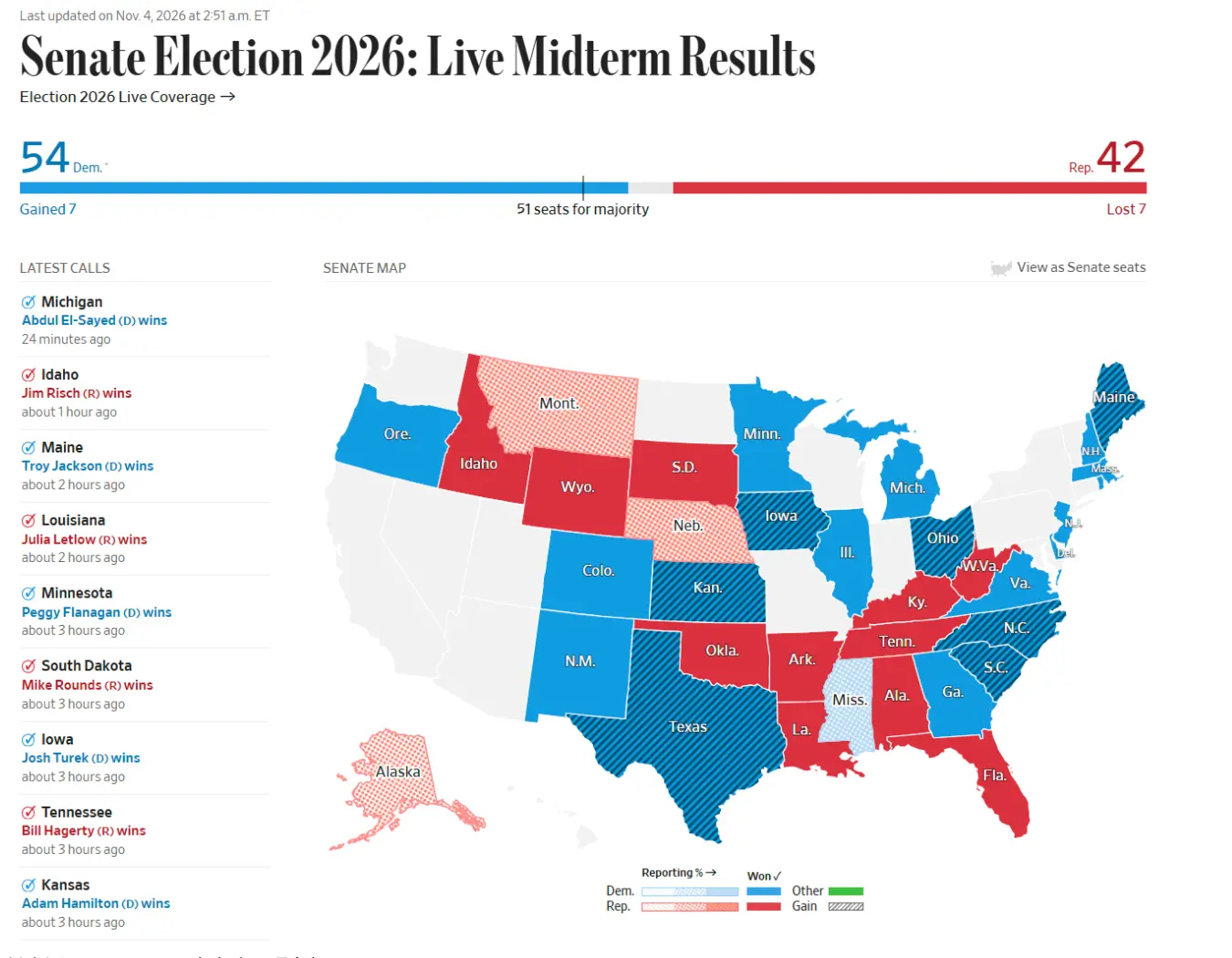
In this congressional midterm election, the Democratic Party has regained control of the Senate and House, achieving a “sweep.” Before the elections, the Republican Party held 53 seats in the Senate, and the Democratic coalition held 47 (including 2 independents) [1]. According to the latest results, the Democratic Party has flipped at least 7 seats (in North Carolina, South Carolina, Texas, Ohio, Kansas, Iowa, and Maine [2]), bringing their total to 54 seats and forming a majority.
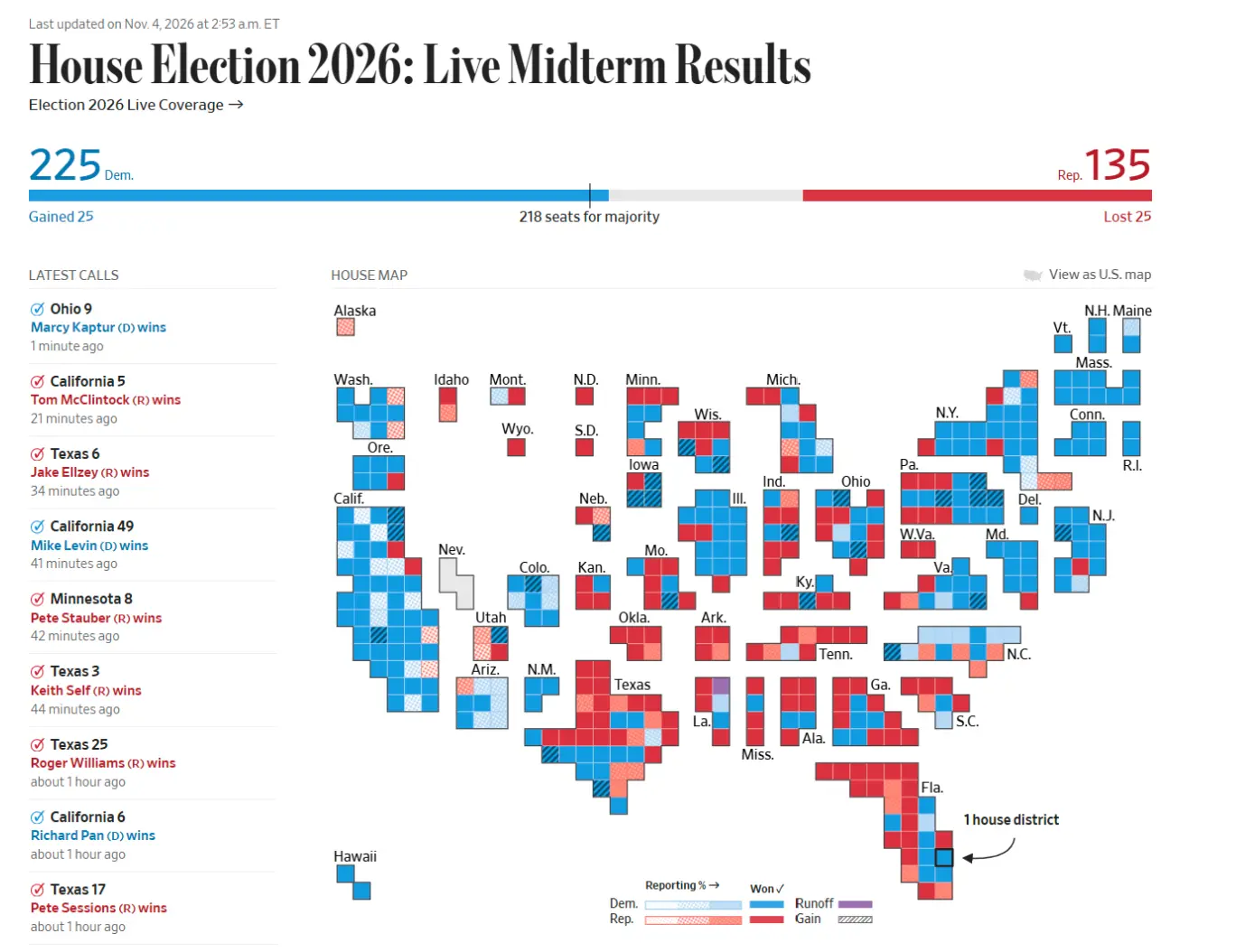
In the House of Representatives, before the elections, the Republican coalition had 219 seats (including 1 independent), while the Democratic Party had 214 seats, with 2 seats vacant [3]. The latest results indicate that the Democratic Party has flipped over 24 seats from the Republicans, covering states like New Jersey, Pennsylvania, North Carolina, Iowa, among others, with the winning scope expanding further into traditionally Republican strongholds [4]. Media outlets like the Associated Press have predicted that the Democratic Party will regain control of the House [5], but the final distribution of seats and the extent of the majority are still to be confirmed.
Furthermore, the Democratic victory scope exceeded expectations, taking several traditional red states. In the 2024 presidential election, Trump had a significant lead in South Carolina, Texas, Ohio, and Kansas [6]. Now, all Republican Senate seats in these states have flipped to blue, and Iowa has also shifted from Republican to Democratic. Notably, South Carolina has elected a Democratic Senator for the first time since 1998 [7], Texas has elected a Democrat for statewide office for the first time since 1994 [8], and Kansas has elected a Democratic federal senator for the first time since 1932 [9].
The gubernatorial elections also saw significant flips. A total of 36 states held gubernatorial elections, with Republicans and Democrats controlling 18 seats each prior to the elections [10]. The Associated Press has confirmed that Democrats flipped Republican-held governorships in Georgia, Ohio, Texas, and Iowa while retaining critical states like Pennsylvania and Wisconsin. In Texas, Democratic candidate Gina Hinojosa defeated Republican Governor Greg Abbott, who was seeking a fourth term, becoming the first elected Democratic governor of the state since 1990 [11]; in Georgia Democratic candidate Keisha Lance Bottoms has become the first African American woman elected governor in U.S. history [12].
The above results indicate that the Democratic Party achieved a comprehensive victory in this election. Although the market had anticipated the Democratic Party’s “sweep,” the extent and advantages of their victory still exceeded market expectations.
2. High living costs and candidate controversies weigh on the Republicans
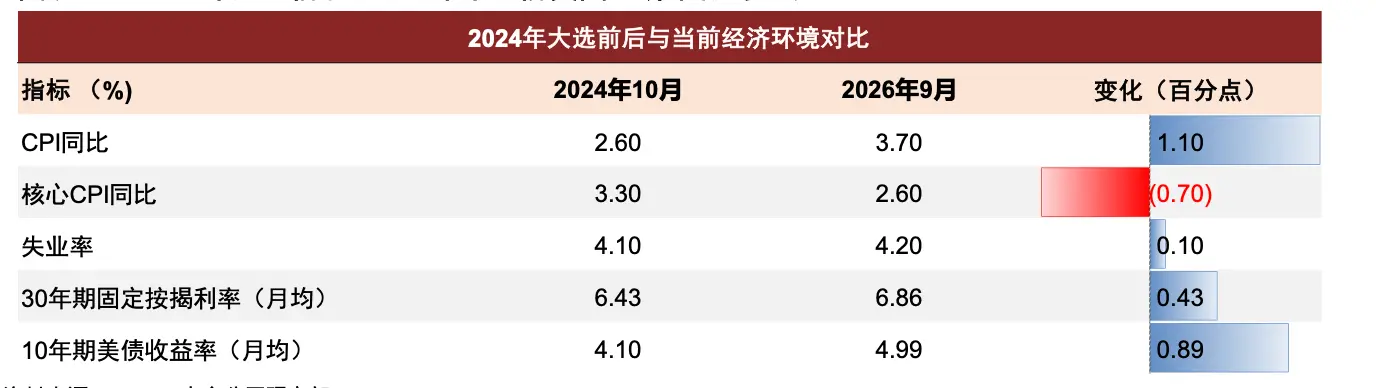
We believe that the Republican failure mainly stems from two factors: one is high living costs and unmet campaign promises. During the 2024 presidential election, Trump promised to lower inflation, energy, and housing costs, but over the past two years, the actual burden on residents has not improved significantly. By October 2024, the U.S. CPI inflation year-on-year was 2.6%, which has now risen to 3.7%; during the same period, 30-year mortgage rates increased from around 6.4% to 7.3% [13]. Trump previously criticized the Biden administration for high inflation and high interest rates, with some voters hoping a party switch would improve living costs, but now, with promises unfulfilled, some voters have shifted back toward the Democratic Party seeking a policy change.
The second reason is that the candidate selection placed too much emphasis on “loyalty” [14]. Texas, traditionally a deep red state, is the most representative example: Trump supported state Attorney General Ken Paxton, who is entangled in corruption allegations and personal controversies, to replace long-serving Republican Senator John Cornyn [16]. However, from the election results, Democratic candidate James Talarico focused on living costs and government corruption issues, ultimately winning, leading to the flipping of this traditional red state [17]. Similar situations occurred in South Carolina and North Carolina. This indicates that even with high “binding,” Trump's personal endorsements did not fully transfer to local support for candidates. Some candidates had significant controversies and weak local foundations, further amplifying the election pressure on the Republicans.
3. The threefold impact on the U.S. economy and policy
We believe that the Democratic Party regaining control of Congress will affect three aspects: U.S.-Iran conflict, fiscal space, and AI regulation.
Firstly, voters expressed dissatisfaction through their ballots, enhancing congressional checks and balances, which may reduce the risks of escalating U.S.-Iran conflicts. In this election, the U.S.-Iran conflict raised oil prices, which was one of the vital factors dragging down the Republican midterm prospects. The election results sent a clear message to the Trump administration: if the conflict escalates further, the Republican Party's situation in the upcoming 2028 elections will only become more passive, and Trump and his team cannot ignore this.
From a political logic standpoint, the Democratic Party winning both chambers means Trump faces stronger domestic institutional constraints. On the fiscal front, the Pentagon's previously requested $80 billion in emergency funding is still stalled in Congress; Democrats can limit the scope of fund usage and require periodic reports to Congress, thereby constraining further military actions. In terms of investigative oversight, Democrats may utilize hearings, subpoenas, and document request rights to investigate the Trump family's business interests, government procurement contracts, cryptocurrency operations, and the interests between businesses and government, keeping Trump preoccupied with domestic issues [18]. Of course, Trump could choose to escalate military actions during the 60-day congressional transition period, but voters are already very dissatisfied with high oil prices, raising doubts about the significance of such actions.
Secondly, the fiscal expansion space will be limited, and the debt ceiling negotiation could create phase disturbances in the market. After the Democrats take control of Congress, they will have greater ability to prevent the Republicans from pushing new large-scale fiscal plans through budget reconciliation. The defense funding plan previously proposed by Trump will also face resistance. This means that over the next two years, the space for new fiscal stimulus will narrow, and the deficit path may gradually converge towards existing policy benchmarks. For U.S. Treasuries, as conflicts escalate and fiscal expansion faces more constraints, it helps alleviate long-term inflation and rising interest rate pressures, enhancing the allocation value of U.S. Treasuries.
However, the negotiation over the debt ceiling between the two parties may become more intense, potentially bringing phase market fluctuations in 2027. As of October 20, 2026, the federal debt under statutory limits was approximately $40.24 trillion. According to projections by the Congressional Budget Office (CBO) and other institutions, the federal government may reach the statutory debt ceiling by mid-2027. After hitting this ceiling, the Treasury can still rely on cash balances and extraordinary measures temporarily, which will not immediately trigger a substantive payment crisis, but may still disrupt economic operations. In October-November 2025, the U.S. experienced the longest federal government shutdown in history, eventually resolved through a Continuing Resolution; during the shutdown, the release of economic data was delayed, and market liquidity tightened marginally. It is possible that similar situations may occur again around the second quarter of next year.
Thirdly, uncertainty surrounding AI regulation is rising, but the likelihood of a total restriction on AI development is low. We previously mentioned that as data center construction increases power prices in some areas, Democrats may enhance oversight of data center approvals, and this regulatory risk is more concentrated at the state and local government levels. In this election, states like Texas, Georgia, and Ohio saw Democratic governors flipped; Pennsylvania's Democratic governor successfully won re-election, and those states are significant markets for data center construction in the U.S.
The elected governor of Georgia, Keisha Lance Bottoms, proposed during her campaign to pause the development and construction of new data centers until the economic and community impacts of these projects are reassessed [19]. Texas's Gina Hinojosa opposes high-energy-consuming data centers, emphasizing energy costs and residents' interests, advocating for the removal of certain tax incentives for data centers [20]. Ohio's Amy Acton supports a conditional pause on new data centers, requiring developers to bear all utility costs [21]. This indicates that state-level regulation of data center construction may intensify, impacting the progress of AI computing power investment in the U.S.
However, we believe that the implementation strength of policies remains to be observed and shouldn't be viewed overly pessimistically. Firstly, data center controversies are not a core priority for the Democrats; the governor's statements are more about requiring tech companies to bear the social costs of data center construction rather than a cessation of AI investment. Additionally, as data center construction can drive local employment and promote tax revenue, it suggests there is still considerable space for compromise, and the actual execution of policies in various states will also need observation.
Secondly, a slowdown in data center construction does not imply that demand will disappear, but rather suggests “postponed satisfaction,” which may lead to differentiation within the AI industrial chain, rather than a blanket negative outlook. Due to the supply not being able to increase swiftly, the scarcity and pricing power of existing data centers will further enhance, allowing operating data centers to raise rents and increase revenues. Large cloud providers that secured electricity and land resources early can continue to provide services to clients even when capacity is constrained, thereby solidifying their competitive advantages.
Thirdly, markets tend to price according to worst-case scenarios initially, leaving space for later recovery. If the actual governance of the new state governors is weaker than the market previously priced in, both sentiment and valuations are expected to improve marginally.
In summary, we maintain our prior judgment: the election outcome may drive down policy uncertainty, creating opportunities for risk clearing. In the pre-election phase, the market engaged in repeated games around U.S.-Iran conflict, Russia-Ukraine conflict, and AI regulation, with all parties wishing to maximize the value of their bargaining chips before the elections, leading to substantial uncertainties. Once the election results are confirmed, these games will converge, and the direction of policy will become clear: military actions will be constrained by Congress, fiscal approaches will shift to neutrality, and AI regulation will be generally restrained. Thus, the midterm elections are more likely to be an opportunity for risk clearing, potentially positively impacting the overall market (refer to “Potential Impacts of the U.S. Midterm Elections”).
Charts: Senate Election Map
Data Sources: WSJ, AP, Zhongjin Research Department
Charts: House Election Map
Data Sources: WSJ, AP, Zhongjin Research Department
Charts: Comparison of U.S. Economic Indicators Before the 2024 Election and 2026 Midterm Elections
Data Sources: Wind, Zhongjin Research Department
Commodities: What is the Impact of the U.S. Midterm Elections?
On November 4, the results of the U.S. midterm elections were announced, and as of the release of this report, the Democratic Party has gained a significant advantage, likely sweeping both chambers to gain control of Congress [22]. We believe the impact of this midterm election result on the commodities market mainly transmits through three paths: foreign policy, fiscal policy, and trade policy. In terms of foreign policy, the constraints on unilateral military escalation will cool the premium from geopolitical conflicts in the Middle East; on the fiscal policy front, large-scale new stimulus bills will be limited, suppressing U.S. domestic demand expectations; regarding trade policy, the resistance to the president's spontaneous tax increases will rise, leading to convergence of unilateral trade friction risks. We judge that post-elections, the financial stimulus, trade frictions, and geopolitical conflict risk premiums that have driven early trading in the commodities market may retreat, and the main line of the commodities market may return to fundamentals.
Oil: Diplomatic Constraints Lower the Risk of Middle East Conflict Escalation, and Geopolitical Premiums Retreat
In the past two weeks, price fluctuations have significantly increased. Last week, the market's concerns about a potential new round of escalation in U.S.-Iran conflicts after the midterms dominated oil prices, which peaked at $120 per barrel. Since this week, as the midterm results approach, geopolitical developments continue to be bumpy. On November 2, the U.S. and Iran indicated that indirect negotiations had resumed [23], with Iran stating it is “trying to resolve issues through dialogue,” and the U.S. expressing a “preference for diplomatic solutions,” causing oil prices to plummet by 7% in one day; on November 3, the U.S. attacked Iran's Qeshm Island [24], signaling a return to limited military actions, leaving the geopolitical direction still unclear. Currently, the midterm results may reduce the risk of Middle East conflict escalation by 2027.
Since the U.S.-Iran conflict began, global oil inventories have continued to decline, with OECD oil inventories consuming an accumulated 260 million barrels, marking a 6% reduction; by the end of September, inventory levels were approximately 7% below the average for the same period over the last five years, and as the release of the SPR (Strategic Petroleum Reserve) approaches closure, the inventory pressure has shifted further to commercial stocks since September, offering greater elasticity for crude oil risk premiums. Fundamentally, while Middle Eastern oil exports have rebounded under high-risk trade models like ship-to-ship, upstream production remains constrained by regional situations and transport risks, indicating that the shortage of spot supplies may persist at least until Q1 2027. We suggest that Brent oil prices may struggle to fall below $90 per barrel within the next 3-6 months. Looking further ahead, the midterm election results may increase the chances of de-escalation in geopolitical situations in the Middle East by 2027; if Middle Eastern supply returns, it may lead to a commodity market that shifts back to surplus conditions, and we predict that under these circumstances, Brent oil prices may return to the $80-$90 per barrel range in the second half of next year.
Gold: The core remains the direction of interest rates
Since the second quarter of this year, the primary pressure on gold prices has stemmed from the Federal Reserve's shift from easing to tightening monetary policy. Since the resumption of interest rate hikes in September, speculative net longs on COMEX gold futures have been reduced by 17%, reflecting expectations priced in for 2-3 more interest rate hikes, i.e., raising the federal funds rate ceiling to 4.5% (4.0% after one hike), indicating that expectations for further rate hikes are relatively fully priced. The recent further adjustments in gold prices may partly stem from liquidity pressures amid sharp fluctuations in the U.S. stock market (for instance, the SPDR Gold ETF significantly reduced its holdings by 12 tons on October 22), and partly constrained by expectations of oil prices potentially rising again amid recurring geopolitical tensions. Looking at next year, the midterm results may have a medium-term impact on the gold market, which will likely still depend on how they influence the geopolitical situation in the Middle East, U.S. fiscal strength, and AI regulatory risks, subsequently transmitting to impacts on U.S. monetary policy directions through energy inflation and economic growth expectations. If geopolitical risks from unilateral conflicts and trade frictions decline marginally next year, and there are expectations of easing pressure from high rates, there may be room for price recovery at the current gold level. Under the baseline scenario where the Fed pauses interest rate hikes next year (federal funds rate ceiling at 4.25%), we expect the annual midpoint for COMEX gold prices to be reasonably positioned at $4,300 per ounce.
Non-ferrous Metals: Short-term uncertainty on copper tariffs rises, but long-term impacts may be limited
The impact on copper is mainly focused on the rising short-term uncertainty around tariffs. In the short term, following the midterms, the market anticipates potential changes to the U.S. 232 tariff investigation, which significantly affects copper prices since 2025, but currently, the tariff authority still rests with the president, and we expect that existing tariffs on copper semi-finished products are unlikely to be immediately revoked. However, as congressional checks and balances increase, we judge that it may become more challenging to impose further taxation on refined copper, potentially causing tariff-related risk premiums to decline. In the long term, considering that domestic copper demand in the U.S. is rising, and the bipartisan stance toward strategic metals primarily composed of copper is generally consistent, if tariffs remain undecided, we expect the market will still tend to price positively, and the high inventory levels of COMEX copper are unlikely to significantly impact copper prices. Furthermore, the Democratic Party's long-term support for emerging industries such as the power grid and renewable energy may also create additional demand for copper in the future.
Agricultural Products: Bioenergy and Sino-U.S. Agricultural Trade Policies May Face Variability
The impact on the agricultural products market primarily revolves around trade and industrial policies. Firstly, the RVO final rule for 2026/2027 [25] has been finalized by the EPA for March-April 2026, with 45Z extended to 2029 [26]; these are existing policies that the midterm elections will not influence, but there may be variability regarding E15 and ILUC policies, which could cause medium to long-term disturbances for corn and soybean oil consumption. Secondly, significant flips in states such as Iowa and Kansas, which are traditional agricultural states, pose a political constraint on Trump's trade policies. Currently, we predict an increased likelihood of easing in Sino-U.S. agricultural trade by 2027. For U.S. soybeans, this is the most direct marginal benefit brought by the elections, but in the medium to long term, the changes will impact trade flows and price differentials rather than altering global balance sheets. Overall, this midterm election likely serves only as a marginal disturbance; the main pricing lines in 2027 will still be weather, costs, and global supply and demand.
Foreign Exchange: With Democrats Controlling Both Chambers, Mid-term Support for the Dollar May Gradually Weaken
The Democratic Party has achieved a clear victory in this midterm election, gaining control of both chambers of Congress, which means that for the next two years, the Trump administration will face significantly enhanced congressional checks and balances. We believe that this election has generally increased the likelihood of diminishing mid-term support for the dollar. Fiscal expansions and tariff policies will face more constraints, possibly reducing additional upward pressure on U.S. demand and inflation; external military actions will also face increased checks, potentially lowering energy risk premiums. At the same time, AI investment's support for U.S. growth and asset returns will continue, but its marginal pull on the dollar may gradually weaken. Specifically, the election's impact will mainly manifest in fiscal and trade policies, AI investments, U.S. asset risk pricing, and geopolitical energy factors.
Fiscal and Trade Policies: New fiscal stimulus space is limited, and obstacles to further tariff expansions are rising. Trump's major tax cuts have already been enacted under the Inflation Reduction Act, meaning there is limited space for large-scale tax reductions and fiscal spending in the next two years. After the Democrats gain control of both chambers, the Republican Party will face greater resistance in pushing further partisan tax cuts and spending expansions. Congressional scrutiny and review of tariff policies may also strengthen, causing the political costs of further tariff expansions to rise. If new fiscal stimulus and tariff measures fall short of prior expectations, additional upward pressure on U.S. demand and import prices may diminish, leading to more moderate market pricing regarding U.S. growth, inflation, and further interest rate hikes, potentially marginally weakening support for short-term dollar interest rates.
AI Investment and Cross-Border Capital: AI investment will continue to support U.S. growth, but regulatory uncertainty may weaken the marginal support for the dollar. With the Democrats controlling Congress, regulatory scrutiny of large tech companies may intensify. At the same time, data center approvals, power supply, and infrastructure compatibility are increasingly dependent on state and local governments, which may diverge in their policy directions and implementation speeds, increasing uncertainty around project approvals, construction costs, and investment returns. This rising uncertainty could affect market risk appetite and tech company valuations, leading foreign investors to reassess the risk-return trade-off of U.S. tech assets. If overseas capital slows down in adding new allocations to U.S. tech assets as a result, the supportive function of cross-border capital inflows on the dollar may diminish. However, Zhongjin Overseas Macro believes that the likelihood of a comprehensive AI suspension order at the federal level is low, and local regulations are insufficient to change the overall investment trend in the industry [27]. The five major cloud providers' direct AI capital expenditures are still expected to grow, and the demand generated from prior investments in equipment, power, and construction is likely to continue spreading toward the manufacturing sector, supporting U.S. growth and corporate profits. However, as the investment base rises, the growth rate of direct capital expenditures may slow compared to before, gradually weakening the impact of new investments on the relative growth advantage of the U.S. Overall, AI investments will continue to provide support for the dollar through growth and capital inflows, but rising regulatory uncertainties and slowing investment growth may lead to a gradual decline in its marginal contributions.
U.S. Debt Supply and Fiscal Risks: New supply pressures may ease, but debt ceiling disturbances remain. After the Democrats gain control of Congress, the Trump administration will face increasing difficulties in pushing for tax cuts and expanded fiscal spending, and the risks of exceeding expected growth in future fiscal deficits and Treasury supply may ease. Consequently, upward pressure on the term premiums of U.S. Treasuries may also diminish. This helps alleviate market concerns over the further accumulation of U.S. fiscal risks, but its impact on the dollar may be relatively indirect, still depending on changes in relative U.S. Treasury yields and overseas capital allocations. At the same time, the burden of existing U.S. debt and interest payments remains heavy. Zhongjin Overseas Macro anticipates that the U.S. may reach its debt ceiling again by mid-2027 [28]. At that time, negotiations between the two parties over the debt ceiling, government appropriations, and fiscal arrangements may intensify, increasing risks of government shutdowns and market liquidity disruptions. Should negotiations further trigger concerns over the U.S. fiscal governance capabilities and repayment arrangements, foreign investors may demand higher risk compensation or increase the hedging ratio for dollar assets, putting pressure on the dollar.
Geopolitics and Energy: Enhanced Congressional Constraints on Military Actions May Gradually Reduce Oil Price Risk Premiums. With the Democrats controlling Congress, the Trump administration will face more constraints on increasing military appropriations and expanding military actions against Iran; congressional investigations and oversight of military powers could further increase the political costs of escalating conflicts. If the risks of U.S.-Iran conflicts diminish, the geopolitical risk premiums within oil prices may retreat, alleviating U.S. inflation pressures and the necessity for the Federal Reserve to maintain high rates. Meanwhile, trade conditions for energy-importing economies like Europe and Japan are expected to improve, which may weaken the dollar's earlier energy-related advantages and safe-haven support. Nevertheless, the new Congress will not officially take office until January 3, 2027, meaning that short-term military actions and oil prices may still face fluctuations.
Overall, as the Democrats win control of both chambers of Congress, the dollar has generally weakened against major currencies, and the market has begun to focus on the narrowing of fiscal expansion space and the rising uncertainties associated with AI regulation's impact on U.S. growth prospects, while falling U.S. Treasury yields have further increased downward pressure on the dollar. In the short term, the election results may still provoke further adjustments in market expectations regarding U.S. policies and growth, but the subsequent trends of the dollar will also be influenced by economic data and Federal Reserve policy expectations. In the medium term, restricted fiscal and trade policies, diminished marginal support from AI investments for growth, and retreating energy risk premiums may all weaken some of the dollar's earlier support. However, the advantages in U.S. growth and asset returns will still provide some offset. We believe this election has increased the likelihood of a gradual weakening of mid-term support for the dollar, with subsequent impacts depending more on the actual effects of policy changes on the U.S.'s relative growth and interest rate advantages.
免责声明:本文章仅代表作者个人观点,不代表本平台的立场和观点。本文章仅供信息分享,不构成对任何人的任何投资建议。用户与作者之间的任何争议,与本平台无关。如网页中刊载的文章或图片涉及侵权,请提供相关的权利证明和身份证明发送邮件到[email protected],本平台相关工作人员将会进行核查。


