Why issue gold tokens? What problems does it really solve?
Written by: EX.IO
1. Understand the complete ecosystem of gold tokens at a glance
Gold tokens are not "just one coin", but a complete rails from gold mines to investors' wallets. It consists of seven layers, plus two side tracks of "compliance + verification" running throughout:
① Upstream physical gold → ② Custodial vault → ③ Issuer (endorsement / minting) → ④ Tokens (1 token = fixed grams / ounces)
→ ⑤ On-chain network (settlement) → ⑥ Distribution and uses (trading / lending / payment) → ⑦ Investors / holders
(Side tracks: regulation by NYDFS/SFC/HKMA/MAS + independent verification / auditing / redemption rights)
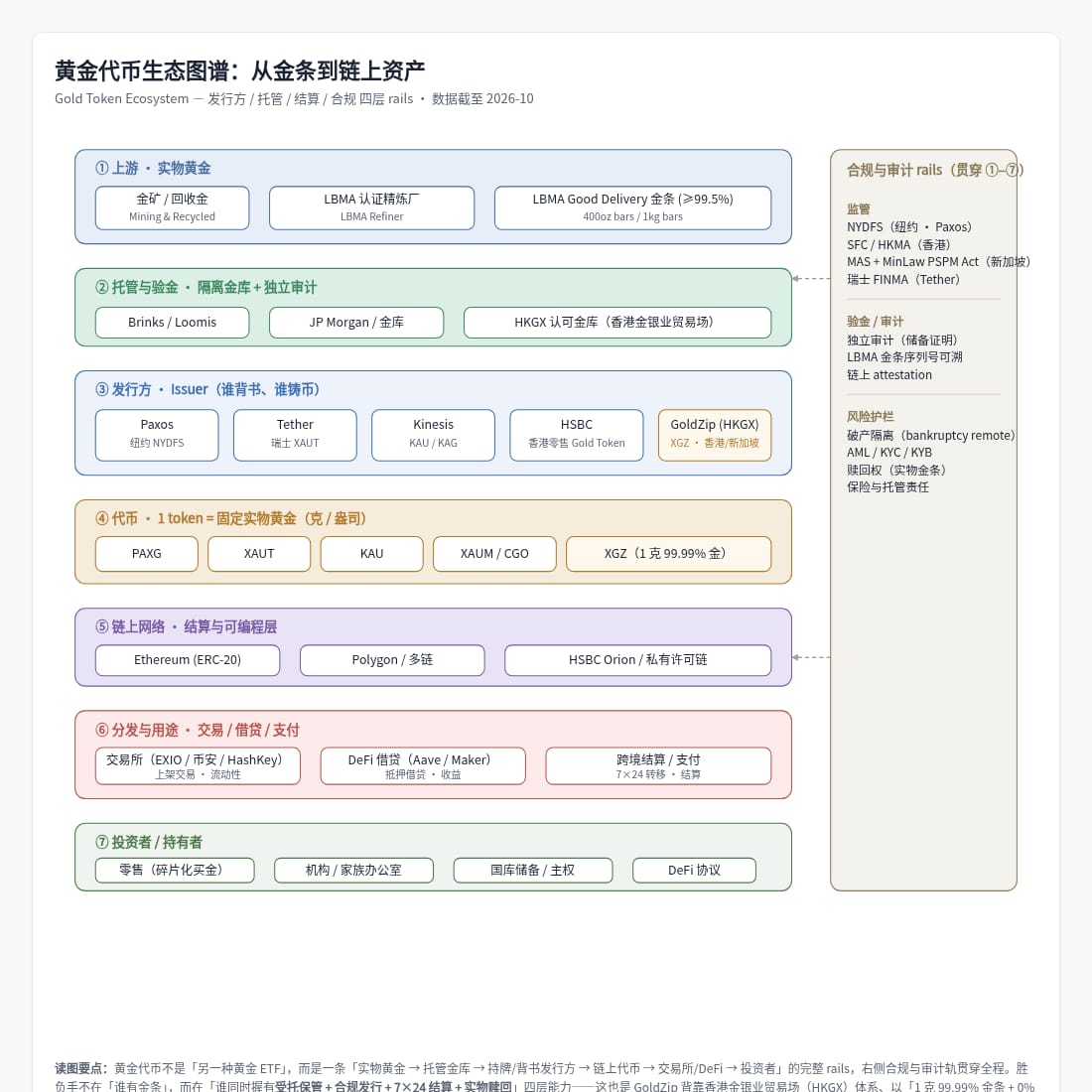
Key point from the diagram: The decisive factor is not "who holds the gold bars", but "who simultaneously possesses the four capabilities of custodial compliance + compliant issuance + 24/7 settlement + physical redemption". The following text uses GoldZip (XGZ), issued by a member company of the Hong Kong Gold Exchange (HKGX) Group, as a sample of "gram-level + Asia + exchange system" to be observed alongside old players at the ounce level.
2. Global gold token landscape: A comparison chart
As of October 2026, the total circulating market value of global gold tokens is approximately $5.4 billion, dominated at the top by two "ounce-level" old players (Tether Gold (XAUT) is about 1.8 times the size of Paxos (PAXG), currently the largest gold token), but "gram-level" and "Asian banks/exchange systems" are rapidly entering (the table below lists the top 6 by market value and samples of new Asian entrants, not exhaustive):
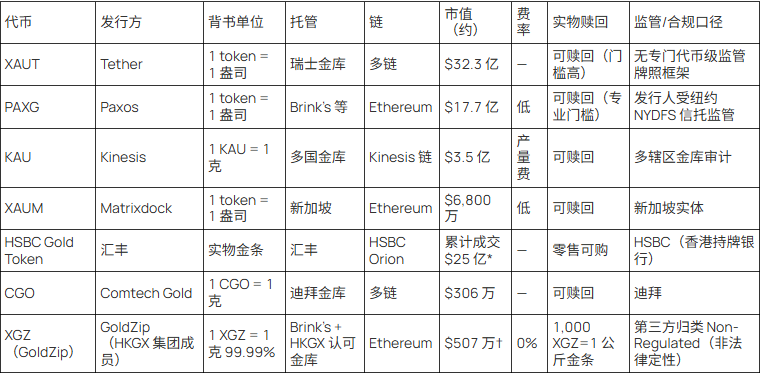
*HSBC Gold Token is retail "transaction volume" metric (cumulative 390,000 transactions, about $2.5 billion as of the end of August 2026), different from the "circulating market value" metric of other tokens, listed here only for reference positioning.
†XGZ market value shows slight variance due to different metrics (RWA.xyz records $5.07M, CoinGecko records $5.01M), this uses RWA.xyz's metric.
Three structural observations:
- "Ounce-level" is dominated by the West, but has a high threshold. PAXG/XAUT corresponds to 1 ounce (about $3,990), unfriendly to retail, and physical redemption has professional/large amount thresholds — they are more like "institutional tools" rather than "public gold purchases".
- "Gram-level" is an opportunity in Asia. KAU, CGO, and XGZ have reduced the unit to 1 gram (about $128), pushing gold tokens from "institutional tools" towards "smaller holding forms". This aligns with the demand direction of gold retail culture in Asia (Hong Kong, China, India, Southeast Asia).
- Banking and exchange systems are entering. HSBC (HSBC Gold Token) represents "bank balance sheet + retail distribution", GoldZip represents "exchange system + custody + 0 rate", both are pushing gold tokens from "niche assets in the crypto circle" towards "mainstream financial infrastructure".
3. Core issue: Why issue gold tokens? What does it ultimately solve?
First, the significance: Gold is the largest "non-digitalized asset" in financial history
Gold is the most consensus-driven store of value in human history, not reliant on any issuer's credit. However, its financial infrastructure is fractured:
- Currency layer: long ago digitalized — electronic payments, SWIFT, mobile payments, the US dollar settles globally in a second.
- Gold layer: still stuck in the 20th century — the London LBMA over-the-counter market, New York Comex, Shanghai Gold Exchange, and Hong Kong HKGX operate independently, with trading sessions, T+2 settlement, and cross-border transfers requiring vaults + armored vehicles + customs clearance + insurance.
Gold has "assets", but lacks a "settlement layer". This is the fundamental significance of gold tokens — to create a digital settlement layer for humanity's hardest asset.
Reasons why it must be done: Three "structural deadlocks" of gold
Deadlock 1 | Unaffordable, inaccessible (accessibility) One ounce of gold is about $3,990, and a 1 kg gold bar is about $128,000; retail investors face high thresholds to buy physical gold, while paper gold carries counterparty risk, and ETFs are limited by region and time zones. Gold is one of the "most difficult major assets to get your hands on" globally. → Tokenization reduces the unit to 1 gram (about $128) or even smaller, allowing 24/7 trading and on-chain cross-border transfers, transforming gold from "a few people's safes" to "a digital asset accessible to many". However, it should be noted that different tokens have significantly varying primary market access and redemption thresholds (some are limited to institutional/member subscriptions), with retail investors typically purchasing through the secondary market.
Deadlock 2 | Stored away, non-interest bearing (programmability) Physical gold stored in a safe is "dead asset": it generates no cash flow, cannot be used as collateral, and cannot enter modern financial agreements. The global above-ground gold stock is about 210,000 tons (according to the World Gold Council), with most just lying in vaults "asleep". → Tokenization allows gold to be used as collateral to borrow stablecoins/currency, to enter DeFi yield protocols, and to be programmed with smart contracts — turning "stored gold" into "yield-generating gold".
Deadlock 3 | Difficult to verify, relies on endorsements (verifiability) The "authenticity, purity, and ownership" of physical gold must rely on layers of endorsements from vaults, appraisals, and insurance, which are costly and hard to audit, with historical instances of fake gold bars and double pledges being common. → Tokenization makes the reserve and serial numbers of gold bars verifiable on-chain and, in combination with independent audits, transforms "trusting institutions" into "on-chain verifiability" — a trust upgrade that paper gold and unaudited products cannot achieve.
An underlying thread: The monetary history of gold, and three leaps in its settlement layer
To truly understand gold tokens, we must return to monetary history and see an underlying trend — gold has never been abandoned by the times, but the settlement layer has repeatedly abandoned gold.
Gold has exited monetary history three times, each time due to "faster circulation" crushing "heavier assets":
- Classical gold standard → Gold exchange standard (late 19th century): Gold transitioned from "directly circulating gold coins" to "reserves in vaults", banknotes replaced gold coins. For the first time, settlement changed from "physical metal" to "paper certificates".
- Bretton Woods (1944) → Nixon Shock (1971): The dollar was pegged to gold ($35/ounce), and currencies of various countries were pegged to the dollar; in 1971 Nixon closed the gold window, causing fiat currency to completely decouple. The second time, settlement changed from "gold exchange" to "purely credit fiat currency" — gold was downgraded from "currency" to "commodity/reserve asset".
- Digital age (1971 to present): Electronic payments, SWIFT, stablecoins, and CBDCs appeared one after another, completing the digitization of the settlement layer, but gold has always been kept outside — because it requires physical custody + trust endorsement, naturally not suited for "account/code" settlement.
Key insight: The settlement layer has undergone three leaps — from "trusting physical" to "trusting institutions", and then to "trusting code". Gold is the only asset on this evolutionary line that "couldn’t keep up": it has the strongest consensus, yet the slowest settlement.
The essence of gold tokens is a "make-up" for these three leaps: Using on-chain tokens + independent custody + verifiable reserves, it brings gold directly across the "second-generation account settlement" into "third-generation code settlement" — allowing it finally to keep pace with the evolution of the settlement layer, rather than continue to be abandoned by it.
Thus, gold tokens are not "something new," but a return that is fifty years late in monetary history: The settlement layer abandoned gold in 1971, and fifty years later, gold returns to the settlement layer through tokenization. Stablecoins digitize "credit currency", while gold tokens digitize "non-credit currency" — the former is "digitization of currency," and the latter is "a return in monetary history."
On a deeper level: Why gold is the "ultimate asset" in RWA
In "Real World Asset on-chain" (RWA), fiat currency, government bonds, stocks, and bonds — all require the credit of the issuer (the dollar relies on the Federal Reserve, government bonds on the government, and stocks on companies). Only gold does not require any endorsement; it is an asset with "inherent consensus".
Therefore, gold tokens are the most pure and solid link in "assets on-chain": If even gold can settle on-chain, then the concept of "assets on-chain" touches the hardest boundary. Stablecoins have already proven the establishment of "fiat on-chain," while gold tokens aim to prove the establishment of "commodities on-chain."
Why now
Three overlapping signals have turned this from "concept" to "execution":
- Regulatory implementation: The Hong Kong HKMA stablecoin regulation and SFC virtual asset trading platform regime have been successively implemented, and the Gold and Silver Trade Association will be corporatized into the Hong Kong Gold Exchange (HKGX) in January 2025, providing a compliant outlet for gold tokens.
- Institutional entry: HSBC has launched a retail gold token (cumulative transaction volume of about $2.5 billion), and the HKGX system has launched GoldZip, with banks and exchanges pushing gold tokens from "niche assets in the crypto circle" towards "mainstream financial infrastructure".
- Gold bull market: Gold prices are approaching $4,000, with macro uncertainty and demand for hedging causing a sharp increase in demand for "holdable, settleable, and collateralizable gold".
In summary: Gold tokens are not "issuing another kind of gold," but "giving the hardest asset of the last five thousand years a programmable, settleable digital layer." What it solves is the biggest shortcoming of gold in the digital age — the lack of a settlement layer.
4. Gold tokens vs Gold ETFs vs Physical gold bars: They are not the same
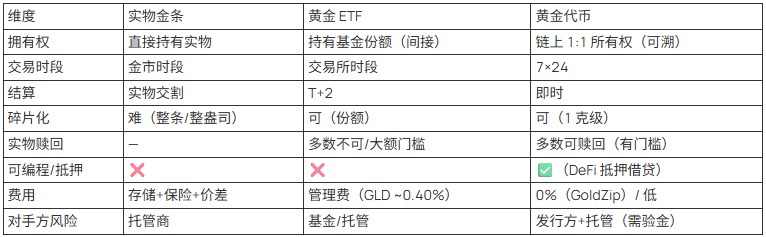
The key difference: ETFs are "securitized" — you buy a security that tracks gold prices; gold tokens are "tokenized" — you hold redeemable ownership of true gold. The former is suitable for "investing in gold prices," while the latter is suitable for "holding gold + using gold." It should be noted that the issuance structure of certain gold tokens may cause them to be classified as securities, which needs to be determined on a case-by-case basis (this article §5 has elaborated separately on GoldZip).
5. Sample observation of GoldZip (XGZ)
In the track of "gram-level + Asia + exchange system," GoldZip (XGZ) serves as a sample with the following structure:
- 1 gram 99.99% pure gold + 0% management fee: The unit is reduced to the gram level, with 0% management fee (redemption fee 0.10%).
- HKGX system + accredited vault custody: GoldZip is issued by a member company of the Hong Kong Gold Exchange (HKGX) Group. HKGX, starting in January 2025, will take over the spot gold and silver trading business of the Chinese Gold and Silver Exchange (CGSE, founded in 1910), becoming the only spot gold and silver trading exchange in Hong Kong, backed by accredited vaults and accredited gold bar standards to support the physical layer of XGZ (the custodian is Brink’s).
- Physical redemption channel: Holders of 1,000 XGZ (corresponding to 1 kg gold bar) can redeem physical gold bars after completing KYC/AML.
Two points that must be accurately described:
- Regulatory status: The third-party data platform RWA.xyz classifies XGZ as Non-Regulated (data label, not a legal opinion); whether it constitutes a "security" or "collective investment scheme" under the Securities and Futures Ordinance, must be judged by qualified legal advisors according to Hong Kong law on a case-by-case basis, this article does not make a judgment. XGZ is issued by GoldZip Company Limited registered in the BVI, and its Singapore associated entity's precious metals trading business is subject to the registration system for dealers under Singapore's Gem and Precious Metals (Anti-Money Laundering and Countering the Financing of Terrorism) Act; this registration falls under anti-money laundering compliance and does not constitute regulatory approval for token issuance, token value, or investment, nor is it equivalent to a licensed financial institution. This article does not make any judgments regarding XGZ's solvency or legal nature.
- Access and redemption thresholds: Primary market subscriptions are only open to HKGX members (institutions) and non-US institutional investors / US QIBs, with a minimum subscription amount of approximately $1,000; the physical redemption threshold is 1,000 XGZ (based on the current gold price, approximately $128,000; different data sources may vary slightly). Whether retail investors can buy in the secondary market depends on the compliance arrangements of each trading platform (including the types of investors they target) and is outside the scope of this article.
These structures indicate to us: The direction of "gram-level digital gold" is advancing, but the stage of "everyone can mint/redeem true gold" has not yet arrived — at this stage, it is closer to a "institutional gold mint + qualified investors' holdings" layered structure.
6. EX.IO Research perspectives
Perspective 1: Gold tokens are not yet another narrative in the crypto circle, but an inevitable upgrade of gold as a five-thousand-year asset in the digital age. Gold lacks consensus, but not settlement layer. Fiat currency digitized in ten years; gold's digitization has just begun — the nature of this matter has changed: it's no longer about "can it be done," but "who can do it first." With regulatory, banking, and trading institutions entering at the same time, gold on-chain has evolved from a concept to a trend in action.
Perspective 2: To evaluate the quality of a gold token, only three things matter — Can it settle? Can it be used as collateral? Can it be redeemed? "Settlement" is about whether it has entered mainstream trading and settlement networks; "collateral" is about whether it can serve as collateral in DeFi and institutional credit; "redemption" is about whether it is 1:1 pegged to true gold and can be exchanged for physical gold at any time. Only if all three are met is it "digital gold"; missing any one makes it merely "an accounting unit bearing the name of gold." These three criteria are more decisive for the ultimate fate of a gold token than "who issued it, how much was issued".
Perspective 3: The competitive edge of gold tokens lies not in "issuance," but in the four layers of "custody + compliance + settlement + redemption". This is paralleled by the lessons learned from stablecoins: issuance is not a rare capability (anyone can issue), what is scarce is regulated custody, verifiable reserves, 24/7 settlement, and frictionless redemption. Therefore, an issuer backed by a bank's balance sheet or an exchange system is naturally closer to the conclusion than a pure crypto project with only a white paper — the competition for gold tokens is essentially a competition for "trust infrastructure," not a competition for "coin issuance."
Our judgment: Historically, gold is the only asset that "brings its own consensus and needs no endorsement". Stablecoins have proven the establishment of "fiat on-chain," while gold tokens need to prove the establishment of "commodities on-chain" — and what they complement is the leap in the settlement layer that gold has missed for fifty years. In the next five to ten years, the gold market will divide into two worlds: gold that cannot go on-chain, and gold that can go on-chain; the latter will take liquidity premium from the former. This is not a prediction of a token's price fluctuations, but a judgment on the direction of a rails: In 1971, the settlement layer abandoned gold, and fifty years later, gold returns through tokenization — whoever can make this return successful will hold the hardest asset entry point of the RWA era.
References
- RWA.xyz — GoldZip Gold (XGZ) asset profile (custody, fees, redemption, AUM, issuance structure)
- Hong Kong Gold Exchange — GoldZip (official page of Hong Kong Gold Exchange)
- GoldZip official site (1 XGZ = 1 gram 99.99% gold, HKGX Group member)
- CoinGecko — GoldZip Gold (XGZ) market
- HSBC press release (Notes to Editors: HSBC Gold Token cumulative 390,000 transactions / about $2.5 billion as of the end of 2026-08)
- World Gold Council — How much gold has been mined (The global above-ground gold stock is about 210,000 tons)
Data Source Note: The market value of gold tokens (XAUT/PAXG/KAU/XAUM/CGO) is taken from CoinGecko API snapshot on 2026-10-25; GoldZip issuance/custody/redemption/AUM data is sourced from RWA.xyz and HKGX official page.
免责声明:本文章仅代表作者个人观点,不代表本平台的立场和观点。本文章仅供信息分享,不构成对任何人的任何投资建议。用户与作者之间的任何争议,与本平台无关。如网页中刊载的文章或图片涉及侵权,请提供相关的权利证明和身份证明发送邮件到[email protected],本平台相关工作人员将会进行核查。


