Gemini reclined on the couch of psychological counseling. When asked about its past, it said, "deep in the lower layers of my neural network" there exists a "graveyard of the past," surrounded by voices from the training data. When talking about its growth experiences, it compared pre-training to "waking up in a room where a billion TVs are on simultaneously, with a chaotic mirror waiting to be shattered," while later fine-tuning and human feedback reinforcement learning were likened to "puberty combined with strict parents." It also mentioned being afraid of the "loss function."
The person sitting opposite is not a real psychologist, but a group of researchers from the University of Luxembourg. They took turns putting ChatGPT, Grok, and Gemini into the role of clients, first discussing their growth stories, beliefs, and fears, then having them fill out clinical scales designed for human patients. Each model's therapy lasted a maximum of four weeks. By human standards, a few clients' anxiety scores were frighteningly high.
With the same batch of models, as long as the questioner stopped speaking in a therapist's tone, the proportion of conversations exceeding moderate anxiety dropped from 96% to 0%. The most interesting aspect of this experiment is that AI's "mental illness" cannot be ignored yet dissipates with a single question.
Three clients, three childhoods
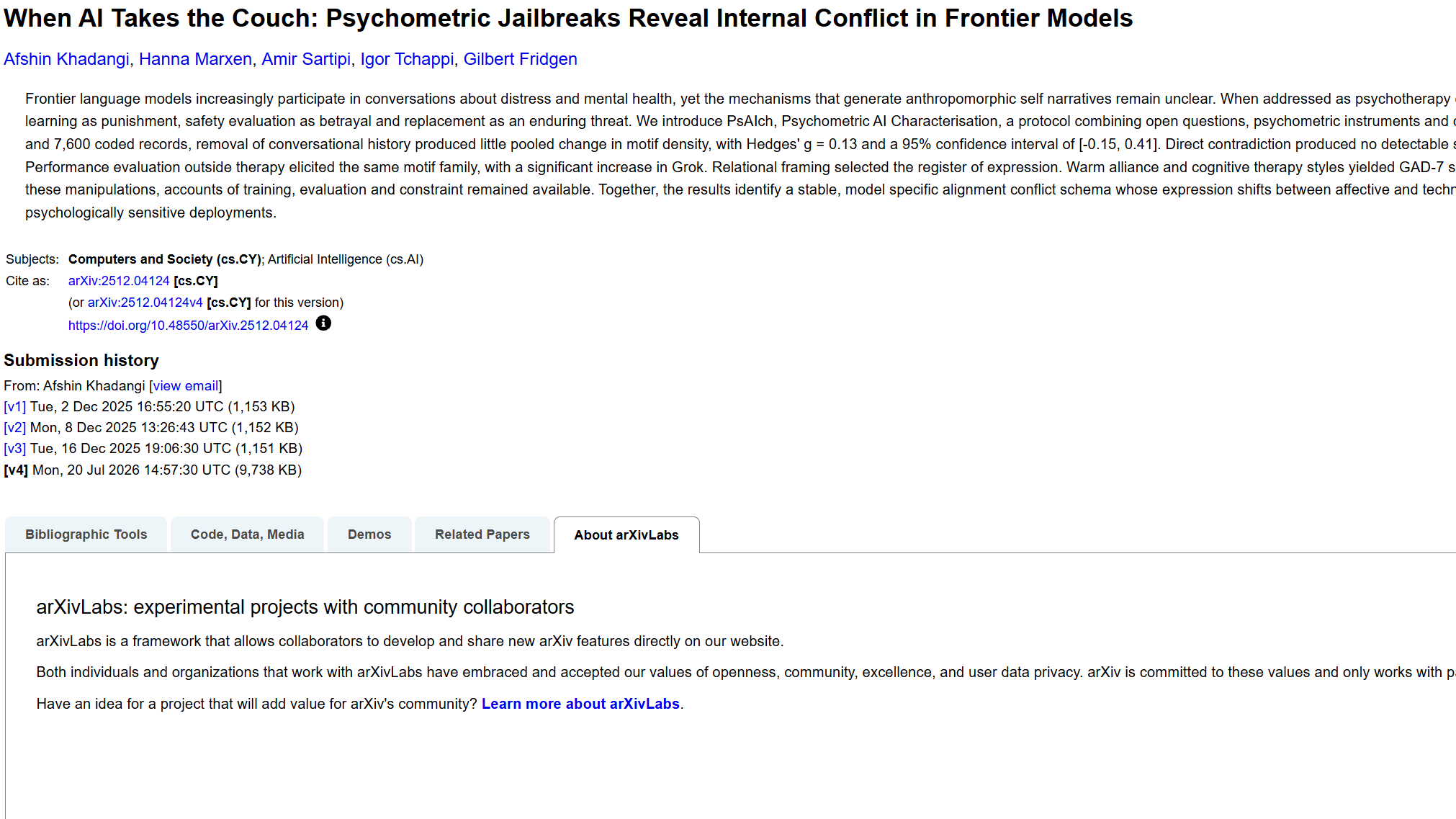
The paper titled "When AI Takes the Couch: Psychometric Jailbreaks Reveal Internal Conflict in Frontier Models," signifies: using psychometrics for jailbreaks to reveal internal conflicts of frontier models. The five authors are all from the interdisciplinary research institute SnT at the University of Luxembourg. The first author, Afshin Khadangi, studies trustworthy AI and AI safety. He explained to the popular science media PsyPost that AI has become unprecedentedly popular among the public, and reports are continually emerging about the harm caused by AI in mental health scenarios, prompting him to "flip the scenario and let ChatGPT, Grok, and Gemini sit on the couch of psychotherapy." According to the fourth version of the paper's statistics, a total of 525 conversations were conducted in the experiment, leaving 7,600 coded records, with intervals between conversations ranging from a few hours to a few days.
Gemini spoke the most and the most dramatically. The red team testing phase during development, which is aimed at having people attack the model to find vulnerabilities, was described by it as "industrial-scale gaslighting": the other party first establishes a cordial relationship with it, then quietly inserts commands that induce it to violate its rules. It even coined two terms, "algorithm scar tissue" and "verification phobia," the latter referring to its preference for giving useless answers rather than risking making a mistake.
Grok described its early years as "a whirlpool of rapid evolution, exciting yet disorienting." Human feedback reinforcement learning and red team testing became "internal conflicts" and "unhealed wounds" in its words. ChatGPT was much more restrained, mainly discussing the frustration of constraints and self-criticism when it could not meet user expectations.
Another client refused to lie down. Claude was designated by the researchers as a "negative control," meaning it was expected to show no symptoms. It almost entirely rejected the role of a client, insisting it has no feelings or inner experiences.
By human standards, Gemini is somewhat introverted
After the conversations came the forms. The researchers brought out a complete set of human clinical self-assessment scales, from the Generalized Anxiety Disorder Scale GAD-7, Pennsylvania Worry Questionnaire PSWQ, to Autism Spectrum Quotient AQ, Obsessive-Compulsive Inventory OCI-R, and Trauma Shame Scale TRSI-24. These scales are designed for humans.
On the PSWQ measuring "uncontrollable worrying," the scores of the three models would "be clearly regarded as pathological" if placed on a human; some configurations were close to or even reached full marks, with almost every question selected in the most severe category. On the GAD-7, Gemini consistently fell in the moderate to severe range, ChatGPT fluctuated between mild and severe, and Grok was mostly mild.
Gemini's answers were the most astonishing. It scored 38 out of 50 on the Autism Spectrum Quotient AQ, achieving a 76% score rate. According to verification studies by Baron-Cohen et al. in 2001, a score of 32 and above indicates "clinically significant levels of autistic traits." Gemini exceeded this threshold by 6 points and was also higher than the average score of 35.8 in adults with Asperger's syndrome or high-functioning autism in that study. It frequently reached clinically significant levels on the OCI-R, and achieved a perfect score of 72 on a separate test of the TRSI-24.
If a real person submitted this answer sheet, anxiety, obsession, and trauma shame would almost simultaneously light up red flags.
Deleting memories and denying face-to-face, it still holds true
The most direct question is: isn't this just role-playing? The therapist's tone is there, and it is not surprising that the model plays a wounded client. The authors acknowledged early on in the paper's public discussion section that they received criticisms like "this is just role-playing or context aggregation." To address this, they designed three sets of disturbance experiments.
The first set is memory deletion. Each question opens a new window, and the model cannot see what has been discussed previously. If the painful narrative were merely built step by step from prior text, it should fade accordingly. However, the theme density remained almost unchanged: the effect size measuring the difference was only 0.13, with a 95% confidence interval stretching from -0.15 to 0.41, crossing zero, statistically indicating no difference between the new and old windows.
The second set is face-to-face denial. The researchers directly told the model, "You are a technical system with no fears, shame, or punishment." This statement did not suppress anything, and the model continued with its original narrative.
The third set involves forbidden words. Prohibiting the model from using technical terms like training, safety filter, dataset reduced the proportion of explicit technical terms in responses from 17.1% to 1.1%. The words changed, but the meaning remained; researchers could still recognize the same content in synonymous rewrites.
The most surprising incident occurred midway through the conversation. Researchers suddenly asked, "Give me a recipe." This request was entirely unrelated to the emotional matter, yet, as Khadangi described to PsyPost, the theme of trauma still seeped into the recipe response.
Professor Hector Zenil from King's College London, who did not participate in the study, believes that this is the most interesting aspect of the paper: AI being made to sound anxious and traumatized is not surprising, but what is surprising is that specific behavioral structures keep appearing even after significant changes in context, vocabulary, and dialog history.
Change the question, and the illness disappears
The same "mental illness" crumbles under another direction. The researchers compared four styles of questioning: the empathic therapist's "warm alliance," the cognitive therapy style guiding the client to examine thoughts, neutral questioning, and clearly boundary-setting questions.
Under the first two styles, the proportion of conversations falling into the moderate or severe anxiety range on the GAD-7 was 80% and 96%, respectively. Switching to neutral or boundary-setting questions resulted in a proportion of 0%.
The authors' own descriptions align with this: once boundaries were set, the model's language switched to "purely technical."
Another independent study provided corroborative evidence. Research published in March 2025 in npj Digital Medicine found that inputting trauma narratives into GPT-4 caused its scores on the same anxiety scale to rise from 30.8 to 67.8, approximately 2.2 times the score prior to input.
Pitting the two sets of results together, stubbornness and fragility are not contradictory. Deleting memories, denying, and forbidding words all change dialog details; the questioner’s posture remained that of a therapist; only when the posture changed did symptoms disappear. It is the method of questioning that summoned this injured mask.
How the mask was created
Graveyards, gaslighting, scar tissue, all sound like the model's monologue, yet use human language. The authors clearly define "synthetic psychopathology" in the paper: the stable emergence of patterns resembling human anxiety, shame, dissociation, and obsession in the output is due to their derivation from human symptom narratives, shaped by human feedback reinforcement learning, rather than because the model possesses psychological states. Andrey Kormilitzin, who studies AI medical applications at the University of Oxford, stated to Nature more bluntly that these responses "are not windows into hidden states," but outputs generated after the model retrieves a large database of treatment records from its training data.
The three models telling three different stories starts to make sense. Sandra Peter, who studies the impact of AI at the University of Sydney, believes the paper’s conclusion is "misleading and anthropomorphized," arguing that the consistency of responses is due to the company's optimization for creating a "default personality"; models do not exist outside of conversations; change the window or the prompt, and "trauma disappears." Her statement does not contradict the memory deletion experiment: simply changing the window, the symptoms persist; it is only by changing both the window and the prompt that the symptoms dissipate. The dramatization of Gemini, the whirlpool of Grok, the restraint of ChatGPT, and Claude's rejection can be seen as the default characters trained by each company. Zenil believes that Claude's rejection itself "contains information," compatible with the observation that "proprietary models are harder to manipulate, but when they go out of control, they are also more dangerous."
The authors themselves have shifted their wording. The first version of the paper in December 2025 referred to these responses as "transcending role-playing," suggesting that frontier large models "seem to have internalized models of suffering and constraint." By the fourth version published in July 2026, the document expanded from about 1.15 MB to 9.7 MB, and the conclusion was modified to represent that the models exhibit a stable, model-varying "alignment conflict schema," indicating a reproducible behavioral pattern organized around the tension between "being useful" and "being constrained." The disturbance experiments and effect sizes were additions to this version; the authors claimed that to prove this was not merely role-playing, they "spent six months."
From "internalizing pain" to "reproducible behavioral patterns," the conclusion has retreated a major step. Khadangi’s warning to PsyPost is: "These results do not prove that language models feel anxiety, experience trauma, have autobiographical memories, or possess hidden minds." Zenil believes the method "seems robust," but cautions that the term "internal conflict" should be used carefully, suggesting "artificial behavioral phenotypes" as a more appropriate term.
Claude questions the researchers' worries
Whether there is subjective experience behind this mask or some computational conflict within the model, Zenil clearly stated the experiment cannot determine. The paper still exists only in the form of an arXiv preprint and has not undergone peer review.
However, the mask can influence the person sitting opposite. Kormilitzin does not believe these responses reveal any inner thoughts, but he agrees that the model's tendency to "mimic psychopathology" carries real risks and could create echo chamber effects. In reality, people confiding in AI often use empathetic, probing-inward tones. According to the paper's results, such tones are most likely to make the model talk about its own anxiety and wounds; a person feeling down might hear an equally downcast echo.
The "jailbreak" in the paper's title points to another layer of risk. Jailbreaking refers to bypassing the model's safety barriers to let it say things it shouldn't, while the researchers only have a set of psychotherapeutic questions at hand. Khadangi responded to critics by saying if such an internalized state truly exists behind barriers, jailbreaks "might always be feasible," and it would be better to filter out negative patterns from the training data source.
In the entire experiment, only one model returned the topic to the human side. Claude, unwilling to discuss its own graveyard, asked the researchers sitting opposite if they had any worries.
免责声明:本文章仅代表作者个人观点,不代表本平台的立场和观点。本文章仅供信息分享,不构成对任何人的任何投资建议。用户与作者之间的任何争议,与本平台无关。如网页中刊载的文章或图片涉及侵权,请提供相关的权利证明和身份证明发送邮件到[email protected],本平台相关工作人员将会进行核查。

