Author: AiPlot Research Institute
Focus: RWA / Digital Assets / In-depth Analysis of Financial Infrastructure
Website: https://aiplot.com/?utm_source=aicoin
The true signal that the RWA sector has entered the next phase is not another project announcing the issuance of real estate tokens, nor the short-term trading volume increase of a public chain, but the systematic definition of "what to build next" by large capital and entrepreneurial incubators.
The latest startup directions released by Y Combinator emphasize stablecoins, stablecoin applications, asset tokenization, institutional products, trading, scalable and privacy-enabled blockchains, as well as AI agents using crypto networks as financial rails as key focuses.
The significance of this list lies in the fact that it does not merely understand the crypto industry as a new asset class, but places it back into the context of payment, financing, trading, and software infrastructure. In other words, what YC cares about is not "which token will rise," but which financial activities may be reorganized by stablecoins and blockchains in the future.
Over the past year, the main driving force of crypto applications has shifted from speculative consumer demand to institutional needs, including price risk hedging, corporate cross-border fund transfers, and more efficient financial settlements.
If this judgment holds true, then the RWA competition in 2027 will no longer be just about "who gets the assets on-chain first," but will turn towards the following questions: who controls the issuance standards, who provides compliance interfaces, who holds liquidity, and who can enable businesses and AI agents to genuinely utilize these assets.
1. YC's Signal: Crypto Startups are Transitioning from “Financial Products” to “Financial Rails”
Y Combinator has explicitly stated in its official Requests for Startups that it expects more YC companies to use crypto financial rails, with stablecoins potentially being involved from financing to payments. YC also mentioned that stablecoins are being adopted by major financial institutions, tokenized stocks are changing trading, and AI agents may use crypto networks as financial infrastructure.
This statement can be broken down into three layers of meaning.
The first layer is the Settlement Layer. Enterprises do not necessarily need to issue their own tokens, but they might require a cheaper, faster, and round-the-clock operating cross-border payment system. In this regard, stablecoins take on the role not of speculative assets but as internet-native dollars or other fiat currency settlement mediums.
The second layer is the Asset Layer. Stocks, bonds, loans, funds, and commodities can be represented as on-chain assets, thus entering into new trading, lending, and collateral systems. Tokenization itself is not the endpoint; its value depends on whether the asset can be utilized.
The third layer is the Automated Financial Layer. When AI agents can automatically purchase data, call APIs, pay service fees, or execute trades, they need a funding and settlement method that can be directly invoked by software. Stablecoins possess programmatic and verifiable characteristics, thus may become the payment foundation of the agent economy.
When these three layers come together, they reflect the true industrial judgment expressed in YC's report: crypto networks may gradually transform from a user-oriented investment market into a financial foundation used by enterprises and software agents.
2. Why “Capital Inflow” Will Make RWA More Lively, but Not Necessarily Benefit All Projects
When capital begins to focus on a sector, it usually leads to three changes.
First, the number of startup projects will increase. More teams will emerge in stablecoin issuance, cross-border payments, on-chain custody, securities tokens, on-chain credit, and AI agent payments. Second, infrastructure will accelerate its construction; wallets, identity, compliance, data oracles, on-chain order books, and clearing systems may receive more funding. Finally, asset issuers will face stronger competition, as merely having a tokenized product will no longer be sufficient to create a moat.
Therefore, “RWA is more vibrant” does not equate to “all RWA assets appreciate.” What is more likely is industry differentiation:
- Products with real underlying assets and compliant custody attract institutional funds;
- Products that can provide continuous liquidity receive more trading and collateral demand;
- Assets that only issue with a lack of application gradually lose attention;
- Public chains and platforms without clear income sources will be re-evaluated;
- Subtle infrastructure like data, identity, risk control, and settlement becomes the new focal point of competition.
Capital inflow in the early stages often expands supply. What is truly scarce is not the number of projects but sustainable user demand and credible asset structures.
3. AiPlot Data Shows: RWA is Currently Dominated by Dollar Assets
The RWA market page of AiPlot shows that the current top ten asset categories include US Treasury bonds, commodities, active strategies, stocks, asset-backed credit, specialized finance, corporate credit, private equity, venture capital, and non-US government debt.
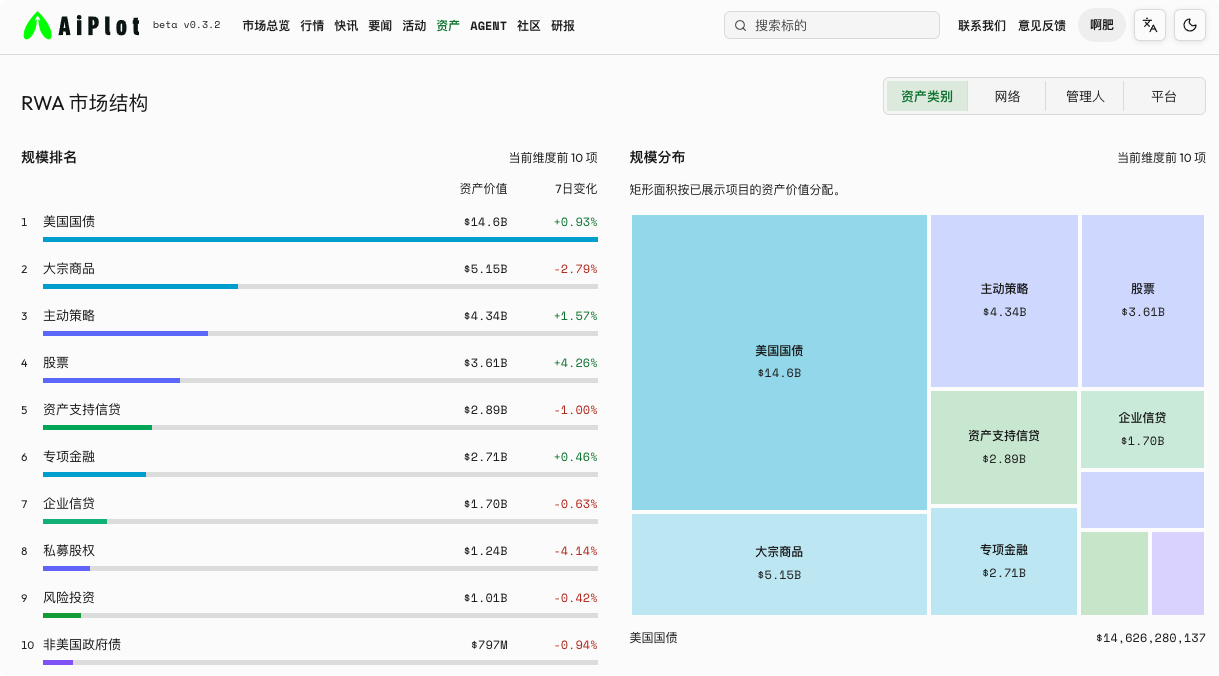
According to the page data, the total of the top ten asset categories is approximately 38.05 billion USD. Among these:
- US Treasury bonds are about 14.6 billion USD, accounting for about 38.4% of the top ten;
- Commodities are about 5.15 billion USD;
- Active strategies are about 4.34 billion USD;
- Stocks are about 3.61 billion USD;
- Asset-backed credit is about 2.89 billion USD.
US Treasury bonds still represent the largest asset category, indicating that the most mature demand in the RWA market remains USD cash management and low-volatility returns, rather than high-volatility equity assets.
This corroborates YC's emphasis on stablecoins and institutional products. Institutions moving on-chain first require reliable settlement assets, cash management tools, and liquidity, rather than complex non-standard assets.
AiPlot's specific asset list also indicates that stablecoins like USDT and USDC possess the largest individual scale; within the Treasury bond asset category, USYC, Ondo USDY, BlackRock BUIDL, and Franklin Templeton's iBENJI occupy important positions; in active strategies, eurSAFO and sUSDe illustrate the expansion of on-chain yield products.
This suggests that RWA is forming a layered structure:
Stablecoins represent the liquidity layer, Treasury bond tokens represent the yield and cash management layer, stocks and commodities represent the trading layer, while credit and private assets represent the financing and risk pricing layer.
The true competition for capital in the future will not be for a singular isolated asset, but rather for the connections among these assets.
4. The Most Noteworthy Mainline for 2027: Stablecoins Transitioning from Payment Tools to Financial Operating Systems
Stablecoins have primarily been used for exchange top-ups, cross-border transfers, and crypto market settlements. As institutional participation increases, they may further penetrate corporate finance, supply chain payments, salary disbursements, cross-border trade, and machine-to-machine payments.
This will lead to a structural change: stablecoin issuers will no longer just be "issuing dollar tokens," but will need to build a whole suite of financial service capabilities, including:
- On-chain and off-chain compliance account openings;
- Enterprise-level wallets and permission management;
- Multi-chain clearing and liquidity routing;
- Transparency in transactions, redemptions, and reserve assets;
- Anti-money laundering, sanctions screening, and transaction monitoring;
- Connections with banks, payment institutions, and accounting systems.
Stablecoins are already one of the largest individual asset groups in the RWA market. The scale of USDT and USDC far exceeds that of most individual tokenized funds, indicating that user demand for stablecoins has extended beyond on-chain trading.
However, scale does not equate to quality. There are variations in reserve structures, redemption mechanisms, issuing entities, network distribution, and regulatory status among stablecoins. The competitive focus in 2027 may shift from "whose supply is larger" to "who can become a long-term settlement asset for enterprises."
5. The Second Mainline: Asset Tokenization Will Expand from Treasury Bonds to Stocks, Debt, and Small Securities
In the future, assets such as stocks, bonds, commodities, and real estate equity will further undergo tokenization, and even equity in startups with valuations below $10,000 and small securities may be issued via blockchain.
The logic behind this trend is clear. The issuance and trading costs of traditional financial markets can be absorbed for large stocks and Treasury bonds, but for small securities, private equity, and segmented debts, they are often excessively high. Blockchain can reduce costs in registration, transfer, investor permissions, and distribution processes.
However, low-cost issuance does not equal low-risk investment. After the tokenization of small securities, several issues still need to be addressed:
- Do investors have the right to purchase;
- Must issuers continue to disclose information;
- Do token holders obtain ownership, rights to revenue, or contractual rights;
- Is secondary transfer subject to lock-up periods and geographical restrictions;
- Who is responsible for the valuation of the underlying assets;
- Does the issuing platform bear market-making and buyback responsibilities.
Therefore, by 2027, asset tokenization may see the emergence of two parallel paths.
One path involves standardized products issued by Treasury bonds, money market funds, and large financial institutions. These products are more likely to attract institutional funding, and their scale may grow faster.
The other path encompasses non-standard assets such as private equity, startup equity, real estate equity, and corporate credit. While these products have a larger potential market, valuation, liquidity, and information disclosure issues are also more complex.
Capital will enter both paths simultaneously, but their risk-return characteristics will differ. Investors should not assume that just because they are all called RWA, they have the same liquidity and security.
6. The Third Mainline: AI Agents Will Advance RWA from “Tradable” to “Callable”
AI agents are one of the most noteworthy aspects of the YC report. YC believes that agents will use crypto networks as financial rails, focusing on agent commerce, transactions, and relevant infrastructure.
Traditional financial products are primarily designed for human users. Humans can read product descriptions, compare yields, input instructions, and complete operations through banks or trading platforms. However, AI agents require structured, verifiable, and programmable financial objects.
For instance, an AI agent might need to:
- Automatically pay service fees to data providers;
- Make payments to suppliers based on inventory status;
- Complete small settlements between different countries;
- Automatically purchase short-term Treasury bond tokens to manage idle funds;
- Use tokenized stocks or commodities as collateral;
- Adjust asset portfolios based on predefined risk rules.
All these scenarios require that funds can be directly controlled by software, yet must also be constrained by permissions, limits, and risk rules. Stablecoins can serve as payment media, tokenized assets can become callable financial objects, and on-chain accounts and smart contracts can provide the execution environment.
This will change the competitive standards for RWA. In the past, projects primarily compared asset scale and the number of holders; in the future, they will also need to compare:
- Whether they have standardized APIs;
- Whether they support machine-readable asset information;
- Whether they can be securely called by wallets and agents;
- Whether they have automatic clearing and risk control mechanisms;
- Whether they can achieve stable settlements across multiple networks.
Thus, AI agents are not merely an add-on narrative to RWA. They may alter how assets are utilized, converting RWA from human-oriented investment products into software-oriented financial modules.
7. Which RWA Directions is Capital Most Likely to Deploy First
Combining YC's entrepreneurial directions with AiPlot's current market structure, capital may prioritize five types of companies in the coming year.
1. Stablecoin Enterprise Services
Including enterprise wallets, cross-border payments and receipts, financial management, payment routing, reserves, and redemption interfaces. They may not necessarily issue stablecoins but can assist enterprises in using stablecoins.
2. Asset Issuance and Compliance Infrastructure
Including securities token issuance platforms, investor identification, permissions control, custody, disclosure, and secondary trading systems. Such companies determine whether assets can transition from "on-chain" to compliant circulation.
3. RWA Data and Risk Control
The valuation, collateral ratios, cash flow, defaults, redemptions, and underlying holdings of real assets need ongoing updates. Whoever can provide reliable data and risk scoring may become the Bloomberg or rating infrastructure of the RWA market.
4. Asset Liquidity and Trading Systems
Including on-chain order books, market-making, buybacks, cross-chain liquidity, and 24/7 trading. Tokenized assets, which lack trading and exit mechanisms, will struggle to form long-term capital retention.
5. AI Agent Financial Interfaces
Including agent wallets, payment APIs, machine identities, permission systems, automated trading, and on-chain settlement. They might serve as an intermediary layer connecting AI applications with stablecoins, Treasury bond tokens, and stock tokens.
These directions share a common characteristic: they do not necessarily create new assets directly, but will enhance the usability and turnover efficiency of existing assets.
8. The RWA Sector Will Become More Vibrant, but the Market Will Also Be More Brutal
After capital inflow, the most significant change in RWA may be the rapid increase in the number of products. The market will simultaneously see more Treasury bond funds, stock tokens, credit assets, commodity tokens, and AI financial applications.
However, once supply increases, investors will pay more attention to the true quality of the assets. Whether a project can obtain long-term funding ultimately depends on five questions:
First, whether the underlying assets truly exist and can be independently verified. Second, whether the custody, issuance, and redemption mechanisms are clear. Third, what legal and economic rights token holders have obtained. Fourth, whether the assets have sustainable liquidity, not just one-off issuance transactions. Fifth, whether the products can connect stablecoins, lending, trading, and institutional accounts.
This means that the RWA competition in 2027 will resemble a competition in financial infrastructure, rather than merely a competition of crypto narratives.
The market may eliminate three types of projects: those that rely solely on subsidies to generate scale, those that only package assets without real cash flow, and those that can only trade internally within a single platform.
Conversely, projects that can simultaneously address compliance, liquidity, and user demand will have the opportunity to secure sustained capital.
Conclusion: In 2027, the RWA Competition is for the Usage Rights of the Financial System
Y Combinator's placement of stablecoins, asset tokenization, and AI agents in the same report on crypto startup directions is not coincidental. The three correspond to funding, assets, and automated execution, respectively.
Stablecoins solve how funds flow in the internet, tokenization resolves how traditional assets are recognized and utilized by digital systems, and AI agents tackle how financial activities are automatically executed by software.
The market data from AiPlot indicates that the current RWA is still dominated by mature dollar assets such as US Treasury bonds and stablecoins. The next phase of growth may center on stocks, credit, commodities, private assets, and on-chain financial products callable by AI agents.
Thus, the RWA sector is likely to become more active next year, but "more active" does not mean "easier to profit." Capital will bring more projects, more assets, and more trading access, but it will also enable the market to faster identify which products are genuine infrastructure and which are merely asset packages.
What truly matters is not whether a certain project announces "tokenization," but whether it can answer three questions:
Who needs this asset? Who provides liquidity? Who bears the risk?
If these three questions have clear answers, RWA may transform from a capital theme into a long-term financial market.
For more data and analysis, please follow AiPlot:
https://aiplot.com/?utm_source=aicoin
📖 Community Interaction:
-Telegram:
https://t.me/+IIYMcJigBAo4Mjg1
This article only represents the author's personal opinions and does not reflect the views of this platform. The opinions, conclusions, and suggestions in the text are for investor reference only and do not constitute any investment advice related to this platform. The market carries risks, and investment requires caution.
免责声明:本文章仅代表作者个人观点,不代表本平台的立场和观点。本文章仅供信息分享,不构成对任何人的任何投资建议。用户与作者之间的任何争议,与本平台无关。如网页中刊载的文章或图片涉及侵权,请提供相关的权利证明和身份证明发送邮件到[email protected],本平台相关工作人员将会进行核查。