Recently, US tech stocks have rebounded, with the Nasdaq closing up 1.11%, the S&P 500 index rising about 0.4%, and the Dow Jones slightly down 0.07%.
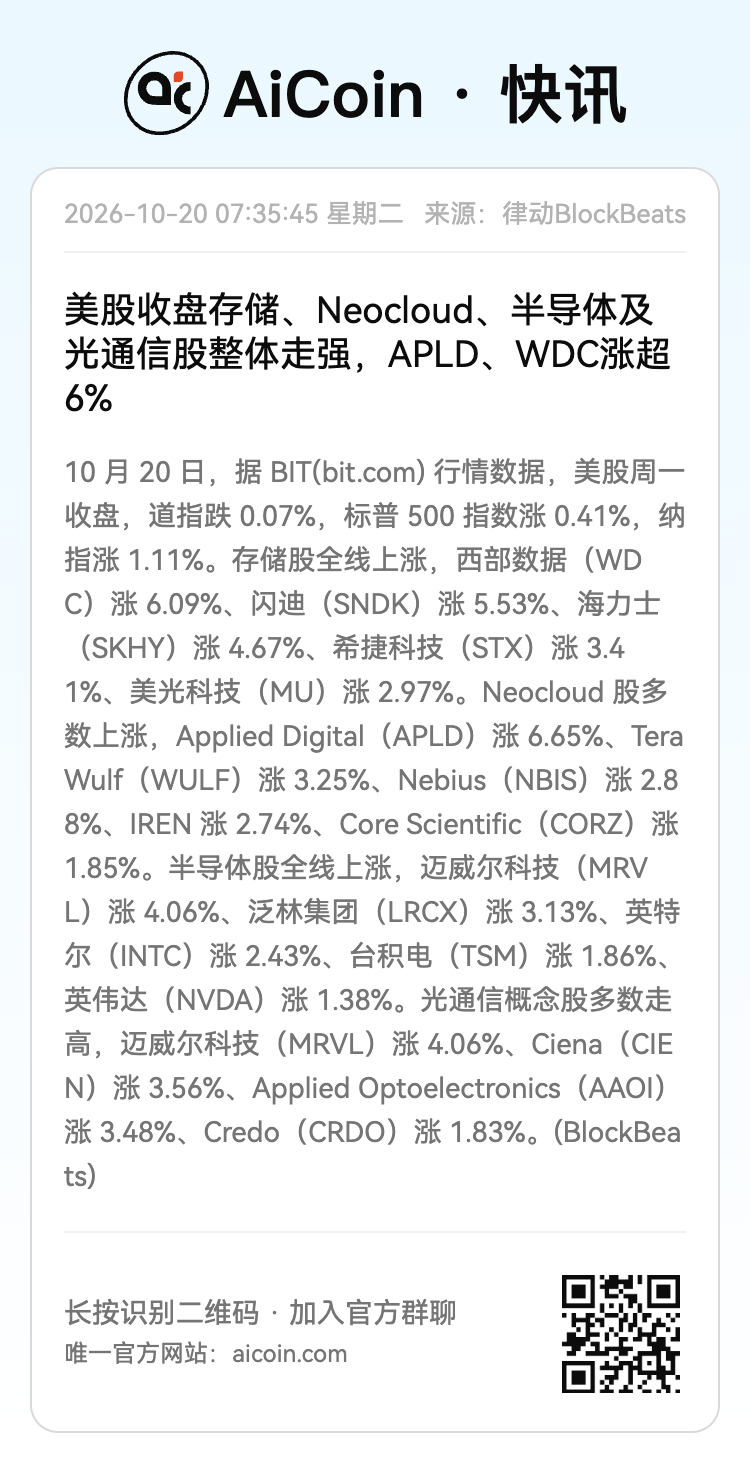
In this round of increase, storage stocks performed particularly well: Western Digital (WDC) rose 6.09%, SanDisk (SNDK) rose 5.53%, Seagate Technology (STX) rose 3.41%; computational infrastructure company Applied Digital (APLD) increased by 6.65%, Marvell Technology (MRVL) increased by 4.06%, and optical communications company Ciena (CIEN) increased by 3.56%.
From storage to semiconductors to optical communication, multiple sectors of the AI industry chain are warming up simultaneously.
However, given that chip stocks have experienced a continuous correction prior to this, a more worthy question to consider now is: is this rebound merely a recovery after a substantial drop, or is capital beginning to favor the AI industry chain again?

1. Storage stocks lead the way, what is the market betting on?
In this round of rebound, the storage sector is the most eye-catching.
Western Digital is up 6.09%, SanDisk is up 5.53%, Micron Technology (MU) is up 2.97%, and Seagate Technology is up 3.41%. Each of these companies has different business focuses but are all influenced by storage demand and changes in industry supply and demand.
AI model training and inference require processing large amounts of data, and the demand for high bandwidth memory (HBM), DRAM, and other products remains a primary focus of the market. At the same time, data center expansion has also driven demand for enterprise-level storage.
Investors are not only concerned about whether AI demand is increasing but also whether demand can be converted into higher product prices, profit margins, and actual performance. If subsequent financial reports can validate these expectations, the rise of storage stocks will have stronger fundamental support.
However, it is important to note that stocks that have previously seen large gains are often more sensitive to performance expectations. Once demand or price performance falls short of market expectations, stock prices may quickly correct.
2. Neocloud strengthens, but there are capital pressures behind the high growth
In addition to chip and storage stocks, companies providing AI computational infrastructure have also seen a rebound.
Applied Digital (APLD) is up 6.65%, TeraWulf (WULF) is up 3.25%, Nebius (NBIS) is up 2.88%, IREN is up 2.74%, and Core Scientific (CORZ) is up 1.85%.
These companies primarily engage in businesses related to data center construction, computational power leasing, and related infrastructure. The growth in demand for AI computational power has brought them new business opportunities, but building data centers requires significant capital investment, and the return cycles may be lengthy.
Therefore, when looking at these stocks, it is important to focus not just on orders or computational power scale, but also on three issues: whether projects are delivered as planned, whether capital investment can produce sustained revenue, and whether financing costs will erode profits.
Especially in an environment where interest rates remain high, the impact of capital costs on heavy asset companies cannot be ignored. A rebound in stock prices may reflect improved market sentiment, but it does not directly prove that the company's profit pressures have vanished.
3. Semiconductors and optical communications warm up simultaneously, focus on performance realization
The semiconductor sector as a whole is performing strongly. Marvell Technology (MRVL) is up 4.06%, Lam Research (LRCX) is up 3.13%, Intel (INTC) is up 2.43%, TSMC (TSM) is up 1.86%, and Nvidia (NVDA) is up 1.38%.
Related optical communication stocks are also generally rising, with Ciena (CIEN) up 3.56%, Applied Optoelectronics (AAOI) up 3.48%, and Credo (CRDO) up 1.83%.
These companies have different business focuses: chip design and manufacturing, semiconductor equipment, and data transmission equipment correspond to different aspects of AI infrastructure. What the market collectively concerns is whether the expansion of data centers can be sustained and whether relevant companies can convert demand into revenue and profits.
Next, financial reports will provide more direct verification.
Orders, deliveries, and performance guidance from chip companies like Nvidia can help determine whether the demand for computational power remains strong; prices and profit margins from storage companies will help observe whether the supply-demand relationship continues to improve. For optical communication companies, whether order growth can continue and whether customer demand is concentrated are also indicators worth tracking.
4. Can this round of rebound be sustained? Focus on three signals

Previously, chip stocks experienced a significant correction, and the market has concerns about investments in AI infrastructure, financing costs, and interest rate trends. The rise on Monday improved risk appetite but was still insufficient to confirm that the market has reversed.
Next, three things can be closely monitored.
First, can financial reports support stock prices? If the performance and future guidance provided by the company meet or even exceed market expectations, the rebound may gain more fundamental support; if performance does not keep pace with valuations, stock prices may still come under pressure.
Second, how will US bond yields and oil prices move? Higher yields will increase corporate financing costs and also impact the attractiveness of high-valuation stocks. If oil prices remain high, it may further increase inflationary pressures and affect the market's judgment on the Federal Reserve's policies.
Third, can the rebound spread from a few stocks to more sectors? If the increase is only concentrated in stocks that have experienced significant declines previously, durability still needs to be observed; if more companies follow suit, and trading and performance expectations improve simultaneously, the foundation of the market will be relatively solid.
For ordinary investors, instead of chasing daily increases, it is better to first understand how the companies you are interested in make money, and then combine financial reports, valuations, and capital costs to assess risks.
5. Pay attention to US stock market trends, how to start?
If you usually track the trends of companies like Nvidia and TSMC, you can also learn about the US stock trading features provided by Binance, checking the supported stocks and specific trading conditions in the app.
If you do not have an account yet, you can register on Binance first:
https://jump.do/zh-Hans/xlink-proxy?id=3
(Invitation code: aicoin668, enjoy a 10% rebate)
Then download and log in to the Binance App, enter Binance US stocks trading, and learn how to find stocks, place orders, and check market trends, etc.
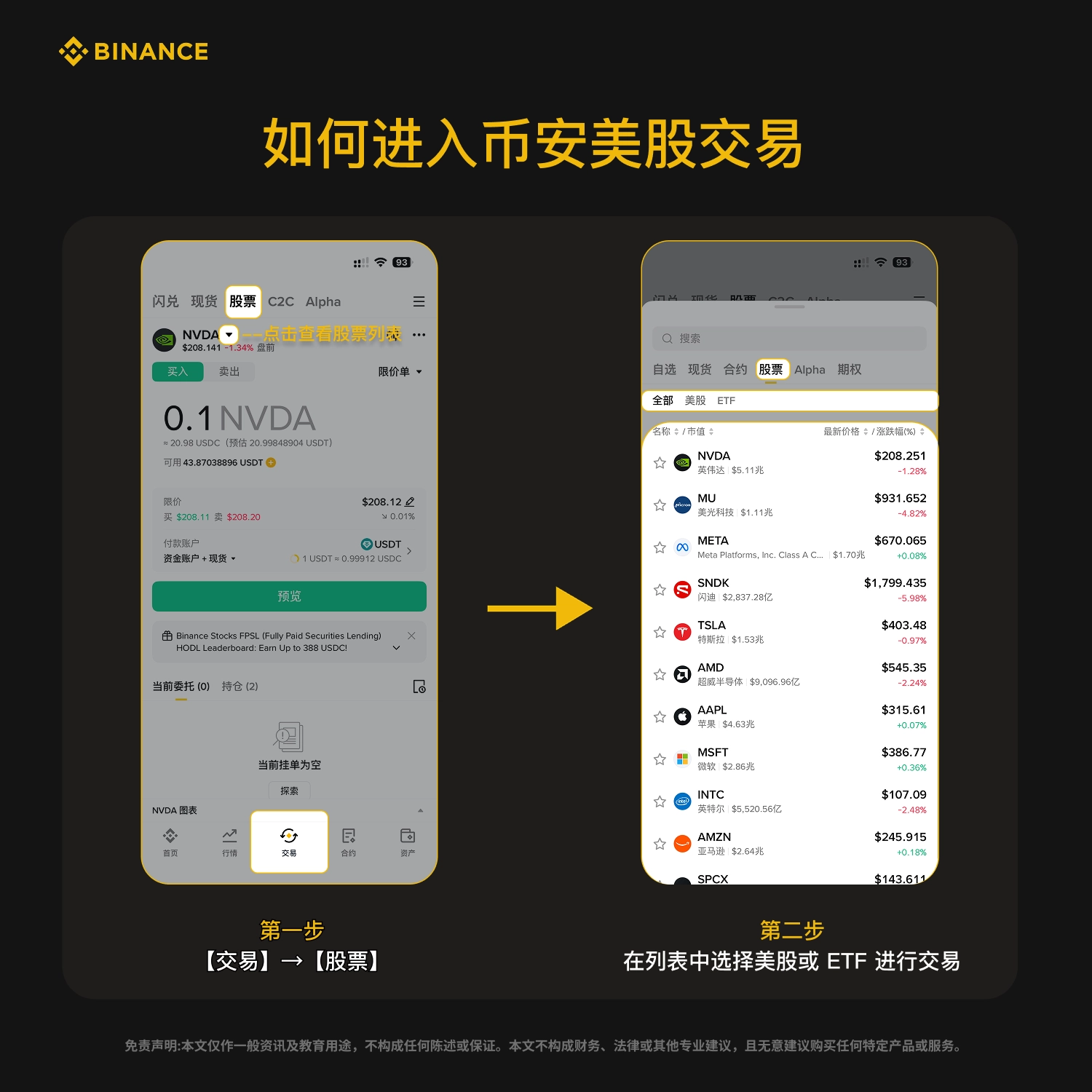
The actual tradable targets and qualification for use are subject to what is displayed on the app page.
Final note: A single day's rebound does not equate to a trend reversal. The long-term demand of the AI industry chain is worth monitoring, but the differences in valuations, profitability, and capital pressures among different companies are significant. It is still necessary to comprehensively judge based on financial reports, industry data, and the market environment.
If you want to learn more about related products of Binance, you can register for an account first and enter the app to check specific products and trading rules.
👉 Register on Binance:
https://jump.do/zh-Hans/xlink-proxy?id=3
(Invitation code: aicoin668, enjoy a 10% rebate)
It should be noted that the scope of Stocks and bStocks and their usage conditions are different, and specific details are subject to the product page in the region.
Join our community to discuss and become stronger together!
Official Telegram community:
https://t.me/aicoin_support
AiCoin Chinese Twitter:
https://x.com/AiCoinzh
Binance benefits group:
https://www.aicoin.com/link/chat?cid=gmLgwvKD1
Risk warning: Investing in US stocks requires self-assessment of market risks, regulatory risks, and compliance risks related to local laws and regulations (especially foreign exchange controls, overseas investment declarations, etc.). This content is only a market observation sharing and does not constitute investment advice. Stocks, ETFs, and tokenized securities are subject to price volatility risks; please fully understand the product rules and potential losses before investing, and participate within your risk tolerance.
免责声明:本文章仅代表作者个人观点,不代表本平台的立场和观点。本文章仅供信息分享,不构成对任何人的任何投资建议。用户与作者之间的任何争议,与本平台无关。如网页中刊载的文章或图片涉及侵权,请提供相关的权利证明和身份证明发送邮件到[email protected],本平台相关工作人员将会进行核查。