Author: AiPlot Research Institute
Focus: RWA / Digital Assets / In-depth Analysis of Financial Infrastructure
Website: https://aiplot.com/?utm_source=aicoin
A set of data has sparked market attention towards the progress of Solana RWA: over the past year, the market capitalization of RWA on the Solana chain has grown from approximately 700 million dollars to 4.3 billion dollars; during the same period, Ethereum RWA grew from approximately 15.5 billion dollars to 16.6 billion dollars. In relative terms, Solana's RWA scale has improved from about 4.5% compared to Ethereum to 26%.
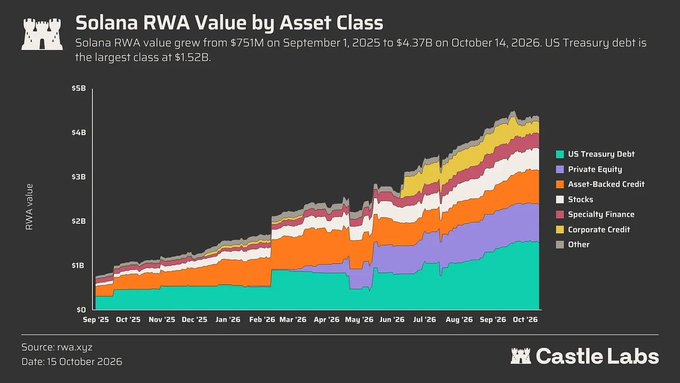
The most important aspect of this data is not that Solana's absolute scale has surpassed Ethereum. In fact, Ethereum still has a larger RWA stock. What truly deserves analysis is that Solana is closing the gap with a faster growth rate and is starting to integrate tokenized stocks, U.S. Treasury bonds, private credit, reinsurance returns, and auto loans into lending and collateral scenarios.
In other words, the competition in RWA for Solana is no longer just about "who can issue more assets," but has entered the next phase: who can create more on-chain usage value for tokenized assets.
1. What 4.3 Billion Dollars Means: Solana is Still a Follower, But No Longer in the Marginal Market
A report from Castle Labs shows that Solana RWA has grown from approximately 700 million dollars to 4.3 billion dollars within a year, an increase of over 600%; Ethereum, on the other hand, grew from 15.5 billion dollars to 16.6 billion dollars, with an increase of about 7%.
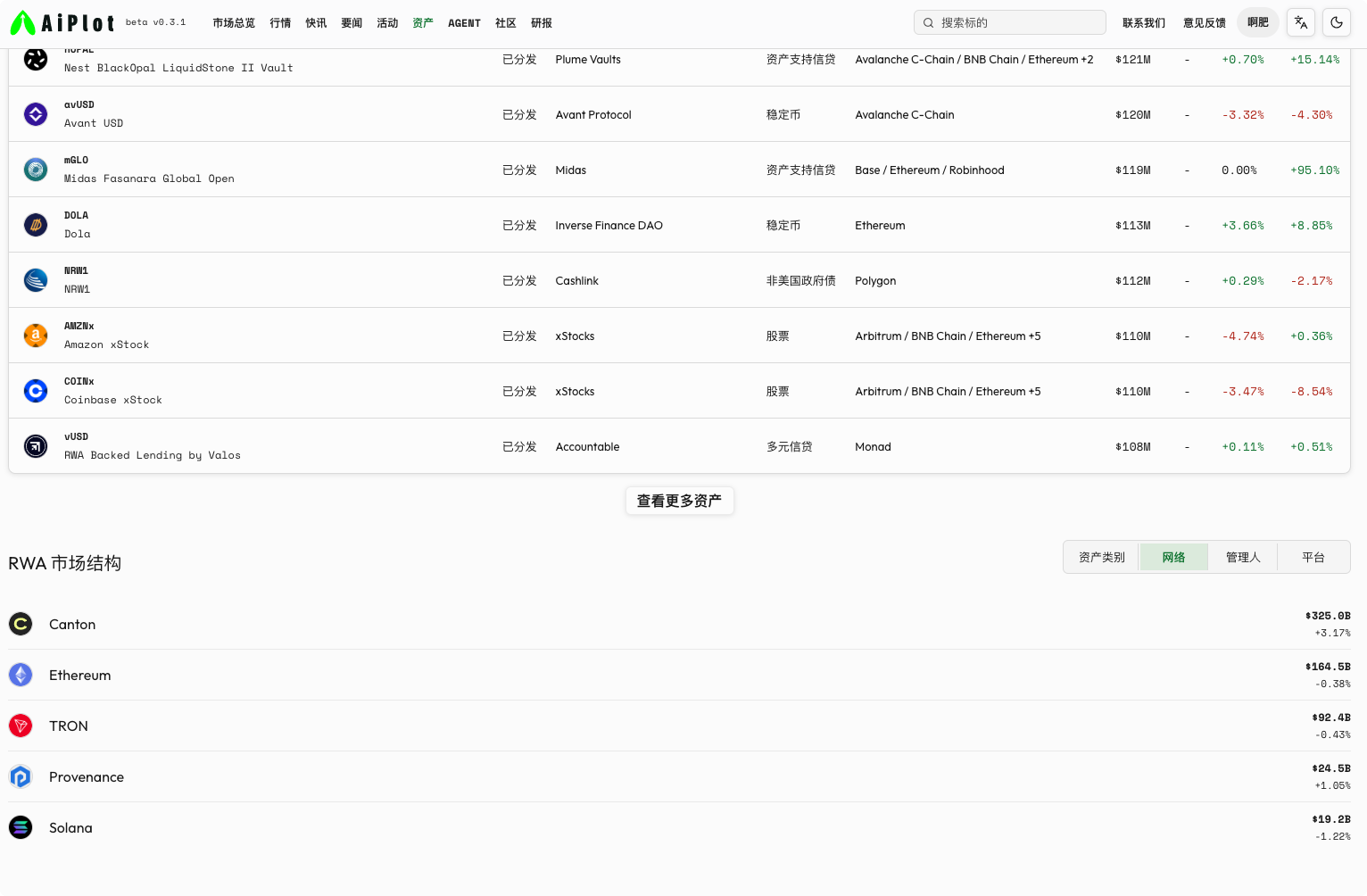
However, the competitive position of Solana versus Ethereum still needs to be accurately described:
- The RWA stock of Ethereum is still significantly larger;
- Solana's advantages lie in growth rate, transaction efficiency, and application layer distribution;
- Solana's next step is not simply to replicate the asset scale of Ethereum, but to enhance the on-chain utilization rate of each unit of RWA assets;
- If tokenized assets are merely held without engaging in lending, trading, and yield strategies, the financial significance of the asset scale itself will be limited.
Thus, "Solana RWA Growth Sixfold" can serve as a trend signal, but cannot be directly equated with the idea that Solana has already won the RWA market.
2. The Primary Growth Line: Tokenized Stocks are Becoming Solana's Breakthrough
The categorized data from Castle Labs illustrates where Solana's RWA growth comes from. Over the past year, the market capitalization of tokenized stocks on Solana has increased from approximately 63 million dollars to about 455 million dollars; the corresponding scale for Ethereum is approximately 750 million dollars.
This means that tokenized stocks have become one of the most important incremental assets in the Solana RWA ecosystem. Their value lies in the fact that stocks possess higher user recognition and trading demand, making them easier to be adopted by wallets, trading platforms, and DeFi protocols.
The growth of tokenized stocks on Solana has been primarily driven by issuance and distribution systems like xStocks and Backpack. They package the price exposure of traditional stocks into on-chain transferable assets, allowing global users to access U.S. stock assets over a longer trading timeframe.
However, it is important to note that tokenized stocks do not automatically equal stocks in traditional securities accounts. Investors still need to confirm:
- Whether the tokens are one-to-one backed by the underlying stocks;
- Who holds the assets;
- Whether the holders have voting rights and dividend rights;
- Whether the tokens can be redeemed for the underlying stocks;
- Whether users from different regions face purchasing and transfer restrictions;
- How the issuer handles stock splits, dividends, and corporate actions.
Therefore, the real financial innovation of tokenized stocks is not just extending trading hours, but whether they can become a standardized collateral recognized by on-chain protocols under a clear legal and custody structure.
3. The Real Breakthrough: Over 65 Million Dollars in Tokenized Stocks Start to Earn Yields
On-chain asset integration alone does not equate to improved financial efficiency. Assets only begin to create on-chain financial value when they are traded, collateralized, lent, or incorporated into strategy portfolios.
The Castle Labs report states that over 65 million dollars in tokenized stocks on Solana are currently earning yields, primarily through xStocks, and can be used as collateral for Kamino and Jupiter Lend.
This change is more noteworthy than simply the market capitalization of tokenization. It signifies that tokenized stocks are transitioning from "on-chain stock substitutes" to "on-chain financial assets":
- Users can hold stock price exposure;
- Assets can enter lending protocols;
- Borrowers can use stock as collateral to obtain liquidity in stablecoins;
- Holders can receive lending yields or strategy profits;
- Assets can be combined with other RWA and DeFi assets.
This is also the distinction between RWA 2.0 and earlier RWA projects. Earlier projects emphasized that "real assets are mapped onto the chain," while the new competitive focus is on "whether mapped assets possess composability."
Of course, using tokenized stocks as collateral still comes with high requirements. Stock price volatility, inconsistency in trading hours with the on-chain 24/7 trading period, and potential price discovery and liquidation issues during underlying market closures can all pose challenges. The issuer's redemption mechanisms, oracle designs, and liquidation discounts will also directly impact whether such assets can successfully scale into DeFi.
4. Solana's RWA Growth Depends on Collaboration Among Three Asset Categories
Solana's RWA is not driven by a single asset category, but has formed a structure of three mutually complementary types.
The first category is high liquid assets, including tokenized stocks and U.S. Treasury bonds. They are easily understood by users and can more readily enter trading, market-making, and collateral markets.
The second category is yield-generating assets, such as private credit, reinsurance returns, auto loans, and housing loans. They can provide a relatively stable source of income to on-chain funds, but their liquidity and information disclosure often lag behind publicly traded assets.
The third category is stablecoins and cash management assets. The actual growth of RWA requires stablecoins to serve as media for pricing, settlement, and lending.
Stablecoins provide liquidity, tokenized Treasury bonds and credit assets offer yields, while tokenized stocks contribute to trading and collateral demand. Together, these three form an application loop for Solana RWA:
Stablecoins handle settlement, RWA supplies assets, and DeFi enhances asset utilization efficiency.
If stablecoins are lacking, RWA will struggle to achieve sufficient trading depth; if yield-generating assets are absent, stablecoins may remain mere trading media; if lending and collateral protocols are missing, tokenized stocks and Treasury bonds may become low-utilization on-chain inventory.
5. Solana's Advantage: Advancing RWA from "Asset Issuance" to "On-chain Products"
Solana's advantages in the realm of RWA primarily stem from three aspects.
1. High Throughput and Low Transaction Costs Facilitate High-Frequency Asset Distribution
Tokenized stocks, stablecoins, and short-duration bonds require frequent transfer, quoting, and settlement. Lower transaction costs help expand RWA from products held by a few institutions to a broader range of wallets and trading scenarios.
2. Consumer Application Ecosystem Provides Entry Points for RWA
Solana boasts a wealth of wallets, trading terminals, launching platforms, and on-chain applications. RWA issuers do not need to build a complete user distribution network from scratch; they can leverage existing applications to reach users.
3. DeFi Protocols are Starting to Accept Real Assets as Collateral
Protocols like Kamino and Jupiter Lend accepting tokenized stocks and other RWA make assets no longer just a showcase but rather enter lending and yield strategies. The Castle Labs report shows that Solana's active RWA TVL has exceeded 500 million dollars, accounting for approximately 8% of the network's net TVL.
These three advantages combine to form Solana's differentiated approach:
Ethereum is closer to institutional-level asset issuance and financial infrastructure centers; Solana emphasizes high-frequency distribution, trading activity, and asset availability within DeFi.
This is not a strict either/or situation. Institutions may issue assets on Ethereum while distributing and trading them on Solana; the same asset could also enter multiple networks through cross-chain infrastructure. Future competition may shift from single-chain asset scale to cross-chain liquidity and depth of protocol usage.
6. Why AiPlot Needs to Consider RWA Market Value, Holders, and Application Layer Data Together
If one only looks at the RWA market cap of a particular chain, there's a risk of overestimating trends; conversely, if one only considers trading volume, short-term speculation might misleadingly appear as long-term asset allocation.
When analyzing Solana RWA, at least four types of data need to be observed together:
- Asset Scale: Whether the Distributed Asset Value of RWA continues to grow;
- User Base: Whether the number of holders is growing, or if it is concentrated among a few institutions and market-making addresses;
- Asset Usage: Whether tokenized stocks have entered lending, collateral, and yield strategies;
- Ecological Revenue: Whether application revenue derives from RWA or mainly from consumer trading and speculative activities.
The role of AiPlot is not just to show what changes have occurred in the price of a particular RWA asset, but to place network, asset, financial, and on-chain usage data into the same analytical framework. For Solana, it can simultaneously track:
- The total scale of Solana RWA and asset classification;
- The market capitalization and holder changes of tokenized stocks like xStocks;
- 30-day transfer volume and stablecoin liquidity;
- The usage of collateral in protocols like Kamino and Jupiter Lend;
- The distribution changes of assets between Solana and other networks like Ethereum, Arbitrum, and Robinhood Chain.
For news media and data platforms, this analytical approach is more valuable than simply reporting "how much RWA has grown on a given chain." It further answers: who issues the assets, who holds them, whether they generate yields, if they can serve as collateral, whether funds are genuinely flowing into protocols, and whether the growth is sustainable.
7. Three Observation Points for the Next Stage of Solana RWA
First, Can Tokenized Stocks Continue to Grow from 455 Million Dollars?
Solana's tokenized stocks have grown from 63 million dollars to 455 million dollars, but there is still a gap compared to Ethereum's approximately 750 million dollars. Future attention should focus on whether users genuinely regard these tokens as long-term asset allocations rather than short-term trading tools.
Second, Can RWA Lending Develop Stable Demand?
Currently, over 65 million dollars in tokenized stocks are earning yields, indicating that assets have commenced usage within protocols. However, this still represents only a fraction of the 455 million dollars in tokenized stock volume. It will be necessary to observe whether collateral ratios, borrowing rates, liquidation losses, and asset utilization stabilize in the future.
Third, Can RWA Growth Break Free from Consumer Application Cycles?
Solana's application revenue is currently quite strong, but approximately 80% comes from consumer applications. The long-term development of RWA requires more income driven by Treasury bond interest, private credit interest, stock financing, and on-chain asset management revenue, rather than relying on short-term trading enthusiasm.
If in the future, the scale of Solana RWA continues to grow while active RWA TVL, lending demand, and asset yield grow in sync, then this would indicate that RWA is becoming a foundational financial module of the network, rather than just a rapidly growing asset category.
Conclusion: Solana is Competing for the "Asset Usage Rights" of RWA
Solana has elevated RWA from approximately 700 million dollars to about 4.3 billion dollars within a year, indicating that the competitive landscape for on-chain real assets is changing. Ethereum still possesses a larger stock and institutional basis, but Solana has become one of the fastest-growing major networks for RWA due to its transaction efficiency, consumer applications, and DeFi compositional capabilities.
The key to this competition is not which network can issue assets on-chain the fastest, but which network can enable assets to be genuinely used:
- Can Treasury bonds become a source of stablecoin yield;
- Can stocks serve as collateral for loans;
- Can private credit form on-chain financing;
- Can reinsurance and consumer loans be split, priced, and combined;
- Can users complete trading, lending, and asset allocation on the same chain.
Solana's RWA growth has moved beyond the stage of "whether there are assets" and is entering the stage of "whether the assets have financial efficiency." For market participants, the next focus should not solely be on whether the 4.3 billion dollars continues to grow, but on how many of those assets truly enter into trading, yield, collateral, and lending systems.
This is also why AiPlot is better suited to participate in RWA research: it not only tells users how the asset scale has changed but also helps users continue to ask, what assets drive these changes, which protocols undertake them, and whether the growth ultimately transforms into sustainable on-chain financial activity.
For more data and analysis, please follow AiPlot:
https://aiplot.com/?utm_source=aicoin
📖 Community Communication:
Telegram:
https://t.me/+IIYMcJigBAo4Mjg1
The content of this article only represents the author's personal views and does not reflect the stance of this platform. The opinions, conclusions, and suggestions in this article are for investor reference only and do not constitute any investment advice related to this platform. The market carries risks; investors should exercise caution.
免责声明:本文章仅代表作者个人观点,不代表本平台的立场和观点。本文章仅供信息分享,不构成对任何人的任何投资建议。用户与作者之间的任何争议,与本平台无关。如网页中刊载的文章或图片涉及侵权,请提供相关的权利证明和身份证明发送邮件到[email protected],本平台相关工作人员将会进行核查。


